Why Microgreens Are Expensive: You Are Mostly Buying the Box
Cal HewittPublished Checked
- price
- economics
- buying
- evidence
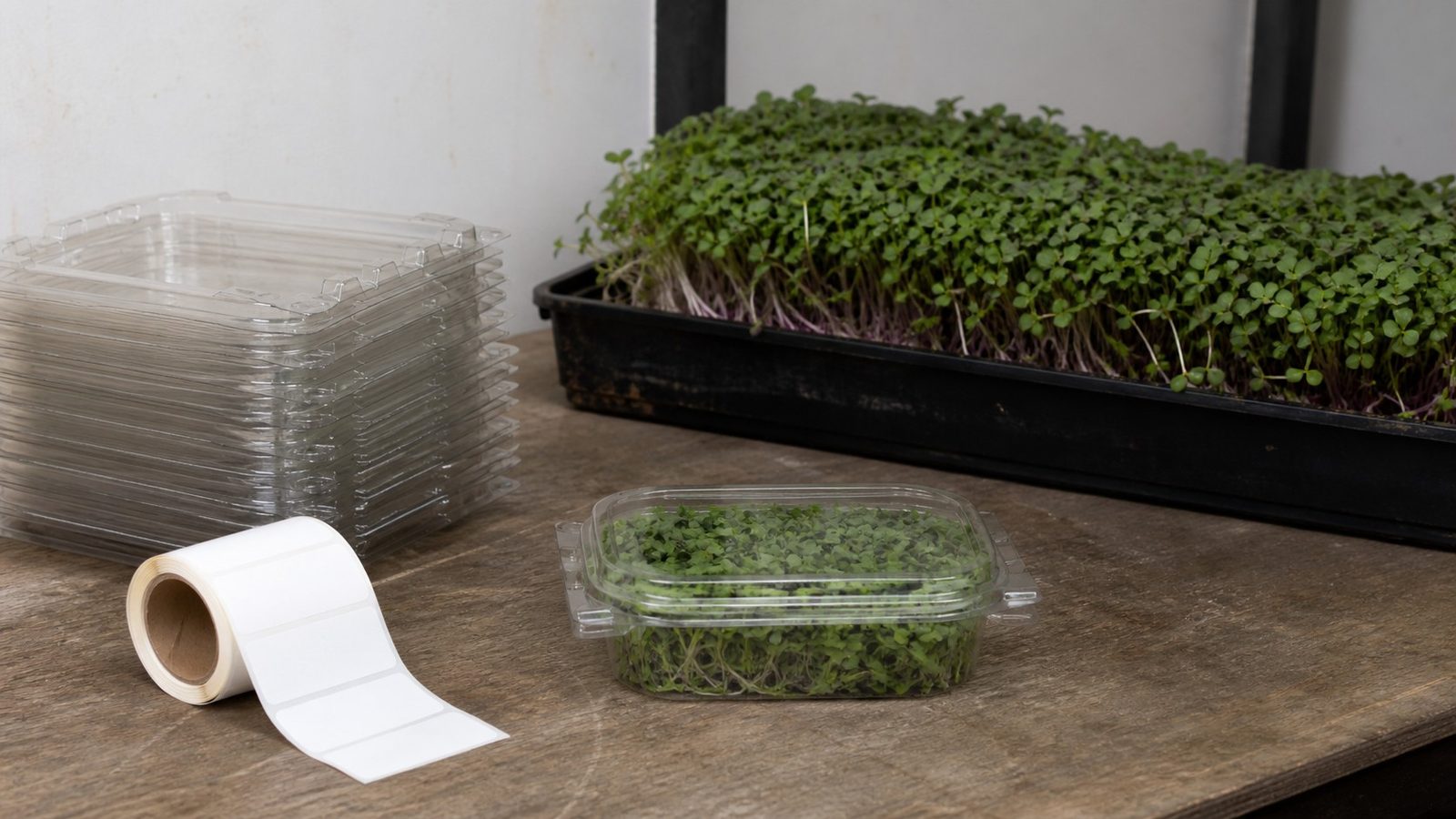
One university extension service publishes a full cost budget for a 1020 tray. Work through its lines and the answer is uncomfortable for everybody: the plant is the cheap part.
Labels, packaging and marketing come to 50 to 60% of what a tray costs to produce. Actually growing the crop, seed and medium and fertilizer and electricity together, is 17 to 23%. The seed itself is between 1.5 and 9.9%.
What to actually do with this
- Buy the bigger pack. The single largest controllable cost is the fixed $1.02 per unit, and you pay it once per box no matter the size.
- Compare against spinach, not against nothing. The one government report puts conventional microgreens at 1.5 times conventional spinach.
- Do not read the price as a nutrition claim. The nutrient concentrations are measured and the price is not derived from them.
- Expect the organic tier to be a different market. Four to six times comparable greens in the same report and the same week.
- If you are pricing your own trays, use the budget as a template and replace every line. Especially the electricity, which cannot be transferred without wattage and hours, and the labor, where two extension services differ by a third.
- If you want to know whether growing beats buying, that is its own arithmetic and the seed line is not the answer. Retail runs 16 to 21 times the seed cost per ounce, and the cost breakdown below is why that multiple is not a scandal.
The whole tray, costed
A March 2024 University of Missouri Extension budget for greenhouse and artificial-light production gives a per-tray total by crop:
Hover or tap a row to highlight it.
| Crop | Total cost a tray |
|---|---|
| Pea | $25.42 |
| Radish | $26.16 |
| Broccoli | $31.64 |
| Mix | $31.80 |
| Cabbage | $40.55 |
Its assumed revenue is $32 to $60 a tray. So, at the bottom of its own revenue range, the cabbage tray at $40.55 loses $8.55. The budget contains a crop that does not pay at the low end of the price it assumes.
And where does the $25 to $40 actually go?
Hover or tap a row to highlight it.
| Line | Per tray | Share of a tray |
|---|---|---|
| Labels, packaging and marketing | $12.96 to $24.30 | 49.5% to 59.9% |
| Growing it: seed, medium, fertilizer, electricity | $4.65 to $8.05 | 16.7% to 22.6% |
| Labor, at 15 minutes and $20 an hour | $5.00 | 12% to 20% |
| Seed alone | $0.38 to $4.00 | 1.5% to 9.9% |
Pea seed is $0.38 of a $25.42 tray. That is one and a half percent. The medium the pea grows in costs eight times its seed.
The cost that explains the pack-size trap
Packaging is $0.42 and the label is $0.60, so $1.02 goes on every retail unit regardless of what is inside it.
That is a per-unit cost, not a per-ounce one, and it does not shrink when the pack does.
Hover or tap a row to highlight it.
| Pack | Packaging and label cost per 100 g |
|---|---|
| 60 g | $1.70 |
| 75 g | $1.36 |
| 100 g | $1.02 |
| 335 g | $0.30 |
A 60 gram pack carries $0.68 more packaging cost per 100 grams than a 100 gram pack. That is the mechanism behind one grower's three $6 packs working out at $45.36, $36.29 and $27.22 a pound. Small packs are not a rip-off. They are genuinely more expensive to make, and the fixed cost per unit is a large part of why.
Labor, which is more than the seed and less than the box
Missouri assumes 15 minutes a tray at $20 an hour, giving $5.00. Penn State breaks the same work down and gets a different total: 3.3 minutes planting, 0.5 irrigating and fertilizing, 4 minutes hand harvesting or 1.3 with electric clippers, and 1.7 packing and distributing. That is 9.5 minutes with scissors or 6.8 with clippers, and it excludes tray cleaning.
The two estimates disagree by roughly a third, which is worth seeing: 15 minutes against 9.5. Neither is wrong; they are different operations counted differently, and Penn State's explicitly leaves out the washing-up.
Either way labor is 12 to 20% of the tray, more than the seed and far less than the selling costs.
Electricity, and why you cannot borrow the number
Missouri budgets $0.83 to $1.20 a tray at 12 cents a kilowatt-hour. It does not disclose the fixture wattage or the lighting hours, so that figure cannot be transferred to anybody else's rack.
The transparent calculation is: fixture watts, divided by 1,000, times light hours a day, times crop days, times your electricity rate, divided by the trays that fixture serves.
A worked example only: a 40 watt fixture over one tray for 16 hours a day for 10 days at 12 cents comes to $0.77 of light. Do not reuse that for a different fixture, crop length or tariff, and note that fans, refrigeration, heating and dehumidification are all extra.
Perishability is a cost, not a feature
Cut microgreens need a cold chain, and that is money. A radish postharvest study found 1°C optimal, and that a 100 mg/L chlorine wash cut initial microbes by 0.5 log but populations rebounded after day 7.
Nobody publishes what share of retail microgreens is thrown away unsold. Every pack harvested and not sold before quality fails is shrink, and it lands on the price of the ones that do sell. One production model says its productivity factor should account for crop failure, damage and low sales, and then does not disclose the percentage.
Compared to what, in the one government report
The multiples people quote are usually against the wrong thing. In a USDA and state agency market report for one week of September 2023 in Vermont:
- Conventional microgreens $12 a pound, against conventional spinach at $8. That is 1.5 times, not ten.
- Organic microgreens $48 a pound, against specialty and mixed greens at $8 to $10. That is 4.8 to 6 times.
So, the eye-watering ratio is an organic and specialty-tier phenomenon, and the ordinary conventional gap against a comparable leafy green is modest. It is one week in one state and it is the only transaction data here, so treat it as a dated observation rather than a national ratio.
Watch out for research prices too. A national choice study priced 2 ounce packs at $6.49, $9.99, $13.49 and $16.99 because those reflected online and Georgia grocery searches. Converted, that ladder runs $51.92 to $135.92 a pound, higher than anything actually observed on a shelf. Those were design prices for an experiment, not observed transactions.
Is the premium justified?
Two honest halves to this.
The nutrient side is real and does not settle the price question. USDA ARS measured vitamins in 25 commercial microgreens and found large ranges, total ascorbic acid running 20.4 to 147.0 mg per 100 g fresh weight, and generally higher phytonutrient concentrations than mature leaves of the same species. That is a measurement, not an economic justification, it does not prove a health outcome, and it does not apply evenly to every crop or serving.
The willingness-to-pay side has been studied and does not ask the question people think. A Tennessee choice experiment with 821 consumers found willingness to pay moved with appearance, origin, height and nutrient-enhancement method, with a light-based enhancement carrying a $0.47 to $0.79 premium. Perceived risk reduced willingness to pay. Nobody has measured what share of consumers considers ordinary microgreens overpriced.
And the margin figures are scenarios rather than benchmarks. A 2013 case study reports $2 to $6 an ounce with a 35 to 75% margin, without disclosing the operator, the channel split, how labor was valued, or whether that margin is gross or net. A provincial model sets a 30% profit goal, which is a target and not an observation. One model's basil scenario loses money even sold as a whole tray, because the cycle length and handling cost more than the crop returns.
What is still genuinely unknown
- Any commercial cull or shrink rate, by crop. The one model that names the concept declines to publish the number.
- What share of retail microgreens goes unsold. No industry figure exists.
- A continuous national retail price series. The best available is a within-year local set of farmers-market box prices whose unit weight is unknown.
- A matched supermarket-against-specialist comparison for the same crop at the same weight.
- What share of buyers considers the price too high, and the leading reason former buyers stopped.
- Any audited business failure attributable to margins. The loss-making scenarios above are models, not closures.
- Cost allocated by sales channel. No controlled study splits it.
Terms on this page
Tap a term to see what it means.
Enterprise budget. A full costing of one production unit, here a 1020 tray, including overheads a grower might otherwise forget. A template to fill in, not a bill.
Sources
Opened 2026-08-12. The cost shares, the packaging-per-100 g figures and the per-pound conversions are arithmetic performed for this page on the published budget lines and prices below. Every budget here is a scenario or a template rather than an audited set of accounts.
- University of Missouri Extension microgreens budget, March 2024 (PDF) - the full per-tray cost breakdown used throughout: seed from $0.38 pea to $4.00 cabbage, medium $3.00, fertilizer $0.07, electricity $0.83 to $1.20 at 12 cents a kilowatt-hour, labor $5.00 at 15 minutes and $20 an hour, labels $4.80 to $9.00, packages $3.36 to $6.30, marketing $4.80 to $9.00, plus repairs, operating interest, depreciation, capital interest and overhead. Totals of $25.42 pea, $26.16 radish, $31.64 broccoli, $31.80 mix and $40.55 cabbage against assumed revenue of $32 to $60, and the $0.42 package and $0.60 label per retail unit.
- Penn State Extension on growing microgreens - the alternative labor breakdown of 3.3 minutes planting, 0.5 irrigating and fertilizing, 4 minutes hand harvest or 1.3 with electric clippers and 1.7 packing, totalling 9.5 or 6.8 minutes and explicitly excluding tray cleaning.
- Alberta concept analysis of microgreen production (PDF) - the productivity factor that should account for crop failure, damage and low sales without a published percentage, the 30 percent profit-margin goal, the broccoli scenario at $25 and $30 a tray, and the basil scenario that loses money even sold whole. Model outcomes rather than observations.
- Radish microgreen postharvest study - 1°C as optimal, and that a 100 mg/L chlorine wash reduced initial microbial populations by 0.5 log before they rebounded after day 7.
- USDA and Vermont Agency of Agriculture weekly farmers market report, week of 17 September 2023 (PDF) - conventional microgreens at $12 a pound and certified organic at $48, against conventional spinach at $8 and specialty or mixed greens at $8 to $10. The only transaction data on this page, from one week in one state.
- Purdue Extension 2019 Indiana farmers market price series (PDF) - microgreen boxes from $3.00 to $5.50 across January to June, with the unit weight unstated.
- HortScience national choice study (PDF) - the $6.49, $9.99, $13.49 and $16.99 per 2 ounce price ladder chosen to reflect online and Georgia grocery searches, and the comparison of supermarket against farmers market purchase location. Design prices for an experiment, not observed sales.
- Rihn, Walters and Bumgarner consumer choice experiment, 2024 - 821 consumers, willingness to pay moving with appearance, origin, height and nutrient-enhancement method, the $0.47 to $0.79 premium for light-induced enhancement, and perceived risk reducing willingness to pay.
- USDA ARS study of 25 commercial microgreens - the measured vitamin and provitamin ranges including total ascorbic acid at 20.4 to 147.0 mg per 100 g fresh weight, and generally higher phytonutrient concentrations than mature leaves of the same species.
- ASHS local grower case study, 2013 - market prices of $2 to $6 an ounce and a margin of 35 to 75 percent, without disclosing operator, channel split, labor valuation, or whether the margin is gross or net.
- University of Maryland Extension on marketing to restaurants and food retailers - that wholesale buyers' expectations materially change how an operation has to run, which is the channel-cost point this page makes qualitatively because no study allocates microgreen cost by channel.
Keep reading
The journal
Buying Microgreens: The Same $6 Buys 60 Grams or 100
Across every observed price, what a shopper can actually pay spans 2-fold while sellers quote across 8.3. Farm-direct covers almost the whole range by itself, because pack size decides the price and the channel does not.
Read Buying Microgreens: The Same $6 Buys 60 Grams or 100The journal
How Much Do Restaurants Pay for Microgreens?
Learn what restaurants pay for microgreens, with distributor and grower offer prices, grams per plate, plate cost math and where it lands in food cost.
Read How Much Do Restaurants Pay for Microgreens?The journal
Microgreen Prices Where You Live: A Buyer's Guide
Wondering what microgreen prices are near you? Compare regional market reports and retail prices, then use a step by step method to survey your own area.
Read Microgreen Prices Where You Live: A Buyer's GuideThe journal
Bulk Microgreen Seeds: Cost Per Tray by Bag Size
Buying bulk microgreen seeds cuts cost per tray, but only if the bag gets used fast enough. Compare 5 and 25 pound prices, shipping, and weekly tray needs.
Read Bulk Microgreen Seeds: Cost Per Tray by Bag Size