Bulk Microgreen Seeds: Cost Per Tray by Bag Size
Cal HewittPublished Checked
- buying
- seed
- economics
- comparison
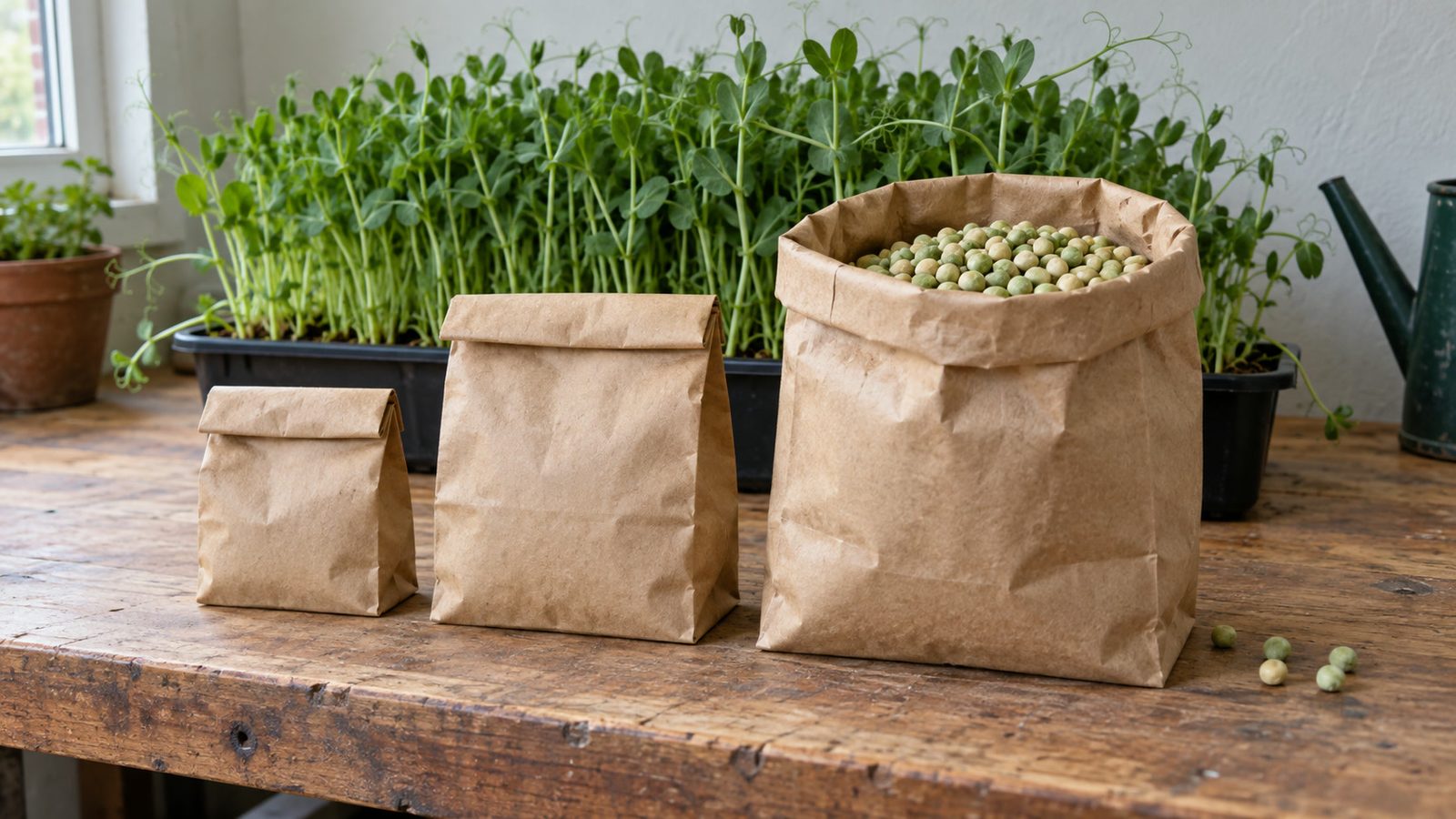
A bigger bag lowers your seed cost per tray at every step, but the savings shrink as the bags get bigger. At True Leaf Market's one-time prices on September 13, 2026, Red Arrow radish sown at 42 g a tray costs $2.68 a tray from a 4 oz pack, $1.35 from 1 lb, $0.76 from 5 lb and $0.57 from 25 lb.
Going from 5 lb to 25 lb saves 10% to 34% a tray, depending on the crop. What decides it is your pace: a 25 lb broccoli or cilantro bag takes 7.79 trays a week to empty in a year, while a 25 lb pea bag takes 1.45.
Every figure below is seed only, before tax, growing medium and losses, and each depends on the sowing rate printed beside it.
How a bag price becomes a cost per tray
The sum is the bag price divided by the grams in the bag, multiplied by the grams you sow. A 5 lb Red Arrow radish bag at $40.80 holds 2,267.96 g, so at 42 g a tray it comes to $40.80 divided by 2,267.96, times 42, which is $0.76. One ounce is 28.35 g and one pound is 453.59 g.
The rates on this page are Utah State University's per 1020 tray: radish 42 g, broccoli 28 g, cilantro 28 g, pea 150 g and sunflower 48 g. Seed sellers print their own. True Leaf's broccoli mix page gives 1 oz (28.35 g), close to USU's figure, but its Red Arrow radish page gives 1 oz against USU's 42 g, and its pea page gives 10 oz against USU's 150 g.
Virginia Tech advises testing density for your own system, substrate and cultivar rather than assuming it. If your trays take a different amount, put the seed for one tray on a kitchen scale, write the grams down and rerun the sum with your own number. For choosing a rate, see sowing and seed density, and for the scale itself, scales and seed measuring.
True Leaf Market prices by bag size on September 13, 2026
These are the one-time prices True Leaf Market displayed that day, not its subscription prices, with shipping left out.
Hover or tap a row to highlight it.
| True Leaf Market product | 1 oz | 4 oz | 1 lb | 5 lb | 25 lb |
|---|---|---|---|---|---|
| Red Arrow radish (radish seed on Amazon) | none | $7.24 | $14.60 | $40.80 | $153.97 |
| Broccoli microgreen mix | $5.96 | $9.17 | $21.46 | $69.26 | $265.26 (out of stock) |
| Pea (pea shoot seed on Amazon) | $4.18 | $5.04 | $8.90 | $19.60 | $64.87 |
| Organic sunflower (sunflower seed on Amazon) | none | none | $16.73 | $47.71 | $214.46 |
| Leisure Splits cilantro | $5.42 | $7.43 | $15.82 | $46.39 | $172.66 |
The 25 lb broccoli was out of stock that day; every other size was in stock. These are single products at one seller, not market averages; for choosing a seller, see microgreen seed suppliers.
Seed cost per tray at each bag size
Dividing each of those prices by the grams in the bag and multiplying by the USU rate gives the seed cost of one 1020 tray.
Hover or tap a row to highlight it.
| Crop, USU rate per 1020 tray | 1 oz | 4 oz | 1 lb | 5 lb | 25 lb |
|---|---|---|---|---|---|
| Red Arrow radish, 42 g | none | $2.68 | $1.35 | $0.76 | $0.57 |
| Broccoli mix, 28 g | $5.89 | $2.26 | $1.32 | $0.86 | $0.65 (out of stock) |
| Pea, 150 g | $22.12 | $6.67 | $2.94 | $1.30 | $0.86 |
| Organic sunflower, 48 g | none | none | $1.77 | $1.01 | $0.91 |
| Leisure Splits cilantro, 28 g | $5.35 | $1.83 | $0.98 | $0.57 | $0.43 |
The biggest drop comes at the small end. Pea sows so heavily that one 1 oz pack doesn't cover a 150 g tray, so $22.12 is a tray's worth of seed bought an ounce at a time; the same pea costs $2.94 a tray from 1 lb. Broccoli falls from $5.89 on a 1 oz pack to $1.32 on a pound.
What the step from 5 lb to 25 lb saves for each crop
A 25 lb bag costs $64.87 (pea) to $265.26 (broccoli) up front, so the table sets it beside 5 lb at the same rates.
Hover or tap a row to highlight it.
| Crop, USU rate per 1020 tray | 5 lb per tray | 25 lb per tray | Saving per tray | Saving |
|---|---|---|---|---|
| Red Arrow radish, 42 g | $0.76 | $0.57 | $0.19 | 25% |
| Broccoli mix, 28 g | $0.86 | $0.65 | $0.21 | 23% |
| Pea, 150 g | $1.30 | $0.86 | $0.44 | 34% |
| Organic sunflower, 48 g | $1.01 | $0.91 | $0.10 | 10% |
| Leisure Splits cilantro, 28 g | $0.57 | $0.43 | $0.14 | 26% |
Pea gains the most at $0.44 a tray, and organic sunflower the least at $0.10. For that sunflower, 5 lb is close to where the discount runs out. The other four still take 23% to 34% off at 25 lb, though the broccoli saving is only on paper until the 25 lb size is back in stock. Whether the bigger bag suits you depends on how fast you'll sow it.
What shipping adds to a single bag
True Leaf Market ships free by standard shipping to the lower 48 on orders of $60 and over, and rates on orders under $60 start at $8.95. Every 25 lb bag in the tables clears $60 on its own, and so does the 5 lb broccoli at $69.26. A lone 5 lb bag of radish, pea, sunflower or cilantro doesn't, so it pays at least $8.95.
To fold shipping into a tray cost, divide what you pay at checkout by the trays the order will sow. On a lone 5 lb radish bag, $8.95 spread over 54 trays adds at least $0.17 a tray, taking $0.76 to about $0.93. On a lone 5 lb pea bag, $8.95 over 15.1 trays adds at least $0.59, taking $1.30 to about $1.89, more than twice the $0.86 of a 25 lb pea bag that ships free. Putting two 5 lb bags in one order usually fixes it; a 5 lb radish and a 5 lb cilantro together come to $87.19 and ship free.
Other sellers set the line differently. Johnny's Selected Seeds charges $8.50 on subtotals of $0.01 to $30, $12.50 on $30.01 to $50, $14.50 on $50.01 to $100, $18.50 on $100.01 to $150 and $23.50 on $150.01 to $200, ships free above $200, and notes that a heavy-item surcharge may apply. Everwilde advertises free lower-48 shipping on orders of $75 and over.
Organic versus conventional at the same bag size
Johnny's sells Red Stem radish microgreen seed in organic and conventional versions, priced as follows on September 13, 2026.
Hover or tap a row to highlight it.
| Johnny's Red Stem radish | 1 oz | 1/4 lb | 1 lb | 5 lb | 25 lb |
|---|---|---|---|---|---|
| Certified organic (4105MG) | $5.25 | $8.80 | $15.80 | $69.00 | $292.25 |
| Conventional (4105M) | $5.20 | $8.60 | $15.55 | $67.95 | $288.00 |
The organic seed cost 1.0% to 2.3% more at each size, and the organic 25 lb bag was backordered until November 28, 2026. That's one cultivar at one seller on one day, so it says nothing firm about the organic premium on other crops or at other sellers. On Johnny's shipping bands, either 5 lb bag falls in the $14.50 band, and either 25 lb bag ships free before any heavy-item surcharge.
How many trays a week empty each bag in a year
The trays in a bag follow from the same USU rates, and dividing by 52 gives the weekly pace that uses the bag up in one year. Each cell shows trays in the bag, then trays a week.
Hover or tap a row to highlight it.
| Crop, USU rate per 1020 tray | 1 lb bag | 5 lb bag | 25 lb bag |
|---|---|---|---|
| Radish, 42 g | 10.8 trays, 0.21 a week | 54.0 trays, 1.04 a week | 270.0 trays, 5.19 a week |
| Broccoli or cilantro, 28 g | 16.2 trays, 0.31 a week | 81.0 trays, 1.56 a week | 405.0 trays, 7.79 a week |
| Pea, 150 g | 3.0 trays, 0.06 a week | 15.1 trays, 0.29 a week | 75.6 trays, 1.45 a week |
| Sunflower, 48 g | 9.4 trays, 0.18 a week | 47.2 trays, 0.91 a week | 236.2 trays, 4.54 a week |
If you sow one tray of radish a week, a 5 lb bag lasts about a year and a 25 lb bag about five. A 25 lb pea bag is the easiest big bag to finish, at 1.45 trays a week. A 25 lb broccoli or cilantro bag needs 7.79 trays a week of that one crop, which is a market grower's pace rather than a household's. One grower on r/microgreens wrote on August 29, 2026 that they buy 5 lb at a time and go through at least a pound of each variety a month.
The one-year mark is a yardstick for bag arithmetic, not an expiry date.
Will the seed still sprout when you reach the bottom of the bag?
Seed kept in a household bag loses germination at a pace that depends on moisture and temperature, so sprout a pinch as a test before you sow from the bottom of a 25 lb bag. What USDA's commercial storage reference offers is a pair of rules of thumb. Seed life roughly doubles for every 1% drop in seed moisture, or for every 5 C (9 F) drop in temperature.
The "100s rule" says relative humidity plus temperature in Fahrenheit should add up to no more than 100, so 40% humidity at 60 F sits right on the line. USDA calls them guidelines and notes they aren't validated at extremely dry or cold conditions; neither is a shelf life for an opened bag.
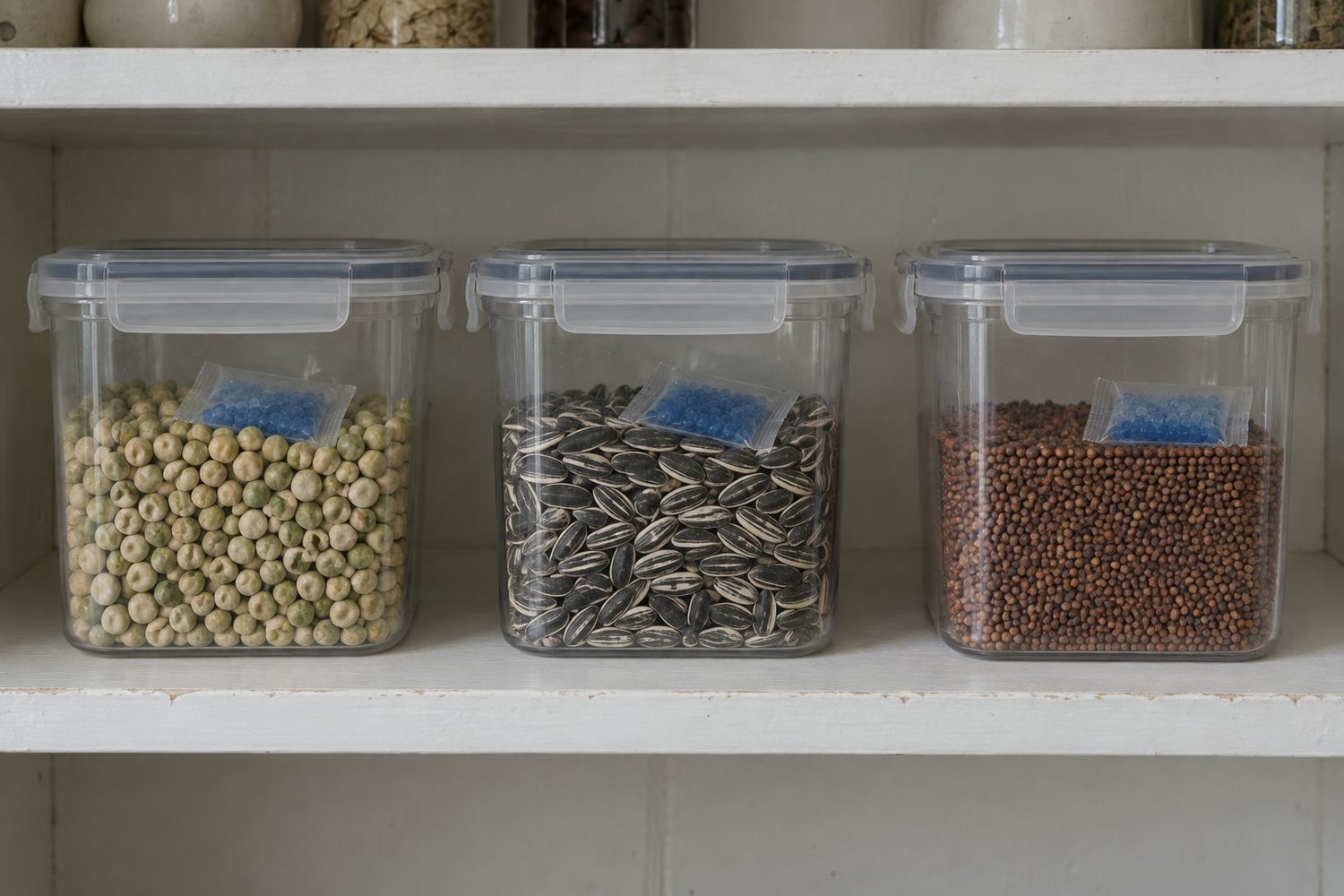
In practice they point to cool and dry. Keep the lot label, use a moisture-tight, food-safe container with a desiccant pack if the bag won't reseal, and store it somewhere cooler than your grow room. See seed storage for containers and how long microgreen seeds last for shelf life.
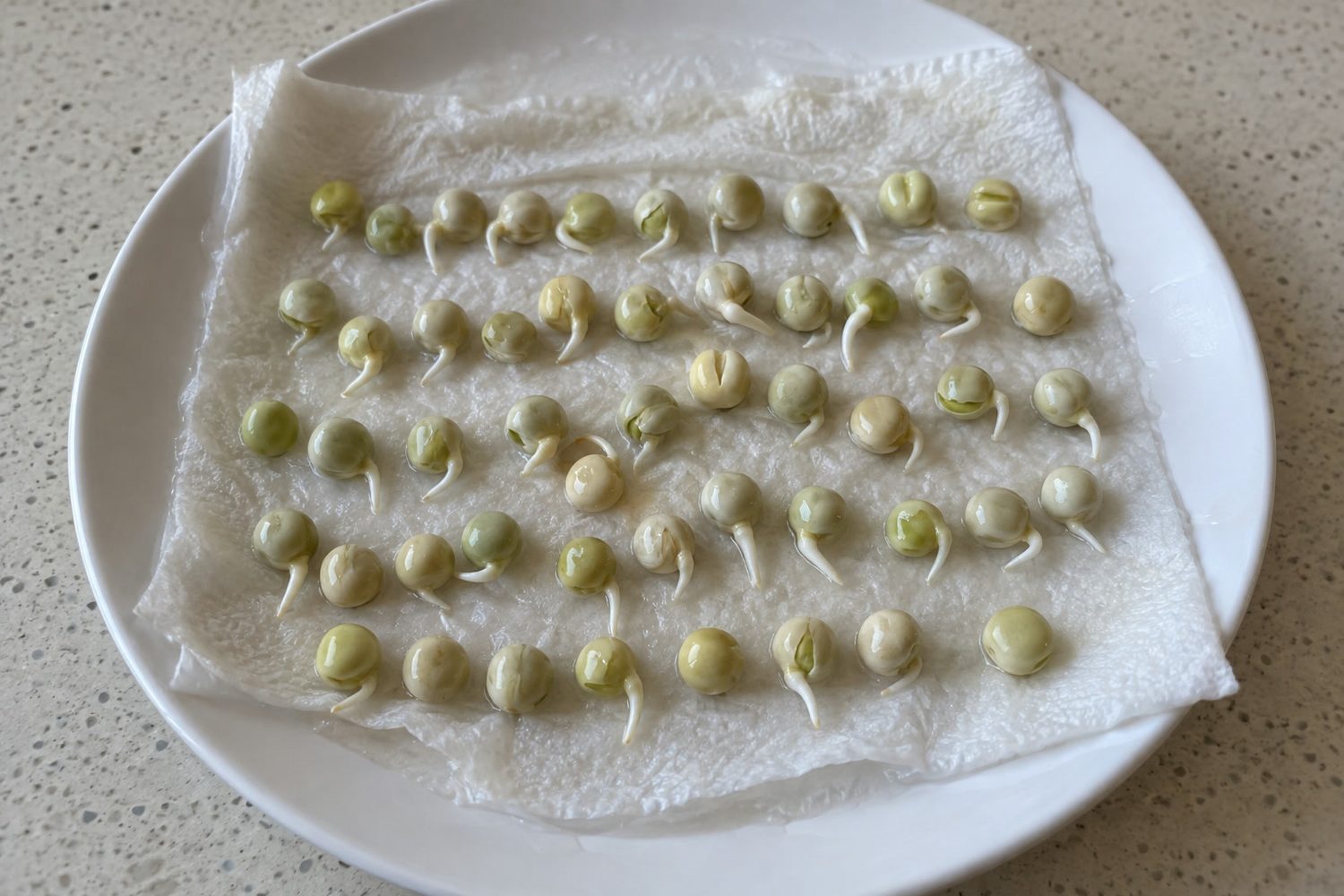
Since no curve exists for your bag, keep your own record. When you open a big bag, sprout 100 seeds on a damp paper towel, count how many come up, and write the number and date on the label; repeat every few months. If trays come up patchy, check poor germination before blaming the seed, and if your count is sliding, sow the rest of that bag sooner.
What the label and supplier testing tell you on a bulk bag
Bag size changes what the label has to show. Under the Federal Seed Act, a vegetable seed container over one pound must carry a lot number, the germination percentage, hard seed if any is present, and the month and year of the germination test. A packet of one pound or less that meets the germination standard needs only the kind, the variety and the shipper's name and address; one that falls below standard must show its germination, the test month and year, and the words "Below Standard".
The test must have been completed within five months, not counting the month of the test, before the seed ships across state lines. Radish, broccoli and pea are listed as vegetable seeds in 7 CFR 201.2, while sunflower is listed only as an agricultural seed, and state seed laws can add to this. On a 5 lb or 25 lb vegetable seed bag, the printed germination figure and test date are your starting point, so write them down next to your own counts.
On pathogen testing, all you have is what suppliers say. Mumm's says it samples each lot and sends the samples to an independent lab for Salmonella and E. coli tests. Johnny's says its pathology tests are completed only at certified outside labs, without naming the organisms. True Leaf says its sprouting seed is tested for salmonella, E. coli and listeria. None of the three publishes a result for a lot. If testing matters to you, and it matters more if you sell, ask the supplier for a certificate of analysis for the specific lot you're buying. FDA's sprout guidance also says microgreens are not sprouts, so the Produce Safety Rule's sprout subpart doesn't apply to them.
Two worked examples: two trays a week and fifty trays a week
Two scenarios show how the per-tray costs above add up over a year, seed only, at the same USU rates. Two trays a week, rotating radish, broccoli, pea and sunflower evenly, comes to 104 trays a year, 26 of each. Organic sunflower isn't sold under 1 lb, so the small-pack case uses True Leaf's conventional black oil sunflower in a 4 oz pack at $5.80, which is $2.46 a tray at 48 g, alongside 4 oz packs of the other three.
That year costs $365.82 on small packs and $191.88 on 1 lb packs, a difference of $173.94. Shipping widens the gap: one set of the four 1 lb packs comes to $61.69 and ships free, while one set of small packs comes to $27.25 and doesn't. A year of this rotation takes about 7 kg of seed, around 34 four-ounce packs of pea alone.
Fifty trays a week of the same four crops is 2,600 trays a year, 650 of each. On 5 lb bags that year costs $2,545.87, and on 25 lb bags $1,944.22, a reduction of $601.64, or 23.6%. At this volume every order at either size clears $60, so shipping doesn't separate the two. Both totals assume the September 13, 2026 prices hold, leave out waste, tax and other inputs, and count on a 25 lb broccoli bag that was out of stock that day.
Which bag size fits how you grow
Start with your own count of trays a week for each crop, not for everything combined, then match it to a bag.
- Stay with 1 lb packs if you sow a crop now and then, or you're still settling which crops you'll keep. For every crop in the tables that is sold in packs under a pound, most of the per-tray saving comes in the step up to 1 lb.
- Move to 5 lb once a pound of that crop runs out well inside a year and the order clears free shipping, either with broccoli on its own or two 5 lb bags together. A 5 lb bag is gone within a year at 1.04 trays a week of radish, 1.56 of broccoli or cilantro, 0.29 of pea or 0.91 of sunflower.
- Move to 25 lb when your count for that one crop reaches 5.19 trays a week of radish, 7.79 of broccoli or cilantro, 1.45 of pea or 4.54 of sunflower, and you have a cool, dry place to keep it. For the organic sunflower, the 25 lb bag saves $0.10 a tray over 5 lb, so the case for it is thin at any pace.
If you grow to sell, buy big only in the crops that sell every week; see which crops to sell, and buying microgreen seed for what to check before you order.
Questions about buying microgreen seed in bulk
These come up once you start sizing up bigger bags.
Does True Leaf's printed sowing rate change the cost per tray?
Yes. True Leaf prints 1 oz (28.35 g) a tray for Red Arrow radish, about a third less seed than USU's 42 g, so radish costs about a third less per tray at that rate. It prints 10 oz for pea, nearly twice USU's 150 g, which nearly doubles every pea figure. Broccoli barely moves, because True Leaf's 1 oz and USU's 28 g are almost the same.
Can I use garden sunflower seed instead of microgreen seed?
True Leaf warns that ornamental garden sunflower seed may be chemically treated, and tells growers of edible sunflower microgreens to buy seed sold for microgreens. Check the seed tag for any treatment and for its intended use before you sow a bag.
Does "tested" on a seed bag mean the lot is free of pathogens?
Not by itself. FDA's sprout guidance says a negative test result does not mean a lot of seed is necessarily pathogen-free, and that the Produce Safety Rule does not require microbial testing of seed for sprouting. A certificate of analysis naming the lot, method, result and date tells you more than a general statement.
Does opening and resealing a big bag shorten its life?
If you open a big bag often, test a pinch for germination now and then. USDA's seed storage facility reports that opening jars was not a moisture concern there, but that room is held at 30% relative humidity, which a kitchen shelf may not match. Keeping the seed in a moisture-tight container between sowings is a sensible precaution rather than a proven one.
Before you order
Put your weekly tray count for each crop next to the trays-a-week table, choose the largest bag you'll empty within a year, and add shipping to the order before you compare sizes. The prices on this page are from September 13, 2026, and seed prices change, so rerun the sum with the prices on the day you buy.
Sources
Prices, stock and specifications are as the linked pages showed them on 2026-09-13.
- True Leaf Market's
- Utah State University's
- Virginia Tech
- Broccoli microgreen mix
- Pea
- Organic sunflower
- Leisure Splits cilantro
- True Leaf Market ships free
- Johnny's Selected Seeds
- Everwilde
- Certified organic (4105MG)
- Conventional (4105M)
- r/microgreens
- commercial storage reference
- Federal Seed Act
- 7 CFR 201.2
- Mumm's says
- Johnny's says
- True Leaf says
- FDA's sprout guidance
- conventional black oil sunflower
- seed storage facility
Keep reading
The journal
Best Microgreen Seed Suppliers for Every Grower Scale
Find the best microgreen seed suppliers for your crops by weighing germination, organic certification, pathogen testing, pack sizes, and shipping costs.
Read Best Microgreen Seed Suppliers for Every Grower ScaleThe journal
Grow or Buy Microgreens? The Answer Is an Hourly Rate, and It Is $23.64
Seed alone makes home growing look eleven times cheaper. Add medium, power, a failure rate and your own time at $20 an hour and the saving against the cheapest retail is 8 percent.
Read Grow or Buy Microgreens? The Answer Is an Hourly Rate, and It Is $23.64The journal
Microgreens vs Mushrooms: On Labor Per Pound the Two Overlap, and the Farm-to-Farm Spread Is 10.9-Fold
Put both crops on labor hours per pound and they land on top of each other. The variation between mushroom farms is 10.9-fold, which is larger than any gap between the crops, so the operator decides this and not the crop.
Read Microgreens vs Mushrooms: On Labor Per Pound the Two Overlap, and the Farm-to-Farm Spread Is 10.9-FoldThe journal
The Cheapest Microgreens to Grow, Tray by Tray
Find the cheapest microgreens to grow by seed cost per tray and per ounce of harvest, plus how small a share seed is of the full cost of a tray.
Read The Cheapest Microgreens to Grow, Tray by Tray