Disclosure: Microgreens Guru may earn a commission if you buy through links on this page. It does not change the prices or the arithmetic shown here.
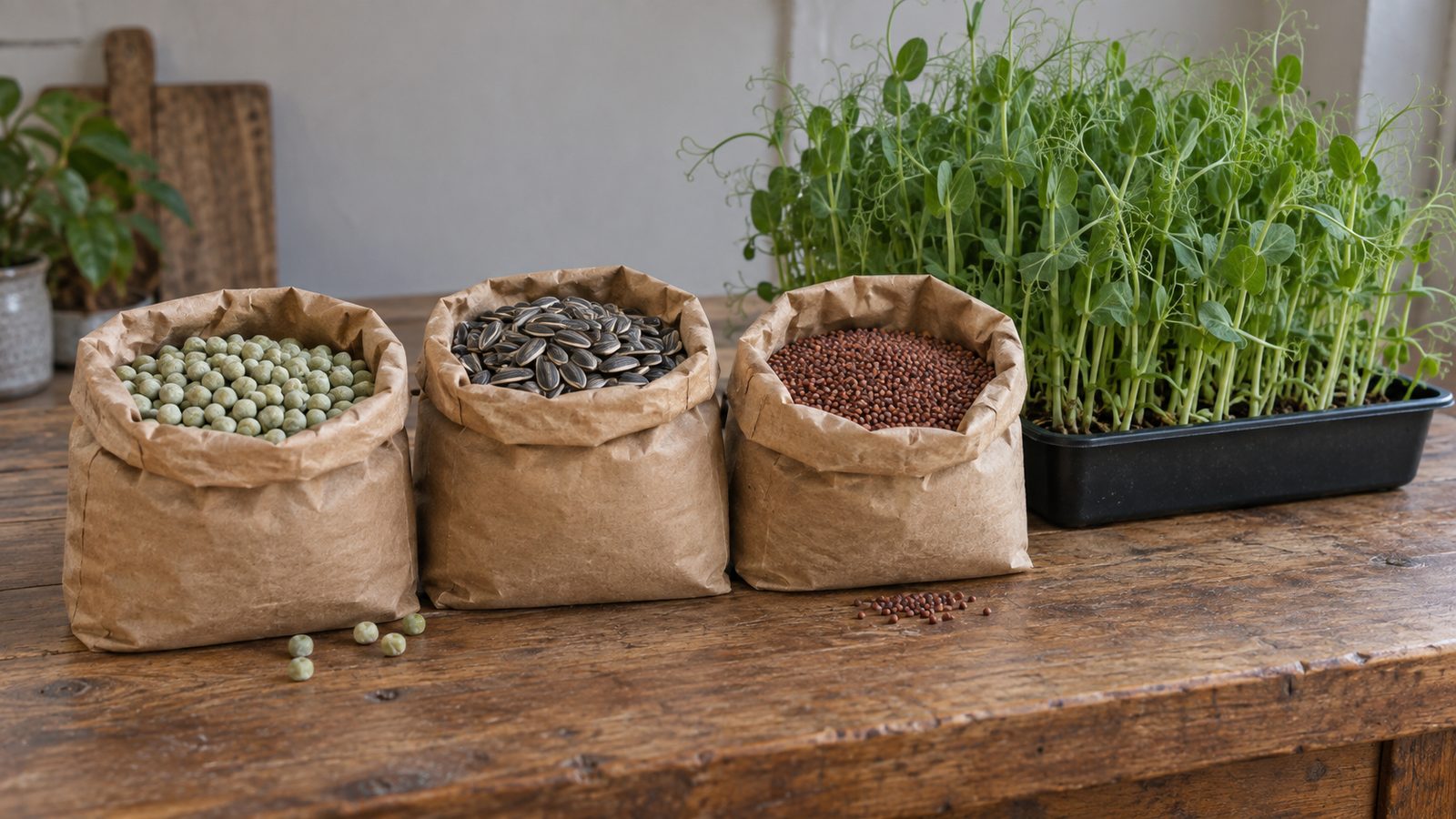
Seed is the small part of what a tray costs. In the University of Missouri Extension's 2024 budget, seed is 1.5% of a pea tray and 9.9% of a cabbage tray, so the cheapest crop to grow depends less on the price of a pound of seed than on how many grams go into each tray and how many ounces come off it. On one seller's matched prices, seeding rates and yields, mizuna, arugula and broccoli cost the least seed per ounce of harvest, and radish costs the most. Pea and sunflower look cheap by the pound, but pea can be one of the dearer trays once you count how heavily it is sown. No source names a single crop as the cheapest to grow, so the rest of this page works it out crop by crop, with the arithmetic shown so you can redo it with your own seed catalog.
The one formula you need
Every seed cost on this page comes from the same line:
cost per tray = price per pound x grams of seed per tray / 453.6
There are 453.6 grams in a pound, so this turns a per-pound price into the price of the seed you actually sow. To get the seed cost per ounce of harvest, divide the tray cost by the ounces you cut from that tray.
The formula is only as good as the three numbers you feed it. The price has to be dated, because seed prices move. The seeding rate has to be for the tray you actually use. And the yield has to have been measured at that same seeding rate, or the per-ounce figure means nothing. If you already grow, the best numbers are your own: weigh the seed you sow, weigh what you cut, and write both down next to the price on your last invoice. For how much seed a tray really wants, see sowing and seed density.
Seed cost per tray at extension prices
Utah State University Extension publishes seeding rates and seed prices for seven crops, with prices dated January 8, 2026 at the five-pound-or-more rate. Utah State does not name the seller behind any price, so treat these as a dated calculation, not a price you can check out at today.
Hover or tap a row to highlight it.
| Crop | Seed per 1020 tray | Price per lb (Jan. 8, 2026) | Arithmetic | Seed cost per tray |
|---|---|---|---|---|
| Arugula | 10 g | $8.22 | $8.22 x 10 / 453.6 | $0.18 |
| Kale | 28 g | $6.41 | $6.41 x 28 / 453.6 | $0.40 |
| Sunflower | 48 g | $4.54 | $4.54 x 48 / 453.6 | $0.48 |
| Radish, Champion | 42 g | $10.19 | $10.19 x 42 / 453.6 | $0.94 |
| Broccoli | 28 g | $19.58 | $19.58 x 28 / 453.6 | $1.21 |
| Pea | 150 g | $3.78 | $3.78 x 150 / 453.6 | $1.25 |
| Basil | 28 g | $32.14 | $32.14 x 28 / 453.6 | $1.98 |
Utah State prints its own tray costs, and they come out about 7% lower than the plain multiplication: $0.17 arugula, $0.37 kale, $0.45 sunflower, $0.88 radish, $1.12 broccoli, $1.16 pea and $1.84 basil. The gap is not rounding. Every one of Utah State's figures is 6 to 7% below price x grams / 453.6, and the page does not show how it got there. The table above uses the plain arithmetic, because that is the number you can reproduce with your own prices.
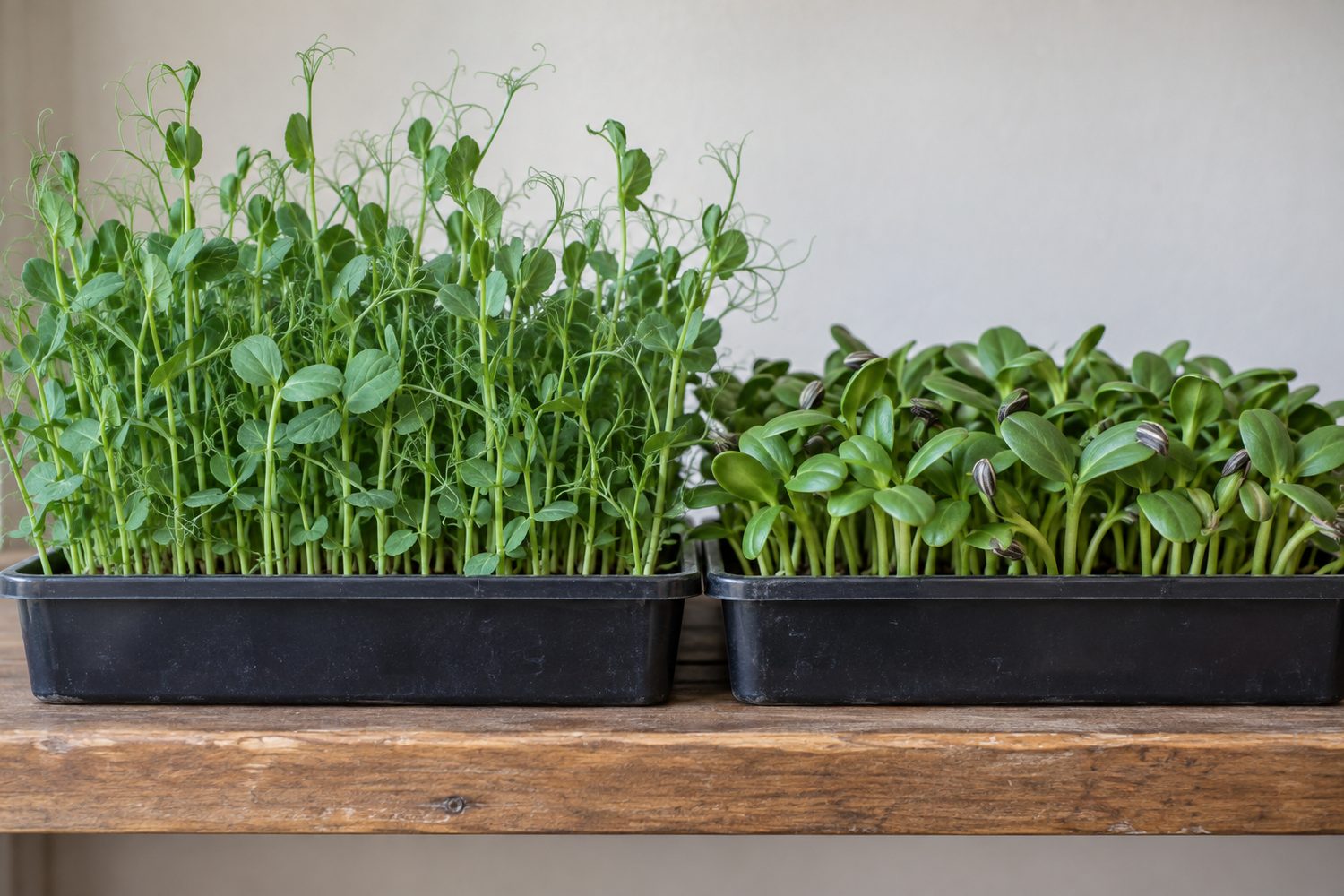
Look at what the rate does to the ranking. Pea is the cheapest seed by the pound at $3.78, but at 150 g a tray it lands near the top of the table at $1.25. Arugula costs more than twice as much per pound, yet at 10 g a tray it is the cheapest tray on the list at $0.18. Sunflower sits between them: cheap per pound and moderately heavy per tray.
Swap in a retail price and the order moves again. At True Leaf Market's 1 lb prices, which were unchanged between September 13 and September 26, 2026, and Utah State's rates, the seed per tray is radish $14.60 x 42 / 453.6 = $1.35, broccoli $21.46 x 28 / 453.6 = $1.32, pea $8.90 x 150 / 453.6 = $2.94 and sunflower $16.73 x 48 / 453.6 = $1.77. Buying a bigger bag brings those down; the price ladders by bag size are on the bulk microgreen seeds page.
Seed cost per tray from one seller's price and rate
Utah State has no rate or price for mustard, cabbage, mizuna, cress or amaranth. Johnny's Selected Seeds covers all of them, and six more, in one place: the seeding rate from its 2017 yield trial and its own 1 lb list price on September 26, 2026. Several of these products are organic, which is part of why they cost more per pound than the Utah State or True Leaf seed.
Hover or tap a row to highlight it.
| Crop (Johnny's product) | Seed per tray (2017 trial) | 1 lb price (Sept. 26, 2026) | Arithmetic | Seed cost per tray |
|---|---|---|---|---|
| Mizuna | 9.5 g | $18.76 | $18.76 x 9.5 / 453.6 | $0.39 |
| Arugula | 10 g | $21.90 | $21.90 x 10 / 453.6 | $0.48 |
| Broccoli, organic | 13 g | $27.60 | $27.60 x 13 / 453.6 | $0.79 |
| Basil, Italian Large Leaf organic | 6.5 g | $57.68 | $57.68 x 6.5 / 453.6 | $0.83 |
| Cress, Cressida organic | 10.5 g | $41.40 | $41.40 x 10.5 / 453.6 | $0.96 |
| Kale, Red Russian organic | 10 g | $48.50 | $48.50 x 10 / 453.6 | $1.07 |
| Amaranth, Garnet Red organic | 7.5 g | $66.45 | $66.45 x 7.5 / 453.6 | $1.10 |
| Cabbage, red organic | 10.5 g | $54.66 | $54.66 x 10.5 / 453.6 | $1.27 |
| Mustard, Garnet Giant organic | 8 g | $88.30 | $88.30 x 8 / 453.6 | $1.56 |
| Radish, Hong Vit | 28.5 g | $31.95 | $31.95 x 28.5 / 453.6 | $2.01 |
These rates are what Johnny's sowed for a first-true-leaf harvest in its own trial, not a universal rate. Johnny's did not trial pea or sunflower in that table, so there is no Johnny's rate to price them at.
Why the two rate sets disagree, and why it matters
Utah State sows 28 g of basil, broccoli and kale and 42 g of radish per tray. Johnny's trial sowed 6.5 g of basil, 13 g of broccoli, 10 g of kale and 24.5 g of Red Arrow radish. That means Utah State uses 4.3 times as much basil seed, 2.2 times as much broccoli, 2.8 times as much kale and 1.7 times as much radish. The rate moves the tray cost as much as the price does, which is why the same crop can look cheap in one table and dear in another.
Tray size is the other trap. Penn State Extension recommends 10 to 15 g of seed, but for a 12 x 20 inch 10-row seeding tray. That tray is 240 square inches, 20% larger than a 1020, so if you use Penn State's rate in a 1020, scale it down by about a sixth before you price it. Whichever rate you start from, check it against what actually fills your tray evenly, and use that gram weight in the formula.
Seed cost per ounce of harvest
This is the measure that tells you which crop gives the most food for the seed money, and it only works when the rate, the price and the yield come from the same place. Johnny's is the one seller that supplies all three together: its September 26, 2026 1 lb prices, the seeding rates from its 2017 trial and the yields that trial measured at those rates. It is one seller and one trial, so read the ranking as a comparison under one set of conditions, not a law.
Hover or tap a row to highlight it.
| Crop | Seed cost per tray | Trial yield per tray | Seed cost per ounce of harvest |
|---|---|---|---|
| Mizuna | $0.39 | 10 oz | $0.039 |
| Arugula | $0.48 | 10 oz | $0.048 |
| Broccoli, organic | $0.79 | 11.5 oz | $0.069 |
| Kale, Red Russian organic | $1.07 | 11 oz | $0.097 |
| Basil, Italian Large Leaf organic | $0.83 | 7.5 oz | $0.110 |
| Cress, Cressida organic | $0.96 | 8 oz | $0.120 |
| Cabbage, red organic | $1.27 | 8.5 oz | $0.149 |
| Mustard, Garnet Giant organic | $1.56 | 9.5 oz | $0.164 |
| Amaranth, Garnet Red organic | $1.10 | 6.5 oz | $0.169 |
| Radish, Hong Vit | $2.01 | 11.5 oz | $0.175 |
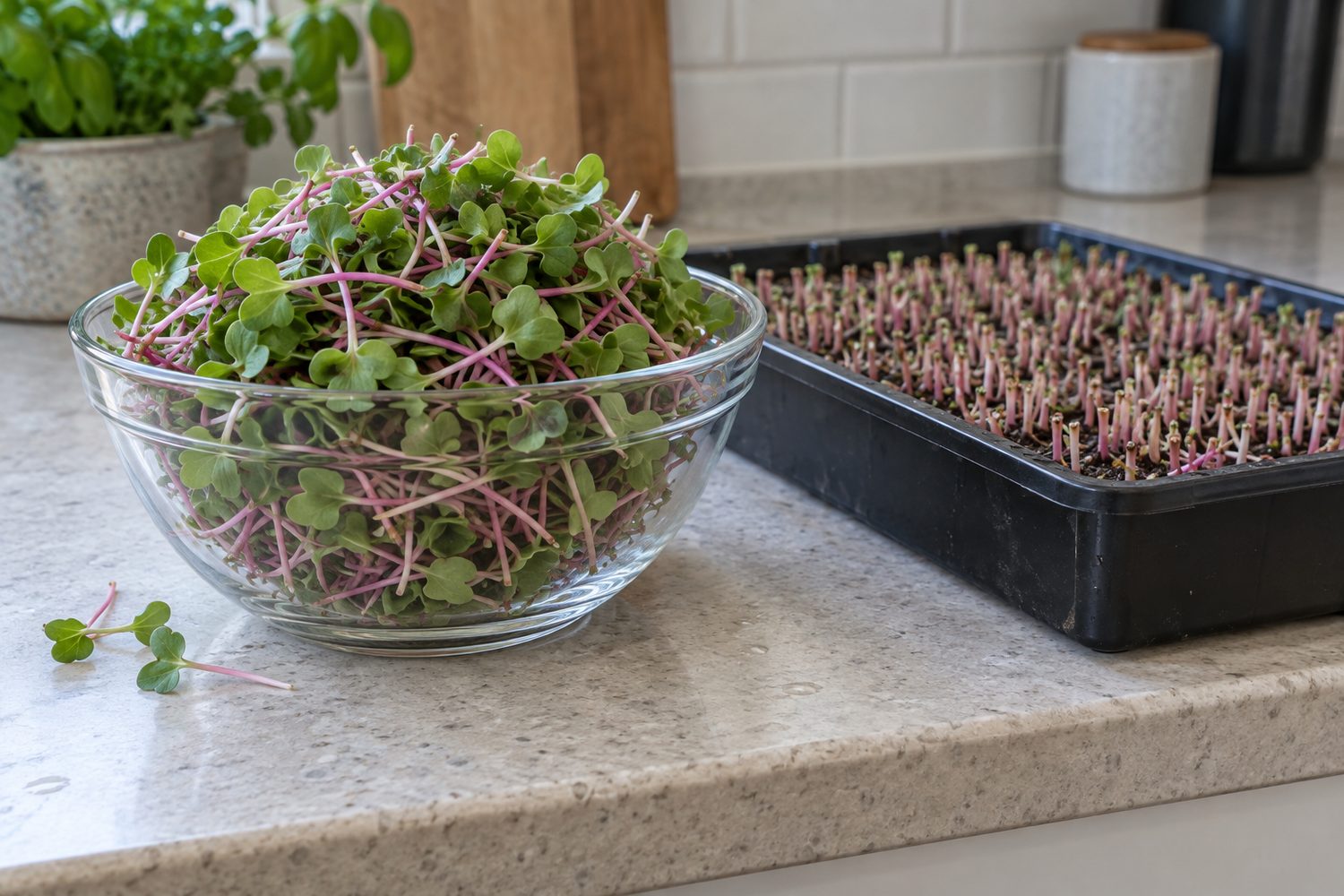
On these numbers the small-seeded brassicas come out lowest: mizuna, arugula and broccoli all cost well under a dime of seed per ounce of greens. Radish yields well but is sown so heavily that it finishes last. Basil is the reverse case, expensive per pound but so light per tray that it lands mid-table.
Johnny's says yield varies with procedure, technique, growing system, conditions, harvest stage and seed lot, so your own ounces per tray will differ. What travels is the method. For your crop, divide your tray's seed cost by what you actually cut. The what a tray actually yields page covers the yield side in more detail.
One shortcut to avoid: do not divide a Utah State tray cost by a Johnny's yield. Each Johnny's yield was measured at Johnny's rate, which is up to 4.3 times lighter than the Utah State rate behind the tray cost, so the result overstates the seed cost per ounce for basil, broccoli, kale and radish. Keep the tray cost and the yield from the same rate.
Pea and sunflower cannot be ranked on the same footing, because the Johnny's trial table has no yields for them. The Missouri budget below assumes pea yields 8 oz on $0.38 of seed, which works out to about $0.048 an ounce, but both figures are budget assumptions rather than measurements. If pea or sunflower is on your list, weigh your own harvest for two or three trays and divide.
What a whole tray costs, and where seed sits in it
The University of Missouri Extension microgreens budget (G693, 2024, built on March 2024 price forecasts for greenhouse production on a shelf under artificial lights) prices everything that goes into a harvested 1020 tray. Its totals, including repairs, interest, depreciation and overhead, run from $25.42 for pea to $40.55 for cabbage, with radish at $26.16, broccoli at $31.64 and a microgreen mix at $31.80.
Hover or tap a row to highlight it.
| Cost item | Missouri assumption | Per tray |
|---|---|---|
| Seed | $0.48/oz pea, $2.00/oz radish, $2.60/oz broccoli and mix, $8.00/oz cabbage | $0.38 to $4.00 |
| Growing medium | 3 quarts at $1.00 a quart | $3.00 |
| Fertilizer | 0.36 oz at $0.20 an ounce | $0.07 |
| Electricity | $0.12 per kWh | $0.83 radish to $1.20 pea, broccoli and mix |
| Labor | 15 minutes at $20 an hour | $5.00 |
| Labels | $0.60 each, one per retail package | $4.80 to $9.00 |
| Packages | $0.42 each, one per retail package | $3.36 to $6.30 |
Seed is 1.5% of the pea tray ($0.38 of $25.42), 3.3% of broccoli ($1.04 of $31.64), 7.6% of radish ($2.00 of $26.16) and 9.9% of cabbage ($4.00 of $40.55). The $3.00 of growing medium alone costs more than the seed in every budgeted crop except cabbage, and the $5.00 of labor costs more than any of them.
Labels and packages deserve a second look before you copy them into your own sums. Missouri counts one label and one package per ounce sold, so an 8 oz pea or radish tray carries $4.80 of labels and $3.36 of packages, while a 15 oz cabbage tray carries $9.00 and $6.30. Those costs follow the number of retail units, not the tray, so if you grow for your own kitchen they drop out entirely, and if you pack in larger units they shrink. Electricity is given in dollars per tray, $0.83 to $1.20, but the budget does not state watts, hours or kilowatt-hours, so to estimate your own, multiply your lights' wattage by the hours they run over a crop and by your electric rate.
Penn State's cost table, from its Hydroponics and Aquaponics course, runs much leaner: $0.67 per tray for the seeding tray, potting mix and fertilizer together, seed at "$0.47 to over $2.21" per tray on a 10 g rate, and labor at $12 an hour. On those assumptions seed can be the largest single direct cost of a tray, the reverse of the Missouri budget. Both are dated calculations, not today's prices, and the difference between them is mostly how the medium and labor are counted. That is why store microgreens cost what they do, and why a crop that is cheap in seed may not be much cheaper once you count the whole tray.
Which crop comes out cheapest, by measure
Pull the numbers together and the answer depends on the question you are asking:
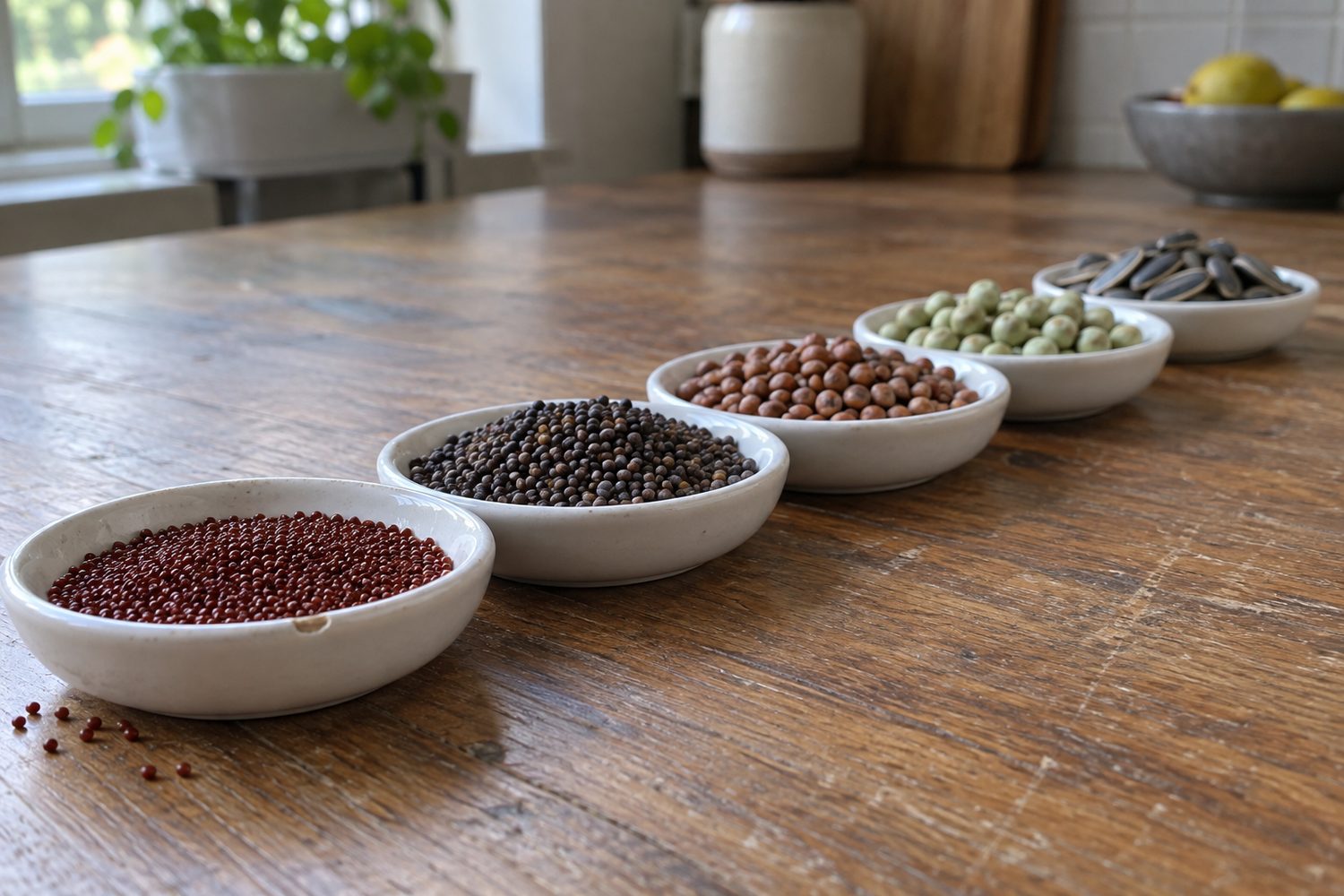
- Cheapest seed per pound: pea and sunflower, at $3.78 and $4.54 in Utah State's January 2026 prices.
- Cheapest seed per tray, extension prices: arugula at $0.18 on Utah State's rate and price, then kale at $0.40 and sunflower at $0.48. Missouri's budget, sown much more lightly, makes pea its cheapest at $0.38.
- Cheapest seed per tray, one retail seller: mizuna at $0.39 and arugula at $0.48 at Johnny's September 2026 prices and trial rates.
- Cheapest seed per ounce of harvest, matched figures: mizuna at $0.039, then arugula at $0.048 and broccoli at $0.069, from Johnny's alone. Radish Hong Vit is highest at $0.175.
- Cheapest whole tray: pea at $25.42 in the Missouri budget, with radish close behind at $26.16. Most of that gap comes from the packaging a smaller harvest needs, not the seed.
A cheap pound can need a heavy sowing rate, and an expensive pound can need very little seed. If you are choosing between a few crops, price each one with the formula at the rate you actually sow, then divide by what you actually harvest. If you are new to growing, the beginner microgreens page covers which crops are forgiving on a first tray, and if you are still deciding whether growing makes sense against buying, grow or buy microgreens runs that comparison.
Frequently asked questions
Does buying seed in bulk change which crop is cheapest? It lowers every crop, but not by the same amount. At Johnny's on September 26, 2026, moving from a 1 lb to a 5 lb bag cut the price per pound by 6.8% for radish Hong Vit and by 39.2% for mizuna, while True Leaf's 1 lb to 5 lb drop for pea was 56.0%. Rerun the formula at the bag size you would actually buy.
Should I use seed counts instead of grams? Grams are what the formula needs, but seed counts show why rates differ so much between crops. Johnny's lists about 20 black oil sunflower seeds per gram against 625 for arugula and 1,317 for amaranth, so a gram of arugula covers far more of a tray than a gram of sunflower. The counts are supplier averages and differ between lots, so weigh your own sowing rather than counting.
Are these seed prices what I will pay today? No. The seller prices here are list prices on a stated date, September 13 or 26, 2026, and exclude shipping and tax. The Utah State and Missouri figures are dated calculations from January 2026 and March 2024 forecasts. Check the current price and plug it into the same formula.
Is organic seed the reason some crops look expensive? Partly. Many of the Johnny's products priced here are organic, while the Utah State and True Leaf seed is not all organic, so a price gap between sellers is partly a product gap. Compare like with like when you shop, cultivar and organic status included.
What is the single cheapest microgreen to grow? No source names one. On matched seller figures, mizuna, arugula and broccoli cost the least seed per ounce of harvest, and on a whole-tray budget, pea comes out lowest. The cheapest crop for you is the one whose seed cost per ounce is lowest at your rate and your yield.
Sources
Prices, stock and specifications are as the linked pages showed them on 2026-09-26.
- Utah State University Extension
- Johnny's Selected Seeds
- Mizuna
- Arugula
- Broccoli, organic
- Basil, Italian Large Leaf organic
- Cress, Cressida organic
- Kale, Red Russian organic
- Amaranth, Garnet Red organic
- Cabbage, red organic
- Mustard, Garnet Giant organic
- Radish, Hong Vit
- Penn State Extension
- University of Missouri Extension microgreens budget
Keep reading
The journal
Microgreen Kit Refills: What Each Tray Actually Costs
See what microgreen kit refills cost per tray from Hamama and Back to the Roots, then compare generic seed and medium prices for the same weekly tray.
Read Microgreen Kit Refills: What Each Tray Actually CostsThe journal
Microgreens Business Startup Costs Before Your First Sale
Microgreens business startup costs, from extension enterprise budgets to insurance rates and per-tray supplies, broken down by starter and commercial scale.
Read Microgreens Business Startup Costs Before Your First SaleThe journal
Bulk Microgreen Seeds: Cost Per Tray by Bag Size
Buying bulk microgreen seeds cuts cost per tray, but only if the bag gets used fast enough. Compare 5 and 25 pound prices, shipping, and weekly tray needs.
Read Bulk Microgreen Seeds: Cost Per Tray by Bag SizeThe journal
Can You Use Your Own Seeds in an AeroGarden?
Yes, you can use your own seeds in an AeroGarden. See current sponge and pod prices, seed counts per position, and sprouting times for your own crop.
Read Can You Use Your Own Seeds in an AeroGarden?