Microgreens Business Startup Costs Before Your First Sale
Cal HewittPublished Checked
- selling microgreens
- business planning
- economics
- cost
Disclosure: Microgreens Guru may earn a commission if you buy through some product links on this site. It does not change the prices or sources cited here.
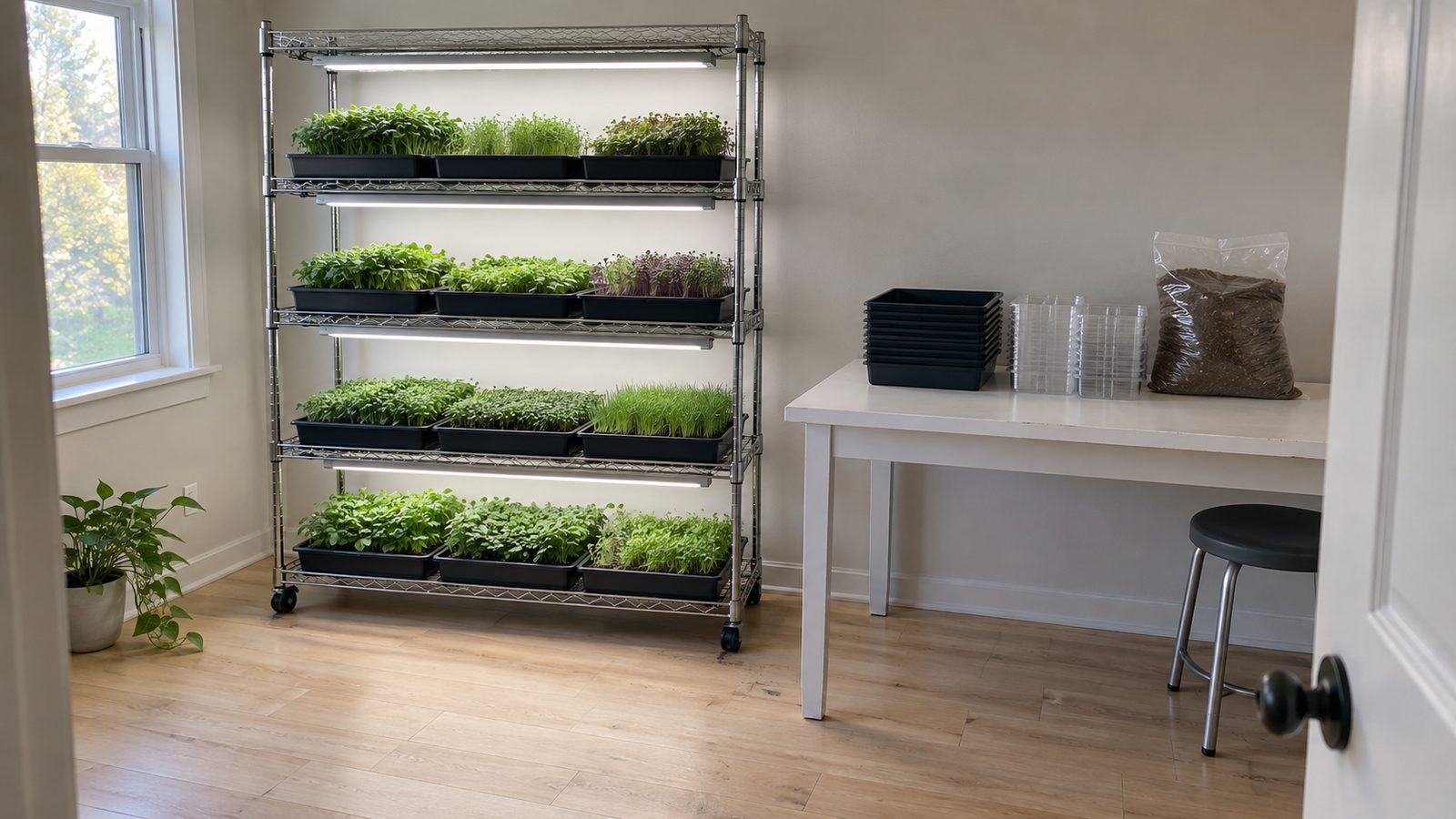
A spare-room start can come in at a few hundred dollars: $452.95 to $482.95 buys one six-tier rack, lights, 16 tray sets, a timer, a power strip, seed and a pack of coir at the 2026 seller prices below. A first commercial shelf priced by the University of Missouri Extension comes to $4,384, and $2,500 of that is cold storage. Insurance for a produce seller starts at $25.92 a month. Every line is set out below, with its source and date, so you can price your own list rather than borrow somebody else's total.
Start from the scale you are actually building
The biggest difference between one startup number and another is not the price of trays. It is what the number assumes you are building. A shelf in a spare room, a single commercial shelf with a cooler, and a 2,000 square foot facility are three different businesses, with costs in the hundreds, the thousands and the hundred thousands.
Two kinds of figures appear on this page, and they are labeled every time. Extension evidence means an enterprise budget published by a university extension service or an agriculture department: a planning model with stated assumptions, not a receipt. Seller practice means a price or total published by a retailer, grower, consultant or course seller. Seller prices are useful because they are current and you can click through and buy the item; they are also one seller's claim on one date.
If you have not yet decided what you will grow and who will buy it, the business plan post and the guide to starting a microgreens business cover those decisions. This page is the money you spend before your first sale.
A shelf in a spare room
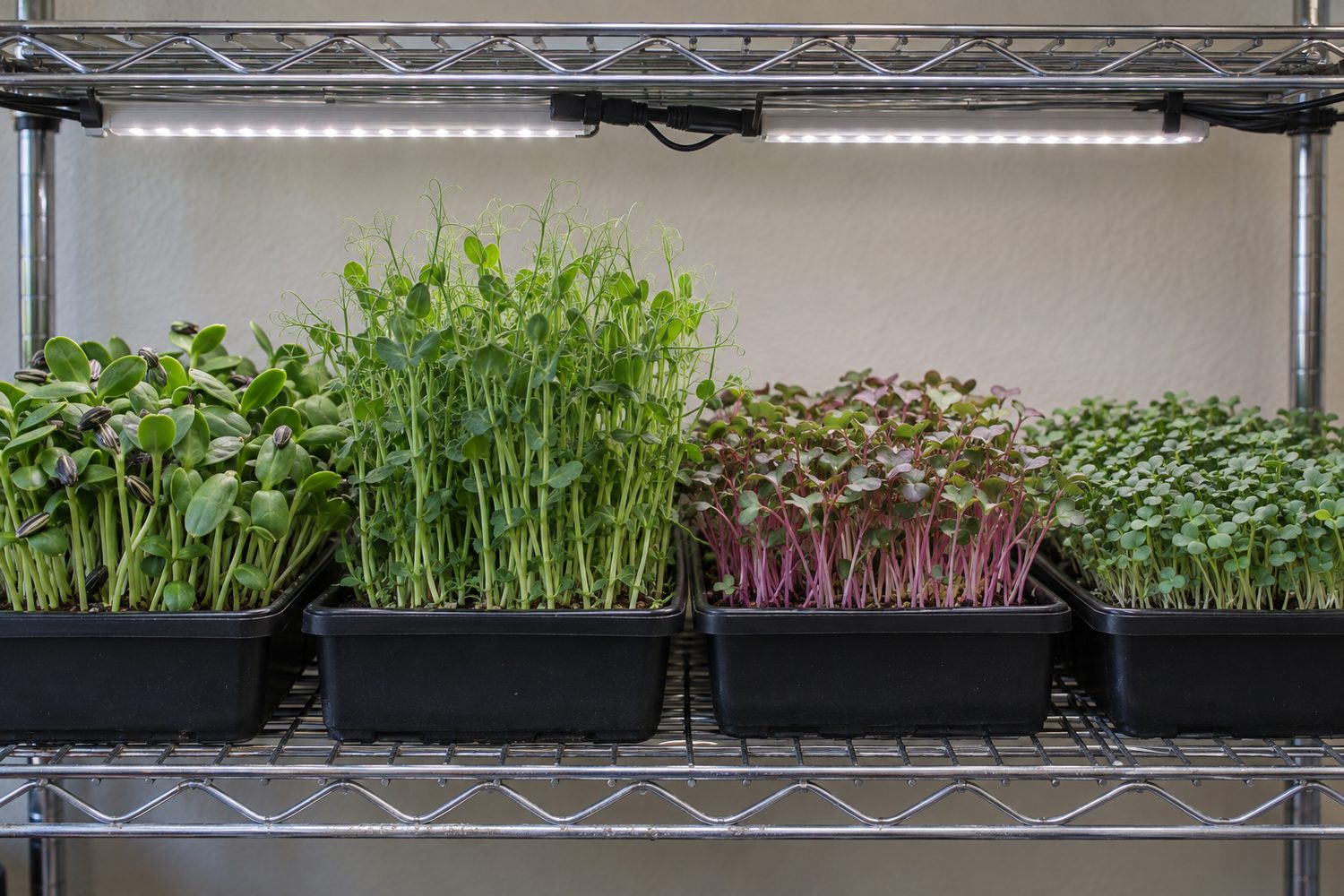
These are seller practice prices. The rack, light, timer and power strip figures are approximate prices from Microgreen Manager's starter-kit guide (April 15, 2026, by Garrett Corwin of Piedmont Microgreens), as carried on the Microgreens Guru equipment list on September 13, 2026. The Bootstrap Farmer tray and coir prices were unchanged on its product pages on September 26, 2026.
Hover or tap a row to highlight it.
| Item | Price | Seller and basis |
|---|---|---|
| Six-tier wire rack, 48 by 18 by 72 inches, NSF, with wheels | About $100 to $130 | Costco, via Microgreen Manager |
| Four-foot 22 W LED shop lights, six-pack | About $34 | Amazon, via Microgreen Manager |
| 1020 shallow mesh tray with holes (inner) | $5.95 each | Bootstrap Farmer, $124.99 for 30 |
| 1020 shallow no-hole tray (outer), black | $5.99 each | Bootstrap Farmer, $136.99 for 30 |
| Outlet timer | About $12 | Amazon, via Microgreen Manager |
| Six-outlet 15 A power strip | About $15 | Amazon, via Microgreen Manager |
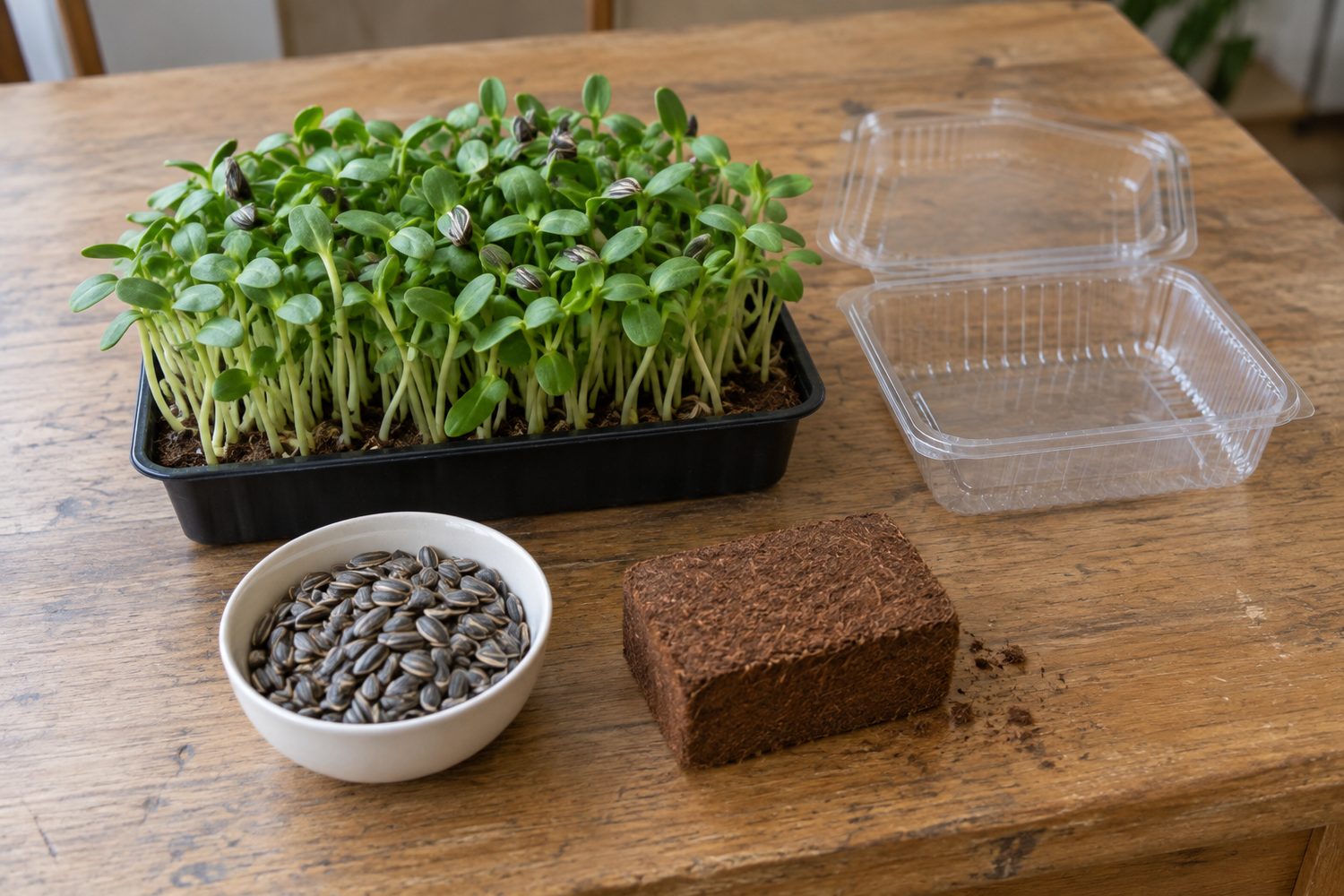
| Coir, ten-brick pack | $48.99 | Bootstrap Farmer; seller says it serves 30 shallow trays |
| Broccoli seed | $1.12 per 1020 tray (28 g) | Utah State University Extension bulk-price benchmark, 5 lb rate, January 8, 2026 |
| Digital scale | $9 | Amazon listing cited by Microgreens Consulting |
Other wire shelving works too, but check the shelf size: a Huluwat four-shelf unit is $89.00 at Home Depot and, at 23.6 by 13.7 inches, holds one 1020 tray per shelf. A single coir brick is $11.99 and covers three trays.
For a full 16-tray rack, the equipment and first medium come to $352.95 before the rack: $95.20 of inner trays, $95.84 of outer trays, $68 for two light six-packs, $12 for the timer, $15 for the power strip, $17.92 of seed and $48.99 of coir. Add the rack and the total is $452.95 to $482.95, before water and tax. That is seller practice added up, not a university cost study.
If you want to start smaller still and test a market with two trays, the list shrinks. One rack, one six-pack of lights, two inner and two outer trays, the timer, the power strip, one coir pack, two trays of broccoli seed, the $9 scale, a $75 pack of 24-ounce clamshells (the Amazon listing Microgreens Consulting cites; its pack count is not stated) and one month of insurance at ACT Pro's $24.25 starting price add to $344.36. At the high rack price, and with a single $49 ACT Go event policy in place of the monthly policy, it comes to $399.11. Treat both as partial. They leave out a harvest tool, a humidity dome, permits, labels, water, tax and delivery, and the insurance lines are an arts-and-crafts insurer's prices; the insurance section below explains why a produce seller would price FLIP instead.
The tools that finish the list
Four items were left out of those sums, and each has a located price.
- Harvest tool. Mainstays 8.6 inch kitchen shears are $1.78 at Walmart (September 13, 2026). Microgreen Manager lists a harvest knife at about $18 on Amazon. The Missouri budget prices one cutter at $30.
- Fans. A four-fan kit sized to one tier was $102.99 in a September 2026 retail snapshot published by UA Organic, which does not name the retailer on that line. As extension evidence, Missouri prices fans at $55 each, and Alberta's 2018 model prices ventilation fans at $100 each.
- Label printer. Microgreen Manager puts a thermal label printer at about $100 to $150 on Amazon and names the Brother QL-820NWB.
- Work table. Microgreen Manager suggests a $12 folding table from Walmart. Alberta's 2018 table prices work tables at $150 each.
Three items have no price you can rely on here: a dehumidifier, a humidity dome and your permits. Price those locally before you finalize the budget. For the dome, Microgreen Manager lists humidity domes under what not to buy and says stack germination works without them, and the equipment list prices an improvised lid at $0. For the dehumidifier, the only dated figure is Alberta's 2018 line of $400 for a 2,000 square foot facility, which is not a guide to a spare room. The full equipment list has the rest of the gear and what each piece does.
One commercial shelf, priced by the Missouri Extension
The University of Missouri Extension's Microgreens Planning Budget, G693, revised in July 2024 and priced from March 2024 forecasts, models one stainless steel shelf system under artificial lights in a greenhouse. It was written by Manita Ale and Juan Cabrera-Garcia with USDA Farm Service Agency funding. The publication page is at extension.missouri.edu, and the PDF tables are readable in an archived copy of the Missouri G693 PDF dated February 14, 2026. This is extension evidence. UA Organic reproduces the list item by item and credits Missouri by name, but the figures are Missouri's.
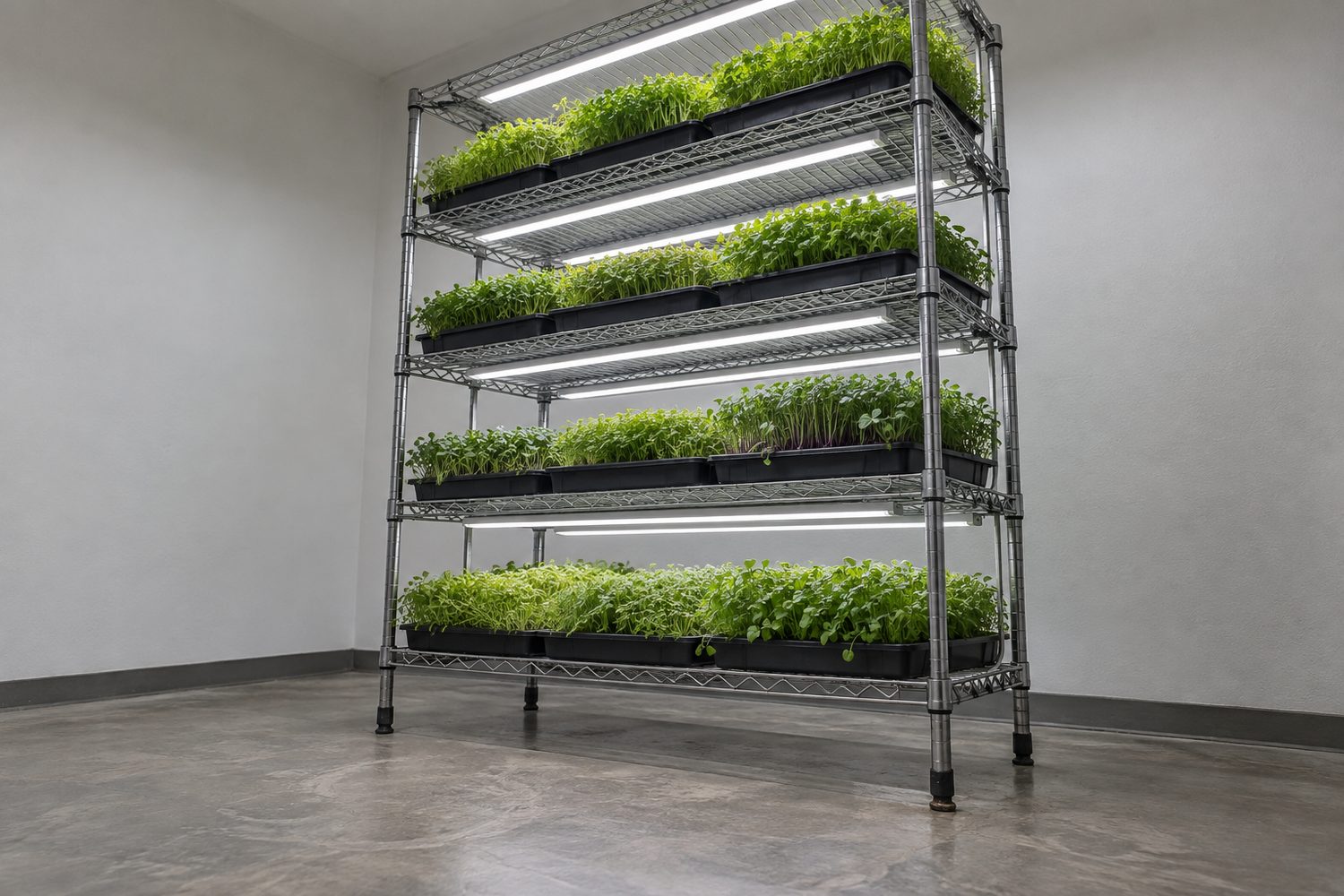
Table 4, capital investments:
Hover or tap a row to highlight it.
| Item | Quantity | Unit price | Total | Useful life |
|---|---|---|---|---|
| Heavy duty 10x20 trays | 20 | $10 | $200 | 3 years |
| Stainless steel shelf unit, 4 levels | 1 | $150 | $150 | 10 years |
| LED lights | 4 | $225 | $900 | 10 years |
| Fans | 4 | $55 | $220 | |
| Cutter | 1 | $30 | $30 | |
| Cold storage/refrigerator | 1 | $2,500 | $2,500 | 10 years |
| Infrastructure for growing crops (greenhouse space charge) | 8 sq ft | $48 | $384 | |
| Total | $4,384 |
The budget works out to $1,096 per shelf level, with $367.47 a year in depreciation and $186.32 in interest. Look at the cooler line before anything else: it is $2,500 of the $4,384, or 57 percent. Everything else comes to $1,884. Microgreen Manager's practice advice is to use a home refrigerator until you are running 100 or more trays a week, so whether that line belongs in your first-season budget depends on your volume, not on the budget.
Notice what Table 4 does not include: seed, growing medium, packaging, permits or insurance. Missouri covers those per tray, in its operating costs.
What each tray costs to run
Missouri's Table 1 gives operating costs per harvested 1020 tray at March 2024 forecasts. For the microgreen mix:
Hover or tap a row to highlight it.
| Cost line | Per tray |
|---|---|
| Seed | $1.04 |
| Soilless growing media | $3.00 |
| Fertilizer | $0.07 |
| Electricity | $1.20 |
| Labor | $5.00 |
| Labels | $6.60 |
| Packages | $4.62 |
| Marketing | $6.90 |
| Repairs | $0.41 |
| Operating interest | $1.23 |
| Total operating costs | $30.06 |
Ownership costs add $1.74, for a total of $31.80 a tray against $46.00 of sales. Across the five crops Missouri budgets (mix, broccoli, cabbage, pea and radish), operating costs run from $23.93 a tray for pea to $39.26 for cabbage. The inputs behind those lines include 3 quarts of media at $1.00 a quart, electricity at $0.12 a kWh, 15 minutes of labor at $20.00 an hour, and labels at $0.60 and packages at $0.42 each, for a tray of mix sold as 11 units. Together, labels and packages are $11.22 a tray, so price your own packaging before you buy your first case of clamshells.
Seller practice numbers for a home setup sit lower because they leave out labor and marketing. Broccoli seed is $1.12 a tray at the Utah State benchmark; coir is $1.63 a tray if Bootstrap Farmer's 30-tray yield holds, or up to $4.00 on a single brick. One 55 W fixture running 16 hours a day for a 10-day crop at $0.16 a kWh costs about $1.41, or about $0.70 a tray when two trays share the light. The electricity and water costs guide works through that calculation with your own rate.
For a 16-tray month, seed at $1.12 comes to $17.92 and coir at $1.63 comes to about $26.08, before packaging and labels. Your packaging cost depends on the format you pick and the pack size you buy, so price your chosen clamshell per unit and multiply by the units you expect per tray.
A first commercial facility: Alberta's 2018 model
Alberta Agriculture and Forestry's Commercial Microgreens: Business Concept and Financial Analysis, dated 2018, is extension evidence at a very different scale: a facility of at least 2,000 square feet producing 960 trays a month. Its Table 1 start-up expenses total $109,284. The currency is not printed on the table, and Table 2 carries a slightly different asset investment of $109,584, $300 more, so quote the table you are using.
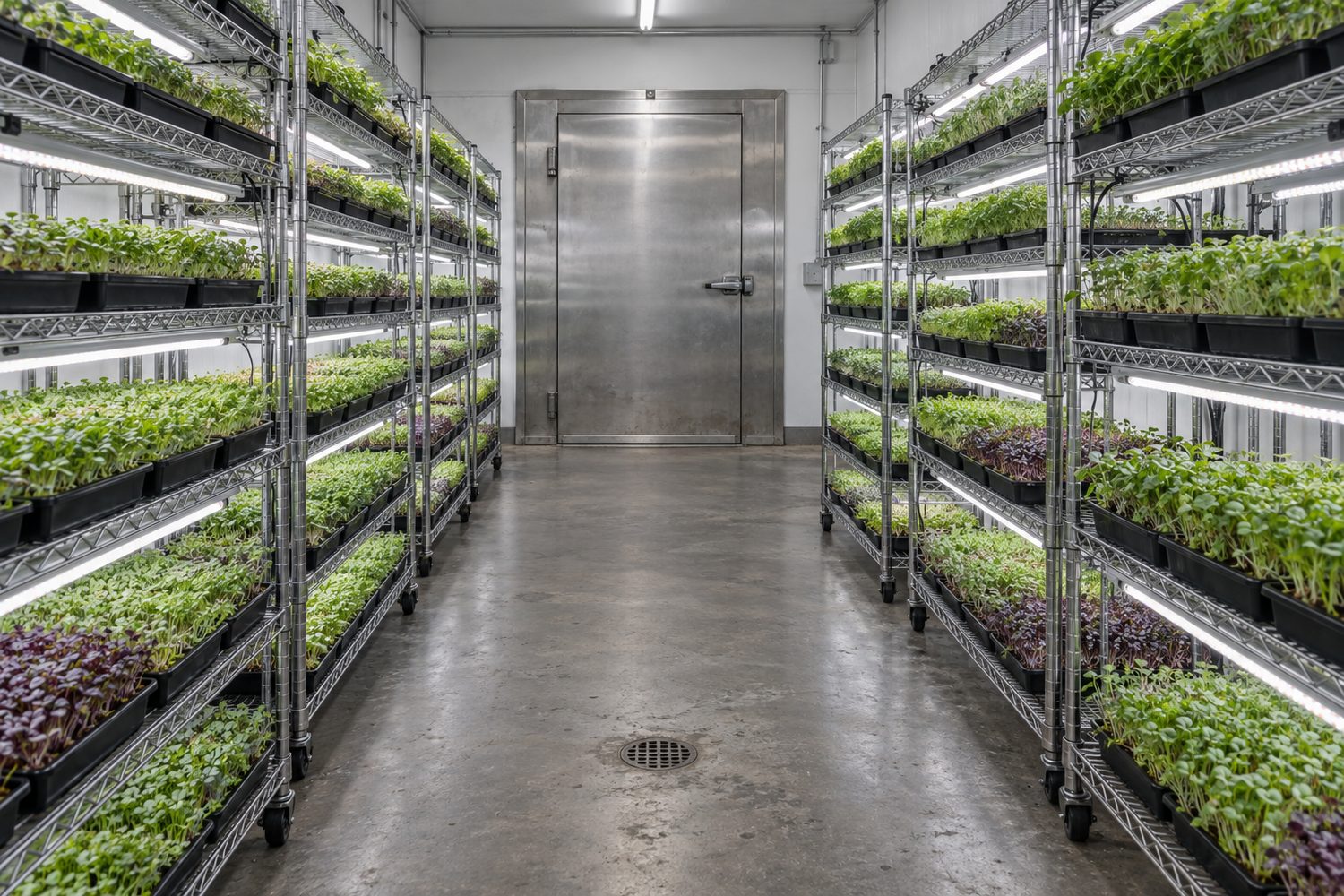
The largest lines are a $60,000 growing facility, 160 lights at $120 ($19,200), a $10,000 delivery vehicle, a $5,000 walk-in cooler, 2,000 1020 trays at $2 ($4,000), 20 racks at $150 ($3,000) and a $2,000 heating system. Smaller lines include harvesting tools at $40, scales at $60, a $300 fridge and a $400 dehumidifier. Without the facility and the vehicle, the equipment comes to $39,284.
The model assumes $6,000 a month in fixed overhead, which spreads to $6.25 a tray at 960 trays. It lists the fixed-cost categories as salaries, insurance, facility or land costs, repairs, marketing (including a website and social media), accounting and administration, and debt interest. Its per-tray costs cover ten crops. Sold as living trays, seed runs from $0.17 (pea) to $2.42 (beet), soil $0.45, the tray $2.00, the label $0.10, labor $6.67 to $19.00 (basil) and overhead $6.25, adjusted by a productivity factor of 75 to 95 percent; broccoli totals $19.53 a tray. Harvested into 60 g or 30 g clamshells, broccoli totals $27.53 a tray, or $5.51 per 60 g unit.
Both the Missouri and Alberta budgets are planning models. Missouri is one small system at 2024 forecast prices; Alberta is a 2018 commercial concept. Neither names a retailer or purchase date, so use them for the shape of the costs and check today's prices yourself.
Insurance for a produce seller
FLIP's farmers market insurance starts at $25.92 a month or $299 a year. It lists fresh fruit and vegetable vendors and farm stands among those covered, with $1,000,000 each occurrence and $2,000,000 general and products-completed operations aggregates. FLIP does not offer a one-day farmers market policy, so budget for at least a month.
ACT Insurance's farmers-market page is written for artists, crafters and tradesmen, and it sends food vendors to its partner FLIP. Its prices are still useful to know. ACT Pro, which includes product liability, starts at $24.25 a month or $279 a year. ACT Go, the event policy, is $49 for 1 to 3 days, $99 for 7 days and $199 for 90 days, and the page describes it as basic general liability only; product liability is listed under ACT Pro. General liability covers your booth operations. Product liability covers injury or damage caused by what you sell, which is the coverage a food seller usually needs.
Both are insurers' published starting prices, not quotes. The microgreens business insurance post covers what markets and buyers ask for.
Permits and market fees
Permit costs depend on your state, county and sales channel, so no national figure holds. Two published fees show the range of what you might meet:
- Nevada. The Nevada Department of Agriculture charges $50.00 for a Producer Certificate application, which includes a farm inspection, and $30.00 for the annual renewal, with no inspection required after the first year.
- Portland, Oregon. The Portland Farmers Market 2026 Vendor Handbook lists a non-refundable $15 annual application fee covering all of its markets. Its stall fee chart lists a farmer 10 x 10 at PSU at $60 from October to April and $65 from May to September, with Shemanski Park at $53, King at $48, Kenton at $42 and Lents International at $40. The chart does not print its time unit, so ask the market how often the fee is charged.
For your own state, start with whether you need a license to sell microgreens and the state guide linked from it, then call the office it names and write the fee into your budget. Add your market's application and stall fees once you know which markets you will apply to.
Headline totals and the line items behind them
You will meet published startup totals from sellers, consultants and course sellers. They are seller practice, and each is easier to use when you set it beside that seller's own line items.
Hover or tap a row to highlight it.
| Source | Headline total | Its own line items |
|---|---|---|
| Fern and Shelf, May 27, 2026 (updated August 25, 2026) | $250 to $500 bootstrap; $800 to $1,500 serious starter; $3,000 to $6,000 commercial | Tier 1 items $275 to $515; Tier 2 $1,020 to $1,920; Tier 3 $4,300 to $8,900 |
| Business Plan Firm, July 10, 2026 | $2,000 to $50,000 for 200 to 500 sq ft | Eight lines summing to $4,000 to $33,500; sells business plans |
| Microgreens Consulting, April 24, 2025 (updated February 23, 2026) | $700 to $1,000 | Priced items sum to $417 to $617; trays and seed not priced; sells a course |
| SpeedCalcs, August 10, 2026 | $500 to $2,000 home; $2,000 to $5,000 side business; $5,000 to $15,000 or more commercial | One 24-tray home rack itemized at $1,005 to $1,345 |
| Microgreen Manager, April 15, 2026 | $876 to $958 starter; $1,325 to $1,407 serious | Excludes software, website and business registration |
| UA Organic, September 19, 2026 | $500, $4,384 and $50,000 builds | $4,384 is Missouri's Table 4; $50,000 is the USDA microloan maximum |
When a headline and its lines disagree, work from the lines. They tell you what the seller priced, and they show you what is missing from your own list.
Build your own number
To build your own budget:
- Pick your scale: trays a week and where they will grow.
- Price the equipment for that scale, one line at a time, with the seller and the date you checked.
- Decide whether you need a cooler now or can use a home refrigerator at your volume.
- Price seed, medium and packaging per tray, then multiply by your first month's trays.
- Get a real insurance quote, starting from FLIP's $25.92 a month.
- Call your state and county offices and your chosen markets for their fees.
- Price the dehumidifier and dome locally if your room needs them.
Write each line down with its source. When you are ready to check whether the business pays back that spend, are microgreens profitable works through margins.
FAQ
Is the $4,384 Missouri figure a full startup budget? No. It is the capital list for one four-level shelf, and it includes a $2,500 cooler but no seed, medium, packaging, permits or insurance. Those sit in the per-tray operating costs, which total $30.06 a tray for the mix.
What currency is Alberta's $109,284 in? The table does not print one. Quote it as Alberta Agriculture's 2018 figure without converting it, and note that Table 2 carries $109,584.
Can I buy one-day insurance for a single market? Not from FLIP, which says it does not offer one-day farmers market insurance; its policy starts at $25.92 a month. ACT Go's $49 event policy covers 1 to 3 days but is basic general liability, and ACT sends food vendors to FLIP.
Do I need a humidity dome? Microgreen Manager lists domes under what not to buy and says stack germination works without them. If you want one, price it locally at a retailer that shows the size and pack count.
How much will my permits cost? It depends on your state and market. Nevada's Producer Certificate is $50 to apply and $30 to renew, and Portland Farmers Market charges a $15 application fee; call your own state and county offices for their current fees.
A few hundred dollars gets a shelf growing and a first market tested. A commercial shelf with its own cooler is a four-figure decision, and a facility is a six-figure one. Price the scale you are building now, keep the dates beside your numbers, and update the list as you grow.
Sources
Prices, stock and specifications are as the linked pages showed them on 2026-09-26.
- University of Missouri Extension
- Microgreen Manager's starter-kit guide
- Microgreens Consulting
- UA Organic
- extension.missouri.edu
- Commercial Microgreens: Business Concept and Financial Analysis
- FLIP's farmers market insurance
- ACT Insurance's farmers-market page
- Nevada Department of Agriculture
- Portland Farmers Market 2026 Vendor Handbook
- Fern and Shelf
- Business Plan Firm
- SpeedCalcs
Keep reading
The journal
The Cheapest Microgreens to Grow, Tray by Tray
Find the cheapest microgreens to grow by seed cost per tray and per ounce of harvest, plus how small a share seed is of the full cost of a tray.
Read The Cheapest Microgreens to Grow, Tray by TrayThe journal
Buying a Microgreens Business for Sale: What to Check First
Thinking about a microgreens business for sale? Learn how sellers state cash flow, what SBA loans require in 2026, and what to check before you buy.
Read Buying a Microgreens Business for Sale: What to Check FirstThe journal
Growing Microgreens for Profit: A Weekly Production Plan
Plan growing microgreens for profit with tray counts per crop, a buffer from your own records, and a weekly sowing and harvest schedule you can repeat.
Read Growing Microgreens for Profit: A Weekly Production PlanThe journal
How to Write a Microgreens Business Plan Step by Step
Build your microgreens business plan section by section, from executive summary to financial plan, with startup costs itemized by scale and source.
Read How to Write a Microgreens Business Plan Step by Step