Microgreen Kit Refills: What Each Tray Actually Costs
Cal HewittPublished Checked
- buying
- seed
- cost
- beginner
Disclosure: Microgreens Guru may earn a commission if you buy through some links on this site. It does not change the prices or the arithmetic below.
A Hamama refill costs $4.69 to $7.33 a tray, depending on how many Seed Quilts you buy at once, and the subscription works out to $5.67 a quilt. Building your own refill from generic seed and a growing medium costs about $2.29 to $4.25 of seed and mat for a standard 1020 tray, depending on the crop and how much of each you buy. At one tray a week, that is roughly $244 to $381 a year for Hamama quilts against roughly $119 to $221 a year for radish on hemp mats, before electricity. The trays are not the same size, so the fair comparison in the end is cost per ounce you actually harvest, and that number comes from putting your own harvest on a kitchen scale.
All prices below were read on September 26, 2026. They change, so check the current listing before you order.
What the kit makers charge for a refill
If you want to keep using the tray you already have, the simplest path is the maker's own refill. Here is what the two main kit makers charge, and what each refill includes.
Hamama Seed Quilts
A Hamama Seed Quilt is a pre-seeded sheet made from coconut fiber, felt, soy wax paper and seeds. You lay one in the reusable tray, add water, and that is one crop. The price per quilt drops as the pack gets bigger, according to Hamama's Classic Microgreen Seed Quilts page:
Hover or tap a row to highlight it.
| Hamama pack | Price | Per quilt (one tray) |
|---|---|---|
| 3 quilts | $22 | $7.33 |
| 9 quilts | $59 | $6.56 |
| 18 quilts | $99 | $5.50 |
| 36 quilts | $169 | $4.69 |
| Subscription, 3 a month | $17 a month | $5.67 |
The Hamama home page lists the subscription as 3 quilts a month for $17. The product page says subscribers get free shipping and "Save 10% or more on all Seed Quilt refills." Notice that the 36-pack, at $4.69, costs less per quilt than the subscription does. The subscription's advantage is free shipping and a steady supply; the 36-pack's advantage is price, if you have room to store 36 quilts and will use them.
Hamama says each quilt grows approximately 3.5 oz (99 g) of greens. That is the seller's claim, not a measured harvest from an owner, so treat it as a ceiling to test against rather than a promise. Other refill varieties, such as rutabaga, cilantro and arugula, list from $24, and cilantro and arugula were sold out on September 26, 2026.
Back to the Roots Mighty Mix refill
Back to the Roots sells a Mighty Mix seed refill of broccoli, kale, purple kohlrabi and red cabbage for $9.99. The page says it provides "enough organic microgreen seeds for 8 grows" of the Back to the Roots Organic Microgreens Kit (Ceramic). That is $9.99 divided by 8, or $1.25 of seed per grow.
It is seed only. The page lists no growing medium and does not state the pack weight, so the $1.25 does not cover whatever you grow the seed in. It was also shown sold out on September 26, 2026, so check back or plan for the generic route if you need seed this week.
True Leaf Market self-watering kits
True Leaf Market's Self Watering Microgreens Kit cost $40.73 for the Hydroponic version (two reusable trays, six seed types and enough micro mat confetti medium for 6 plantings) and $35.89 for the Soil version (compressed soil discs for 4 plantings). Those are kits that include the trays, not refills, and neither page lists a refill pack. If you own one of these, your refill is effectively generic seed and medium, which is the next section.
Will generic seed and medium work in your kit tray?
This depends on the kit, and it is worth being exact about what each maker says.
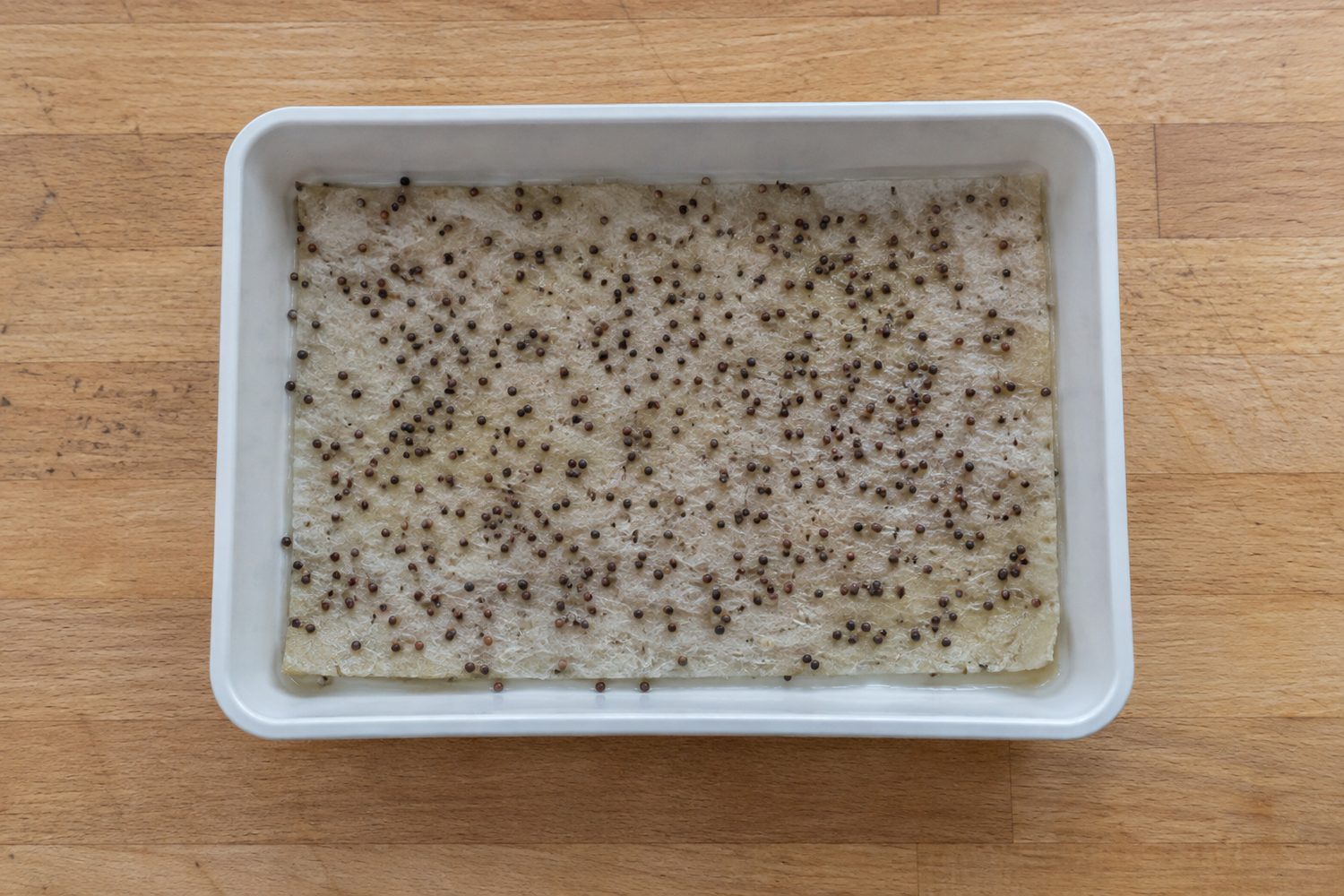
Hamama sells its quilts as refills for its own tray and describes a quilt as "Everything you need to grow microgreens. Just add water!" Its FAQ says the kit "replaces the soil with natural coconut fiber." None of the Hamama pages says generic seed and medium are approved substitutes, and none gives instructions for adapting the tray. Hamama's pages don't forbid it either. If you want to try generic seed in a Hamama tray, run one test tray and write down what you sowed, what you used as a medium and what you harvested before you commit to a year of it.
Back to the Roots' refill is loose seed, not a pod or a pre-seeded mat. It names its Ceramic kit as the tray it refills and says nothing about other trays or media.
True Leaf Market's self-watering trays already use ordinary medium, either micro mat confetti or compressed soil discs, and the maker does not say its trays require branded seed.
Building a generic refill: seed cost per tray
The generic path means buying seed by the bag and pricing out each tray yourself. The seeding rates below come from Utah State University Extension, per 1020 tray (a standard tray about 10 by 20 inches). The prices are True Leaf Market's on September 26, 2026. Virginia Tech Extension cautions that density has to be tested for your own tray, medium and cultivar, so use these rates as a starting point and adjust after your first crop.
The arithmetic is the same for every crop. A pound is 453.6 g, so:
seed cost per tray = (bag price ÷ pounds in the bag) × (grams per tray ÷ 453.6)
For radish at 42 g a tray from True Leaf's 1 lb bag of Red Arrow at $14.60, that is $14.60 × (42 ÷ 453.6) = $1.35 a tray. From the 5 lb bag at $40.80 it is $8.16 a pound × 0.0926 = $0.76 a tray, and from the 25 lb bag at $153.97 it is $6.16 a pound × 0.0926 = $0.57 a tray.
Hover or tap a row to highlight it.
| Crop (USU rate per 1020 tray) | 1 lb bag | 5 lb bag | 25 lb bag |
|---|---|---|---|
| Radish, Red Arrow (42 g) | $14.60, $1.35/tray | $40.80, $0.76/tray | $153.97, $0.57/tray |
| Broccoli mix (28 g) | $21.46, $1.32/tray | $69.26, $0.86/tray | $265.26, $0.65/tray |
| Sunflower, organic (48 g) | $16.73, $1.77/tray | $47.71, $1.01/tray | $214.46, $0.91/tray |
| Pea (150 g, 6-hour presoak) | $8.90, $2.94/tray | $19.60, $1.30/tray | $64.87, $0.86/tray |
Two things fall out of this table. Pea is the cheapest seed by the pound but uses the most seed, 150 g a tray, so it ends up among the more expensive crops per tray; its 1 oz and 4 oz packs don't even hold one tray's worth. And bag size matters more than crop choice: a 5 lb bag of radish holds about 54 trays at 42 g, which is a year of one tray a week. A 1 lb bag holds about 10.
Utah State prints its own broccoli figure as $1.12 a tray at $19.58 a pound, priced at its 5 lb rate as of January 8, 2026. Recomputed from those inputs, 28 g at $19.58 a pound is $1.21, so work from the rate and your own bag price rather than the printed per-tray figure.
If you want more on bag sizes and suppliers, the bulk microgreen seeds breakdown goes crop by crop.
Growing medium cost per tray
Seed is only part of the refill. A Hamama quilt includes its coconut fiber pad; generic seed needs something to grow in. Two dated prices:
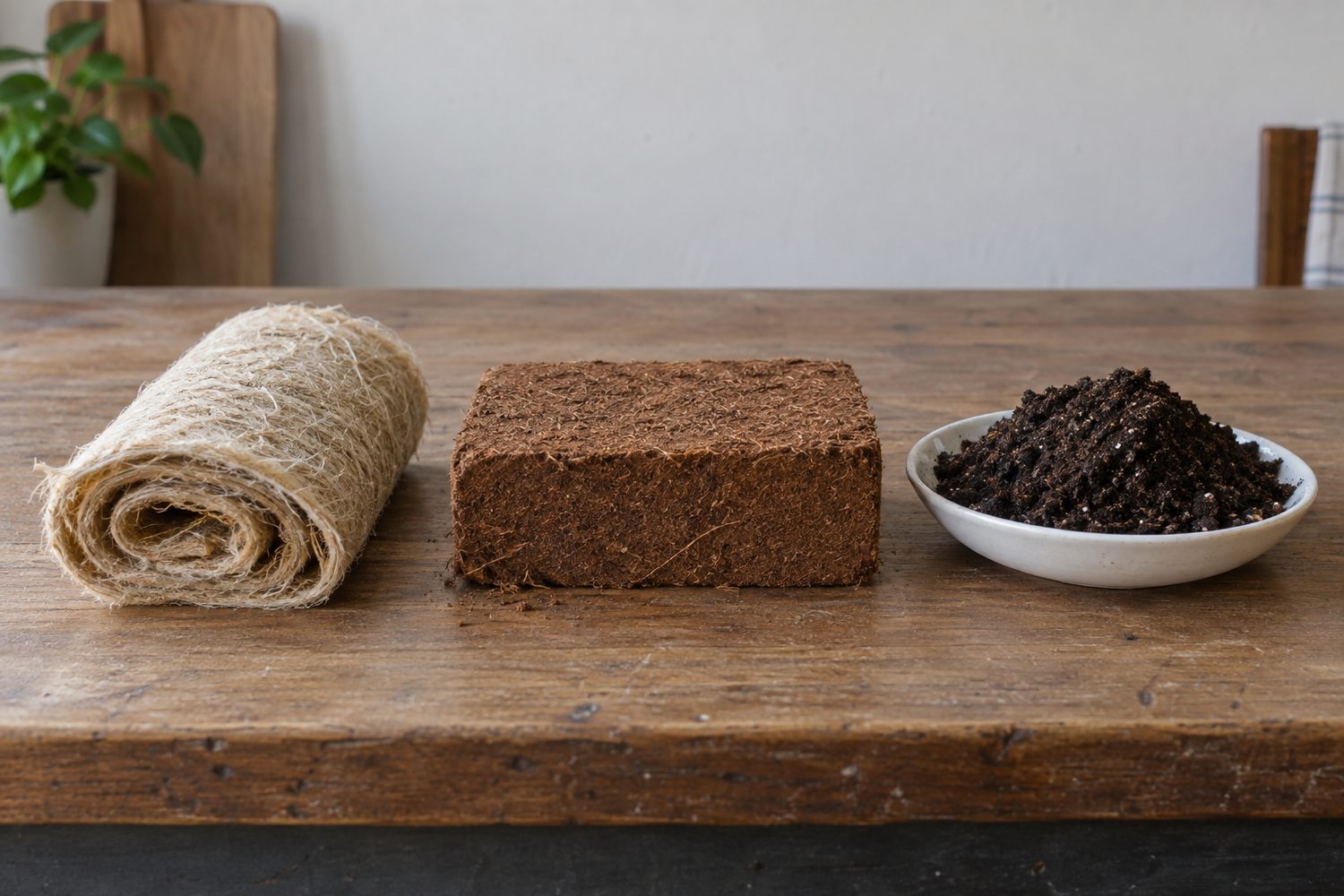
- Hemp mats. Bootstrap Farmer listed pre-cut 1020 hemp grow mats at $28.99 for 10 and $240.99 for 140. At one mat a tray, that is $2.90 a tray from the 10-pack or $1.72 a tray from the 140-pack.
- Compressed coir. True Leaf Market's Minute Soil coir was $10.38 for a 14 oz roll that it says expands to about 6 to 8 quarts. Utah State says to add 2 quarts of coir to a 1020 tray, so one roll covers about 3 to 4 trays, or roughly $2.60 to $3.46 a tray. Both the expansion and the fill are approximate, so measure what one roll actually does in your tray.
Notice that the medium often costs more than the seed, whether you use grow mats or coco coir. On a 10-pack of hemp mats, the mat is $2.90 and a 5 lb bag's worth of radish is $0.76. If you want to cut that part of the bill, the pages on choosing a soil or medium and reusing medium and trays cover what can be stretched and what can't.
A generic tray, added up
Put seed and medium together and you have the generic equivalent of a refill. These totals are computed from unrounded figures, which is why a couple of them differ by a cent from adding the rounded numbers above.
Hover or tap a row to highlight it.
| Generic tray | Seed | Medium | Per tray |
|---|---|---|---|
| Radish, 1 lb bag, hemp mat 10-pack | $1.35 | $2.90 | $4.25 |
| Radish, 1 lb bag, Minute Soil coir | $1.35 | $2.60 to $3.46 | $3.95 to $4.81 |
| Radish, 5 lb bag, hemp mat 10-pack | $0.76 | $2.90 | $3.65 |
| Broccoli, 5 lb bag, hemp mat 10-pack | $0.86 | $2.90 | $3.75 |
| Sunflower, 5 lb bag, hemp mat 10-pack | $1.01 | $2.90 | $3.91 |
| Pea, 5 lb bag, hemp mat 10-pack | $1.30 | $2.90 | $4.20 |
| Radish, 25 lb bag, hemp mat 140-pack | $0.57 | $1.72 | $2.29 |
These are before shipping, water, electricity and any tray that fails. The cheapest line also asks the most of you up front: $153.97 for the seed and $240.99 for the mats, about $395 before your first tray, for enough seed for roughly 270 trays and mats for 140.
One tray a week: the weekly and yearly cost side by side
Here is the comparison at one tray every week, 52 trays a year.
Hover or tap a row to highlight it.
| Path | Per week | Per year (52 trays) |
|---|---|---|
| Hamama, 3-packs | $7.33 | $381.16 |
| Hamama, 9-packs | $6.56 | $341.12 |
| Hamama, subscription rate | $5.67 | $294.84 |
| Hamama, 18-packs | $5.50 | $286.00 |
| Hamama, 36-packs | $4.69 | $243.88 |
| Generic radish, 1 lb bag, hemp mat 10-pack | $4.25 | $221.05 |
| Generic radish, 5 lb bag, hemp mat 10-pack | $3.65 | $190.03 |
| Generic radish, 25 lb bag, hemp mat 140-pack | $2.29 | $119.17 |
Two practical wrinkles. The subscription ships 3 quilts a month, which is 36 a year, so a tray every week means topping up with packs; the $294.84 line is simply the subscription's per-quilt rate times 52. And packs come in whole numbers. In practice 52 quilts from 36-packs means buying two packs for $338 and carrying the leftovers into the next year, or pairing a 36-pack with an 18-pack for $268 and 54 quilts.
Back to the Roots doesn't fit neatly into this table. At $1.25 of seed a grow, 52 grows would be $65 of seed, but the page doesn't state the grow size, the yield or what medium you add, so you can't compare it to a 1020 tray until you know what one grow produces in your kit.
Why cost per tray is not the whole answer
A Hamama tray and a 1020 tray are different sizes, so "per tray" compares different amounts of food. Hamama claims about 3.5 oz a quilt. No measured home yield for a 1020 tray has been published, and the NASA crop tests that report seed and harvest weights did it per hydroponic trough, a 5.52 x 28 inch channel in a controlled growth chamber, not per tray, so those figures don't transfer to your kitchen.
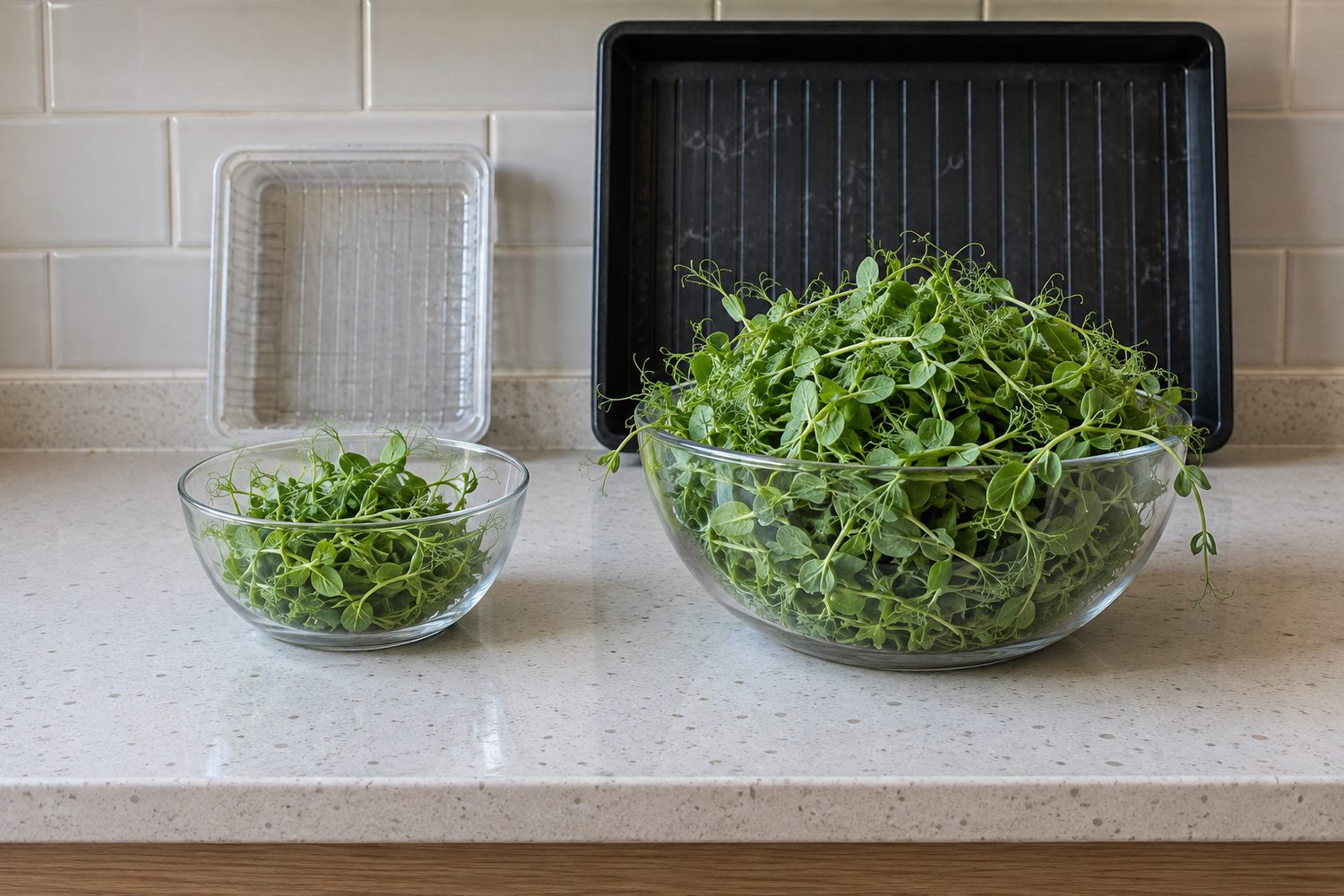
The way to settle it is to weigh. Put each harvest on a kitchen scale and divide what you spent on that tray by the ounces you cut. Do that for one quilt and one generic tray and you will have the only cost-per-ounce figure that matters, which is yours.
The same goes for how many trays you actually need. There is no USDA serving size for microgreens, and no established one elsewhere; the microgreens serving size and cost page works from a 2.5 g garnish. Start with one tray a week, note how much you actually eat before it goes limp, and scale from there.
Adding electricity
If your kit sits on a windowsill, electricity is zero. If it runs under a grow light, the cost depends on the light, the hours and how many trays share it:
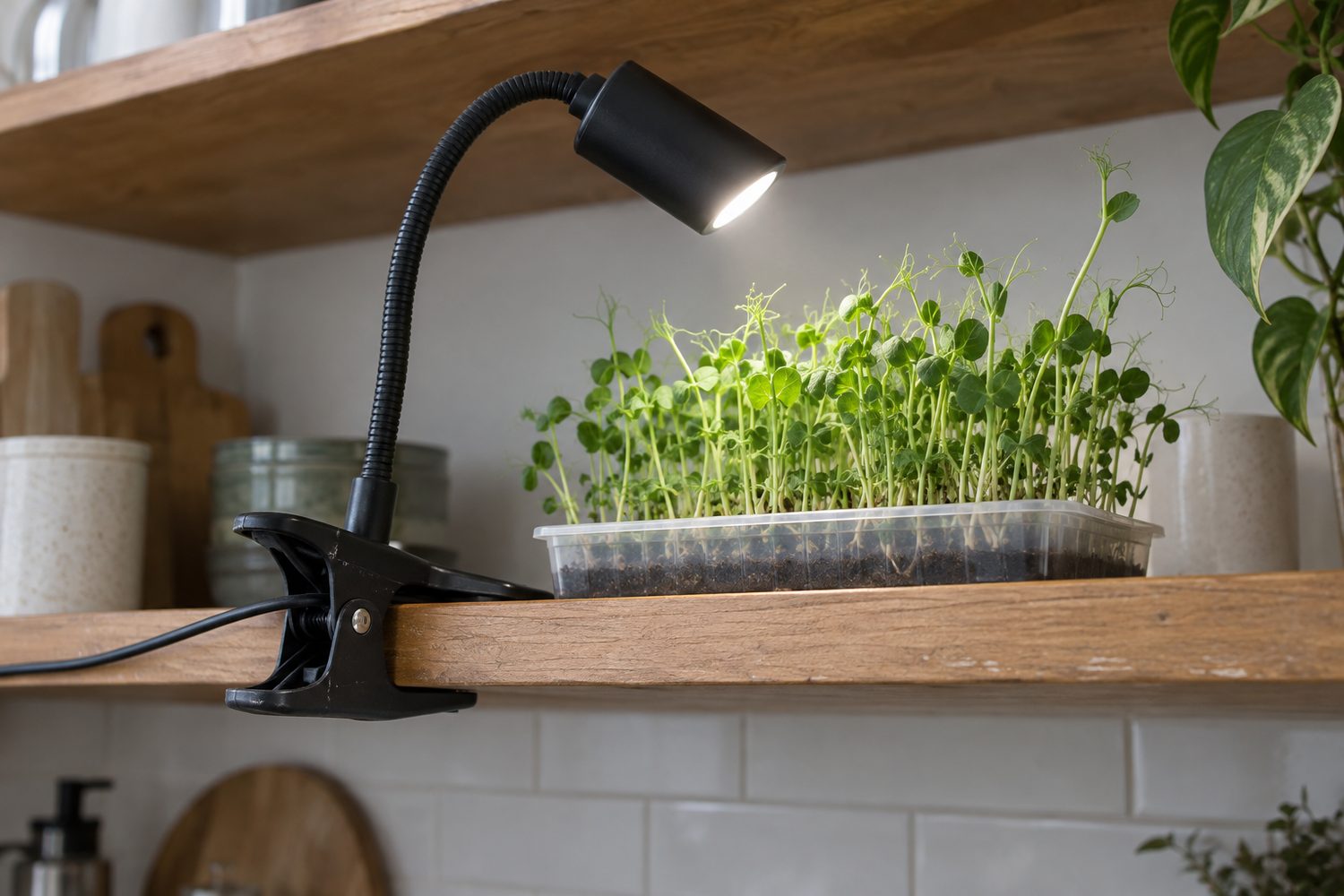
cost per tray = light watts ÷ 1,000 × hours the light runs × your $/kWh ÷ trays under the light
The U.S. residential average was 18.19 cents per kWh year to date through July 2026, according to the EIA's Electric Power Monthly Table 5.6.B, with states ranging from 12.36 cents in North Dakota to 46.28 cents in Hawaii. Read the wattage off your light's label, use the rate on your own bill, and count the hours from sowing to harvest. Running two trays under one light halves the per-tray share.
So, which path should you take?
If you like the kit and grow a tray now and then, Hamama's 36-pack at $4.69 a quilt is the cheapest way to stay with it, and the subscription is fine if free shipping and a steady supply matter more than the last dollar. If you are going to grow a tray every week for a year, the generic path costs less, from about $2.29 to $4.25 a tray, and a single 5 lb bag of radish covers the year. The catch is that you supply the setup, the medium and the trial and error, and for a Hamama tray you are going beyond what the maker describes.
For a closer look at whether a kit or your own setup suits you, see grow kits against DIY, and if you are still choosing a kit, the best microgreen growing kits review compares what each one includes.
FAQ
Is the Hamama subscription the cheapest way to buy Seed Quilts? No. The subscription works out to $5.67 a quilt, while the 36-pack is $4.69 and the 18-pack is $5.50. The subscription does include free shipping and a discount of 10% or more on refills, so compare it against the pack price plus shipping to your address.
How long does a 5 lb bag of radish seed last? At Utah State's 42 g per 1020 tray, a 5 lb bag holds about 54 trays, which is a year of one tray a week. A 1 lb bag holds about 10 trays.
Why does the growing medium cost more than the seed? Radish seed from a 5 lb bag runs $0.76 a tray, while a hemp mat from a 10-pack is $2.90. The 140-pack brings mats down to $1.72, and coir runs about $2.60 to $3.46 a tray at 2 quarts.
Does the Back to the Roots refill include soil? No. The Mighty Mix refill is seed only, and the page lists no medium and no pack weight. It is sized for 8 grows of the Back to the Roots Ceramic kit, at $1.25 of seed per grow.
What should I track to know my real cost per tray? Write down what you paid for the seed and medium used, what you harvested in ounces, and any tray that failed. Divide the spend by the ounces, and add electricity if you use a light. After a few trays you will have your own cost per ounce for each path.
Sources
Prices, stock and specifications are as the linked pages showed them on 2026-09-26.
Keep reading
The journal
The Cheapest Microgreens to Grow, Tray by Tray
Find the cheapest microgreens to grow by seed cost per tray and per ounce of harvest, plus how small a share seed is of the full cost of a tray.
Read The Cheapest Microgreens to Grow, Tray by TrayThe journal
Best Microgreen Seed Suppliers for Every Grower Scale
Find the best microgreen seed suppliers for your crops by weighing germination, organic certification, pathogen testing, pack sizes, and shipping costs.
Read Best Microgreen Seed Suppliers for Every Grower ScaleThe journal
Bulk Microgreen Seeds: Cost Per Tray by Bag Size
Buying bulk microgreen seeds cuts cost per tray, but only if the bag gets used fast enough. Compare 5 and 25 pound prices, shipping, and weekly tray needs.
Read Bulk Microgreen Seeds: Cost Per Tray by Bag SizeGrowing guides
How to buy microgreen seed, and what the label cannot tell you
Pathogen testing of microgreen seed is a supplier practice, not a rule, food grade is not a certification, and organic makes no measured difference to the microbes. What matters is a traceable, explicitly untreated lot, and the six ways a seed search goes wrong.
Read How to buy microgreen seed, and what the label cannot tell you