Microgreen Grow Kits Against DIY: The Cheapest Kit Is the Most Expensive
Cal HewittPublished Checked
- comparison
- kits
- buying
- growing
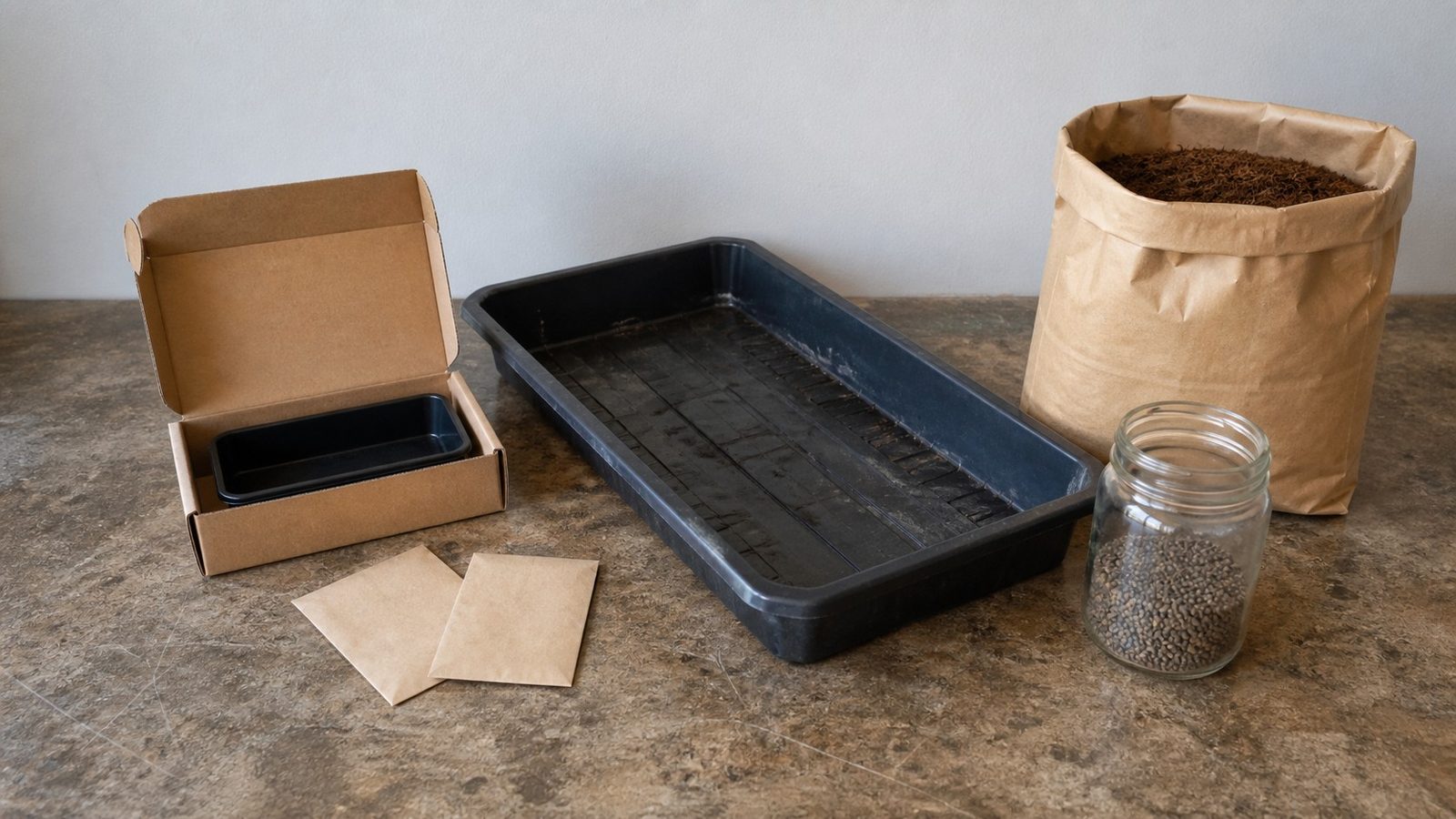
Kits are sold by the box and used by the square inch, and those two things rank them in almost opposite orders.
The $20 kit and the $60 kit are not the same purchase at different sizes. They are different amounts of growing area, and once you divide by that, the bargain and the splurge swap places.
What to actually do
- Divide the price by the growing area before you compare anything. It reorders the shelf, and it is the whole finding of this page.
- If you want a kit, buy the one with the most tray, not the one with the smallest number on the box.
- Treat a kit as tuition rather than as a cheaper way to eat. Six to forty times DIY buys you pre-measured seed and no decisions, which is genuinely useful once.
- Check the refill price before you buy the kit. Half the sample does not publish one, and the subscription economics are the only ones that beat a shop.
- Do not compare a 3.5 oz quilt to a 1020. Convert to area first, exactly as the table below does.
- Assume you will need a light unless the kit includes one and you have a genuinely bright window. Only one of six does.
- After the first kit, buy 1020 trays, coco coir and seed. The DIY baseline is under $10 a tray excluding light, and the cost ladder shows where that stops saving you money.
The inversion
A 1020 tray is nominally 200 square inches, which is the standard the trade works in; the inside floor of a Bootstrap Farmer shallow 1020 is about 187 square inches, and its mesh tray about 174. Most kits are much smaller than that, and the smallest are a fraction of it.
Hover or tap a row to highlight it.
| Kit | Sticker | Growing area | As a share of a 1020 | Per 1020-equivalent |
|---|---|---|---|---|
| Barefoot grow kit | $60.00 | two 1010 trays, 200 sq in | 1.00 | $60.00 |
| Great Northern starter | $22.00 | 9 by 6.75 in, 60.75 sq in | 0.30 | $72.43 |
| Hamama starter | $35.00 | 12.5 by 6.5 in, 81.25 sq in | 0.41 | $86.15 |
| Ono starter | $20.00 | 5 by 5 in, 25 sq in | 0.13 | $160.00 |
| microGREEN FX Standard | $30.00 | 5 by 5 in, 25 sq in | 0.13 | $240.00 |
| microGREEN FX Deluxe | $49.99 | 5 by 5 in, 25 sq in | 0.13 | $399.92 |
Read the first and last columns together. The cheapest kit on the shelf, at $20, works out at $160 per 1020-equivalent. The dearest, at $60, works out at $60. The most expensive kit is 2.7 times cheaper per unit of growing area than the cheapest one.
A 5 by 5 inch tray is one eighth of a 1020. Three of the six kits sampled are built on one, and all three sit at the expensive end once that is accounted for.
Against assembling it yourself
The DIY baseline: two 1020 trays cost $5.78, medium is $1.04 to $1.30 a tray, seed is $0.39 to $2.01 a tray, and everything except a light comes to under $10 for a tray.
Hover or tap a row to highlight it.
| Kit | Multiple of DIY |
|---|---|
| Barefoot grow kit | 6.0x |
| Great Northern starter | 7.2x |
| Hamama starter | 8.6x |
| Ono starter | 16.0x |
| microGREEN FX Standard | 24.0x |
| microGREEN FX Deluxe | 40.0x |
Six to forty times. And the DIY baseline excludes a light, as five of the six kits also do.
That is not automatically an argument against kits, which is the next section. It is an argument against reading the sticker price as the comparison.
What the premium actually buys, and it is real
Two things, and neither is nothing.
Pre-measured seed. Every kit sampled supplies seed portioned for its tray. Getting that right yourself needs a scale that can actually weigh it, and the crops that need the least seed are exactly the ones a kitchen scale cannot. A kit removes that problem entirely for a beginner.
Sourcing and decisions removed. Tray, medium, seed, depth, timing and cover all arrive matched, with instructions. For a first attempt that is worth something real.
What it does not buy is a light. Only the $49.99 Deluxe in this sample includes one, and its seller frames it for apartments, offices and rooms without a sunny window. Two other sellers say a window or ordinary indirect light will do. Those are seller claims, not measured light trials, and the lighting page covers what hours actually do.
Only one seller publishes a yield, and it can be checked
Of six kits, exactly one publishes a harvest weight: approximately 3.5 oz of fresh greens per seed quilt. The others show a photo, promise a number of crops, or say nothing about weight at all.
That single number can be checked. 3.5 oz from 81.25 square inches is 0.0431 oz per square inch, which scaled to a full 1020 implies 8.62 oz.
The median published tray yield is 7.055 oz. So the one published kit yield implies a rate 22% above that median. That is not impossible and it is on the optimistic side, and it is the only kit claim in the sample that can be tested at all.
It also stops a false comparison: a 3.5 oz countertop harvest is not a tray, and should never be set against a 1020's output as though it were.
The per-ounce arithmetic, where the starter kit loses to the shop
For the one seller that publishes a yield, the cost per ounce can be worked out.
Hover or tap a row to highlight it.
| Route | Arithmetic | Per claimed ounce |
|---|---|---|
| Starter kit, $35 for three quilts | $35 ÷ 10.5 oz | $3.33 |
| One-time quilt refill, from $22 for three | $22 ÷ 10.5 oz | $2.10 |
| Subscription, $17 monthly for three | $17 ÷ 10.5 oz | $1.62 |
| A grocery reference, 2 oz for $6.49 | $3.25 |
The starter kit works out dearer per ounce than the grocery store it is meant to replace. $3.33 against $3.25, on the seller's own claimed yield.
The subscription and the bulk refill packs clearly win. The subscription comes to about half the grocery price, and Hamama's 36-Quilt pack at $169 works out to $1.34 per claimed ounce, below the subscription's $1.62 (kit prices checked September 12, 2026). So, the kit's economics are a recurring-purchase story rather than a starter-box one, which is the opposite of how they are usually sold.
Every figure there rests on a seller's yield claim that no one has independently verified, and the grocery reference is one store on one day for a different crop. It is not like-for-like, and it excludes your time.
One-shot or reusable, which changes everything
Kits differ fundamentally on whether you get a tray or a set of disposals, and the product names do not tell you.
- One seller's kit is six seed packets, six compostable trays, six soil discs and six covers. That is six one-grow sets, not a permanent tray.
- Another's quilts are one-time: the seller says the cut crop does not regrow and to compost the used quilt.
- Others supply a reusable tray plus a stated number of crops: five, or two with a variety claiming up to five because each packet averages about 2.5 harvests.
- One supplies four seed packets and does not publish whether each is a complete crop for its tray, so "four crops" is unestablished.
Ask how many harvests, then what a replacement costs. For three of the six sampled kits, no matching refill price is published at all, which makes the second and third crop uncostable at the point of purchase.
What is still genuinely unknown
- Actual delivered yields for any kit. One seller publishes a claim; nobody has verified it, and the other five publish nothing.
- Whether the pre-measured seed rates are appropriate for the trays they ship with. Most kits publish no seed grams; Honest Seed (10, 10 and 30 gram packs) and the micro farmers (20, 4 and 5 gram portions) are the exceptions.
- Refill prices for half the sample, which makes long-run cost uncomputable at purchase.
- Whether the light claims hold, since window and ambient-light adequacy is asserted by sellers rather than measured.
- Whether one kit's four seed packets are four complete crops. Not published.
- Failure rates for beginners using kits against assembling their own. That is the number that would actually justify the premium, and nobody has measured it.
Terms on this page
Tap a term to see what it means.
1020 tray. The 10 by 20 inch standard tray, treated here as its nominal 200 square inches; the inside floor is closer to 187. The unit that makes kits of different sizes comparable.
Sources
Opened 2026-08-12. Prices are displayed US prices on that date before tax and shipping. Every area conversion, per-1020 figure, per-ounce calculation and DIY multiple is arithmetic performed for this page. Kit contents and yields are seller claims, not independent measurements.
- Kit listings supplying the prices, contents and tray dimensions in the tables: Hamama and its seed quilt listing, the source of the 12.5 by 6.5 inch tray, the approximately 3.5 oz per quilt yield claim, the one-time-harvest and compost instruction, the $22 one-time quilt price and the $17 monthly subscription; microGREEN FX for the $30 Standard and $49.99 Deluxe on a 5 by 5 inch tray, the two included harvests, the sweet-pea packets averaging about 2.5 harvests, the $5 single refill and ten for $30, and the LED framing; Back to the Roots at $39.99 for six seed packets, six compostable trays, six soil discs and six covers; Great Northern at $22 for two 9 by 6.75 inch trays with one doubling as the dome, five pre-measured seed packs and five coco wafers; Barefoot at $60 for two holed and two solid 1010 trays with four seed packets; and Ono at $20 for two solid and one slotted 5 by 5 inch tray, which says "2 or more" grows without stating how many its single coco disk supports.
- WIRED's review of an automated indoor microgreens garden - the $449 direct and $499 marketplace prices and $23 nine-pack seed trays, included as the ceiling of what the word "kit" can mean and a warning against treating all kits as one category.
- A grocery listing - 2 oz for $6.49, or $3.25 an ounce, displayed 2026-08-12 for one pickup store. A local and changeable retailer price, used as the reference the per-ounce table is set against.
Keep reading
The journal
Grow or Buy Microgreens? The Answer Is an Hourly Rate, and It Is $23.60
Seed alone makes home growing look eleven times cheaper. Add medium, power, a failure rate and your own time at $20 an hour and the saving against the cheapest retail is 8 percent.
Read Grow or Buy Microgreens? The Answer Is an Hourly Rate, and It Is $23.60The journal
How to Choose a Hydroponic System for Microgreens
Compare a still-water tray, ebb-and-flow table and NFT channel hydroponic system for microgreens, with setup costs, what each needs and problems to expect.
Read How to Choose a Hydroponic System for MicrogreensThe journal
Microgreens vs Baby Greens: Same Seed, Same Tray, and the Only Difference Is When You Cut
These are harvest stages of one plant, not three foods. USDA and Maryland disagree on where microgreens end, 17 of 61 crops with a published harvest window break the day counts, and the yield result everyone cites is a density experiment.
Read Microgreens vs Baby Greens: Same Seed, Same Tray, and the Only Difference Is When You CutThe journal
What Is a Microgreen? A Young Seedling, Cut Above the Soil at First True Leaf
A young edible seedling, grown densely and cut above its medium at about the first true leaf, usually 1.5 to 3 inches and 7 to 21 days. That cut is what separates it from a sprout.
Read What Is a Microgreen? A Young Seedling, Cut Above the Soil at First True Leaf