What Is a Microgreen? A Young Seedling, Cut Above the Soil at First True Leaf
Cal HewittPublished Updated Checked
- beginner
- evidence
- comparison
- growing
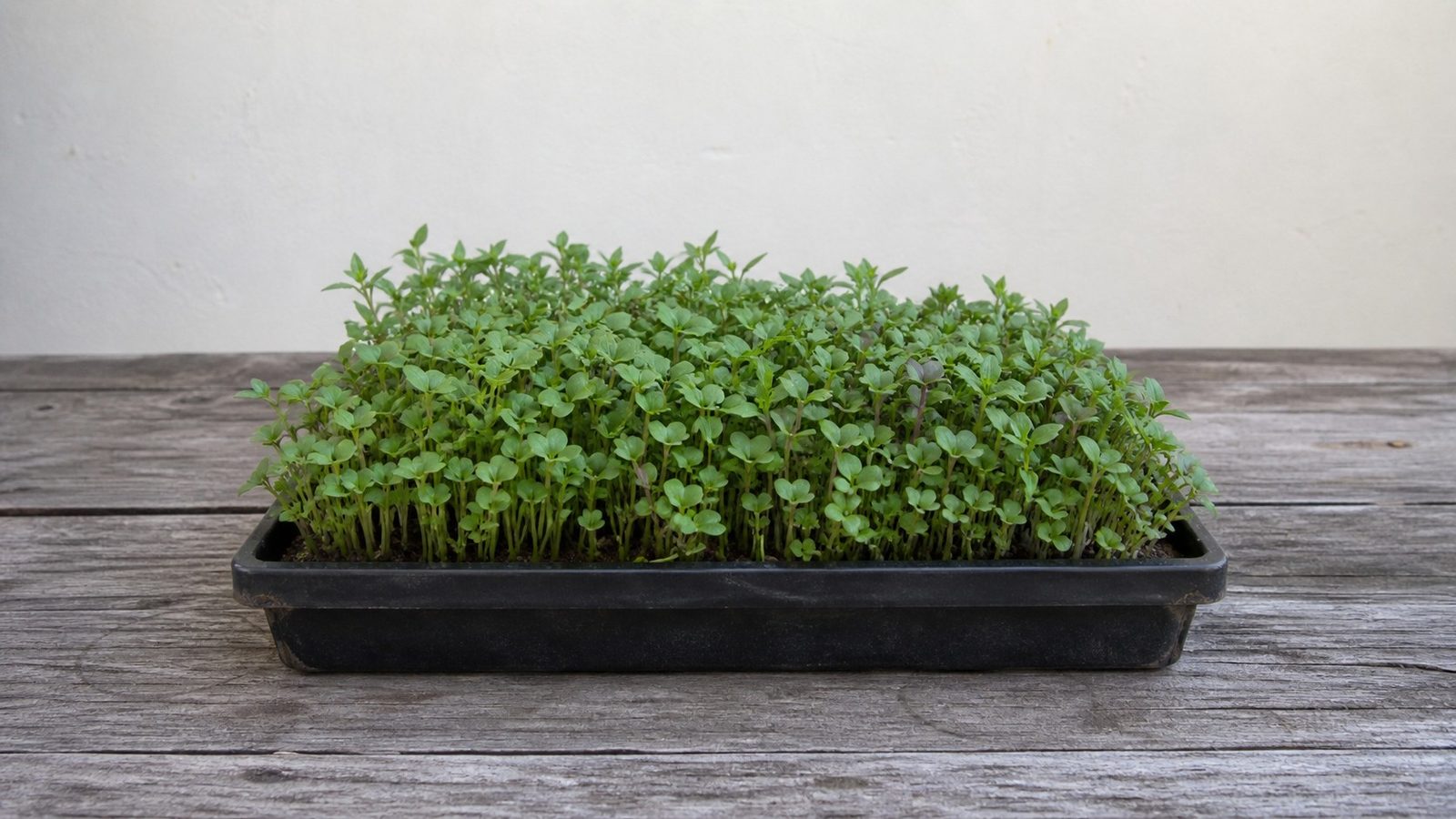
A microgreen is a young edible seedling, grown densely, and cut above its growing medium at about the point its first true leaves appear.
In practice that means a crop 1.5 to 3 inches tall, cut 7 to 21 days after sowing, depending on the species. You eat the stem and the seed leaves. The roots and the seed coat stay in the tray.
That is what every agricultural source agrees on, and it is enough to identify one on sight.
How to tell it from the three things it gets confused with
This is the question underneath the question, because almost nobody arrives here having only met the word microgreen. They have met sprouts, or baby leaves, or pea shoots, and want to know which one is in front of them.
Hover or tap a row to highlight it.
| Harvested | Height | Eaten | |
|---|---|---|---|
| Sprout | before true leaves, at germination | n/a | whole: seed, root and shoot |
| Microgreen | at first true leaf | 1.5 to 3 in | the cut shoot only |
| Baby green | 21 to 40 days, spaced and leafier | 4 to 6 in | mostly the leaf |
| Shoot | later, tip-harvested, 2+ sets of true leaves | taller | the tender tip |
The single line that matters is the cut. A sprout is eaten whole, seed coat and roots included, because it never leaves the jar. A microgreen is grown in a medium and cut above it, so the seed and the roots are left behind. FDA draws the boundary by growth stage, and USDA's audit scope draws the same one operationally: sprouts have no true leaves and are eaten whole; shoots and microgreens have emerged true leaves and exclude the roots and seed teguments.
Baby greens are simply later. Maryland Extension puts microgreens at 2 to 3 inches and 7 to 21 days, and baby greens at 4 to 6 inches and 21 to 40 days, thinned to about 2-inch spacing and sometimes regrowing. There is no moment at which a plant legally becomes a baby green; it has crossed over when it is grown as a spaced leaf crop rather than a dense seedling crop.
Shoots are the loosest word of the four. Washington State describes pea shoots as young tender vine tips, and Purdue names them an exception to its usual 2 to 4 inch harvest, often cut taller with two or more sets of true leaves. A pea or sunflower product cut young at the true-leaf stage fits the microgreen description; a taller pea-tip product is more accurately a pea shoot.
Why the cut is the part worth knowing
Because it decides which federal rule applies to a business. Sprouts fall under the FDA Produce Safety Rule's Subpart M, which carries requirements built around sprout production conditions. Microgreens are covered produce but sit outside Subpart M, unless the actual production and harvest facts make the product a sprout.
There is a real edge case, and FDA wrote about it. A substrate-grown sprout sold root-intact, then cut above the substrate by a commercial recipient, is discussed specifically in the 2023 guidance, which is exactly the kind of product where the label and the rule can part company. The sprout comparison works through what changes on each side of that line.
For a home grower none of this is a compliance problem. It is still the reason to be precise about what you bought, because the safety record either side of the cut is genuinely different.
Where to go from here
Almost every follow-on question is a boundary question, so they are listed that way here.
- Is it a sprout? Microgreens vs sprouts covers the cut, the federal rule and the safety asymmetry.
- Is it a baby green? Microgreens vs baby greens covers the stage line and why the day counts fail.
- Is it worth growing rather than buying? Grow or buy, with why they are expensive behind it.
- Which crop should a beginner start with? Beginner microgreens, and what they taste like before you commit a tray.
- How much should I eat? How much microgreens per day.
- How do I actually grow one? The growing guides, starting with sowing and seed density, which is where most first trays go wrong.
- What is this crop on the bag? The crop directory carries 62 entries, and crop names and aliases explains why the bag rarely tells you the species.
No United States law defines the word
Everything above is a description, not a standard, and it is worth knowing which is which. There is no US statute, regulation or mandatory marketing standard that defines "microgreen".
What is regulated is the boundary, not the word. FDA's 2023 sprout guidance separates the two by growth stage. That is guidance, which explains how FDA thinks, not a legal definition of the noun. USDA's audit scope draws the same line operationally, and that is a scope rule for an audit program, which again defines the boundary rather than the word.
The closest thing to an official American definition is a thesaurus entry. USDA's National Agricultural Library gives a concept definition of vegetable or herb seedlings harvested before true leaves appear. A thesaurus is controlled vocabulary for indexing documents. It is not a standard, and on the substance it says the opposite of what FDA says: cotyledons alone are too early for the prevailing extension and FDA boundary.
One limit on that claim, stated plainly. This is a finding about the United States. It is not evidence that no country anywhere defines the term, which would need a jurisdiction-by-jurisdiction search.
The dictionary and the extension services are not describing the same object
Merriam-Webster defines a microgreen as "a very small, young, and tender edible leaf." Read that literally and a microgreen is a leaf.
Every agricultural source describes a whole cut seedling, stem included, which is the part you actually eat and the part that carries most of the weight in a tray. Iowa State, North Carolina and Maryland all describe a dense young seedling cut above the medium at or near first true leaf. The dictionary is describing the garnish a diner sees. The extensions are describing the crop a grower cuts.
Neither is wrong, and that is the problem. A word doing two jobs this different will not settle an argument, so the way to settle one is to name a stage and a cut point rather than appeal to the term.
The published day and height ranges disagree too, and real crops break them. Only 34 of the 61 crops here that publish a harvest window sit entirely inside the 7 to 21 day range everybody quotes, which is worked out in full in the baby-greens comparison.
The category was measured by the federal government for the first time in 2024
Until recently there was no official count of this crop at all. USDA's National Agricultural Statistics Service added microgreens to the food-crops-under-protection section of the Census of Horticultural Specialties for 2024, so a number now exists.
Read from the primary table on 2026-08-13:
Hover or tap a row to highlight it.
| Item | Reported |
|---|---|
| Operations | 516 |
| Area under protection | 2.924 million square feet |
| Production | 508,132 hundredweight, about 50.8 million pounds |
| Of that, from hydroponic systems | 42,008 hundredweight, 8.3% |
| Total sales | $86.378 million |
| Wholesale sales | $77.070 million, 89.2% |
| Retail sales | $9.309 million, 10.8% |
The average reporting operation is small: about 5,667 square feet under protection and $167,399 of sales.
Two things this number is not. It is not a market size, because the census counted only crops grown and sold in permanent protected structures, and excluded open-field growing, temporary structures and plants bought in for finishing. And it is not a trend, because 2024 is the first year the item was collected. There is nothing to compare it with yet.
It is still the best figure in the category, and it is worth saying why: it comes from a federal statistics agency that does not sell microgreens, seed, trays or courses. Most numbers in circulation do not have that property.
The census's own two headline figures do not reconcile
Divide the reported sales by the reported production and the crop comes out at $1.70 a pound.
That is not a microgreen price. It is not close to one. The cheapest transaction data located anywhere is $12 a pound for conventional microgreens, and the widest seller-stated range runs to $100.00. The census figure is between 7 and 59 times below the prices actually observed.
Before blaming the arithmetic, run it on the neighbors. Every other crop in the same table, computed the same way, lands exactly where a wholesale price should:
Hover or tap a row to highlight it.
| Crop | Per pound |
|---|---|
| Strawberries | $0.69 |
| Cucumbers | $1.39 |
| Tomatoes | $1.45 |
| Microgreens | $1.70 |
| Herbs, cut fresh | $2.01 |
| Eggplant | $2.14 |
| Lettuce, all | $2.87 |
| Spinach | $3.25 |
The method is fine. Microgreens are simply sitting in the middle of a list of ordinary greenhouse vegetables, priced like a cucumber, in a category that retails at ten to fifty times cucumber money.
Put the same tonnage on a per-tray basis and it gets starker. Converted to 1020 trays at the tightest commercial yield band published anywhere, the 29-crop trial's own 5.5 to 15 ounces a tray, 50.8 million pounds is somewhere between 54 million and 148 million trays. That works out at $1.59 down to $0.58 of sales per tray.
A single tray of radish costs $2.01 in seed alone, and broccoli costs $0.79. At the yield most favorable to the census, the reported sales do not cover the reported seed.
What this does not mean. It does not mean the census is wrong, and it does not mean anyone misreported anything. It means the two fields are not measuring what a reader would assume, and there are several innocent explanations: growers reporting weight on a different basis, a handful of very large low-price wholesale operations dominating a total, or the ordinary noise of a brand-new item that respondents had never been asked about before. The census does not say which, and neither will this page. The row is flagged "see text" in the table, and the note behind that flag is the thing to read next.
The practical reading for anyone using this number: cite the sales figure or the operations count, both of which are simply what growers reported. Do not derive a price from it.
The word is younger than the food
Merriam-Webster gives 1998 as the first known use. For a food that now has a federal production line item, that is very recent, and it is worth holding onto when a page tells you what microgreens have "traditionally" been.
Where the category came from is documented as a setting rather than an origin story. The credible account puts it in California restaurant kitchens first and commercial growing in Southern California afterwards. No named inventor, farm or founding event survives checking, and accounts that supply one tend to conflict with the dictionary's own date. The honest version credits the restaurant sector and stops there.
What is documented is the teaching. By 2024 the Associated Press was running microgreens as an ordinary winter kitchen project, and Maryland Extension revised a full home-growing guide in March 2026. That establishes that home growing is public and taught. It does not establish when households took it up, which nobody has measured.
The claim you will meet first, and what it actually is
Nearly every introduction to this food leads with a version of "up to 40 times more nutrients than mature greens."
It traces to a single 2012 study of 25 commercially bought microgreens, comparing measured concentrations against database values for mature leaves. It was not a study of all microgreens, it measured no health outcomes, and it produced a wide spread by crop and by nutrient rather than one multiplier.
Where the 40 times figure came from takes it apart in full, and which microgreen is actually most nutritious is where the per-crop comparisons sit. The short version for a newcomer: the measurements are real, the generalization is not, and no source supports "microgreens" as a single nutritional object.
What nobody has measured
Stated as gaps rather than glossed over, because the honest answer to several beginner questions is that no one knows.
- How often the sprout and microgreen categories are confused in practice. No inspection dataset, label audit or buyer survey counts it.
- What share of the people growing microgreens are households. The census counts commercial protected operations and excludes home trays by design.
- Whether the category is growing. 2024 is a baseline with nothing behind it.
- What the first documented use of the word in 1998 actually was. The dictionary's evidence file is not public.
- Whether the definition has drifted over time. The sources disagree with each other today, which is not the same as changing direction.
Terms on this page
Tap a term to see what it means.
Microgreen. A young edible seedling, grown densely and cut above the growing medium at about first true leaf. A descriptive term rather than a legal one, because no United States law defines it.
Sources
Opened 2026-08-13. The 2024 census figures were read from the primary PDF table rather than from any description of it, and the abbreviation cwt is confirmed as hundredweight on Introduction IX of the same publication. Every figure derived from those numbers is this page's own arithmetic and is labeled as such: the channel shares, the per-pound unit values for all eight crops, the tray conversion, and the per-operation averages. The tray conversion is stated on a 1020 basis using the 29-crop trial's own 5.5 to 15 ounce band, and it is a range rather than a figure because yield is a crop property. The wholesale and retail figures sum to $86.379 million against a stated total of $86.378 million, which is rounding in the source and is left as printed.
- USDA NASS, Table 15, Food Crops Grown Under Protection and Sold: 2024 (PDF) - the microgreens row in full: 516 operations, 2,924 thousand square feet, 508,132 hundredweight of which 42,008 from hydroponic systems, and $86,378 thousand of sales split $77,070 wholesale and $9,309 retail. The row is printed as "Microgreens (see text)". The comparison crops in the unit-value table are the other rows of the same table, read at the same time.
- USDA NASS, 2024 Census of Horticultural Specialties, introductory text (PDF) - the abbreviation list confirming cwt as hundredweight. It does not carry the "see text" note for the microgreens row, which was not located for this page and remains the thing to read next.
- USDA NASS, 2024 Census of Horticultural Specialties questionnaire (PDF) - the inclusion and exclusion rules: food crops grown and sold in permanent protected structures, excluding open field, temporary structures and plants bought in for finishing.
- FDA, guidance for industry on sprouts, 2023 (PDF) - the growth-stage boundary, sprouts harvested before true leaves against microgreens at true-leaf emergence, and the fact that this is guidance rather than a definition. Also the soil-grown, root-intact edge case, and the note that wheatgrass has long been treated as a sprout.
- USDA GAP Program Scope, effective April 2020 (PDF) - the audit-scope treatment: sprouts have no true leaves and are eaten whole, shoots and microgreens have emerged true leaves and exclude roots and seed teguments.
- USDA National Agricultural Library Thesaurus, microgreens - the 2016 concept definition placing harvest before true leaves appear, which is the entry that disagrees with FDA and the extension services.
- Merriam-Webster, microgreen - the definition "a very small, young, and tender edible leaf" and the first known use of 1998. Read in a browser on 2026-08-13 because a direct fetch returned 403.
- University of Maryland Extension, growing microgreens and baby greens indoors - the March 2026 revision, the stage comparison and the home-growing guidance.
- Iowa State Extension, how to grow your own microgreens - first-true-leaf harvest and the distinction from sprouts.
- N.C. Cooperative Extension, what are microgreens - stage, harvest above the medium, and the comparison with baby greens.
- Purdue Extension, grow microgreens at home - the 2 to 4 inch just-emerging-true-leaf harvest, and pea shoots named as an exception harvested taller.
- NASA, harvesting microgreens in microgravity - an independent description of the same stage, true leaves just emerging and the shoot cut.
- Associated Press, January 2024 - home growing treated as an ordinary winter project, with true leaves as the harvest signal.
- The 2012 study behind the "40 times" claim is named here and not quoted from. Where that figure came from carries it with its own sourcing.
- Prices used as comparisons are figures already published elsewhere on this site, not new research: $12 a pound conventional from why microgreens are expensive, the $100.00 upper bound from the buying guide, and the per-tray seed costs from the radish and broccoli entries. The 5.5 to 15 ounce commercial yield band is from what a tray actually yields.
- Opened and not used. Several sources in the research for this page returned 403 responses, bot checks or fetch errors and are recorded as leads rather than citations: Washington State University on pea shoots, the USDA Agricultural Research Service January 2014 magazine that carries the California origin account, NASS Appendix B, the PubMed record for the 2012 study, Penn State Extension, Mississippi State Extension, Quebec's sprout and microgreen safety page, WebMD, and two PMC review articles. Nothing on this page is quoted from any of them, which is why the origin section credits a sector rather than citing a date.
Keep reading
The journal
Microgreens vs Baby Greens: Same Seed, Same Tray, and the Only Difference Is When You Cut
These are harvest stages of one plant, not three foods. USDA and Maryland disagree on where microgreens end, 17 of 61 crops with a published harvest window break the day counts, and the yield result everyone cites is a density experiment.
Read Microgreens vs Baby Greens: Same Seed, Same Tray, and the Only Difference Is When You CutThe journal
Which Microgreens Mold Most and What to Change
Which microgreens mold most, and why. Learn the crops named for mold risk, what causes it, and the sowing and watering changes that reduce it.
Read Which Microgreens Mold Most and What to ChangeThe journal
Grow or Buy Microgreens? The Answer Is an Hourly Rate, and It Is $23.60
Seed alone makes home growing look eleven times cheaper. Add medium, power, a failure rate and your own time at $20 an hour and the saving against the cheapest retail is 8 percent.
Read Grow or Buy Microgreens? The Answer Is an Hourly Rate, and It Is $23.60The journal
How to Choose a Hydroponic System for Microgreens
Compare a still-water tray, ebb-and-flow table and NFT channel hydroponic system for microgreens, with setup costs, what each needs and problems to expect.
Read How to Choose a Hydroponic System for Microgreens