Four Bags Labeled Kale, Two Species and a 227 Percent Price Gap: How Microgreen Seed Actually Gets Named
Cal HewittPublished Checked
- buying
- beginner
- method
- food safety
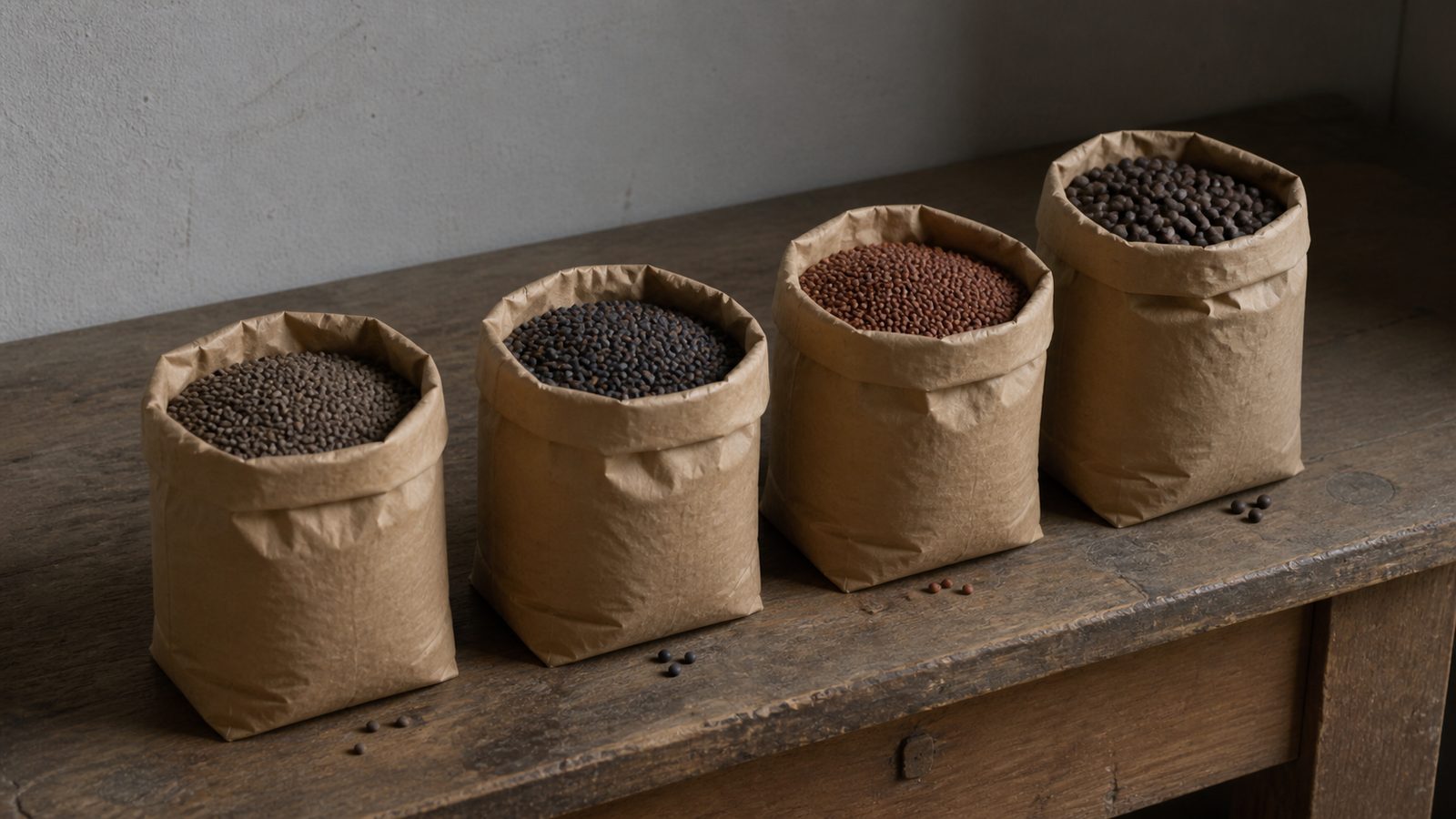
The crop word on the bag is the least precise thing on it, and United States seed law does not require the thing that would fix that.
Here is the case that makes it concrete. On 2026-08-12 one catalog listed four conventional kale microgreen seeds at one pound each:
Hover or tap a row to highlight it.
| Listing | Species on the page | Price per pound |
|---|---|---|
| Toscano | Brassica oleracea | $25.73 |
| Bright Green Curly | Brassica oleracea | $32.65 |
| KX-1 | *Brassica napus* | $74.65 |
| Purple Reign F1 | Brassica oleracea | $84.25 |
The top listing is 227% above the bottom one, and one of the four is a different species from the other three. KX-1 is Brassica napus, the rapeseed species, not Brassica oleracea. All four are sold as kale, because "kale" is a crop word rather than a taxonomic one.
The price spread is not proof the cultivar caused it. Organic status, inventory, seed treatment and contract supply all move a seed price. The buyer-relevant fact is simpler: four bags carrying one crop word had different variety labels, different species fields and a threefold price range.
What to actually do
- Buy on kind plus variety, and ask for the species. The variety is required on the label. The species usually is not, and it is the thing that tells you whether two bags are the same plant.
- Treat a crop word as a category. "Kale" spanned two species and a threefold price range in one catalog on one day. Kale microgreen seed is a shelf, not a product.
- Do not assume two identical cultivar names are identical material. A 14-entry trial found seed companies' "Lacinato" strains are not all the same.
- Ask for the lot number on anything over a pound. It is a required label element at that weight and it is what makes a problem traceable.
- Know that a brand is allowed, and is required to look like a brand. If a word on the bag is doing the job of the kind or variety and is not one, that is the thing to question.
- Check whether your seller prints a binomial at all. Some do as a matter of course and some never do, and neither is breaking a rule.
- Remember the interstate limit. Seed grown, conditioned and traded entirely inside one state is outside the Federal Seed Act, so the label guarantees you are relying on may not apply.
- Use aliases as search terms, not as identity. Peppergrass and curly cress will find you the same crop. They will not tell you which strain arrives.
What the label is legally required to say
For vegetable seed in United States interstate commerce, the binding claims are kind and variety name. USDA's Agricultural Marketing Service stated on 2023-03-06 that there is no exception for vegetable seed. A brand may sit alongside the kind or variety, and it must be clearly identified as a brand rather than dressed up to look like the kind or variety.
What is not required is the botanical binomial. The regulations speak in terms of kind, variety and type. No provision found requires a Latin name on a domestic vegetable-seed packet at all.
What must appear scales with the pack. A vegetable-seed label of one pound or less meeting the germination standard states kind, variety and the interstate shipper's name and address or AMS code. Below-standard seed adds germination, test date and the words "Below Standard". Over one pound it also adds germination, test date and lot number.
And the Federal Seed Act reaches interstate commerce only. Seed grown, conditioned and traded wholly within one state sits outside it.
The enforcement is real where it applies. AMS calls false varietal labeling a serious violation and publishes settlements that include false kind and variety labeling. There is also an adjudicated wrong-variety case on record. So, the crop name is enforceable insofar as it is the required kind and must not be false or misleading. It is not a license to swap a required variety for a slogan.
Species, cultivar and marketing name are three different things
Getting these apart is most of the work.
- Species is the scientific binomial placing the plant in a biological species, for example Brassica oleracea. It answers what plant this is.
- Cultivar is the selected material within that species, differentiated by stated characters and maintained by appropriate propagation, conventionally written in single quotes: Brassica oleracea 'Toscano'.
- Trade designation or marketing name is a selling device. The International Code of Nomenclature for Cultivated Plants says explicitly that a trade designation can market a cultivar, Group or grex in place of or alongside its accepted name.
So "microgreen", "dinosaur", "premium" or a brand can be useful search language and establishes neither species nor cultivar. A translated cultivar epithet used for marketing gets the same treatment: the Code makes it a trade designation, not automatically the accepted name.
A cultivar name is also not automatically a property right. The United States has no mandatory variety-registration system. Once a variety has been traded or sold under a name, that name cannot be changed and cannot be reused for another variety of the same kind. Separate protection exists through Plant Variety Protection, which USDA says runs 20 years, or 25 for vines and trees, plus plant and utility patents. That protects the variety, not ownership of every ordinary word used as a name.
Synonym sets are real, and they are not always one thing
Toscano kale is also called lacinato, Tuscan and dinosaur kale. North Carolina Cooperative Extension says so directly, and the catalog's own category says "Lacinato (also known as Toscano or Dinosaur kale)". That is a genuine synonym set for one seller's named material.
Then the complication that matters. A British Columbia seed trial, run in 2016 and published in 2018, says many seed companies offer heirlooms named "Lacinato" that are not all the same, and its 14-entry trial treated their strains as maintained or selected differently.
So, the synonym set holds within a seller and does not hold across sellers. Two bags both reading "Lacinato" can be different maintained strains. Ask for the cultivar designation, the seed-lot record, and whether the seller means an exact maintained cultivar, a type, or a marketing synonym, before treating two listings as the same thing.
Cress runs the same way in the other direction. One seller's listing sells "Curly Cress (Garden Cress)" and reports regional names including garden pepper cress, pepper grass, pepperwort and poor man's pepper. That is direct evidence one seller markets those aliases. It is not taxonomic proof, and a different seller's page identifies cress as Lepidium sativum, which is a cross-reference rather than a guarantee that every listing reading "cress" is that species.
Whether the species appears at all is a seller-by-seller choice
Practice differs sharply, and this is checkable rather than assumed.
- The catalog with the four kale listings prints a Latin Name field on its product pages.
- A large competitor's broccoli microgreen seed mix page gives the crop, claims and growth information and no botanical-name field at all.
- The cress listing above **does not print Lepidium sativum**.
None of those is a violation, because no rule found requires a binomial. What share of United States packets carry one has never been measured, and settling it would take a regulator's nationwide packet audit.
Where to find the species name instead
Every crop entry here carries the botanical name a packet is not required to print, alongside the names that crop is actually sold under.
Hover or tap a row to highlight it.
| Field | Coverage |
|---|---|
| Publishes a botanical name | 62 of 62 |
| Publishes a list of names it is sold under | 62 of 62 |
| Total trade names recorded | 234 |
| Distinct trade names | 234, no name reused across two crops |
| Mean names per crop | 3.8 |
| Most on one crop | 6, garden cress, including peppergrass and curly cress |
| Botanical families represented | 15, of which Brassicaceae is 18 crops |
Two species carry more than one entry, which is the same-word problem in miniature: Beta vulgaris appears as both beet and Bull's Blood beet, and Brassica oleracea var. capitata as both green cabbage and red cabbage. They are kept apart rather than merged, because a buyer choosing between them is choosing between different material.
That 234 names map onto 62 crops with no name reused is a property of a curated list rather than of the market. The market is ambiguous, so check the binomial instead of the crop word.
Garden cress carrying six names is the clearest single case, and it is the same crop that finished last or near last in two of the three consumer taste panels. A buyer who dislikes it under one name can buy it again under another.
What nobody has measured
- What share of United States seed packets print a botanical name. This needs a regulator's nationwide packet audit, and until then every statement about it is an impression.
- How often two bags carrying one cultivar name contain materially different strains. One trial found it for one kale name.
- Whether the species field changes what buyers pick. No study tests it.
- How much of a same-crop price spread is cultivar rather than organic status, inventory, treatment or contract supply. The four listings above cannot separate them.
- How often microgreen buyers receive a different variety than ordered. There is an adjudicated case and no rate.
Terms on this page
Tap a term to see what it means.
Kind. The crop-level name required on a vegetable seed label in interstate commerce, for example kale. It is enforceable and it is not a species.
Sources
Opened 2026-08-12. The naming counts across all 62 variety entries are this site's own, read from the botanical, botanicalFamily and soldAs fields. Prices are a single-date snapshot from one catalog and are not a price history; the 227% figure is computed from the two displayed per-pound prices on that date.
- USDA AMS, varietal labeling requirements under the Federal Seed Act - the 2023-03-06 statement that kind and variety name are required with no exception for vegetable seed, that a brand may accompany them but must be clearly identified as a brand, and that false varietal labeling is a serious violation.
- 7 CFR Part 201, current - the Federal Seed Act regulations, framed in terms of kind, variety and type rather than a mandatory botanical binomial, and reaching interstate commerce rather than seed grown, conditioned and traded wholly within one state.
- USDA AMS, seed company records and the Federal Seed Act (PDF) - the September 2017 guide setting out what a label must carry at one pound or less against over one pound, including germination, test date, lot number and the "Below Standard" wording.
- USDA AMS, Federal Seed Act settlements (PDF) - published settlement examples including false kind and variety labeling.
- Agricultural Services Association v. Ferry-Morse - an adjudicated wrong-variety case.
- USDA AMS, variety name clearance and AMS variety naming guidelines - no mandatory United States variety-registration system, and the rule that once a variety has been traded or sold under a name that name cannot be changed or reused for another variety of the same kind.
- USDA Plant Variety Protection Office - certificates protecting qualifying new varieties for 20 years, or 25 for vines and trees, with rights to exclude marketing and sale and to manage certain breeding uses.
- International Code of Nomenclature for Cultivated Plants, ninth edition (PDF) - the cultivar definition, the convention of single quotation marks, and the explicit statement that a trade designation can market a cultivar, Group or grex in place of or alongside its accepted name, including a translated epithet used for marketing.
- NC State Extension, the nomenclature of horticultural plants - the species, cultivar and trade-designation hierarchy in plain terms.
- North Carolina Cooperative Extension, growing kale from seed - 'Toscano' kale also called lacinato, Tuscan and dinosaur kale, and described as coming from Italy.
- BC Seed Trials, Lacinato kale variety trial 2016 brief - the statement that many seed companies offer heirlooms named Lacinato that are not all the same, across a 14-entry trial treating their strains as maintained or selected differently.
- NRCS seed tag guide (PDF) - what a seed label and lot record actually contain.
- Practice, one catalog's listings snapshotted 2026-08-12 and used only as dated observations of what was offered: Toscano at $25.73, Bright Green Curly at $32.65, KX-1 at $74.65 and carrying B. napus rather than B. oleracea, and Purple Reign F1 at $84.25, plus its Lacinato category page giving the synonym set and its microgreen vegetable catalog as the naming universe audited.
- Practice, other sellers opened 2026-08-12 as records of what is printed: Mumm's Curly Cress and Garden Cress, listing garden pepper cress, pepper grass, pepperwort and poor man's pepper as regional names and not printing Lepidium sativum; True Leaf Market's broccoli microgreens seed mix, which gives crop, claims and growth information and no botanical-name field; and West Coast Seeds, which identifies cress as Lepidium sativum as a cross-reference.
Keep reading
Growing guides
Growing microgreens in a small space: what fits, and what a jar actually gives you
A windowsill and a shallow tray will grow microgreens; a rinsed jar grows something else. Jars produce sprouts, eaten whole, which FDA treats as a distinct risk category, so the method decides what you end up with.
Read Growing microgreens in a small space: what fits, and what a jar actually gives youGrowing guides
Microgreens with kids: the crops that finish inside a two-week unit, and covering the weekend
Pick from the 5 crops that reliably finish inside a two-week unit, and plan for the weekend, because every published protocol assumes daily care and a school week is five days in seven.
Read Microgreens with kids: the crops that finish inside a two-week unit, and covering the weekendThe journal
Which Microgreens Should a Beginner Grow? Start With Broccoli, Radish or Mustard
Nearly every beginner list names radish, pea and sunflower. Pea and sunflower are the only two of that set not rated beginner: both carry high mold risk, both need a soak, and both sow at six times the median seed rate.
Read Which Microgreens Should a Beginner Grow? Start With Broccoli, Radish or MustardThe journal
Microgreens vs Sprouts: The Difference Is a Cut, Not a Nutrient, and It Decides Which Federal Rule Applies
A sprout is eaten whole, a microgreen is cut above its roots, and that cut decides whether FDA's sprout rule applies. The nutrition claim used to rank them was measured on mature vegetables.
Read Microgreens vs Sprouts: The Difference Is a Cut, Not a Nutrient, and It Decides Which Federal Rule Applies