Best Tasting Microgreens: 233 Consumers Ranked Them, and Bull's Blood Beet Won
Cal HewittPublished Checked
- comparison
- buying
- beginner
- nutrition
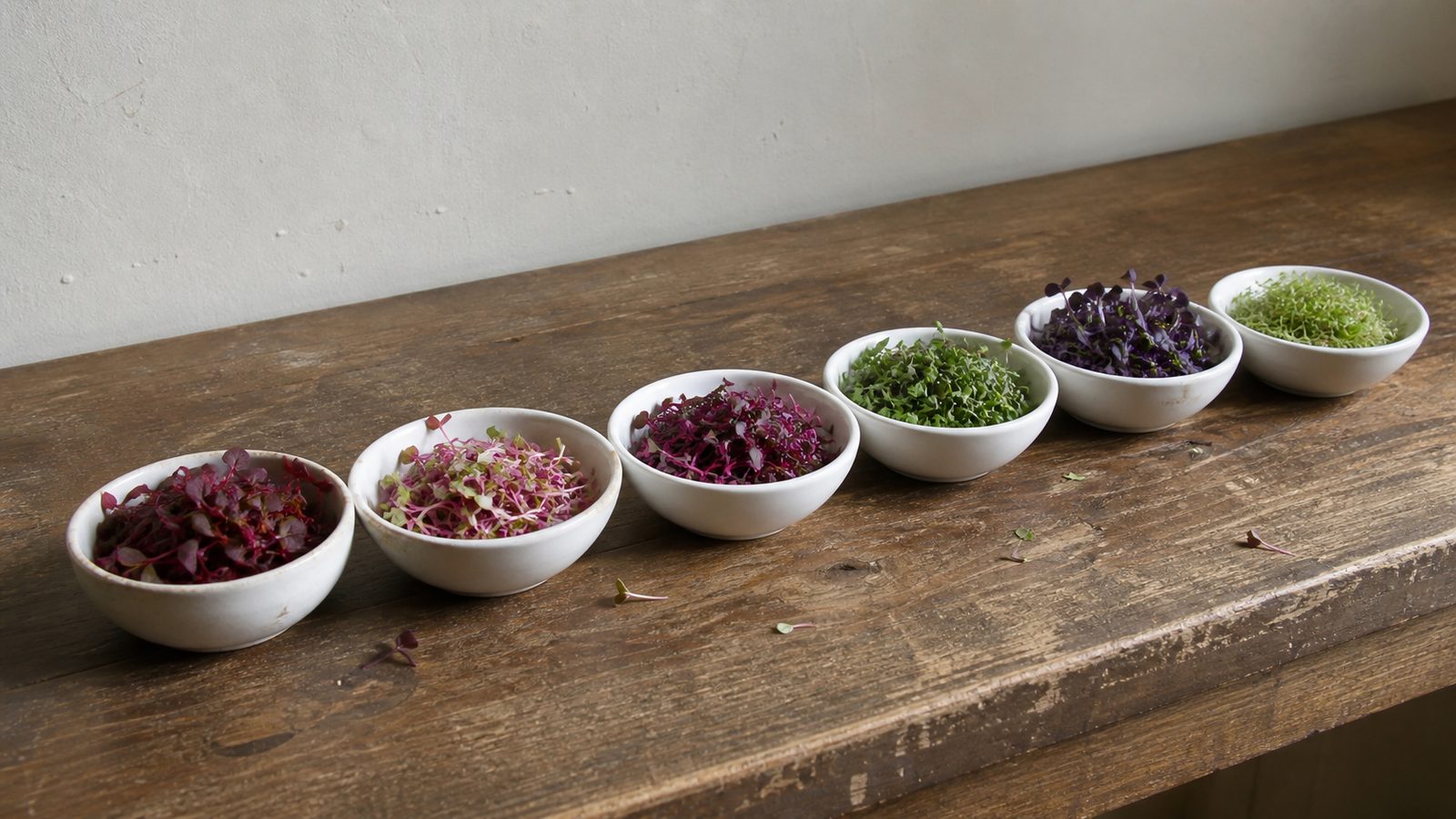
If you want the crops that actually won a taste test, start with the mild ones: Bull's Blood beet, pea shoots and Swiss chard. On this question the research is better than the coverage, and the two disagree.
Preference has been measured. Three consumer panels, 233 people between them, have tasted named microgreen crops under a stated protocol and published the scores. The best-tasting lists you will find cite none of them.
What the panels do not support is a universal top ten. What they do support is something more useful, and all three found it independently: lower bitterness, astringency, sourness and heat raise average acceptance, and flavor and texture matter more than appearance once people actually taste the product.
What to actually do
- Choose by the role, not by a ranking. A mild handful green, crunchy bulk, or a potent seasoning are three different jobs, and no panel ranked crops across them.
- If you want the crops that actually won, start with the mild ones. Bull's Blood beet seed topped the only 0-to-100 consumer ranking published, and pea shoots and Swiss chard led the other two panels.
- Treat a best-tasting list as editorial until it names a panel. Not one of the three audited pages does, and the crop all three agree on placed fourth of six.
- Expect arugula and cress to divide people. Both finished last in a panel, on bitterness, astringency, sourness and heat. That is a reason to sample before committing a tray, not a reason to avoid them.
- Ignore sugar content entirely when choosing for sweetness. The highest-sugar crop tasted the least sweet, and the correlation was not significant.
- Buy fresh and local where you can. The one thing a 150-person blind test did find was that local-farm broccoli beat grocery samples on taste and liking, though it could not say why.
- Sample a small amount first. Every panel here is an average, and the panels themselves disagree about which crops sit in the middle.
- For what each crop actually tastes like rather than which is preferred, see the flavor page.
What was actually measured
Hover or tap a row to highlight it.
| Study | Consumers | Crops | Top | Bottom |
|---|---|---|---|---|
| USDA-ARS and Maryland, February 2013 | 80 | 6 | Bull's Blood beet, 76.5/100 overall eating quality | Peppercress, 39.7/100 |
| Colorado, published 2020 | 99 | 6 | Tendril pea, 7.9/9 overall | Arugula, 6.0/9 overall |
| Naples, published 2020 | 54 | 12 | Swiss chard and coriander, most appreciated | Mibuna and cress, least accepted |
The USDA-ARS work is the oldest and most detailed. An experienced eight-member descriptive panel first characterized 25 commercial varieties in 2012, building a sensory vocabulary and sorting them into mustard, herbal, vegetable, mild and peppery or radish groups. That was description, not liking. The 80-consumer liking test came in February 2013 and covered six crops on 0 to 100 scales.
Its full order was: Bull's Blood beet 76.5, red amaranth 63.1, Dijon mustard 61.0, China Rose radish 53.7, Opal basil 49.0, peppercress 39.7. Only beet was significantly above peppercress. The middle four did not differ significantly from each other, which means the 63.1 against 53.7 gap is not a result you can rank on.
The 99-consumer study adds a second partial ranking: tendril pea highest at 7.8/9 for flavor and 7.9/9 overall, arugula lowest at 5.8 and 6.0. All six crops were at least slightly acceptable, which is worth saying plainly: nothing tested was rejected.
The web lists and the panels do not agree
Three best-tasting pages, counting only their explicit recommendations:
Hover or tap a row to highlight it.
| Crop | Best-tasting pages | What a consumer panel found |
|---|---|---|
| Radish | 3 of 3 | China Rose radish placed 4th of 6, 53.7/100, heat 67.2/100 |
| Pea | 2 of 3 | Tendril pea placed 1st of 6 in the 99-consumer study |
| Basil | 2 of 3 | Opal basil placed 5th of 6, 49.0/100 |
| Arugula | 2 of 3 | Lowest of 6 in the 99-consumer study |
| Mustard | 2 of 3 | Dijon mustard placed 3rd of 6, 61.0, heat 86.2/100 |
| Sunflower | 2 of 3 | Not tested in any of the three panels |
| Cilantro | 1 of 3 | Coriander among the most appreciated at Naples |
| Bull's Blood beet | 0 of 3 | Won the USDA panel outright at 76.5/100 |
| Swiss chard | 0 of 3 | Among the most appreciated of 12 at Naples |
Two things fall out of that table and they point in opposite directions.
The lists are not simply wrong. Pea is named by two of three and won the largest panel. Cilantro is named by one and scored among the best at Naples. When they land, they land.
But the crop they agree on hardest is the one the panel ranked fourth, and the two crops that actually topped a panel appear on none of the three lists. Arugula is the sharpest case: it is on two of three best-tasting pages and finished last of six among 99 consumers, on exactly the bitter, astringent, sour and hot attributes that drove its score down.
No page in the audit names a panel, protocol, sample size, tasting date, cultivar source or statistical comparison. That absence is not proof of copying. It means the provenance of the most repeated claim in this subject is undisclosed, and it traces to editorial and seed-catalog culture rather than to a replicated preference result.
The flavor descriptions line up with the panels
All 62 crop entries carry a one-line flavor description, and every crop the three panels tested has one. So, the two can be checked against each other.
Classifying all 62 by whether the flavor line names heat, pungency or bitterness at all:
Hover or tap a row to highlight it.
| Reading | Count |
|---|---|
| Names heat, pungency or bitterness only | 9 of 62 |
| Names mildness or sweetness only | 10 of 62 |
| Names both, a mild crop with an edge | 39 of 62 |
| Names neither | 4 of 62 |
| Any mention of heat or bitterness | 48 of 62 |
Forty-eight of the 62 crops carry the attribute that lowered acceptance in every panel that measured it. That is not a warning about the category, it is a statement about what microgreens are for: most of them are seasoning, and the panels were scoring them as food eaten plain.
The nine crops whose flavor line names heat or bitterness with no mildness at all are celery, chia, cucumber, endive, fenugreek, garden cress, radish, shiso and sorrel. Cress and radish are both on that list, which is the same pair the evidence and the web disagree about hardest: cress finished last in two separate panels, and radish is the crop every audited page names first.
Those descriptions were written from the crops rather than from the panels, and they line up: Bull's Blood beet is "crisp and juicy rather than peppery", Swiss chard mild with "none of a brassica's pepper", pea shoots "mildly sweet" with "no brassica pepperiness". The three panel winners are the three mild ones. Arugula, by contrast, is the one where "the pungency is the point".
Sugar does not predict sweetness, and the data invert
This is the measurement trap in this subject, and it is a clean one.
In the six-crop USDA-ARS comparison, China Rose radish had the highest measured total sugar at 1.03 g per 100 g fresh weight and the lowest perceived sweetness. Red amaranth had the lowest total sugar at 0.17 g per 100 g and the highest perceived sweetness.
Hover or tap a row to highlight it.
| Crop | Total sugar | Perceived sweetness |
|---|---|---|
| China Rose radish | 1.03 g/100 g, the highest | the lowest |
| Red amaranth | 0.17 g/100 g, the lowest | the highest |
| Ratio between them | 6.1-fold | inverted |
Total sugar was not significantly correlated with perceived sweetness at all. The authors point to acid masking: radish also had the highest titratable acidity at 0.19% as citric acid and a low pH of 5.67.
So, a crop can be six times sweeter on the bench and taste less sweet in the mouth. If you are choosing a crop by a lab number, this is the specific way that goes wrong, and it is the same trap as ranking crops by nutrient assay: the measured quantity and the experienced one are different questions.
Texture was tasted directly rather than inferred. In the 99-consumer study texture means ran 7.1 to 8.0 out of 9, and texture acceptance contributed positively to overall acceptance. That is evidence that texture matters. It is not a crop-by-crop crunch ranking, which nobody has published.
What the panels cannot tell you
Who was tested matters, and none of these is a representative sample of buyers. The 99-person panel was unusually highly educated, with 56 of 99 holding postgraduate education. The Naples panel averaged about 23 years old. A separate 150-person University of Alabama study was largely students, and tested three broccoli sources rather than different crops.
That Alabama study is worth naming for what it actually found, because it is easy to misread as a flavor result: local-farm broccoli rated higher than commercial grocery samples for taste, 4.61 to 4.75 against 3.68 out of 7, and for overall liking, 4.85 to 5.00 against 3.60. Soil against the farm's own hydroponic sample trended higher and was not significant. The study cannot separate freshness, cultivar, postharvest age, handling and growing system, so it is evidence about source and freshness, not about how to grow better flavor.
Six things are simply not established, and each needs a different study:
- Harvest day. No study compared several microgreen harvest days of the same named crop with human tasters. A 2023 paper compared sprouts against microgreens for five crops, but its repository PDF returned a 403 and no number from it is used here.
- A heat threshold. Nobody has paired batch-level glucosinolate and breakdown-product assays with blinded liking scores, so there is no concentration at which a brassica is measurably "too hot".
- A bitterness rejection point. The six crops' total phenolics ran 149.5 to 700.4 mg gallic-acid equivalents per gram dry weight and correlated with several sensory attributes in that small set. That is a correlation in six crops, not a rejection threshold, and it cannot be carried to cress, mustard, radish or arugula.
- Growing conditions. No light, temperature or harvest-day setting has been shown to improve consumer liking across microgreens.
- Chefs against consumers. No study puts both groups on the same crops under the same protocol. What exists is a public forum thread, which is practice.
- Blends against single crops. Nobody has served identical total weights of a mix and its components separately. The claim that blends work by balancing heat and texture is plausible and untested.
And "acquired taste" is not a sensory outcome anyone measures. The nearest real finding is lower first-exposure acceptance: arugula lowest in one panel, peppercress in another, cress and mibuna in a third. Whether repeated eating turns that around has never been tested.
What nobody has measured
- A preregistered, multi-location tasting of the crops people actually recommend: at minimum pea, radish, basil, cilantro, arugula, mustard, sunflower and broccoli, as named cultivars, blind, fresh at recorded ages, with several hundred demographically reported consumers and both plain and culinary-use servings. This is the single highest-value missing study in this subject.
- The same crop at several harvest days, tasted rather than assayed.
- A rejection probability for bitterness or heat, from compound assays paired with individual consumer liking rather than a six-crop correlation.
- Chefs and consumers tasting the same crops under one protocol, analyzed by intended use.
- Blends against their own components at equal total weight.
- Child acceptance. A seller's "kids love microgreens" names no crop, no ages, no number of children and no method.
- Repeat purchase by crop. A grower co-op could settle what people come back for by publishing anonymized transaction cohorts, and nobody has.
Terms on this page
Tap a term to see what it means.
Sensory panel. People evaluating a product's sensory properties under a defined protocol. May be trained or drawn from consumers, and the two answer different questions.
Sources
Opened 2026-08-11. The classification of all 62 flavorOneLine entries is this site's own, and the panel-against-list table sets each audited page's named crops beside the published panel result for the same crop. The audit is three pages on one date and is not a count of every best-tasting page online, and the panel counts are the studies' own stated sample sizes. Two repository PDFs returned 403 and no number from either is used here.
- Xiao, University of Maryland dissertation (PDF) - the USDA-ARS Beltsville project: an eight-member experienced descriptive panel characterizing 25 commercial varieties in 2012 into mustard, herbal, vegetable, mild and peppery or radish groups, then an 80-person consumer test in February 2013 on six crops using 0 to 100 scales. Overall eating quality of Bull's Blood beet 76.5, red amaranth 63.1, Dijon mustard 61.0, China Rose radish 53.7, Opal basil 49.0 and peppercress 39.7, with only beet significantly above peppercress and the middle four not significantly different. Peppercress bitterness 51.9, astringency 41.9, flavor acceptance 39.5. Heat of 67.2 for China Rose radish and 86.2 for Dijon mustard. Total sugar of 1.03 g per 100 g fresh weight for radish against 0.17 for red amaranth with the perceived-sweetness order inverted and no significant correlation, radish titratable acidity 0.19% as citric acid and pH 5.67, and total phenolics across the six running 149.5 to 700.4 mg gallic-acid equivalents per gram dry weight. Also the source of the astringency and pungency definitions used in the glossary.
- Michell et al., 2020, consumer acceptance of microgreens (PDF) - 99 consumers on arugula, broccoli, Bull's Blood beet, red cabbage, Red Garnet amaranth and tendril pea: tendril pea highest at 7.8 of 9 for flavor and 7.9 overall, arugula lowest at 5.8 and 6.0, all six at least slightly acceptable, texture means of 7.1 to 8.0, overall acceptance rising with acceptable flavor, texture and appearance and falling with astringency, bitterness, heat and sourness, and 56 of the 99 holding postgraduate education. Also the source of the nine-point hedonic scale definition.
- Caracciolo et al., 2020, record - 54 untrained student volunteers, averaging about 23 years old, on 12 species including amaranth, green and purple basil, coriander, cress, komatsuna, mibuna, mizuna, pak choi, purslane, Swiss chard and tatsoi: Swiss chard and coriander most appreciated, mibuna and cress least accepted, with lower astringency, sourness and bitterness plus flavor and texture acceptance driving higher acceptance, and appearance scoring well without overcoming unfavorable flavor.
- Tan et al., 2020, record - 150 University of Alabama campus consumers in a blind comparison of three broccoli microgreen sources and growing systems on a seven-point liking scale: local-farm samples at 4.61 to 4.75 for taste and 4.85 to 5.00 for overall liking against 3.68 and 3.60 for commercial grocery samples, with soil against the farm's hydroponic sample trending higher but not significant, and freshness, cultivar, postharvest age, handling and growing system not separable.
- Practice, three best-tasting pages audited 2026-08-11 as a record of what is recommended rather than as evidence, and the source of the page counts: Farmer X Foodie, which lists cilantro, radish, basil, pea shoots and arugula as best-tasting and separately lists radish, broccoli, sunflower, pea shoots and kale as easiest, overlapping on two of five; Total Gardener, which calls mustard, radish, basil and sunflower most flavorful; and Hatchi Seeds. None names a panel, protocol, sample size, tasting date, cultivar source or statistical comparison.
- Practice, seller and community observations opened 2026-08-11 and used only as records of what is offered or said: Tahoe Microgreens, a Truckee, California farm listing a $36 full flat of pea shoots, $38 for broccoli, kale or radish, $40 for micro basil and $45 for cilantro, amaranth, fava bean and shiso, and carrying the unsupported line that kids love microgreens; Paperpot Co's shiso grower notes (PDF), reporting a farm's target of about $17 per 105 g shiso clamshell, 25 to 30 days to maturity and $25.50 to $34 estimated revenue per tray; and an r/Chefit discussion in which commenters report buying lemon tricolor basil, pea shoots and cilantro at about CAD 25 a flat, name micro shiso as a favored garnish, and record one order note reading "No micros". These are named handles, not verified chefs or a survey.
- Opened but returning 403 Forbidden, so no numerical claim rests on either: Cano-Lamadrid et al., 2023 (PDF), the intended source for sprout-against-microgreen sensory work, and the Caracciolo et al. full text (PDF), for which the DOAJ record was used instead.
Keep reading
The journal
The Healthiest Microgreens: Which Are Most Nutritious, and Why the Ranking Collapses
Red cabbage leads vitamin C, red sorrel beta-carotene, cilantro the other carotenoids and green daikon radish vitamin E, all in one study. Converted to a real serving, first and third are 15 micrograms apart.
Read The Healthiest Microgreens: Which Are Most Nutritious, and Why the Ranking CollapsesThe journal
Microgreens vs Baby Greens: Same Seed, Same Tray, and the Only Difference Is When You Cut
These are harvest stages of one plant, not three foods. USDA and Maryland disagree on where microgreens end, 17 of 61 crops with a published harvest window break the day counts, and the yield result everyone cites is a density experiment.
Read Microgreens vs Baby Greens: Same Seed, Same Tray, and the Only Difference Is When You CutThe journal
Microgreens vs Sprouts: The Difference Is a Cut, Not a Nutrient, and It Decides Which Federal Rule Applies
A sprout is eaten whole, a microgreen is cut above its roots, and that cut decides whether FDA's sprout rule applies. The nutrition claim used to rank them was measured on mature vegetables.
Read Microgreens vs Sprouts: The Difference Is a Cut, Not a Nutrient, and It Decides Which Federal Rule AppliesThe journal
Microgreens Equipment List: What to Buy at Every Scale
See a microgreens equipment list priced at three scales, from one windowsill tray to a full rack, with what to buy, skip, or borrow from the kitchen.
Read Microgreens Equipment List: What to Buy at Every Scale