Microgreens vs Baby Greens: Same Seed, Same Tray, and the Only Difference Is When You Cut
Cal HewittPublished Checked
- comparison
- nutrition
- growing
- beginner
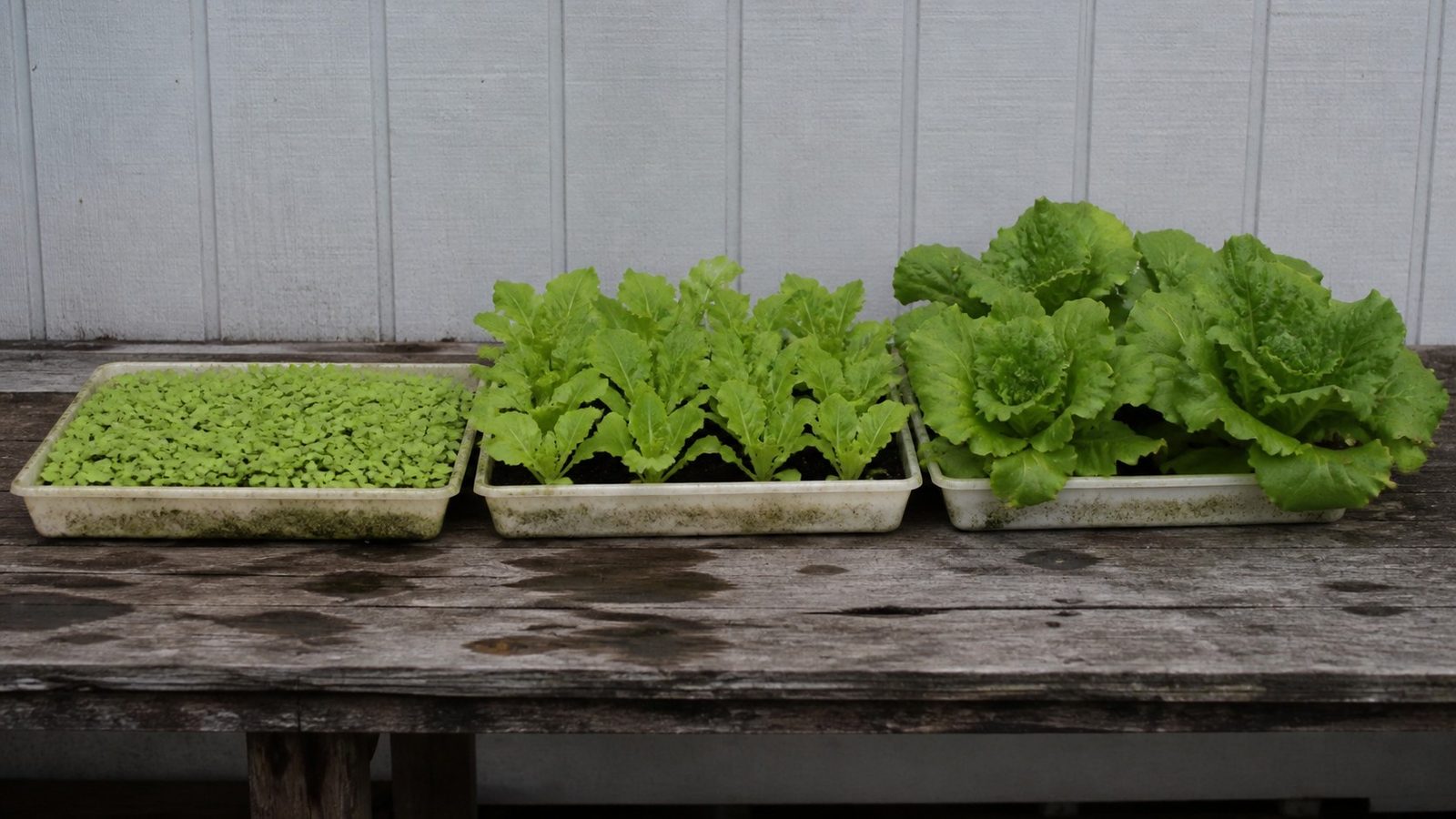
A microgreen, a baby green and a mature leaf can be the same seed, the same cultivar and the same tray. The only thing that separates them is when you cut.
That is the whole subject. The boundary between a sprout and a microgreen is sharp enough to carry a federal rule: roots in or cut above. Here there is no boundary at all. Not a legal one, not an agreed biological one, and not one the published harvest windows of 61 crops respect.
What to actually do
- Describe the cut, not the category. Leaf stage and how far above the medium you cut are reproducible. "Baby green" is a market word with no cutoff behind it.
- Distrust any stage verdict that does not name a cultivar. Two lettuce cultivars in one chamber moved in opposite directions for vitamin C, which is the end of every universal claim.
- Check the denominator on a yield claim. Per square meter and per plant answer different questions, and here they differ by more than three orders of magnitude.
- Check the basis before dividing. Fresh weight against dry weight is not a comparison, and a generic moisture percentage does not fix it.
- Grow one packet through all three stages yourself. The same seed lot does all of it, so a packet of lettuce seed will show you the flavor, texture and yield change on your own bench, which is the only comparison matched to your conditions.
- Expect the day counts to fail on slow crops. Celery, parsley and thyme sit in the baby-green day range for their entire published microgreen window here.
- Wash and store by the tissue, not the label. Gentle young leaves keep better unwashed and are washed just before eating.
- Do not read a stage as a safety level. Nothing has measured one, and baby spinach carries a documented outbreak.
Reputable sources contradict each other on where microgreens end
This is not a gap in the literature. It is a live disagreement between sources that are all worth reading.
- USDA's National Agricultural Library thesaurus says microgreens are harvested before true leaves appear.
- University of Maryland Extension describes them as closely spaced seedlings harvested at the true-leaf stage.
- FDA associates them with true-leaf emergence, and uses that to separate them from sprouts.
Those cannot all be right, and one of them is the opposite of another. The two that agree with each other are the two that draw the line for a regulatory purpose, which is worth noticing but is not proof.
"Baby green" is in worse shape. It is not a regulated harvest-stage term in the United States. FDA uses "baby leaf" as an example of fresh leafy greens on its Food Traceability List, and that list prescribes no leaf count, no height and no day count. It is a market description.
Maryland does publish numbers, and they are the ones everyone quotes:
Hover or tap a row to highlight it.
| Stage | Height | Days after sowing |
|---|---|---|
| Microgreens | 2 to 3 inches | 7 to 21 |
| Baby greens | 4 to 6 inches | 21 to 40 |
| Mature greens | above 6 inches | 40 to 60 |
Treat those as planning ranges, which is what they are. They are useful, and they are not a definition.
The day counts fail on 17 of 61 crops
If 21 days is where microgreens end, then 17 of the 61 crops that publish a harvest window are not microgreens for part of their own range.
Hover or tap a row to highlight it.
| Reading | Count |
|---|---|
| Crops sitting entirely inside 7 to 21 days | 34 of 61 |
| Crops that can still be uncut after day 21 | 17 of 61 |
| Crops whose harvest does not begin until day 20 or 21 | 3 (celery, parsley, thyme) |
| Longest published window here | 35 days (parsley and thyme) |
Celery does not even start until day 21. Its published window, 21 to 30 days, opens on the exact day Maryland's baby-green range opens and runs a third of the way through it. Parsley runs 21 to 35 and thyme 20 to 35. These are sold, grown and harvested as microgreens, and by the day count in circulation they are baby greens for their whole life.
The same crop-by-crop spread turns up in how fast microgreens actually grow, arriving at the same conclusion from a different direction: a universal day range for this category does not survive contact with the crops in it. A day count cannot define a stage when the crop moves the day count by 31 days.
Use the leaf stage and the cut point instead, which is what the sources that disagree on days still agree on: record whether you cut at cotyledon or at true leaf, and how far above the medium. Days and height follow the crop, the season and the light.
The 40 times claim is one compound, in one crop, against a number from a different paper
It traces to Xiao, Lester, Luo and Wang, 2012, which assayed 25 commercially grown microgreen varieties bought between May and July 2011. The figure behind the claim is red cabbage microgreen alpha-tocopherol, vitamin E, at 24.1 mg per 100 g fresh weight, set against 0.06 mg per 100 g for a mature counterpart taken from a separately published study. That division is where "over 40 times" comes from.
That is red cabbage's own value, not the paper's highest. The highest alpha-tocopherol in the study is green daikon radish at 87.4 mg per 100 g, and the paper's stated range runs 4.9 to 87.4. Red cabbage leads the study on vitamin C, not on vitamin E. And 24.1 divided by 0.06 is about 400, not 40, so the famous phrasing understates the one result it rests on.
What that study did not do:
- It did not grow microgreens and mature red cabbage side by side.
- It did not measure baby greens at all.
- It did not establish a 40-fold result for other nutrients or other crops.
- It did not measure servings, intake or any health outcome. The authors say the data could support future intake estimation, not that they had done it.
Its own results contain the warning. Light alone changed the paper's pea-tendril values, which is a direct demonstration that growing conditions move these numbers independently of stage.
Two of the four comparison pages checked repeat a 40-times-type claim, one saying "5 to 40 times" and one "4 to 40 times". One of those two links the 2012 paper on the claim and the other does not. A third names the paper and states that it included a baby-green stage, which it did not. Where the 40 times figure comes from takes the number apart in full.
The three-stage data says the middle stage wins several things
The one study that measured all three stages put the middle one ahead on several measures, which is a harder problem for "younger is denser" than a simple absence of evidence would be.
Eleven lettuce varieties were measured at microgreen, baby and adult stage:
Hover or tap a row to highlight it.
| Measure | Result |
|---|---|
| Chlorophyll | Baby leaves highest, 27.7% above microgreens and 15.8% above adults |
| Carotenoids | Reported near-null in microgreens and highest at baby stage |
| Phenols | Microgreen and baby similar, both about 79% above adult |
| Iron, dry-weight basis | Baby lowest, 53.5% below microgreen and 39.0% below adult |
| Potassium | Adult tended highest, baby lowest |
| Calcium and iron | Direction varied by variety |
The relationship is not monotonic in either direction. Baby greens win chlorophyll and carotenoids outright, lose iron to both neighbors, and tie microgreens on phenols. A single ranking of the three stages cannot be written from this, and one caveat matters: the adult plants here were field-grown, so the adult column carries an environment change as well as a stage change.
Then the cleanest result in the whole subject. Two Salanova butterhead lettuce cultivars, green and red, grown in one climate chamber under one photoperiod, measured from microgreen to mature. Total ascorbate fell about fourfold in the green cultivar and rose 23.7% in the red one. Calcium and sulfur also depended on cultivar.
Same chamber. Same light. Same species. Opposite directions for vitamin C. If a cultivar can reverse the sign of the effect, no verdict that names only a stage can be correct.
The yield result everyone cites is a density experiment
The same Salanova study is the source of "microgreens yield more per square meter," and its own method paragraph is the correction.
Microgreens produced 2.27 kg fresh weight per square meter, about 2.3 times mature lettuce. They were also sown at 44,000 seeds per square meter against 15 plants per square meter for the mature crop.
Hover or tap a row to highlight it.
| Step | Figure |
|---|---|
| Microgreen yield | 2.27 kg/m² at 44,000 seeds/m² |
| Mature yield, implied | about 0.99 kg/m² at 15 plants/m² |
| Planting density, microgreen against mature | 2,933 times |
| Fresh weight per microgreen seedling | about 0.052 g |
| Fresh weight per mature plant | about 65.8 g |
| Per plant, mature against microgreen | about 1,275 times |
So, the headline is true and it is not a stage effect. Microgreens returned 2.3 times the mass from the same floor area while using nearly three thousand times the plants to do it. One mature Salanova head carries roughly 1,275 microgreen seedlings' worth of fresh weight.
The study is not hiding this. It states both densities plainly, which is exactly why it can be recomputed. The pages that carry the 2.3 forward as a stage result are the ones dropping the denominator.
A cross-check against real trays. A 1020 tray is 200 square inches nominal, which is 0.129 m², and the median published tray yield is 7.055 oz, or 200 g. That is 1.55 kg per square meter, so the chamber-grown lettuce figure sits about 46% above a median bench crop. A climate chamber, one cultivar chosen for the trial and a heavy sowing rate is a reasonable explanation for a gap that size, and the two numbers being the same order apart is the useful part.
Nitrate runs the other way, and the direction alone decides nothing
In the Salanova work, nitrate was 16-fold higher in the mature leaves than in the microgreens, on a fresh-weight basis. Phosphorus was 35.7% higher, magnesium twofold and potassium 3.5-fold higher in mature leaves. Sodium went the other way, 32.99 against 4.44 mg per 100 g fresh weight in favor of the microgreens.
Whether the nitrate direction is a point for microgreens depends entirely on which question you are asking. Asked as a contamination question, nitrate and heavy metals in microgreens is where the fresh-weight against dry-weight trap makes most published nitrate figures unusable. Asked as a dietary question, dietary nitrate and heart measures treats it as a possible benefit. Both readings are defensible and neither settles this comparison.
Basis is where most of these comparisons actually fail
Fresh weight includes the water. Dry weight does not. A ratio across the two is not a result.
The three-stage lettuce paper reports its nutraceutical compounds on fresh weight and its minerals on dry weight, in the same tables. The 2012 microgreen paper reports its headline concentrations per 100 g fresh weight.
You cannot repair this with a generic moisture percentage. A valid conversion needs the measured dry-matter fraction for the same cultivar, treatment and stage, and even then it only fixes the basis. It does nothing about a different cultivar, density, light level, fertility, harvest point or storage history. Where the basis differs and the fraction is not published, the honest output is that the two numbers are not comparable.
Safety does not have a stage regime
There is no separate rule because a leafy crop is young.
Microgreens are covered produce under the Produce Safety Rule unless a general exemption or exclusion applies, and they are not sprouts, so the sprout-specific requirements do not reach them. "Baby leaf" appears on FDA's Food Traceability List within fresh leafy greens, and fresh-cut leafy greens are covered separately. None of that makes a stage safer or riskier.
No study was found that inoculates or monitors one cultivar at all three stages while holding the growing environment and postharvest handling constant. FDA's reason for treating sprouts differently is the warm, wet production conditions that amplify seed-borne pathogens, not a measured risk gradient by plant age. The real drivers are seed, water, substrate, worker and equipment hygiene, animals, cut surfaces, wash water, temperature and time.
And baby greens have their own documented outbreak. In the 2006 United States E. coli O157:H7 spinach outbreak, a Utah and New Mexico investigation documented illness onsets from 22 August to 11 September 2006, with the national outbreak strain isolated from three opened packages, all brand A baby spinach. That investigation reported 18 confirmed Utah cases and 5 in New Mexico, against 205 ill nationally. One documented outbreak in a product is not an incidence rate for a stage, and it is enough to retire the idea that only sprouts have a record.
Washing guidance does not change by stage either. Rinse under running water, no soap, no detergent, no commercial produce wash, refrigerate, keep separate from raw animal foods, and packaged produce labeled ready-to-eat can be used without further washing. The one stage-specific note is practical rather than regulatory: microgreen tissue is gentle, so wash it immediately before eating rather than before storing. Whether to wash them at all covers the trade-off.
Cost, shelf life and the right stage to stop are all open
Cost. No matched three-stage cost comparison exists. Extra days do occupy a bench longer at a fixed footprint, but days alone will not produce a number: it needs tray area, density, light intensity and fixture efficiency, irrigation and runoff, nutrients, labor, HVAC, crop loss, number of cuts and saleable yield. The 2,933-fold density gap above is exactly why a cost inference from days would mislead.
Shelf life. No published study compares the three stages from one cultivar under matched growth, harvest, package, temperature and humidity. There is no stage answer to quote.
Where to stop. There is no general economic stop stage for an indoor grower. It falls out of local price per saleable kilogram, yield and cycle time, vertical space use, electricity and HVAC prices, inputs, crop architecture, disease loss, and whether a premium market pays for young leaves. That is a question your own budget answers, not a chart.
Flavor. Guides consistently call microgreens stronger and baby greens milder, and use one as garnish and the other as a salad base. That is culinary reporting with no blinded matched-cultivar panel behind it. Volatile compounds have been measured across early microgreen stages, which is not a three-stage sensory comparison. What microgreens taste like treats flavor as its own subject.
What nobody has measured
- One crop set through all three stages under matched conditions: same density where biologically possible, same root volume, light dose, water, fertility, temperature, harvest handling and a single weight basis. This is the comparison the whole subject is missing.
- A cultivar-labeled market census of how often the variety actually changes between microgreen, baby-leaf and mature production.
- Nutrients per portion actually eaten, which needs weighed servings for the specific crop and use alongside matched composition.
- A matched three-stage shelf-life trial with quality, weight loss, texture and microbial endpoints.
- A stage-stratified microbial risk study holding seed, water, facility, handling and packaging constant.
- A binding definition of "baby green" anywhere in United States marketing standards.
Terms on this page
Tap a term to see what it means.
Cotyledon. The seed leaf or leaves that emerge first after germination, supplied by the embryo.
Sources
Opened 2026-08-11. Two calculations here were performed for this page. The per-plant recomputation divides each published yield by its own published density, both stated in the Salanova paper, and the mature yield is derived from the paper's 2.3-fold ratio rather than quoted directly. The day-count comparison reads the daysToHarvest field across the 61 of 62 variety entries that publish one, against the ranges University of Maryland Extension publishes; the per-square-meter cross-check converts the median published tray of 7.055 oz over the 0.129 m² a 1020 occupies.
- University of Maryland Extension, growing microgreens and baby greens indoors - microgreens at 2 to 3 inches and 7 to 21 days after sowing, baby greens at 4 to 6 inches and 21 to 40 days, mature greens above 6 inches and 40 to 60 days, microgreens described as closely spaced seedlings harvested at the true-leaf stage, and the cotyledon and true-leaf definitions used in the glossary.
- USDA National Agricultural Library Thesaurus, microgreens - microgreens defined as harvested before true leaves appear, which is the direct contradiction of the Maryland and FDA descriptions.
- FDA, guidance for industry on sprouts (PDF) - microgreens associated with true-leaf emergence and cutting above the substrate, microgreens as covered produce under the Produce Safety Rule rather than sprouts, and the warm wet production conditions that are FDA's stated reason for treating sprouts differently.
- FDA, Food Traceability List - "baby leaf" used as an example of fresh leafy greens, with fresh-cut leafy greens covered separately, and no leaf count, height or day count prescribed anywhere in it.
- Di Gioia et al., 2020, butterhead lettuce at different developmental stages - green and red Salanova in one climate chamber on a 12 hour photoperiod: microgreens at 2.27 kg fresh weight per m² and 2.3 times mature lettuce, sown at 44,000 seeds per m² against 15 plants per m²; nitrate 16-fold higher in mature leaves, phosphorus 35.7% higher, magnesium twofold, potassium 3.5-fold; sodium 32.99 against 4.44 mg per 100 g fresh weight in favor of microgreens; total ascorbate falling about fourfold in green Salanova and rising 23.7% in red; calcium and sulfur cultivar-dependent.
- Morales et al., 2022, microgreens, baby leaves and adult lettuce - 11 lettuce varieties at three stages: baby leaves highest in mean chlorophyll at 27.7% above microgreens and 15.8% above adults, carotenoids near-null in microgreens and highest at baby stage, mean phenols similar at microgreen and baby stage and about 79% above adult, baby-stage iron 53.5% below microgreen and 39.0% below adult on a dry-weight basis, adult potassium tending highest and baby lowest, and calcium and iron varying by variety. Nutraceutical compounds are reported on fresh weight and minerals on dry weight, and the adult plants were field-grown.
- Xiao, Lester, Luo and Wang, 2012, vitamin and carotenoid concentrations of edible microgreens (PDF) - 25 commercially grown microgreen varieties purchased May to July 2011, most soil-grown with proprietary fertilization and two hydroponic, assayed for ascorbic acid, carotenoids, phylloquinone and tocopherols on a per 100 g fresh weight basis; the source of the "over 40 times" figure, being red cabbage microgreen alpha-tocopherol at 24.1 mg/100 g against 0.06 mg/100 g for a mature counterpart drawn from Podsedek et al. rather than from the USDA database used elsewhere in the paper, a ratio of about 400; green daikon radish leads alpha- and gamma-tocopherol at 87.4 and 39.4 mg/100 g, so 24.1 is red cabbage's own value and not the study maximum; and the pea-tendril values that changed with light alone.
- Renna et al., 2019, three wild leafy species at microgreen and baby stages - antioxidant and mineral composition at two stages with time to baby stage differing by species, and volatile compounds measured across early microgreen stages rather than as a three-stage sensory comparison.
- CDC, spinach-associated E. coli O157:H7 outbreak, 2006 - illness onsets from 22 August to 11 September 2006, the national outbreak strain isolated from three opened packages all described as brand A baby spinach, 18 confirmed Utah cases and 5 in New Mexico, and 205 persons ill nationally.
- FDA, selecting and serving produce safely - wash under running water, no soap, detergent or commercial produce wash, refrigeration and separation from raw animal foods, and packaged produce labeled pre-washed or ready-to-eat usable without further washing.
- Penn State Extension, a step by step guide for growing microgreens at home - washing microgreens in fresh drinking water immediately before eating, with the note that their gentle tissue may lose shelf life after washing.
- Practice sample, audited 2026-08-11 as a record of what is currently published rather than as evidence, and the source of the two-of-four count on the 40-times claim: Microgreens World, which says "5 to 40 times" and links some research; Wind River Greens, which says "4 to 40 times" and also calls true leaves cotyledons; ChefPax, which names the 2012 paper and states that it included a baby-green stage, which it did not; and Gardendif, which supplies no primary evidence for its nutrition, space or fiber generalizations.
Keep reading
The journal
Best Tasting Microgreens: 233 Consumers Ranked Them, and Bull's Blood Beet Won
Preference has been measured on 233 consumers across three panels. Bull's Blood beet topped the only 0-to-100 ranking, pea shoots and Swiss chard led the other two, and milder crops won throughout.
Read Best Tasting Microgreens: 233 Consumers Ranked Them, and Bull's Blood Beet WonThe journal
The Healthiest Microgreens: Which Are Most Nutritious, and Why the Ranking Collapses
Red cabbage leads vitamin C, red sorrel beta-carotene, cilantro the other carotenoids and green daikon radish vitamin E, all in one study. Converted to a real serving, first and third are 15 micrograms apart.
Read The Healthiest Microgreens: Which Are Most Nutritious, and Why the Ranking CollapsesThe journal
What Is a Microgreen? A Young Seedling, Cut Above the Soil at First True Leaf
A young edible seedling, grown densely and cut above its medium at about the first true leaf, usually 1.5 to 3 inches and 7 to 21 days. That cut is what separates it from a sprout.
Read What Is a Microgreen? A Young Seedling, Cut Above the Soil at First True LeafThe journal
Grow or Buy Microgreens? The Answer Is an Hourly Rate, and It Is $23.60
Seed alone makes home growing look eleven times cheaper. Add medium, power, a failure rate and your own time at $20 an hour and the saving against the cheapest retail is 8 percent.
Read Grow or Buy Microgreens? The Answer Is an Hourly Rate, and It Is $23.60