Microgreens with kids: the crops that finish inside a two-week unit, and covering the weekend
Cal HewittPublished Checked
- beginner
- method
- troubleshooting
- food safety
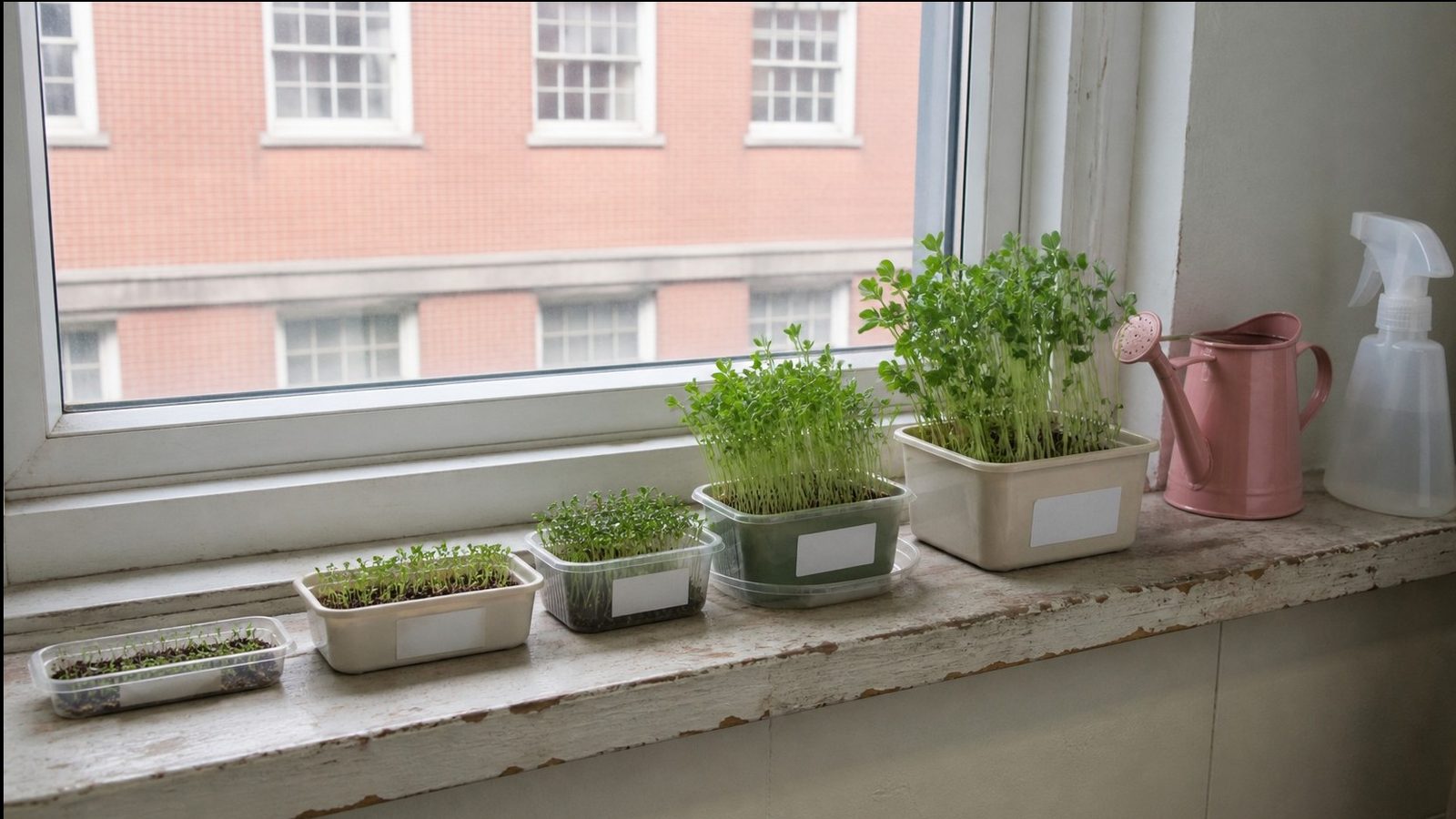
This works in a classroom, and the two things to plan are the crop and the weekend. Microgreens are genuinely fast enough for a two-week unit, but only some of the commonly recommended crops actually finish in one, and every published protocol assumes somebody is there every day.
Every one of them assumes daily care. One requires inspecting soil and watering daily. Another says observe daily, water as needed, and rotate the tray every day or two. A preschool account records daily misting. None of them describes a crop you set up on Monday and return to.
A school week is five days out of seven. The tray is unattended for 29 percent of its life, and longer over a holiday.
Nobody has studied what happens during that gap. No published work records a classroom tray's condition before and after a weekend or a school closure. There is no Friday-to-Monday protocol anywhere in the reviewed guidance.
And there is one honest report of it not working. A real second-grade Extension classroom planned to harvest on May 3 and reported that the microgreens "didn't grow as well as hoped." The report does not diagnose why, so it cannot be blamed on the weekend, the light or the watering. What it does show is that a supported classroom, running a designed program, still had a disappointing tray, and that the published accounts are not uniformly success stories.
What to actually do
- Plan for the weekend before you plan the lesson. Every protocol assumes daily care and nobody has published a closure protocol. Decide who waters on Saturday.
- Choose from the five crops that reliably fit: radish, pea shoots, sunflower, beet or turnip. Radish is the only one all four sources agree on.
- Check the crop's range against your calendar, not against the promise. Swiss chard is on a school list and cannot finish a two-week unit.
- Sow more trays than you need, staggered. The one honest classroom report is of a tray that underperformed, and slack is cheaper than a disappointed class.
- Light it properly or accept the risk. Four hours of direct sun is the stated requirement in one account, and two programs supply a grow light instead.
- Make the drainage holes yourself and pre-moisten the medium, so a child's watering has somewhere to go. Bottom watering or a fine spray, then drain the excess.
- Assign an adult moisture check regardless of who is nominally caring for the tray. The finger test is the check.
- Teach the observation, not the outcome. Daily measuring, photographing and recording is the part that works whatever the tray does.
- Start tasting with pea. Sweet, fast, on three of four lists, and the crop children actually voted for.
- Do not promise it will change how they eat. The honest claim is knowledge and willingness to taste, and the measured intake effect from a whole multicomponent program was a tenth of a serving.
The four crop lists agree on one crop
Four published sources recommend crops for classrooms. Put their lists side by side and the agreement is thinner than it looks.
Hover or tap a row to highlight it.
| Crop | Lists naming it | Days to harvest | Finishes inside 14 days |
|---|---|---|---|
| Radish | 4 of 4 | 6 to 10 | Yes |
| Pea shoots | 3 | 8 to 14 | Yes |
| Sunflower | 2 | 9 to 12 | Yes |
| Beet | 2 | 10 to 14 | Yes |
| Turnip | 1 | 7 to 12 | Yes |
| Arugula | 2 | 6 to 19 | No |
| Mustard | 2 | 10 to 15 | No |
| Broccoli, kale, tatsoi, garden cress | 1 each | 8 to 15 | No |
| Onion | 1 | 10 to 21 | No |
| Swiss chard | 1 | 16 to 19 | Cannot start to finish one |
Radish is the only crop all four sources name.
Five of the thirteen reliably finish inside a two-week unit. The other eight can run past the end of it, and Swiss chard cannot finish a two-week project at any point, because its earliest harvest is day 16.
That is not a criticism of the crop. It is a scheduling fact that a teacher planning around a term needs and that none of the four lists supplies. Check the crop's own range against the days you actually have, using the crop entries.
And note what the lists are not. They are recommendations, not trials. One source calls kale, broccoli and pea "excellent" for classrooms without stating a criterion. Another's rule is ready germination and quick growth. No published trial ranks any of these crops under child watering, no weekend care, ordinary room temperature and no grow light, which is the condition set that actually applies.
"It grows on any windowsill" is not what the guides say
The light requirements in the published accounts are more demanding than the pitch.
One preschool project specifies at least four hours of direct sun per day. Another source asks for a warm sunny windowsill or bright indoor space. Two of the programs do not rely on the window at all: one moves trays under grow lights after the usual two to three day germination, and an Extension classroom kit includes a returnable grow light among its supplies.
So, the supported classrooms are lighting the crop. "It works on any desk" is not supported by any of them, and no controlled trial shows that any named crop tolerates low classroom light better than another. See lighting and, for why a short crop is usually not a light problem, stunted and short crops.
The equipment list is longer than seed and a tray too: shallow containers with adult-made drainage holes, a sterile or peat-based mix, labels, a fine rose can or spray bottle, and a grow light. The hidden assumption in every guide is an adult who supplies the kit, makes the holes and guarantees the daily check. A child is not running this alone.
What growing food actually does to how children eat
This is the claim the whole activity is usually sold on, and it deserves the careful version.
The encouraging study is real. A 2009 study of 115 second-graders compared nutrition-plus-garden, nutrition-only and control. Both treatment groups improved knowledge and taste ratings, and the garden group was more likely to choose and consume vegetables afterward.
The counterevidence is larger. A later cluster trial enrolled 1,256 children with 641 completing follow-up, and found no statistically significant difference between two active gardening delivery models, despite a tendency toward greater intake in one arm.
And the review is measured. A 2020 systematic review of farm-to-school activity reported consistent knowledge gains while saying the evidence for actual consumption remained less conclusive. Its summary includes one multicomponent comparison with 4.5 percent more children trying vegetables and 0.11 additional vegetable servings.
Read that last figure honestly. A tenth of a serving, from a program combining education, tasting and cooking, not from a tray.
Nothing isolates microgreens. No opened peer-reviewed study takes a classroom microgreen tray, compares it against an equally timed non-growing unit, and measures later eating. What is defensible is that growing food can support vegetable knowledge, willingness to taste, and selection when it sits inside a wider program. What is not defensible is promising that a tray changes a child's diet.
One more caution before the tasting. Microgreen flavor can be more intense than the mature crop. Offering a child a sharp mustard or radish microgreen is offering a stronger version of a vegetable they may already refuse. The one classroom observation available is a preschool group voting for carrot and pea, and recording that peas were sweet. No sample size, no controlled tasting, and it is the best direct evidence there is.
So, start with the sweet crops. Pea is on three of the four lists, it finishes inside a two-week unit, and it is the crop children in the one recorded vote actually liked.
Eating it safely with children
The crop is raw, and children are among the people who least tolerate a foodborne illness.
The baseline is ordinary and non-negotiable: wash hands for 20 seconds, wash home-grown produce under running water, keep it away from raw meat, and understand that washing reduces bacteria rather than eliminating them.
Two things worth carrying into a classroom. If anyone is tempted by a jar method, that produces a sprout, not a microgreen, and sprouts carry a distinct risk that FDA describes in terms of organisms multiplying during growth. Do not run a jar with children and call it a microgreen project. And whether microgreens are safe to eat raw is worth reading before any tasting is planned.
Tiny, optional tastes, from a healthy tray, with clean hands. A tray with mold, slime, an off smell or insects is a teaching moment about disposal, not a snack. See mold or root hair.
What nobody has measured
- What a classroom tray does over a weekend or a holiday, which is the single most useful missing study here.
- Real classroom light, temperature or attendance, paired with tray outcomes.
- Any crop ranking under actual classroom conditions: child watering, no weekend care, ordinary temperature, no grow light.
- Whether any crop tolerates low light better than another, in this context.
- Whether any crop forgives irregular or excessive watering, which is what a child's tray will get.
- A child taste preference comparison across microgreen crops, blinded and with intake rather than liking.
- Whether a microgreen unit specifically changes later eating, against an equally timed non-growing unit.
- What care a child can reliably perform unsupervised, at any age.
Terms on this page
Tap a term to see what it means.
Two-week unit. The common classroom project length, and the schedule most of these crop recommendations are implicitly promising to meet.
Sources
Opened 2026-08-12. The crop table is this page's own work: the four published recommendation lists were resolved against the daysToHarvest field on the variety entries here, and a two-week unit is taken as 14 days. Teaching, charity and commercial pages are labeled as documenting what is recommended rather than what has been tested.
- National Agriculture in the Classroom, growing microgreens - kale, broccoli and pea shoots named as excellent classroom choices with sunflower, radish, beet, tatsoi, mustard, onion and arugula as further examples, peat-based potting soil, shallow containers and a spray bottle, daily inspection and watering, grow lights after the usual two to three day germination, first true leaves at about 10 days, and watering only as needed after a finger check.
- RHS, growing microgreens in schools - cress, radish, chard, turnip, mustard and beetroot listed, a warm sunny windowsill or bright indoor space, compost kept moist but not soggy or waterlogged, clean containers with adult-made drainage holes, labels and a fine rose watering can, and visible results in one to three weeks.
- NAEYC, project-based learning with microgreens, 2018 - a preschool winter project requiring a sunny window with at least four hours of direct sun per day, daily misting, a two-week harvest with peas at 3 inches and other crops at 2 inches, a stated general expectation of two to four weeks, and children voting for carrot and pea and recording that peas were sweet.
- KidsGardening, microgreens growing guide - a long crop option list including arugula, brassicas, pea, radish and sunflower, a stated selection rule of ready germination and quick growth, a warm bright spot ideally a sunny window, clean shallow containers and a sterile mix, daily observation with rotation every day or two, bottom watering or careful spraying with excess drained, and the warning that microgreen flavor can be more intense than the mature crop.
- University of Minnesota Extension, the great microgreens caper - a grade 3 to 4 program using pea, radish and soybean microgreens to support seed anatomy, comparison, identification, flavor and texture and plant care lessons.
- Oregon State University Extension, growing microgreens in the classroom - a classroom kit supplying trays and clamshells, soil, seed, a sprinkler, harvest bags, printed materials and a returnable grow light.
- Oregon State University Extension, classroom report - a second-grade classroom that intended to harvest on May 3 and reported that the microgreens did not grow as well as hoped, with no cause diagnosed.
- ERIC record of a school garden study, 2009 - 115 second-graders across nutrition-plus-garden, nutrition-only and control groups, with both treatment groups improving knowledge and taste ratings and the garden group more likely to choose and consume vegetables at post-assessment.
- Cluster trial of gardening delivery models, 2014 - 1,256 children enrolled with 641 completing follow-up and no statistically significant difference between two active gardening delivery models. This page returned an access challenge, so it is used only as the counterevidence its record describes.
- Systematic review of farm-to-school activities, 2020 - consistent knowledge gains with less conclusive evidence for actual consumption, and one multicomponent comparison with 4.5 percent more children trying vegetables and 0.11 additional vegetable servings. This page also returned an access challenge and is used only for the figures its record carries.
- FDA, selecting and serving produce safely - washing hands for 20 seconds, washing home-grown produce under running water, keeping produce apart from raw meat, and that washing reduces rather than eliminates bacteria.
Keep reading
Growing guides
Growing microgreens in a small space: what fits, and what a jar actually gives you
A windowsill and a shallow tray will grow microgreens; a rinsed jar grows something else. Jars produce sprouts, eaten whole, which FDA treats as a distinct risk category, so the method decides what you end up with.
Read Growing microgreens in a small space: what fits, and what a jar actually gives youGrowing guides
Outdoors and under glass: the tunnel is hottest exactly when you need it coolest
A high tunnel has been recorded at 120 to 140F in March and April and near 0F overnight in January, against a recommended 64 to 75F band. Ventilation cannot cool the air below what is outside.
Read Outdoors and under glass: the tunnel is hottest exactly when you need it coolestGrowing guides
Pests and mold on a tray: isolate it, do not spray it, and fix the next crop
For a tray that is already affected the answer is isolate and dispose, then clean the system before the next crop. Spraying is not an option on a seven-day crop, and prevention is where all the leverage actually is.
Read Pests and mold on a tray: isolate it, do not spray it, and fix the next cropThe journal
Four Bags Labeled Kale, Two Species and a 227 Percent Price Gap: How Microgreen Seed Actually Gets Named
Federal law makes a seed packet state its kind and variety, not its species. One catalog's four kale microgreen listings span two different species and $25.73 to $84.25 a pound.
Read Four Bags Labeled Kale, Two Species and a 227 Percent Price Gap: How Microgreen Seed Actually Gets Named