Pests and mold on a tray: isolate it, do not spray it, and fix the next crop
Cal HewittPublished Checked
- troubleshooting
- food safety
- damping off
- method
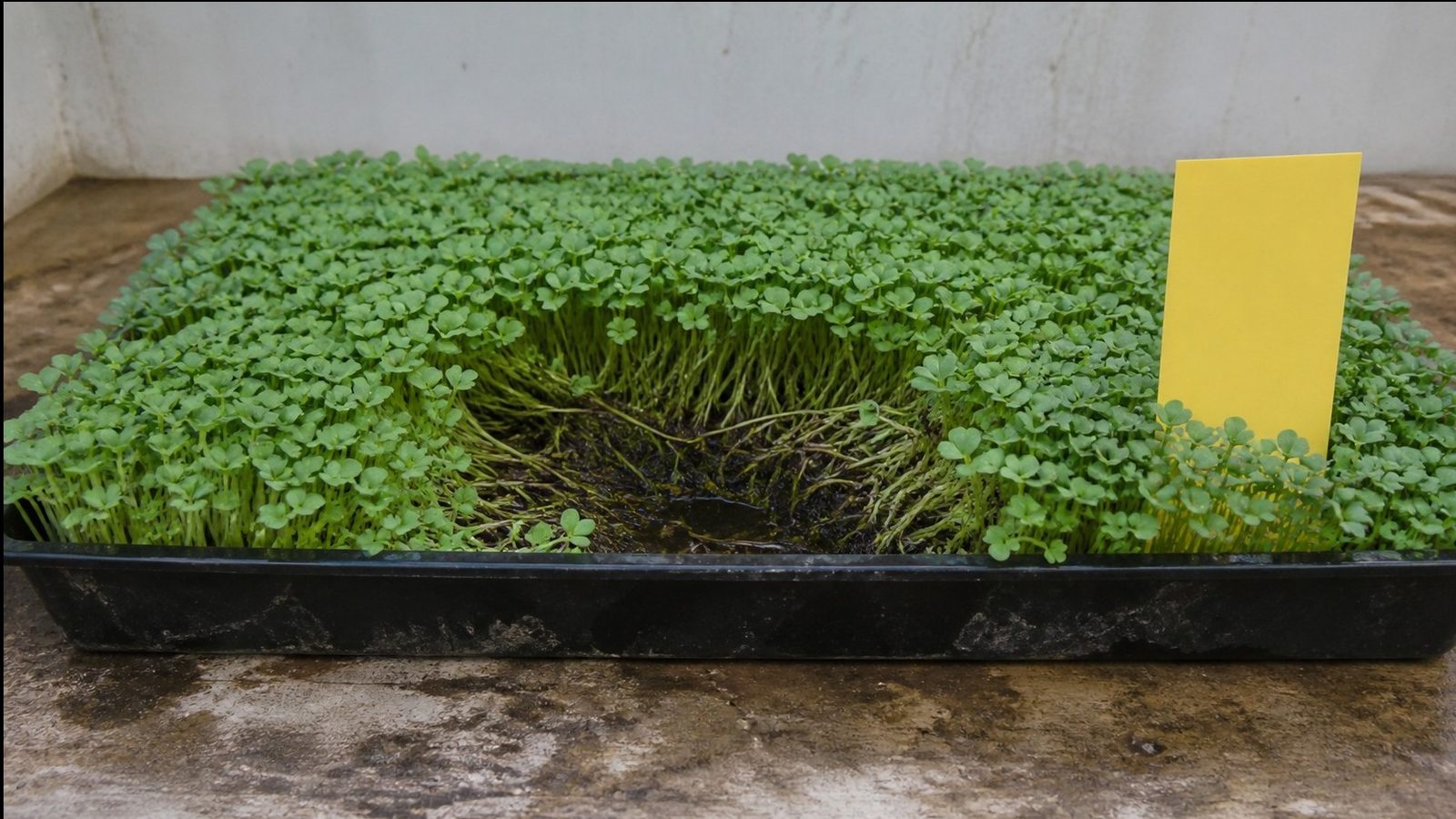
If a tray is already affected, isolate it and compost it, then clean the system before the next crop. There is no spray to reach for, and the reason matters, because it is also where all the leverage is.
Using a pesticide inconsistently with its labeling violates federal law, and a food-crop label covers only the crops with a tolerance or exemption listed on it. A crop that is not named is not covered, however natural, organic or gentle the product is.
One label surfaced in this research that expressly names the crop. LR 85 SP Algaecide and Fungicide Granules, EPA registration 84868-2, active ingredient sodium carbonate peroxyhydrate at 42.5 percent, lists greenhouse "Leafy Vegetables: Lettuce, Microgreens" for foliar use. It warns of leaf necrosis and lesions, and it prohibits irrigation-system and soil-drench application.
No microgreen-specific insecticide label was identified at all. That is a search finding rather than proof none exists, and it is the honest state of what could be verified.
And even where a label exists, the crop outruns it. Treatment intervals on food-crop labels commonly run 7 to 10 days. A seven-day microgreen is harvested and eaten before the second application would be due. The entire spray-program model assumes a crop that stays in the ground long enough to be treated twice, and this one does not.
So, the practical answer to "what can I put on it" is: for a tray that is already contaminated, nothing. The default is isolation and disposal, then cleaning the system before the next crop. That is not a counsel of despair, it is where all the leverage actually is, and the measured evidence below says where to spend it.
What to actually do
- Buy traceable seed from a documented supplier and keep the lot record. Nearly half of surveyed samples carried coliforms, and it varies by species.
- Use clean soilless medium rather than brought-in soil. In the one comparison, the mix containing soil had two to three times the disease of a peat mix, crop by crop, and was the only medium with detectable E. coli.
- Set density by crop, not by habit. The best-yielding rate ranged sixfold between crops, and doubling it multiplied bacterial load about eightfold.
- Run sticky cards and actually read them. Monitoring is the one intervention with no label question attached.
- Do not spray a food crop on the strength of a blog. Check the current label for your crop, your site, your state, and the pre-harvest interval, and assume an unlisted crop is not covered.
- Remember the cycle outruns the program. A seven-day crop is eaten before a second application would be due.
- Treat a contaminated tray as disposal, not as a patient. Remove it from the room, do not harvest it, bag the crop and the single-use medium, then clean and sanitize.
- Clean between crops on a written routine. Remove debris, scrub, apply a sanitizer exactly as labeled, honor the contact time, flush if the label says to, air dry. See cleaning and sanitation.
- Never use appearance to clear food safety. It answers the marketability question and it cannot answer the other one.
What is documented, and what is just repeated
The crop-specific record is thinner than the advice volume suggests.
Insects named in microgreen sources: aphids and thrips. Fungus gnats appear in one experimental record. None of the microgreen-specific sources identifies a confirmed species, only pest groups. Do not promote a houseplant pest list into a diagnosis.
Diseases: the major concern is damping off from Pythium, now often placed as Globisporangium, plus Phytophthora, Rhizoctonia and Fusarium, with Botrytis and Sclerotinia on some hosts. One brassica pathogen has a confirmed commercial report, downy mildew on kale, broccoli and cabbage microgreens, which the year-round page covers.
What does not exist is an incidence rate. No representative commercial survey of plant pests and diseases in this crop could be verified. A single bad tray is not a rate, and a retail food-safety survey is not a farm-disease survey.
The three measured levers
Three things have actually been measured, and all three are upstream of the tray rather than sprayed onto it.
Seed, where nearly half the samples carried coliforms
A survey of 102 samples across 14 species found 48 percent carried coliforms. One onion sample was PCR-positive for Salmonella and one carrot sample presumptively positive for Listeria, though viable cells were not recovered in either case. Aerobic plate counts varied significantly by seed species.
Read that carefully in both directions. Coliforms are an indicator of hygiene, not a human pathogen, and a PCR signal without a viable isolate is not an infection. What the survey establishes is that seed is a real and highly variable route, which is why traceable seed and a documented supplier matter more than anything you could spray. See buying microgreen seed.
A negative seed test proves nothing about the lot. It tells you what that sample and that assay could detect.
Medium, at two to three times the disease
A greenhouse experiment across five brassica microgreens measured disease infestation at harvest by substrate.
Hover or tap a row to highlight it.
| Substrate | Disease infestation | Detectable *E. coli* |
|---|---|---|
| Coir with sand and soil | 5.9 to 9.6 percent | On two crop entries |
| Sphagnum peat with vermiculite | 2.9 to 4.1 percent | None detected |
Crop by crop, that is about two to three and a third times the disease rate, in the same greenhouse, from about 2 times on red cabbage to 3.3 times on broccoli. The two mixes differed in more than soil, since one was coir with sand and soil and the other sphagnum peat with vermiculite, and the authors pointed to the soil and sand as a source of pathogens and to poor aeration.
That fits what the medium does elsewhere. It moves yield by 13 to 16 percent and nitrate by about twofold, as soil and medium sets out, and here it moves disease two to three times over. So, the medium is a modest lever on how much crop you get and a large one on almost everything else about it.
Density, where doubling the seed multiplied the bacteria eightfold
The clearest density measurement is microbial rather than plant-disease.
In cress, raising density from 6 to 14 seeds per cm², a 2.3-fold increase, raised total aerobic bacteria from 7.04 to 7.94 log CFU per gram. That is roughly an eightfold rise in bacterial load for a bit over double the seed.
And the best-yielding density is nothing like universal: 12 seeds per cm² for cress and rocket, 2 seeds per cm² for pea. A sixfold difference between crops, which is why a single sowing rate cannot be right. See sowing and seed density.
Do not turn this into "seed less and you will be fine." In the amaranth trial, higher density increased fresh yield, and it was a low-density treatment that developed black mold. No replicated density-against-damping-off curve exists for any crop.
Diagnosing without a remedy to reach for
Start with observation, and separate three things that look similar.
- Pest: live adults or larvae, webbing, frass, honeydew, stippling or silvering, discrete chewing or sucking damage.
- Disease: a spreading patch, rotted seed or roots, a pinched or water-soaked stem at the media line.
- Environment or production: a uniform pattern that maps onto a light, a fan, a watering zone, a weight, or a whole cultivar failing to emerge, with no organism visible.
That is triage, not identification. Naming a pathogen needs a diagnostic lab.
"Too much water" is not a diagnosis, and it is the reflex this page most wants to retire. Water is not the pathogen. The route can be seed, medium, recirculated water or a contaminated tray, and moisture, drainage, humidity, crowding, temperature, crop susceptibility and inoculum all interact. Stop handling the tray, record the crop and lot, check whether symptoms follow the wet zones, and clean the system before the next crop.
On fungus gnats specifically: adults around moist medium are a monitoring signal, and larvae in the root zone are the damage stage. Seeing a few adults does not prove they caused a collapse. In the one experimental record, gnats were present in a tray that collapsed, and that observation did not establish them as the cause. No threshold of adults predicting yield loss has been published for this crop.
Cosmetic, unsellable, and the one you cannot see
These are three different questions and only two of them can be answered by looking.
- Cosmetic: minor unevenness in color or height, with no rot, insects or slime. A quality question.
- Unsellable: visible insects or larvae, webbing, frass, fuzzy growth, slimy or rotted tissue, collapsing seedlings, or any unknown chemical on edible tissue.
- Unsafe: cannot be determined by sight. Salmonella, pathogenic E. coli and Listeria need testing, not a sniff.
A tray can look perfect and carry a pathogen, which is exactly what the seed survey demonstrates: contamination detected with no visible-tray criterion involved.
For insects the two thresholds differ sharply. The plant-damage threshold is about yield. The marketability threshold is effectively one confirmed insect in a raw product sold to somebody else.
For a home tray, discard rather than spray and eat. For sale, hold it out of commerce, isolate and inspect the adjacent trays, and follow your food safety plan.
What is commonly recommended, and what it leaves out
Five non-extension pages were checked. Two directly recommend treating the crop or the medium without presenting a food-crop label or a pre-harvest interval: one recommending neem, Bacillus thuringiensis and predators, another recommending 2 to 3 percent diatomaceous earth in the growing medium.
That is not a legal finding about any specific use. The label and the jurisdiction decide legality, not this page. It is an observation that the recommendation is being made without the information that would let a reader check it.
To their credit, one of the five explicitly confines neem to houseplants rather than to the edible crop, which is the distinction the others skip.
Sticky cards are the exception worth keeping. They are recommended by extension guidance, they are monitoring rather than treatment, and they put nothing on the food.
What nobody has measured
- Which species the aphids, thrips and fungus gnats in microgreens actually are. The record names groups.
- A commercial incidence rate for pests or disease in this crop, in any country.
- An airflow rate that reduces disease by any amount. The recommendation is sound and the number does not exist.
- A density-against-damping-off curve for any crop, which is why "seed less" remains untested as a cure.
- A gnat threshold that predicts yield loss.
- A universally effective, crop-safe seed treatment, which would need pathogen reduction, germination, yield, residue and finished-product testing per crop.
- Any validated wash or spray that makes a contaminated raw tray safe to sell.
- A universal sanitizer concentration and contact time for microgreen trays. The product label decides it.
- Which organisms actually spoil stored microgreens, by crop, temperature, package and storage day. Not every fuzzy clamshell is Botrytis.
Terms on this page
Tap a term to see what it means.
Damping off. Seed rot before emergence, or root and stem collapse at the media line after it. The major disease concern in this crop and fast enough to take a tray before harvest.
Sources
Opened 2026-08-11. The doubling comparisons on substrate and density, and the eightfold bacterial figure, are computed from the published values and shown alongside them. The confirmed downy mildew report is covered on the year-round page linked above rather than re-derived here. Nothing on this page is legal advice about any specific pesticide use; the current label and the jurisdiction decide that.
- EPA, pesticide labeling questions and answers - that using a pesticide inconsistently with its labeling violates federal law, and that food-crop labels list only crops with a tolerance or exemption so an unlisted crop is not covered.
- EPA, LR 85 SP Algaecide and Fungicide Granules label, 2021 (PDF) - EPA registration 84868-2, sodium carbonate peroxyhydrate at 42.5 percent, expressly listing greenhouse "Leafy Vegetables: Lettuce, Microgreens" for foliar use, with warnings of leaf necrosis and lesions and a prohibition on irrigation-system and soil-drench application.
- University of Kentucky, microgreens crop profile (PDF) - aphids and thrips named as potential insect problems, Pythium and Phytophthora damping off as the major disease concern with Botrytis, Sclerotinia and Rhizoctonia on some hosts, the advice to use well or county water rather than surface water because ponds pose contamination risk, and density that permits air circulation.
- Frontiers in Sustainable Food Systems, microgreen seed survey, 2023 - 102 samples across 14 species with 48 percent carrying coliforms, one onion sample PCR-positive for Salmonella and one carrot sample presumptively positive for Listeria without viable cells recovered, and aerobic plate counts varying significantly by seed species.
- Substrate experiment in five Brassica microgreens (PDF) - disease infestation at harvest of 5.9 to 9.6 percent in coir with sand and soil against 2.9 to 4.1 percent in sphagnum peat with vermiculite, with detectable E. coli on two crop entries in the soil-containing mix and none in the others.
- Seed density and microbial load study, 2026 - cress raised from 6 to 14 seeds per cm² increasing total aerobic bacteria from 7.04 to 7.94 log CFU per gram, bacterial and fungal loads rising with density, and optimum-yield density differing sharply by crop at 12 seeds per cm² for cress and rocket against 2 for pea.
- George Mason University, hydroponic amaranth microgreen study - fungus gnats recorded in a tray that collapsed with damping off and root rot symptoms without establishing them as the cause, higher density increasing fresh yield, and black mold appearing in a low-density treatment.
- USDA Agricultural Research Service, downy mildew on microgreens - Hyaloperonospora brassicae confirmed by transfer testing and genetic analysis in commercial Michigan kale, broccoli and cabbage microgreens, sporulating on inoculated seedlings within one week, with the outbreak rate described as high but no farm-incidence denominator published.
- Virginia Cooperative Extension, introduction to microgreen production (PDF) - that controlled-environment facilities still need integrated pest management because the environment is conducive to plant and foodborne pathogens, sticky card monitoring, humidity and airflow discouraging infection with a common 50 to 70 percent range and the caveat that settings need species and system specific trials, and a between-crop routine of scrubbing channels, running a label-directed hydrogen peroxide sanitizer through the recirculating system and flushing with water.
- FDA, summary of the Produce Safety Rule - water, workers, soil amendments, tools, equipment, buildings, sanitation and animals identified as produce contamination routes.
- Retail survey of sprouts and microgreens, Riga - Listeria innocua in 2 of 45 mixed samples, STEC genes in 3 dried sprout samples and Salmonella in 1 sunflower seed sample. A retail survey, which does not estimate farm disease incidence.
- Practice sample, checked 2026-08-11 for whether a food-crop label or pre-harvest interval accompanies a treatment recommendation: Petite Produce, recommending neem, Bacillus thuringiensis, predators and sticky traps, and Home Microgreens on diatomaceous earth, recommending 2 to 3 percent in the growing medium, neither with a label or interval; against Home Microgreens on fungus gnats, which recommends monitoring and explicitly confines neem to houseplants; plus Microgreens Resource, which lists flying insects without species confirmation, and Urban Farming Concepts, which says pests are rare indoors and mentions pesticides while warning of toxicity.
Keep reading
Growing guides
Yellowing, wilting and collapsing microgreens
Four different faults end with a tray lying down, and their remedies are opposites. The collar is what tells you which one you have, and a wilted tray that stands back up was thirsty, not diseased.
Read Yellowing, wilting and collapsing microgreensGrowing guides
Microgreens with kids: the crops that finish inside a two-week unit, and covering the weekend
Pick from the 5 crops that reliably finish inside a two-week unit, and plan for the weekend, because every published protocol assumes daily care and a school week is five days in seven.
Read Microgreens with kids: the crops that finish inside a two-week unit, and covering the weekendGrowing guides
Outdoors and under glass: the tunnel is hottest exactly when you need it coolest
A high tunnel has been recorded at 120 to 140F in March and April and near 0F overnight in January, against a recommended 64 to 75F band. Ventilation cannot cool the air below what is outside.
Read Outdoors and under glass: the tunnel is hottest exactly when you need it coolestGrowing guides
Growing microgreens in a small space: what fits, and what a jar actually gives you
A windowsill and a shallow tray will grow microgreens; a rinsed jar grows something else. Jars produce sprouts, eaten whole, which FDA treats as a distinct risk category, so the method decides what you end up with.
Read Growing microgreens in a small space: what fits, and what a jar actually gives you