Disclosure: Microgreens Guru earns from some links on this page, including affiliate links, at no extra cost to you.
No published trial ranks microgreen crops by how often their trays mold, so the list you can work from is short and mostly anecdotal. One extension fact sheet names watercress, Swiss chard, Thai basil, mint and nasturtium as more disease-prone. One seed supplier names sunflower and pea shoots. Another names basil when it is sown thickly. Before you blame any of these, check for seed gel: basil, chia, arugula and cress coat themselves in a clear gel when wet that can pass for fuzz. For the crops that keep failing on you, change sowing density first, then soaking, watering, airflow and tray cleaning, in that order.
The crops sources name, and on what basis
Three sources tie specific crops to mold or disease, and none of them measured it. That matters for how much weight you give each name, so the basis sits beside every one.
Hover or tap a row to highlight it.
| Crop | Who names it | What they say | Basis |
|---|---|---|---|
| Watercress, Swiss chard, Thai basil, mint, nasturtium | Perennia, Nova Scotia advisory body, March 2021 | "tend to be more susceptible to disease issues" | The fact sheet calls it anecdotal evidence |
| Sunflower | Deliseeds, seed supplier, July 2025 | "Notorious" for surface mold, because large seeds and hulls hold moisture and are harder to clean | Supplier practice, labeled anecdotal |
| Pea shoots | Deliseeds | Can develop problems in a thick, poorly ventilated canopy | Supplier practice, labeled anecdotal |
| Basil, sown densely | Seedmart, Australian seed supplier | Dense, overlapping seed areas hold moisture and are more prone to fungal problems | Supplier guidance |
Perennia's wider point is worth taking with it. The same fact sheet says some species "may be more susceptible to disease than others" and recommends preparing each species on its own terms and growing them in separate trays, because their watering, climate and germination needs differ. If one crop keeps failing while the rest of the rack stays clean, that is the practical reading: the crop is telling you its conditions are off, even when the rack suits everything else.
Since nobody has counted failed trays by crop across many growers, your own records are the best ranking you will get. Write down the crop, seed lot, sowing weight, date and whether the tray failed. After a few rounds you will know which crops are hard in your setup, which is the ranking that matters to you.
Gel is not mold: basil, chia, arugula and cress
Basil, chia, arugula and cress are mucilaginous. When the seed gets wet, it releases a clear, slippery gel. Perennia lists basil, chia and arugula as mucilaginous, and a University of Wisconsin Extension presentation lists basil, chia and cress. Seedmart describes the clear coating around wet basil seed as normal mucilage and not mold.
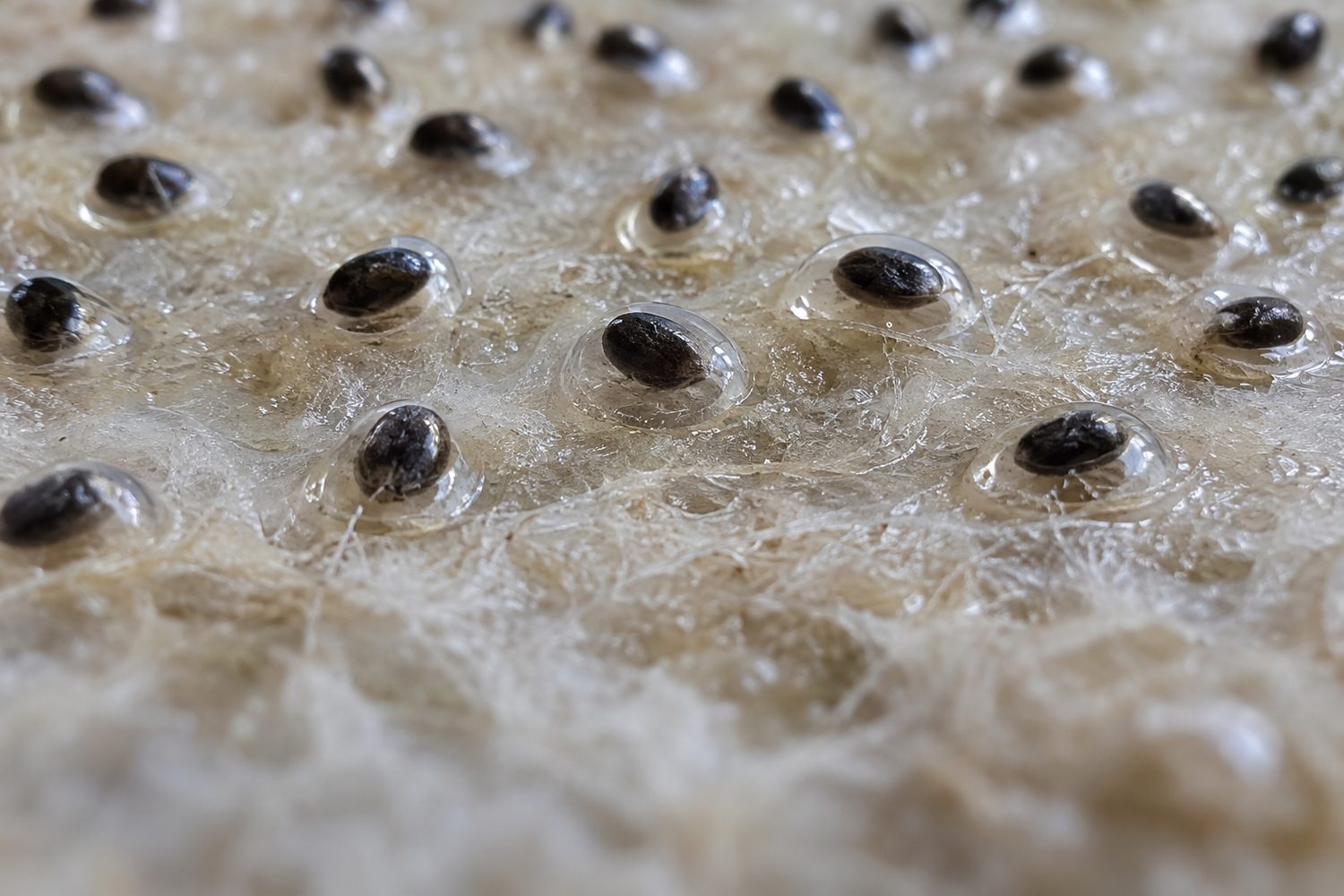
Treat the gel as a sowing fact rather than a mold rating. It tells you how to handle the seed, not that the crop molds more. The trouble it does cause is indirect. Wet mucilaginous seed clumps, spreads unevenly, and the clumps hold moisture, which is exactly the condition Seedmart links to fungal problems in basil. The fix sits at sowing, covered below.
If what you are looking at is white and fuzzy around the roots rather than clear and slick around the seed, it may be root hairs. Deliseeds, a supplier, tells the two apart this way: root hairs are "uniform and attach to the root" and mat down or vanish when misted, while mold grows on the surface of the medium in patches or cottony clumps, may smell musty, and keeps spreading after watering. That is supplier practice, not a lab test, so use it as a first look. The step-by-step check is on mold or root hair, and if it is mold, save or compost a tray covers what to do with it.
What the lab work measured
A few studies did put numbers on fungi and disease by crop. None of them measured mold in a home or commercial tray across many crops, and the difference matters.
Fungi on dry seed. Ocho Bernal, Lyttle and Jung (West Virginia State University, published November 2023) plated 102 seed samples of 14 microgreen kinds bought online and counted molds and yeasts together. Borage (4.42 log CFU/g), carrot (3.78), onion (3.62) and chard (3.59) carried the highest counts; mustard (2.19), kale (2.08) and pea (2.00) the lowest. Each crop had 4 to 11 samples, and the seed was never grown out. Gilbert and colleagues (University of California Santa Cruz, February 2023) plated 14 kinds of sprouting seed and found legumes carried the fewest surface fungi, a mean of 1.1 per seed, and the two brassicas, broccoli and radish, the most, 90.5 per seed. They also found seed size did not predict fungal load. That is worth holding against the idea that big seeds are dirty seeds, though neither study looked at what happened once the seed was in a tray.
Disease after deliberate infection. McGehee and colleagues (Crop Protection, 2019) inoculated arugula, kale, radish and mustard with two Pythium species, the water mold behind root rot and damping-off. Disease was low overall in their hydroponic run, but every infected plant was at least 28% smaller than uninfected plants, and arugula and mustard grown in hand-watered trays lost 74.4% of their shoot dry weight. The abstract does not rank the four crops against each other, and because the infection was deliberate it says nothing about which crop catches Pythium most often on its own.
Substrate. A Vietnamese greenhouse study of five brassica microgreens (Academia Journal of Biology, 2022) found the most damaged plants in a coco coir, soil and sand mix and the fewest in a sphagnum peat and vermiculite mix. Broccoli, for instance, ran 9.6% against 2.9%. No pathogen was identified, the disease figures carry no statistical test, and the wettest mix was not the worst one, so read it as a hint to avoid garden soil and sand in trays rather than a rule about moisture.
The one mold with a name. In a Rodale Institute broccoli trial in Pennsylvania, damaged plants sent to the Penn State Plant Disease Clinic showed a zygomycete fungus, Rhizopus or Mucor. That is one crop at one site, and it is the only case here where a lab put a name to the mold on damaged microgreens. Other disease organisms turn up in extension material by name. The University of Kentucky crop profile says Botrytis, Sclerotinia and Rhizoctonia "may pose a problem on some hosts" without naming the hosts. For symptoms and the wider disease list, see pests and diseases.
What to change for the crops that keep failing
The changes below come from extension and supplier guidance. None of them was tested crop by crop, so change one thing per round and write down what happened.
Sow thinner
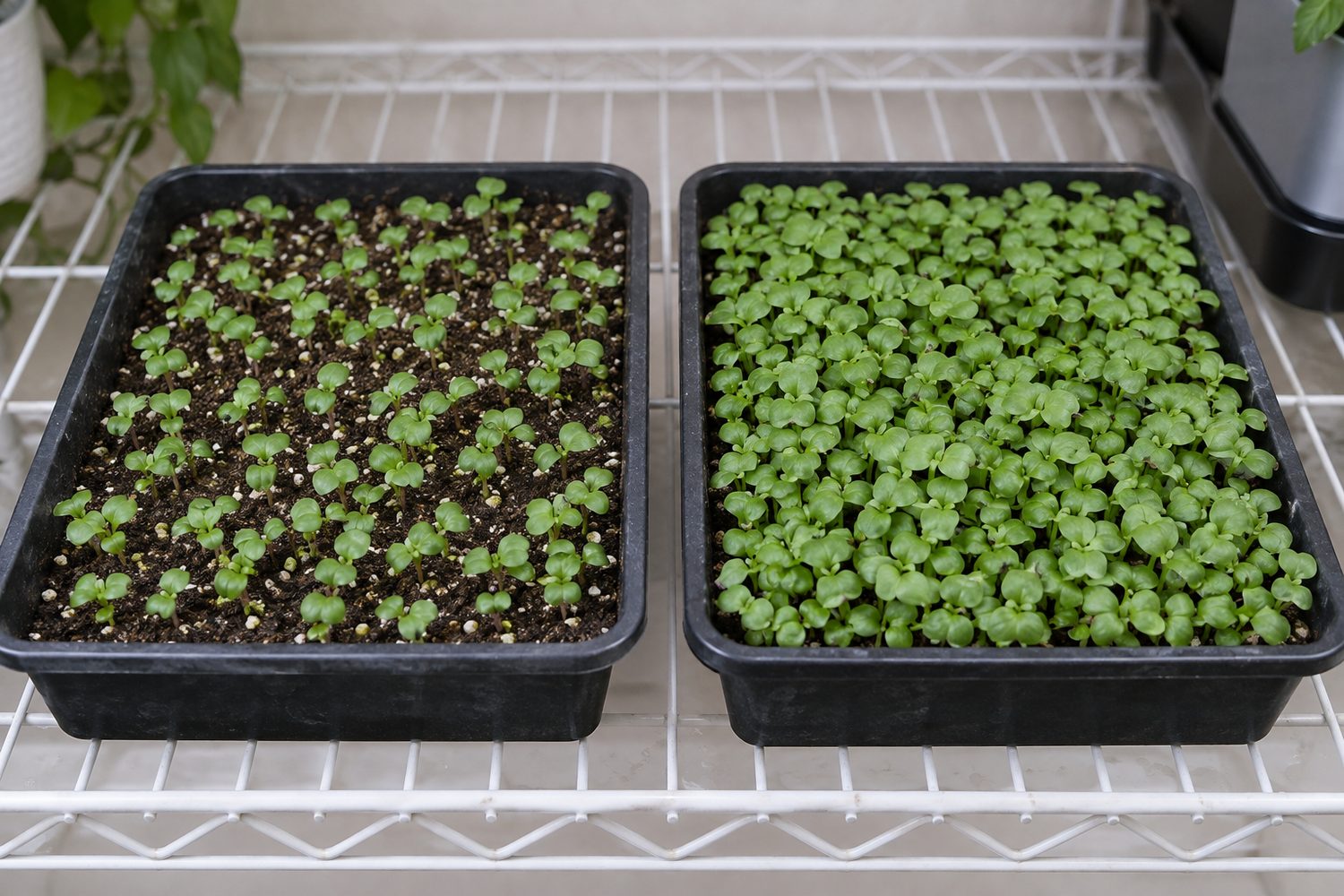
Density is the first thing to check. Perennia says microgreens are planted densely, "making them more susceptible to damping off and other humidity-based afflictions", and that the seed should cover the tray without being so thick that air cannot move through the canopy later. Its starting figures are 10 to 12 seeds per square inch for small seed and 6 to 8 per square inch for large seed, with the note that the right density varies by variety.
For basil, this is the change Seedmart leans on: do not sow it in thick piles, because the dense patches hold moisture. Spread mucilaginous seed dry and as evenly as you can, since clumps are hard to break up once the gel forms. For a crop on the disease-prone list that fails at your current rate, drop toward the low end of the range for one tray and compare it with your usual tray side by side.
Do not pre-soak gel-forming seed
Perennia advises against pre-soaking basil and chia, because the wet seed turns slippery and is hard to distribute. Seedmart says the same for basil. Sow them dry and water afterward. Large seed such as pea and sunflower is a different case, and soaking microgreen seed covers which crops benefit from a soak and for how long.
Water from below and keep the surface from sitting wet
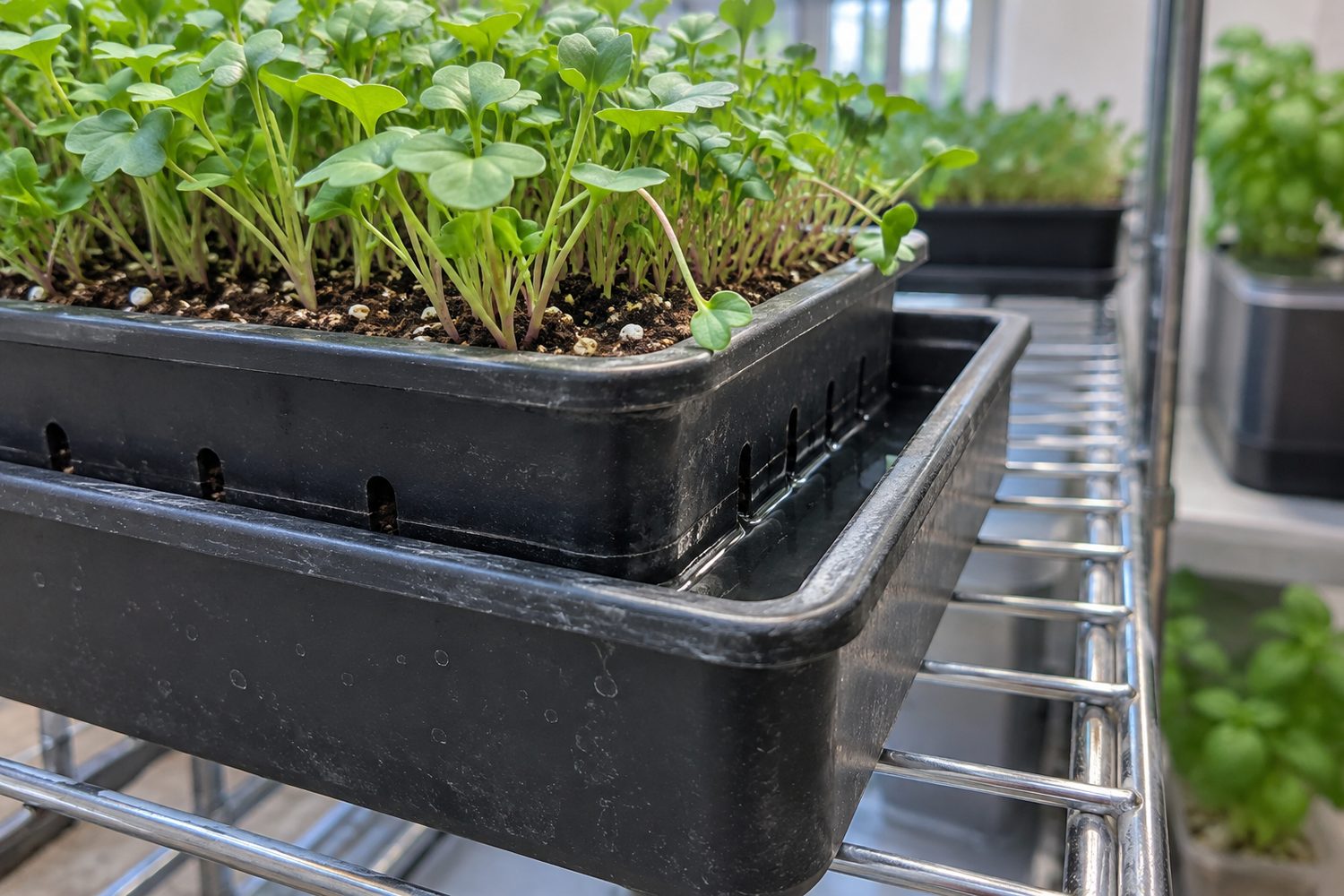
Penn State Extension recommends sub-irrigation, or bottom watering, because it keeps leaves and stems dry, which it calls important for avoiding disease. Perennia names standing water and saturated media as contributors to damping-off, and Seedmart says basil wants steady moisture but not stagnant, saturated conditions. For thick-canopy crops like pea shoots, where the canopy traps moisture at the base, bottom watering matters most. A bottom tray without holes under a slotted growing tray is the usual setup. More on timing and amounts is on watering microgreens.
Uncover early and move the air
Seedmart recommends taking the cover off basil once the seedlings lift, then bottom watering with airflow once the roots establish. Deliseeds points to pea shoots in dense, poorly ventilated canopies, and gives humidity over 60% with no ventilation as a mold-risk condition, which is a supplier's rule of thumb. Perennia gives 18 to 24°C and 40 to 60% relative humidity as enough for most crops and says going past those limits raises disease pressure. A small clip fan on low and a hygrometer at canopy height let you see whether your rack sits inside that range. No source gives a crop-specific airflow figure, so aim the fan across the tray rather than straight down, and watch whether the base of a pea canopy dries between waterings. Temperature and airflow has the details.
Clean trays between crops and use fresh media
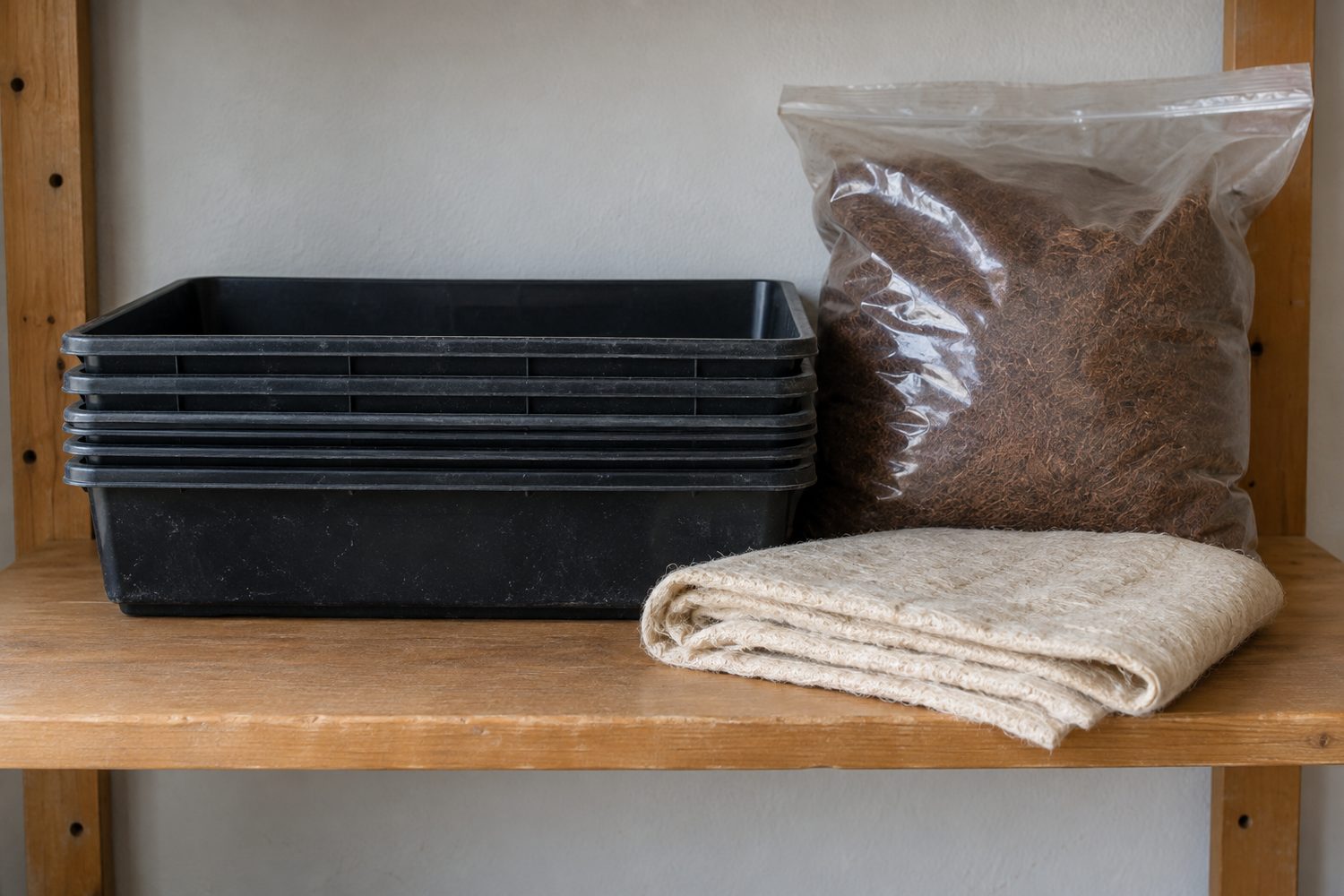
Perennia recommends soaking trays for 30 minutes in a 10% bleach solution between crops, or an equally effective method, and warns that reusing contaminated media raises disease pressure. If one crop fails and the next tray of it fails too, the tray and the media are as likely a source as the seed. The full routine is on cleaning and sanitation.
Be cautious about seed treatments
Seed treatments act on the seed surface, and mold can also come from the substrate, reused trays, water and air. On 3% hydrogen peroxide, the drugstore strength, two studies disagree. Gilbert and colleagues found it "was not consistently effective at reducing microbial loads" on sprouting seed, while Ocho Bernal's team found a 10-minute soak in it significantly reduced molds and yeasts on amaranth, borage and carrot seed. The two used different seeds, soak times and measures. In the Gilbert study, diluted household bleach (0.6% sodium hypochlorite) and freshly made hypochlorous acid were the most effective treatments without harming germination, and the authors warned that concentrated peroxide is corrosive and unsuitable for home use. If you try a peroxide soak, run it on one tray against an untreated tray from the same seed lot, and do not count on it to rescue a crop that is sown too thick or kept too wet.
Frequently asked questions
Does sunflower mold more because its seeds are big?
Deliseeds says sunflower is notorious for surface mold because the large seeds and hulls hold moisture, and it labels that claim anecdotal. On dry seed, Gilbert and colleagues found seed size did not predict fungal load across 14 kinds of sprouting seed. Treat hull moisture as the thing to manage: sow at the large-seed rate and keep the surface from staying wet.
Is the clear slime on my basil seed a sign it will mold?
No. The clear gel is mucilage, a normal seed trait in basil, and Seedmart says plainly that it is not mold. The risk comes from what the gel does at sowing, when seed clumps into wet patches, so sow it dry and spread it evenly.
Which crop carried the most fungi on the seed itself?
In the West Virginia State University survey, borage had the highest mean mold and yeast count at 4.42 log CFU/g, with all five samples above the detection limit. Sunflower had all ten samples above the limit, at a lower mean of 2.92. These are counts on dry seed bought online, not a measure of how trays of those crops turned out.
What mold was found on damaged broccoli microgreens?
A lab at the Penn State Plant Disease Clinic identified a zygomycete fungus, Rhizopus or Mucor, on damaged broccoli from untreated trays in a Rodale Institute trial. It does not mean broccoli molds more than other crops, since the trial grew broccoli alone.
Where to start
If one crop keeps failing while the rest of the rack stays clean, sow the next tray of it thinner, dry if it is basil or chia, and bottom-watered with the cover off as soon as it lifts. Clean the tray in a 10% bleach soak first and use fresh media. Change one thing at a time, keep notes, and within a few rounds you will know whether it was the crop or the conditions.
Sources
Prices, stock and specifications are as the linked pages showed them on 2026-09-26.
Keep reading
The journal
What Is a Microgreen? A Young Seedling, Cut Above the Soil at First True Leaf
A young edible seedling, grown densely and cut above its medium at about the first true leaf, usually 1.5 to 3 inches and 7 to 21 days. That cut is what separates it from a sprout.
Read What Is a Microgreen? A Young Seedling, Cut Above the Soil at First True LeafThe journal
Is Homegrown Safer? What the Produce Recalls Actually Change
Partly, and not for the reason people think. Growing your own does not remove contamination risk, it moves it onto seed, substrate and water, which are three things you can act on. And one tray is one to two days of one adult's vegetables, not a replacement.
Read Is Homegrown Safer? What the Produce Recalls Actually ChangeThe journal
What Does a Tray Actually Yield? The Range Is 18-Fold and the Reason Is Not the Crop
Published yields for 39 of 62 crops run from 1.00 oz to 18.77 a tray. A seed catalog's range is only 2.7-fold, because the commercial world has already selected out the low yielders.
Read What Does a Tray Actually Yield? The Range Is 18-Fold and the Reason Is Not the CropThe journal
Growing Microgreens Without a Grow Light on a Windowsill
A sunny windowsill can grow microgreens without a grow light for many crops, though stems run longer and paler. Learn which window and crops work best.
Read Growing Microgreens Without a Grow Light on a Windowsill