Watering a tray: how much, how often, and what overwatering actually means
Cal HewittPublished Checked
- water
- method
- mold
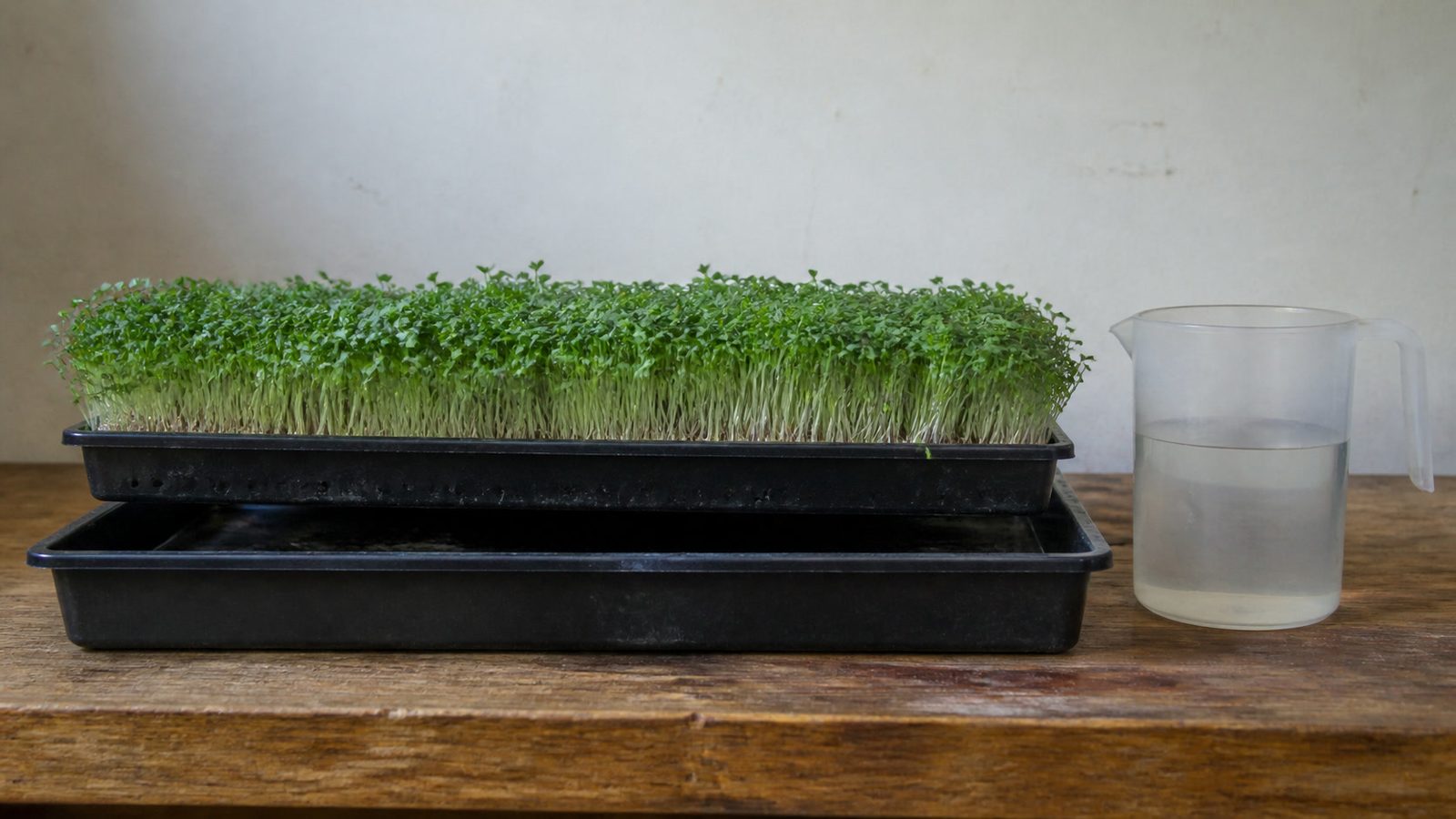
Overwatering is named as the main cause of failure in this crop more often than anything else, and no source anywhere defines it. Not as a volume, not as a tray weight, not as a moisture percentage. The definition offered is a feeling: moist but not soggy, damp not wet.
That is a real warning wearing the clothes of an instruction, and it leaves a grower with no way to tell whether they are doing it.
Three findings are worth having before you pick up a jug:
- The published volumes disagree by four times, and the disagreement is mostly the medium rather than the advice. Water-holding capacity has been measured, and hemp holds nearly three times as much per gram as coco coir does.
- Nobody has compared top watering against bottom watering on yield, mold or quality. Not once. The only controlled comparison anybody has run on the two methods is a food-safety one, and it found no significant difference.
- The one method that produces a number instead of an impression is weighing the tray, and no source publishes a target weight to aim at.
What to actually do
- Water to what your tray and medium can hold, not to a cup count from a page that was using a different material.
- Learn the weight. Put the tray on a kitchen scale when it is freshly watered and again when it is ready for more. Those two numbers are your dose, and they are the only ones calibrated to your setup.
- Water when it has dried back down, not on a schedule. Check daily, because demand climbs as the canopy fills.
- Mist gently at sowing so the seed stays where you put it, and switch to watering from below once roots are established.
- Drain the reservoir and discard what is left. Every source that gives a soak time says this, and it is the part they agree on.
- Keep the canopy dry because of leaf wetness, and know that the pathogen-transfer claim behind bottom watering is not established.
- Do not treat wet as a diagnosis. If a tray is going wrong, correct water, airflow, density and cleanliness together. Temperature, humidity and airflow is the other half of this, and mold or root hairs is where to start before concluding anything.
The volumes that actually exist
Five of the six pages examined for this topic give some quantity. Only three give a figure resembling a repeatable dose.
Hover or tap a row to highlight it.
| Source | Figure | What it is a figure FOR |
|---|---|---|
| Utah State Extension | 2 cups in the lower tray | Setup soak against 2 quarts of coir, drained after 30 minutes |
| Missouri State Extension | 4 cups before soil, 1 cup before a wood-fiber mat | Sowing, not an ongoing dose |
| West Virginia Extension | 1 inch in the lower tray | A depth rather than a volume, tray size not stated |
| Home Microgreens | 2 cups when the tray is about dry | A grower's rule for a 9.5 by 19.75 inch tray |
| Bootstrap Farmer | 1.5 to 2 cups, plus 1 more if still dry | Supplier instruction for a mesh tray in a solid 1020 |
There is no published total. Nobody has measured what a 1020 tray takes from sowing to harvest, with the crop, the medium, the depth and the conditions all stated. The nearest cumulative figure in print is a 2025 patent table listing about 4,268 grams of water over 6 days for a radish run on roughly a 1020 footprint, and it does not identify the tray, the medium, the replication, or whether recovered water was excluded. That is published data rather than an independent trial.
Why the numbers disagree, and it is not the advice
The medium is doing most of the work, and its capacity has been measured. A 2020 study of microgreen cultivation matrices reported water held at saturation:
Hover or tap a row to highlight it.
| Medium | Water held |
|---|---|
| Peat and vermiculite | 3.3 mL per gram |
| Coco coir | 3.3 mL per gram |
| Hemp mat | 8.9 mL per gram |
| BioStrate mat | 10 mL per gram |
A mat holds roughly three times what a loose medium does, per gram. So the four-fold spread in the published cup counts is largely two different setups being described with the same unit, and Missouri State's own 4 cups for soil against 1 cup for a wood-fiber mat is that contrast inside a single source rather than a contradiction to average out.
Virginia Tech's controlled-environment center states the practical consequence: hemp needs a LOWER irrigation rate than burlap, because it holds more. Which means a cup count copied from somebody using a different material is not conservative, it is arbitrary. This site's growing medium review covers coir, peat, soil, hemp, jute, burlap and BioStrate, and the number you need is a property of whichever one is in your tray.
How often
The only useful published range comes from a working facility rather than a trial. Virginia Tech's center bottom-waters trays anywhere from once every two days to several times a day, depending on growth stage, and runs 10 minutes three times daily in a nutrient film system.
That is a range, not a schedule, and the honest reason is that demand rises through the crop. A bare tray of seed loses water by evaporation. A full canopy loses it through transpiration as well, and the fuller it gets the more it moves. Nobody has published a daily water-use curve from emergence to harvest for any crop.
Days on the bench vary enormously, which makes the missing rule concrete. Across the 61 crops with a published range, harvest runs from 4 days for alfalfa to 35 for parsley and thyme, checked 2026-08-12. That is an eight-fold difference in how long a tray sits there drinking, and no source connects a crop's length to a quantity of water.
On withholding water before harvest, there is nothing. No extension source prescribes it and no controlled study has tested it. If somebody tells you to stop watering a set number of hours before cutting, that figure is theirs, not the literature's.
Top, bottom, or mist
The case for bottom watering is that it puts water at the roots without wetting the canopy, and a wet canopy is what disease wants. West Virginia Extension says emerging microgreens prefer it and warns that overhead water can encourage disease. Utah State's method is a nested tray, 2 cups, soaked and then drained after 30 minutes.
The case for gentle top watering is about the seed, not the plant. Missouri State places misting immediately after sowing and before covering, specifically to avoid washing seed out of position, and Purdue calls a spray bottle the initial watering. Both are phase instructions rather than claims that misting is worse later.
And the comparison nobody has run is the one that matters. There is no controlled trial comparing top, bottom and mist on yield, uniformity, mold incidence or quality, at matched water. The only method comparison in the literature is about food safety, and two microgreen studies found no statistically significant difference in E. coli O157:H7 transfer between watering methods.
So "bottom watering is safer" is unsupported for the one outcome anybody actually tested. That is not a reason to switch to overhead watering. It is a reason to stop repeating a claim as settled when the evidence for it does not exist, and to keep bottom watering for the reason that does hold up: it keeps the leaves dry, which is a condensation and leaf-wetness argument rather than a proven pathogen one.
What growers actually do, from a survey of 176 US microgreen growers: 33 percent reported bottom or drip irrigation and 23.9 percent reported overhead. The remaining 42.6 percent did not answer, which is worth stating rather than quietly rescaling the other two.
On how long a tray should sit in water, the published times are 30 minutes, up to 20 minutes, and "a few minutes." All three sources agree on the part that matters more: drain it and discard what is left. Nobody has established a safe maximum standing time by medium or crop.
The one method that gives you a number
Weigh the tray. It is the only approach in this whole subject that turns a judgment into a measurement, and it works because the thing you are trying to track, water in the medium, is most of what changes in the tray's mass day to day.
The method as growers describe it: learn what the tray weighs when it comes out of blackout and is ready for water, then water when it returns to that weight rather than on a schedule. No source publishes a target. Not a tare weight, not a dry mass, not a post-watering figure, for any tray, medium or crop.
Research does use mass this way, which shows the approach is sound. A 2020 kale microgreen study controlled water gravimetrically at 150, 350, 500, 600 and 700 grams, corresponding to 7.5 up to 35 percent of container volume, and found the driest treatment raised stress indicators and shortened shoots while 17.5 percent was the most water-efficient setpoint in that system. Those are research numbers in a research container, not a target for a 1020.
Which means the number you need is one you can only produce yourself, with a kitchen scale, in an afternoon. That is an unsatisfying answer and it is the true one.
What overwatering actually is
The best available definition is a relative one, and it comes from a grower rather than a study: a tray is overwatered when it is watered again before it has dried back down, not because a particular volume was used. That is usable, it fits the weight method, and it explains why a cup count cannot define the term.
What the evidence does support is the direction. Damping-off pathogens are favored by wet, poorly drained conditions: Minnesota Extension associates overwatering with more damping-off, and UC IPM names saturated mix and cold wet conditions as what makes seedlings vulnerable.
What the evidence does not support is the causal shortcut. No controlled microgreen trial has shown that water alone causes mold or damping-off. A pathogen has to be present, and sowing density, temperature, humidity, airflow, sanitation and medium all move the outcome at the same time. West Virginia Extension gets this right by listing mold on the medium as possibly too much water, or poor airflow, or high humidity.
Nor is there a validated symptom order. The defensible sequence borrowed from general seedling evidence runs: persistently wet medium, then water-soaked soft gray-brown cotyledons or stems, then thin threadlike stem lesions and wilt, then collapse, with cobweb growth possible at high humidity. Those signs diagnose an infection, not an excess of water. Yellowing or stunting is a prompt to go and look at the conditions, not proof of what caused it.
Underwatering has one measured result and it is the kale study: the driest treatment reduced shoot length and raised stress markers. That was a controlled deficit rather than a forgotten tray. How fast a tray actually fails once it dries out, and whether it recovers, is unpublished.
What nobody has measured
- The total water a 1020 tray takes, from sowing to harvest, for any crop, in any medium, in an independent trial.
- A daily water-use curve from emergence to harvest.
- Target tray weights by tray, medium, crop and stage. The one method that produces a number has no published number.
- Top against bottom against mist, on yield, uniformity, mold or quality, at matched water.
- An overwatering threshold in tray mass, substrate moisture or reservoir depth.
- Whether water alone causes mold, holding airflow, density and pathogen pressure constant.
- How fast a dried-out tray fails, and whether it recovers.
- Whether withholding water before harvest does anything at all.
Terms on this page
Tap a term to see what it means.
Bottom watering. Putting water in a lower reservoir so the medium draws it up. Keeps the canopy dry.
Sources
Opened 2026-08-12. The days-to-harvest figures are sourced individually on each crop's own entry and were recounted across all 62 for this page on 2026-08-12.
- Utah State University Extension, grow your own microgreens - the nested-tray method with 2 quarts of coir, 2 cups in the lower tray, a 30 minute soak and discarding the remainder, plus per-crop harvest ranges.
- Virginia Cooperative Extension, introduction to microgreen production and the PDF version - that rate varies by substrate and stage, the once every two days to several times daily bottom-irrigation range, the 10 minutes three times daily nutrient film timing, and the statement that hemp needs a lower rate than burlap.
- West Virginia University Extension, grow this microgreens (PDF) - the 1 inch lower-tray depth, watering when the medium is dry or the greens droop, the warning that overhead water can encourage disease, and mold on the medium listed as water or airflow or humidity.
- Missouri State University microgreens deck (PDF), 2018 - 4 cups before soil against 1 cup before a wood-fiber mat, and misting at sowing to avoid washing seed out of place.
- Purdue Extension, grow microgreens at home, 2022 - the spray bottle as initial watering and bottom watering later.
- Journal of Applied Microbiology, microgreen cultivation matrices, 2020 - water held at saturation: 3.3 mL per gram for peat and vermiculite and for coco coir, 8.9 for hemp and 10 for BioStrate.
- Frontiers in Sustainable Food Systems, irrigation of kale microgreens, 2020 - the gravimetric treatments of 150 to 700 grams at 7.5 to 35 percent of container volume, the stress and shoot-length reduction at 7.5 percent, and 17.5 percent as the most water-efficient setpoint in that system.
- Food Protection Trends, characterization of microgreen growing operations (PDF), 2021 - the survey of 176 growers reporting 33 percent bottom or drip and 23.9 percent overhead with 42.6 percent not answering, and the review finding no statistically significant difference in E. coli O157:H7 transfer between watering methods in two microgreen studies.
- University of Minnesota Extension, how to prevent seedling damping off - wet conditions favoring damping-off pathogens, the association with overwatering, and the symptom sequence.
- UC IPM, damping-off diseases in the garden, updated 2024 - saturated mix and cold wet conditions as what makes seedlings vulnerable, and the collapse sequence after stem decay.
- Practice sources, used as practice: Home Microgreens on how to water and its podcast transcript, which supply the 2 cup figure by tray size, the tray-weight method and the definition of overwatering as rewatering too soon, and Bootstrap Farmer's tray guide for 1.5 to 2 cups, the soak of up to 20 minutes and the listed underwatering symptoms.
- US patent 12,256,679 - the only cumulative water table located, about 4,268 grams over 6 days on roughly a 1020 footprint, published but not independent and missing the tray, medium and replication detail that would make it usable.
Keep reading
Growing guides
Cleaning trays between crops: the sequence, and how long the sanitizer actually needs
Published chlorine figures for food contact run 50 to 200 ppm depending on the job, and the required wet contact time is measured in seconds rather than minutes. The number that governs is the one on the bottle in your hand.
Read Cleaning trays between crops: the sequence, and how long the sanitizer actually needsGrowing guides
My microgreens are too short: telling a stunted tray from a naturally compact crop
Check the height against the crop before you treat it as a fault, because several crops simply finish short. If the tray is genuinely stunted, low light is the one cause it cannot be: too little light makes a tray taller.
Read My microgreens are too short: telling a stunted tray from a naturally compact cropGrowing guides
Tray setup and drainage: the real usable area of a 1020, and how deep it needs to be
Two 1020 trays on sale today have inside floors of 187.6 and 192.6 square inches against the nominal 200, so every per-tray rate is quoted in a unit that varies. The one depth trial found yield still rising at 2.3 inches, which is above almost all published advice.
Read Tray setup and drainage: the real usable area of a 1020, and how deep it needs to beGrowing guides
What water to use on microgreens: the chlorine worry is 9x below the tested threshold, and the real risk is elsewhere
In the one dose-response study, broccoli tolerated 37 mg/L of residual chlorine before declining and vegetable seed germination was unaffected at 77. The federal drinking water ceiling is 4.0. Of eight ranking pages audited, none cited a source.
Read What water to use on microgreens: the chlorine worry is 9x below the tested threshold, and the real risk is elsewhere