My microgreens are too short: telling a stunted tray from a naturally compact crop
Cal HewittPublished Checked
- troubleshooting
- method
- yield
- water
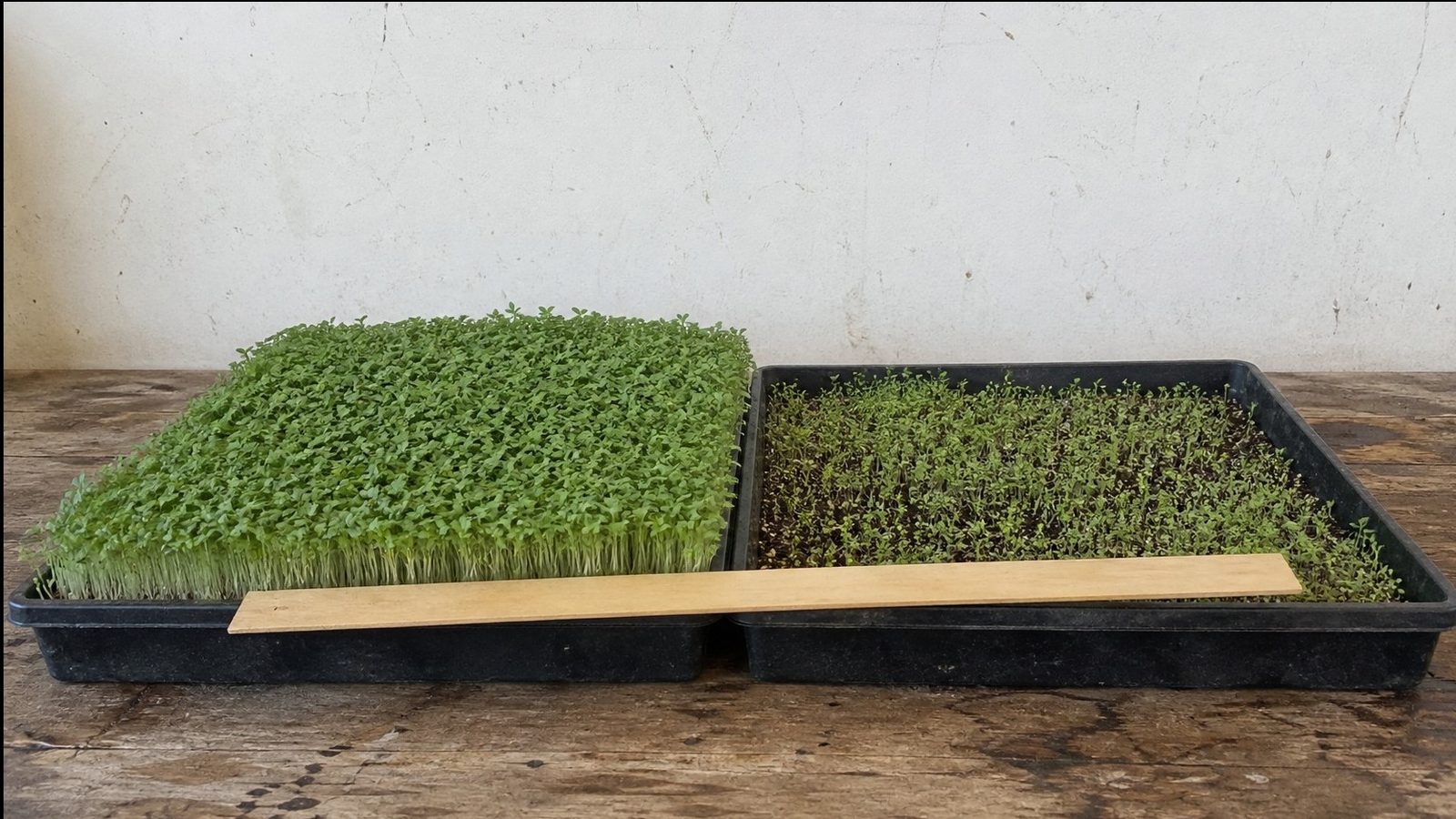
Before diagnosing a short tray, check that it is short.
The category convention is 2 to 3 inches, which extension sources give as the product description, with harvest at the cotyledon or first true leaf stage. Two inches is 5.08 cm.
Now the measured heights. A peer-reviewed unheated-greenhouse trial reported harvested means across ten crops.
Hover or tap a row to highlight it.
| Crop | Mean height | Against 5.08 cm |
|---|---|---|
| Carrot | 2.9 cm | Under |
| Lettuce | 2.9 cm | Under |
| Chard | 3.6 cm | Under |
| Kale | 4.4 cm | Under |
| Arugula | 6.2 cm | Over |
| Radish | 6.6 cm | Over |
| Spinach | 6.7 cm | Over |
| Mizuna | 7.9 cm | Over |
| Fennel | 8.4 cm | Over |
| Broccoli | 8.5 cm | Over |
Four of the ten came in below the height the category tells people to expect. Not because the trial failed, but because carrot and lettuce microgreens are short crops. Broccoli averaged 8.5 cm and carrot averaged 2.9, a spread of 5.6 cm within one experiment.
So, a grower who measures carrot microgreens against a ruler, finds 2.9 cm, and concludes the tray is stunted has diagnosed a healthy crop as a failure. The ruler is the wrong instrument. The right comparison is the same crop, same cultivar, same seed lot, at the same stage.
Those heights come from one trial with its own conditions, harvested at 33 days across seasons spanning 3.6 to 36.6°C. They are not target heights. They are a demonstration that the spread between crops is larger than the spread the convention allows for.
What to actually do
- Compare against the same crop, not a ruler. Four of ten crops in a peer-reviewed trial were under the advertised height and none of them was failing.
- Keep a reference tray. Same crop, cultivar, seed lot, density, medium and date, photographed daily beside a ruler. It is the only comparison that answers anything.
- Check the seed size before blaming the tray. Seed weight and shoot mass correlate at 0.92, so a small crop is usually a small-seeded crop.
- Do not add light to a short, green, sturdy tray. Low light stretches a crop taller and paler, so shortness is the symptom it does not cause.
- Check moisture under the root zone, not the surface. Severe deficit was worth up to three times the shoot length in the one trial that measured it.
- Weigh the tray before thinning. A dense tray of small plants may be at its designed yield.
- Feel the medium. Hard, slow-draining or waterlogged, with shallow roots and a boundary that follows the medium, points at air capacity.
- Measure media temperature, not room temperature, and expect cold to delay a uniformly healthy tray rather than shorten a sick one.
- Run the two-day measured test before deciding anything. Ten marked shoots, same time, two days.
- Change one variable at a time, or you will not learn which one it was.
Most of the size difference was decided before you sowed
A 17-species study measured individual fresh shoot mass from 16.7 mg in amaranth and 17.1 mg in lemon balm to 390.4 mg in sunflower. That is a 23-fold range between crops in the same system.
And it found seed weight and shoot mass correlated at r = 0.92.
A coefficient that high means the great majority of the size difference between crops is explained by how big the seed was. You chose the plant's size at the point you chose the crop, and no amount of light, warmth or feeding moves amaranth into sunflower's range.
Which is why "my microgreens are small" is usually a crop question rather than a fault. See the directory for what each crop is actually expected to do.
Low light makes a tray taller, not shorter
It is natural to blame a short crop on too little light, but low light does the opposite.
Low light promotes hypocotyl stretching. A tray that is underlit gets taller, and weak and pale with it. A Virginia Tech thesis reports that more light can make microgreens shorter, and that its shaded radish blend likely gained fresh weight through stretching rather than through growth.
So, a compact, green, sturdy tray is the one thing a light shortage does not produce. If the crop is short but the color is good and the stems are firm, rule out low light before touching the fixture.
Light still matters for biomass, color and timing, and one cited study found higher light increased brassica dry weight by 34 percent. It is not the explanation for shortness, and see leggy and pale microgreens for the problem it does cause.
What actually shortens a crop
Water deficit, which is the largest measured effect
A kale irrigation trial measured it directly. Under the most severe deficit, at 7.5 percent effective container volume, shoot length fell to 4.38 to 5.13 cm against roughly 7.49 to 13.12 cm in the other treatments. Fresh yield fell to 0.68 to 0.83 kg per m² from about 1.7 to 1.93.
That is up to three times shorter and nearly three times less crop, and it is the clearest measured cause of a short tray.
How to tell it apart from cold: an underwatered tray has dry or light medium, reduced turgor, short shoots and low fresh mass. Lift a corner of the mat and check under the root zone rather than judging the surface, which dries first and lies. See watering.
Density, where short is the design
A dense tray of small plants is often working exactly as intended. Sowing and seed density carries the measurement: higher density raised tray yield while cutting individual broccoli plants from 0.081 g to 0.052 g, about 36 percent smaller per plant.
Total tray weight can be fine while every stem is short. That is the trade density buys.
The tell is uniformity. Overcrowding produces many healthy, similarly small shoots in a continuous canopy. Failure is patchy, or comes with dry zones, collapse, odor, poor rooting or discoloration. Weigh the tray before thinning anything.
Medium, through air rather than nutrition
Physical properties limit roots. In one experiment, radish yielded 2.95 kg per m² on coir against 1.95 on sponge, and the authors attribute the difference partly to lower air capacity hindering root growth. Garden soil is too dense for a shallow indoor container for the same reason.
Recognition: the medium feels hard or waterlogged, drains slowly, roots are shallow or barely penetrating, and the affected area follows the medium boundary rather than a light or fan pattern. See soil and medium.
Cold, which delays rather than stunts
A cold tray is usually uniformly behind its calendar while staying green and turgid. The published bands are 60 to 70°F from one source and 70 to 75°F from another, and no single low-temperature effect size applies to all microgreens.
Confirm with a thermometer at media level and a warmer reference tray, not by inferring cold from height. The year-round page covers why the room temperature and the medium temperature are different numbers.
Nutrition, but only in a fed or inert system
"Microgreens live on the seed reserve" is too broad. It is true enough that no fertilizer is needed for a short home crop, and peer-reviewed work still finds nutrition changing yield, especially later in the crop and in interaction with species and substrate. Switching to plain water for the latter half of the crop reduced fresh production in one sponge system.
You cannot diagnose nutrient limitation from height. Look for a system-wide pattern that follows nutrient delivery, and rule out moisture, temperature, density and root restriction first. See fertilizer and nutrients.
Slow, or stopped
There is no validated way to call a tray dead from one inspection, and no published daily-growth threshold separating slow from stopped for any crop.
The bench test is a time series, not a glance. Mark ten shoots, measure and photograph them at the same time on two consecutive days after the crop's usual emergence window.
- Measurable increase, expanding cotyledons or true leaves, fresh green tissue: slow.
- No measurable change, plus lost turgor, damaged roots, odor or dead tissue: possibly stopped.
Nobody has run the rescue trial. No experiment takes stalled trays, corrects one cause, and reports what proportion recover to saleable size. That is a gap, not a verdict that recovery is impossible. A living green tray that starts adding height after a measured correction was slow all along.
A slimy or collapsed tray is a different question entirely, and it belongs with pests and diseases and disposal rather than with rescue.
What nobody has measured
- A universal minimum microgreen height, legal or industry. The convention is a product description, not a specification.
- A day-by-day height curve for any common crop. Your own ruler record beats any generic curve.
- A threshold separating slow from stopped, by crop.
- What proportion of stalled trays recover after a correction, at any crop age.
- A single low-temperature effect size applying across microgreens.
- A symptom-to-deficiency atlas for microgreen species.
- Whether seed age or vigor changes final height, isolated from germination percentage.
- Whether tray depth alone limits height, independent of medium and compaction.
- The visual sensitivity of telling underwatering from cold. Both descriptions above are triage, not a validated test.
Terms on this page
Tap a term to see what it means.
Etiolation. Stretching in low light, producing a taller, paler, weaker stem. The opposite of what a light shortage is usually blamed for here.
Sources
Opened 2026-08-12. The comparison of measured crop heights against the 2 inch convention is arithmetic on the two published figures, converting 2 inches to 5.08 cm, and both sides are shown. The density figures come from the seed density page linked above and are referenced rather than re-derived here.
- Riga and colleagues, microgreen crop comparison, 2024 (PDF) - harvested means of chard 3.6 cm, carrot 2.9, radish 6.6, lettuce 2.9, kale 4.4, arugula 6.2, mizuna 7.9, fennel 8.4, spinach 6.7 and broccoli 8.5 cm, measured after 33 days in an unheated greenhouse across seasonal experiments at temperatures from 3.6 to 36.6°C.
- Di Gioia and colleagues, 17 microgreen species, 2023 - individual fresh shoot mass from 16.7 mg in amaranth and 17.1 mg in lemon balm to 390.4 mg in sunflower, seed weight and shoot mass correlating at r = 0.92, 10 to 19 days to harvest, and source seed germination from 79 percent in red basil to 99 percent in borage.
- Tavan and colleagues, irrigation in kale microgreens, 2021 - the most severe water deficit at 7.5 percent effective container volume reducing shoot length to 4.38 to 5.13 cm against roughly 7.49 to 13.12 cm in other treatments, fresh yield falling to 0.68 to 0.83 kg per m² from about 1.7 to 1.93, rising proline and water stress indices, and a significantly lower root to shoot ratio under severe deficit.
- Nolan, Virginia Tech master's project report, December 2018 - that more light can make microgreens shorter, that a shaded radish blend likely gained fresh weight through hypocotyl stretching, and a cited study in which higher light increased brassica dry weight by 34 percent.
- Frontiers in Sustainable Food Systems, substrate and nutrient regime, 2023 - radish fresh yield of 2.95 kg per m² on coir against 1.95 on sponge with lower air capacity named as a contributing reason, and switching to water in the latter half of the crop reducing fresh production in the sponge system.
- Virginia Cooperative Extension, introduction to microgreen production - microgreens defined as harvested with the stem soon after the first true leaves emerge, germination typically 2 to 5 days, days from sowing to harvest of radish 6 to 10, broccoli 8 to 13, kale 8 to 14, arugula 6 to 14, sunflower 9 to 12 and beet 12 to 23, a general production recommendation of 60 to 70°F with a daily light integral of 9 to 16, and that density must be tested by facility, system, substrate and species.
- University of Maryland Extension, growing microgreens and baby greens indoors - microgreens listed at 2 to 3 inches and 7 to 21 days from sowing, 70 to 75°F for good germination and growth, no fertilizer needed for the short home cycle because seed nutrients suffice for initial growth, garden soil described as too dense for indoor containers, the instruction to keep medium moist but not saturated, the advice to sow purchased seed within three years, and the warning against mixing species with differing germination and growth rates.
- UF and IFAS Gardening Solutions, microgreens - harvest at the cotyledon stage or just as first true leaves emerge, at about 2 inches tall.
Keep reading
Growing guides
Do microgreens regrow after cutting?
A normal microgreen cut removes the growing point, so there is usually nothing left to regrow from. Roots do not make a new shoot; a surviving node does. The one documented path takes 3 to 4 weeks, about twice as long as sowing a fresh tray.
Read Do microgreens regrow after cutting?Growing guides
Growing a mix: one blend has a one-day harvest window and another keeps for three days
One commercial brassica blend's five components overlap on exactly one harvest day, and a three-crop spicy blend keeps only 2 to 3 days because of its cress, while another component lasts 14.
Read Growing a mix: one blend has a one-day harvest window and another keeps for three daysGrowing guides
Tray setup and drainage: the real usable area of a 1020, and how deep it needs to be
Two 1020 trays on sale today have inside floors of 187.6 and 192.6 square inches against the nominal 200, so every per-tray rate is quoted in a unit that varies. The one depth trial found yield still rising at 2.3 inches, which is above almost all published advice.
Read Tray setup and drainage: the real usable area of a 1020, and how deep it needs to beGrowing guides
Watering a tray: how much, how often, and what overwatering actually means
Overwatering is blamed for more failed trays than anything else in this category and has no numerical definition anywhere. The published volumes disagree by four times, and the reason is the medium: hemp holds nearly three times as much water per gram as coir does.
Read Watering a tray: how much, how often, and what overwatering actually means