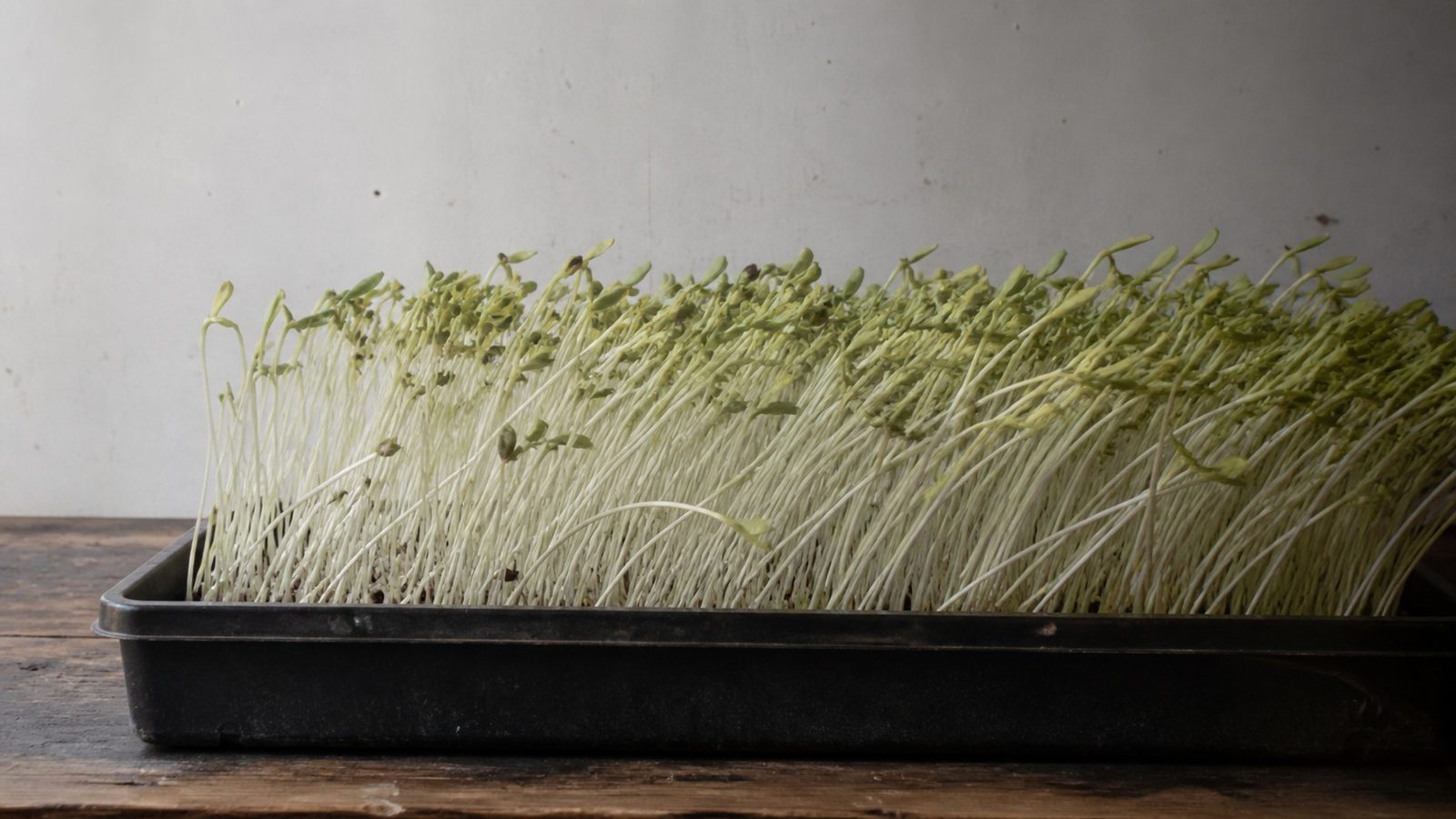
This is a light problem. Long, thin stems and pale leaves are the plant responding to not enough light, and the response has a name: etiolation.
It is worth saying up front what that rules out. It is not an overwatering problem, whatever the first ten results tell you, and it is not a disease. A stretched tray and a diseased tray fail in completely different ways, and confusing them is how people apply the wrong fix twice.
There is also one piece of bad news, and knowing it early saves you effort: already-stretched stems do not shorten. Nothing you do brings them back.
What is actually happening
In low light a seedling burns through its seed reserves pushing the hypocotyl upward, as though trying to outgrow shade. Light normally suppresses that extension and permits chlorophyll to form, which is why the same tray is both long and pale: the two symptoms share one cause.
The physical result is a long, narrow lever with very little support. That matters for what happens next, because a tray can fall over for two entirely different reasons.
Three different trays that all look wrong
Hover or tap a card to highlight it.
Etiolation
Uniformly long, thin, pale stems across the whole tray, bases CLEAN and firm. A light problem. Not recoverable to a short sturdy tray, but usually still edible.
Phototropism
Green, firm, healthy tissue leaning consistently toward one window or one lamp. A light DIRECTION problem, and the easiest thing on this page to fix. Rotate the tray.
Damping-off
Brown, black, pinched or water-soaked bases at or below the medium line, bare patches, seedlings dying after they fall. A disease. Not recoverable and not a lighting question at all.
Read that middle row carefully, because a leaning tray is the one people most often misdiagnose. Leaning toward the light with firm green tissue is a plant doing exactly what plants do.
The five-minute sequence
What to check, in order
- 1
Was the cover just removed?
If yes and the bases are clean, pale cotyledons are EXPECTED. This is normal post-blackout appearance, not a fault. Give even light immediately, and do not water it because it looks pale.
- 2
Is the lean consistently toward one light source?
If yes and the tissue is green and firm, that is phototropism. Rotate the tray or fix the light direction. Nothing is wrong with the crop.
- 3
Inspect the bases
Brown, black, pinched, water-soaked or mushy at the medium line, bare patches, or seedlings dying after falling, means likely damping-off. Stop handling other trays and discard the affected material and its medium.
- 4
No lesion, but the whole tray is long, thin and pale?
Etiolation. Uncover, supply the light you planned, and record the lamp position. The existing stems will not shorten, so this fixes the next tray rather than this one.
- 5
Foul odor, slime or spreading fuzz?
Treat that as spoilage or disease, not as legginess. Do not eat it and do not sell it. Clean and reset.
- 6
Still uncertain?
Do not make a food-safety call from appearance. Photograph the base, and grow a small clean comparison tray next run.
What causes it, kept separate
The documented causes, each with its own evidence, because they have different fixes.
Uncovering too late. The most direct cause. Extension guidance is to uncover when the majority have germinated, typically 2 to 5 days, then turn the light on. Every extra day under cover after that is a day of deliberate etiolation.
Not enough light at the canopy. Low light means low chlorophyll and long stems. A lamp further from the tray delivers sharply less intensity, and the distance is the variable people forget, because a fixture that looks bright to your eye can be well under what the tray needs.
Light from one side only. That produces a lean, not a uniformly pale weak tray. Different symptom, different fix.
Damping-off, which is not a lighting problem at all and belongs to the collapse question rather than this one.
What is not established, and it is most of the usual answer
This is the part worth reading twice.
Commonly listed causes with no primary source behind them
Hover or tap a card to highlight it.
"Too much water" and "not enough water"
Both are widely listed as causes of legginess, by several grower and vendor pages, and neither links to a primary source establishing it for stretched microgreens. You cannot diagnose water from height.
Heat, crowding, humidity, nutrients, pH, fans
All routinely named. All appear on grower pages without a source that establishes them as causes of etiolation specifically. Some may well matter; nobody has shown it.
The implication that a leggy tray was mishandled
Usually it just needed light sooner. The most common real cause is a cover left on past majority germination, which is a schedule decision rather than a mistake of care.
None of those factors is disproven. They are unevidenced for this symptom, and they are stated online with a confidence nobody has earned. The mechanism that IS documented is light, and it explains both symptoms at once, which the water explanation never does. So, when a tray comes out long and pale, change the light before you change anything else.
What growers are actually saying
Sampled from public posts and videos, July to August 2026. Every line links what it is quoting. How often something is repeated is not evidence that it is true, so every line also says what the sources actually establish.
Run the fan the moment it comes out of blackout, and a 12 hour light cycle is enough
Circulating u/jackbenway in r/microgreens, 3 upvotes
PRACTICE, and it points at the right two variables. Light-on-time is the documented cause of stretch, and getting light on the crop at uncover is exactly the fix. The 12 hour figure itself is a grower's number: no trial has established a photoperiod threshold for legginess.
What you can actually recover
Hover or tap a row to highlight it.
| What you have | Recoverable? | What to do |
|---|---|---|
| Just uncovered, pale, clean bases | Nothing to recover | Normal. Light it properly and carry on |
| Leaning, green and firm | Yes, fully | Rotate the tray or fix the light direction |
| Etiolated, clean and crisp | Partly. The stretch is permanent | Stop further stretch, let the cotyledons green. Fine for home use, poor as garnish. Stems will not stand again |
| Damping-off at the bases | No | Affected seedlings will die and cannot be saved. Discard the tray and medium, clean the area |
The middle row is the one that surprises people. A stretched tray is usually still perfectly good food. What it has lost is structure and appearance, which matters enormously if you are selling it as garnish and barely at all if you are putting it in a sandwich.
Fixing the next tray
Since this one cannot be un-stretched, everything useful happens next run.
Uncover on majority germination, typically 2 to 5 days, and treat that as a signal rather than a date. Get light on it immediately at that point. Put the lamp at the distance its output actually requires rather than where it fits, since intensity falls off sharply with distance. Light the tray evenly, or rotate it, so it has no reason to lean.
And write down what you did: cover-off day, lamp height, hours on. Legginess is the one microgreen problem where your own two trays side by side settle the question faster than any published figure can, because the variable is entirely in your room.
If you want a crop that shows this quickly and cheaply while you calibrate, radish is up in a day or two and tells you almost immediately whether your light is doing its job.
Terms on this page
Tap a term to see what it means.
Etiolation. The growth pattern of a plant in insufficient light: long thin stems, pale tissue, reaching upward. One cause producing both symptoms, which is why they always arrive together.
Sources
- University of Minnesota Extension, lighting indoor plants - insufficient light reducing chlorophyll production and producing pale tissue with long thin stems.
- University of New Hampshire Extension (seedlings under lights) - low-light seedlings elongating as if to outgrow shade, the sharp fall in intensity with lamp distance, and the key practical point that light will not shrink already stretched stems.
- University of Illinois Extension (PDF) - phototropism and the directional lean toward a one-sided light source, documented for microgreens specifically.
- Virginia Tech Extension (PDF) - uncovering when a majority have germinated, normally 2 to 5 days, then supplying supplemental light, and the crop-specific light responses in the dark-treatment literature.
- UC IPM, damping-off in the garden and the nursery guidance - decay at or below the medium line, a brown or water-soaked base followed by collapse, and the point that Rhizoctonia can occur in warmer and drier conditions rather than only wet ones.
- Utah State University Extension and University of Wisconsin Extension - the pathogens involved, and that affected seedlings will die and cannot be saved.
- PRACTICE, not evidence, and listed because these are the pages a grower finds first: Microgreens Resource, DeliSeeds and MicroVeggy each list heat, crowding, humidity, nutrients, fans, overhead watering, too much water and not enough water as causes of legginess, none of them citing a primary source that establishes any of it for this symptom.
Keep reading
Growing guides
Lighting microgreens: how much, how long, and when it starts
Aim for about 230 to 250 PPFD at the canopy and sixteen hours. Brightness saturates, hours move yield more than spectrum does, and the same five-day blackout raised sunflower yield 13 percent while cutting arugula's by 24.
Read Lighting microgreens: how much, how long, and when it startsGrowing guides
Growing microgreens in a small space: what fits, and what a jar actually gives you
A windowsill and a shallow tray will grow microgreens; a rinsed jar grows something else. Jars produce sprouts, eaten whole, which FDA treats as a distinct risk category, so the method decides what you end up with.
Read Growing microgreens in a small space: what fits, and what a jar actually gives youGrowing guides
Microgreens with kids: the crops that finish inside a two-week unit, and covering the weekend
Pick from the 5 crops that reliably finish inside a two-week unit, and plan for the weekend, because every published protocol assumes daily care and a school week is five days in seven.
Read Microgreens with kids: the crops that finish inside a two-week unit, and covering the weekendGrowing guides
Mold or root hair?
The white fuzz on a microgreen tray is usually root hair, and there is no test at the tray that proves it. What the mist test can and cannot tell you, and the one word that separates the two.
Read Mold or root hair?