Growing microgreens year round: what actually changes indoors between summer and winter
Cal HewittPublished Checked
- method
- temperature
- humidity
- troubleshooting
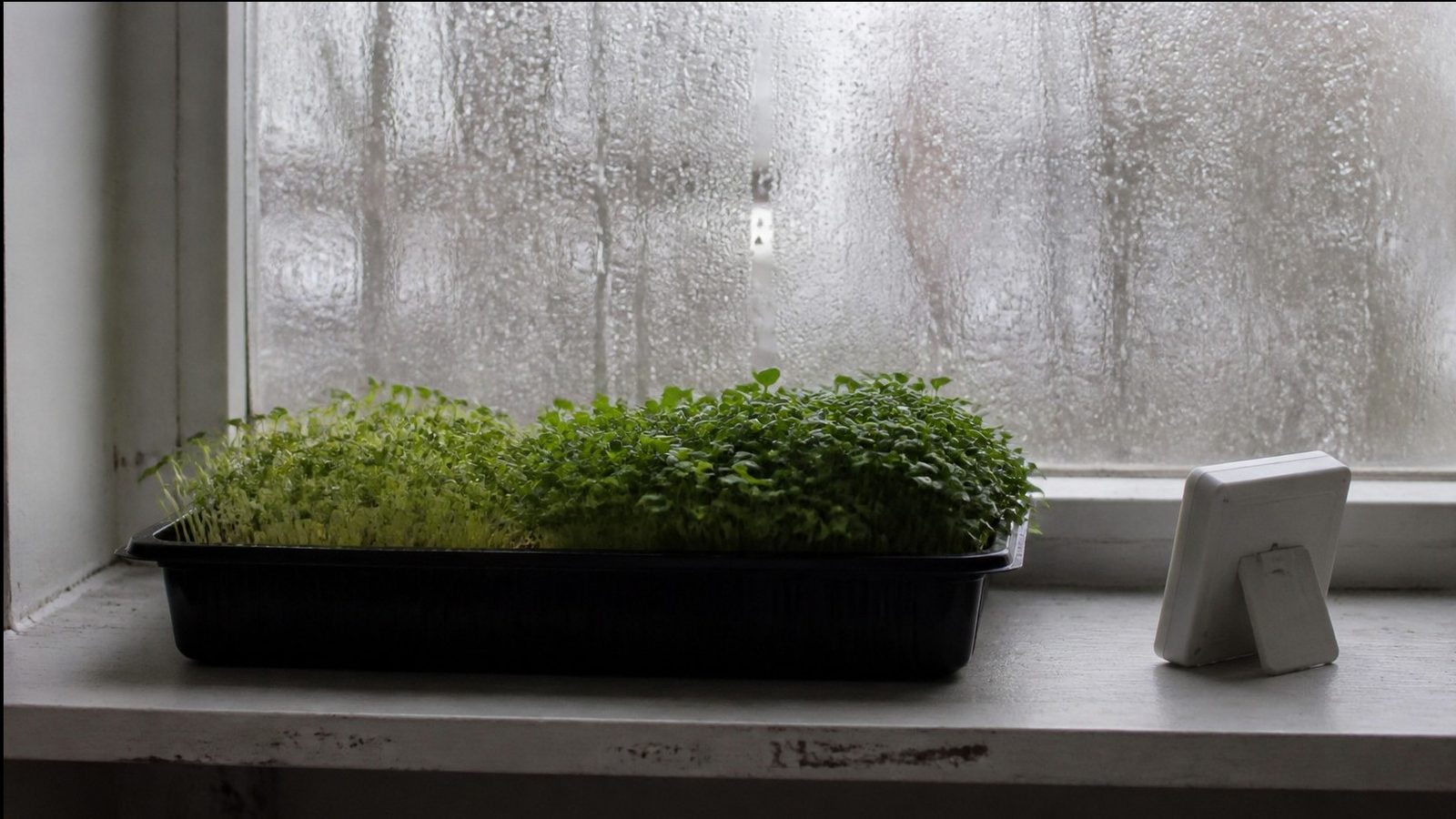
You can grow all year indoors, and what changes between seasons is the room, not the crop. Expect to manage temperature and humidity differently in winter than in summer, because a heated or air-conditioned room is still a climate and it moves.
That is worth saying plainly, because the usual promise is that moving indoors removes the seasons entirely. One page in the audit below puts it as "no seasons, no weather dependency," then tells the reader to maintain 70 to 75°F. Both halves cannot be true. If the room needed no management, there would be nothing to maintain.
And there is a measurement that settles it. Indoor temperature was recorded across 327 homes. In the warm season, outdoor temperature strongly predicted indoor temperature: at roughly 28°C outdoors, multi-day average indoor temperatures ran from about 22°C to above 30°C. In the heating season, homes sitting at the same outdoor temperature still differed by more than 10°C from each other. Indoor relative humidity was lowest in winter and highest in summer.
That is not microgreen research and it does not need to be. It is direct evidence that "a heated indoor space" is not one climate, and that two growers following identical advice in identical months are not running the same experiment.
The honest version of the claim is narrower and still generous: microgreens can be produced in every month indoors, under lights and with heat where needed. Season-buffered, not season-proof. A conditioned, sole-source-lit rack really can hold one climate all year, and that is an engineering achievement rather than a property of the crop.
What to actually do
- Put a thermometer and hygrometer at canopy height and write it down daily. This is the cheapest thing on the list and the extension guidance says plainly that it is enough to show where adjustment is needed.
- Measure the medium during germination, not the room. A 70°F room can hold a much colder tray.
- Move the rack off the variables first. Direct HVAC drafts, radiators, sunny glass and cold exterior walls are free to fix and cost nothing to test.
- Run a fan after emergence. It is the intervention for condensation and still canopies, and it does not dehumidify a sealed room, so do not expect it to.
- Do not add a heat mat or a humidifier before the log says which problem you have. More water never cured a cold tray.
- Shift the crop that is actually slow. If a cold spell only delays basil, move basil's sow date. Do not warm every tray or add three days to everything.
- Check the seed's summer, not the calendar. A bag stored hot and humid is a likelier cause than the month.
- Turn a leaf over before you diagnose. Downy mildew shows on the underside, and it is a different problem from damping off.
- If the rack is enclosed with sole-source LEDs, stop blaming the short days. They are not reaching your crop.
What actually changes at the tray, and what does not
The calendar does not change under sole-source lights. A timer delivers the same photoperiod in January as in July, so if your rack is enclosed and the LEDs are the only light, short outdoor days are not your explanation for anything.
What does change:
- Air and medium temperature, which are two different numbers and only one of them governs a seed.
- Humidity and condensation risk, in opposite directions across the year.
- Air movement, which changes when the heating or cooling runs.
- Daylight contribution, if a window or greenhouse reaches the tray at all.
- Irrigation demand, and the temperature of the water itself.
The one that catches people is the window. If daylight can reach the tray, the timer is not the whole light recipe, and the recipe changes month to month without you touching it. Either move the tray somewhere consistently opaque or accept that you are running a variable. See lighting.
Two crops in one family disagree, which is why "cold tolerant" is not a property
The heat mats page covers what warmth does to germination speed and the collapse at 35°C. This is the other half of the same study, and it is the more useful half for choosing a winter crop.
Rocket and radish were tested at eight constant temperatures from 5 to 35°C.
Hover or tap a row to highlight it.
| Measure | Rocket | Radish |
|---|---|---|
| Temperature of maximum final germination | 15 to 20°C | 20 to 25°C |
| Final germination in the cold | Above 87 percent from 5 to 25°C | Above 75 percent even at 5°C |
| Early root dry weight at 5°C | Down about 35 percent from maximum | Down as much as 83 percent |
| Inferred germination range | Narrower | Base about 1°C lower, ceiling more than 5°C higher |
Read the last two rows against each other, because they point opposite ways. Radish has the wider temperature range on paper, and radish is the one more damaged by cold in the growth that follows. It germinates at 5°C and then builds almost no root.
So "radish is cold tolerant" is true and useless. Tolerant at what? Percentage germinated, speed, uniformity, or the vigor of what comes up afterward? Those four answers are not the same answer, and a page that says a crop tolerates cold without naming the outcome has told you nothing you can act on.
It also retires family-level rules. These are two brassicas. If rocket and radish diverge this much, "the brassicas like it cool" is not a planning tool.
There is no validated temperature-sensitivity table for microgreen crops at all, and you can check any crop's own figures in the crop entries. Two species have been tested this way. The rest is inference.
The published bands disagree, and mostly they are not arguing
Hover or tap a row to highlight it.
| Source | Temperature | Humidity | What it is measuring |
|---|---|---|---|
| Virginia Tech | 60 to 70°F, 16 to 21°C | 50 to 70 percent | Air, general production |
| Perennia | 64 to 75°F, 18 to 24°C | 40 to 60 percent | Air, "most crops," stated to vary by variety |
| Johnny's | 65 to 75°F, 18 to 24°C | Not stated | Ambient air, with a warning that medium temperature is crop-specific |
| Illinois | About 75°F | Not stated | Soil temperature for germination, not air |
Three of those are air and one is medium, which is most of the apparent disagreement. The temperature and airflow page owns the working band and the airflow question. What matters here is the distinction: germination happens in the medium, and a 70°F room can hold a considerably colder tray on a cold shelf, near glass, or on a concrete floor.
Measure the medium during germination, not the room. If the two differ, the medium is the one the seed is answering to.
Winter: cold, slow, and condensing
The documented winter problems are not a special winter disease. They are cold medium, low light where a window is involved, and condensation.
Cold extends the pre-emergence window, and that is the actual risk. A seed that takes longer to come up spends longer as a seed in wet medium, and anything that slows a seedling raises damping-off exposure. The mechanism is well established even though no published conversion exists from a cold room to added days-to-harvest for any crop. Nobody has run it.
Condensation is the one people misread. Air cooling in the evening loses its capacity to hold water until moisture condenses on plant and structure surfaces, and a measured greenhouse example showed relative humidity approaching 100 percent overnight with leaf wetness rising, while air circulation reduced it. A room hygrometer reading 55 percent at head height tells you nothing about a leaf surface at 4am. If leaves are wet at lights-on, that is your answer and a fan is the intervention.
Do not harvest to a calendar promise in a cold room. Cut to the crop's stage, log the sow date, and record the extra days against that crop's own winter history.
Summer: hot, humid, still, and a named pathogen
Warm-season outdoor temperature strongly predicts indoor temperature, so an uncooled grow room genuinely is hot, whatever the word "indoors" implies.
Heat alone is not the disease mechanism and this is where the folk explanation fails. Dense, wet, poorly ventilated seedlings are the combination that matters, and the organism decides which conditions favor it: some Pythium prefer cool and wet, while Rhizoctonia and other Pythium cause damping-off in warmer and drier conditions. So "summer mold means too much water" is an incomplete diagnosis covering at least six candidates: seed density, contaminated seed, medium or trays, standing water, delayed emergence, canopy humidity, and which pathogen you actually have.
One pathogen now has a specific microgreen report behind it. A 2024 USDA report confirmed **downy mildew, Hyaloperonospora brassicae, on commercial kale, broccoli and cabbage microgreens, with symptomatic cotyledons yellow, gray or dying and the disease visible on leaf undersides in very humid conditions. That is a named organism on named microgreen crops**, which is rarer in this literature than it should be. Turn a leaf over before calling anything mold, and see mold or root hair.
On general summer humidity, resist the tempting number. Indoor fungal counts in a five-home study peaked in summer at a median 235 CFU per m³ against 26 in winter, a ninefold difference. That is household air, not crop pathogens, in five homes, and the researchers themselves found temperature, humidity and air exchange did not fully explain the seasonality. It makes a seasonal effect plausible. It does not measure one.
The seasonal variable nobody thinks about: where the seed sat
Seed does not know what month it is at sowing. It does know how it was stored since the last one.
High temperature and humidity reduce vegetable seed germination and vigor. The guidance is to avoid storage above 70°F or 60 percent relative humidity, with 35 to 40°F below 40 percent RH as ideal, and sealed containers if the fridge is the plan, because fridge humidity runs high.
So, the real seasonal seed risk is not winter. It is a bulk bag that spent July in a garage. If a crop that has always been reliable goes slow, run a counted germination test from that lot beside a fresh one at the same measured medium temperature before changing anything about the tray. See buying microgreen seed and poor germination.
Water temperature is a smaller version of the same idea. Clean water at 68 to 77°F is the seedling guidance, and 50°F water slows growth and increases the opportunity for damping-off infection. Plumbing runs colder in winter. Nobody has measured winter against summer irrigation water on this crop, but it costs nothing to avoid visibly cold water on a cold germination tray.
What the year-round guides leave out
Six pages returned for year-round indoor growing were audited on 2026-08-11. Three of the six assert or imply any-time growing without addressing room temperature at all.
The recurring error is not "you cannot grow indoors in winter." That claim would be wrong, and the crop evidence says so: rocket and radish both germinated at 5°C. The error is using the word "indoors" as though it meant measured, stable environmental control, when the 327-home measurement shows it routinely does not.
The most repeated factual error underneath it is treating ambient room temperature as sufficient. Germination happens in the medium, crop optima differ even within one family, and a tray can fail cold, hot, wet or still by four different routes.
What nobody has measured
- A conversion from a cold room to added days-to-harvest, for any crop.
- A temperature-sensitivity ranking across microgreen crops. Two species have been tested properly.
- Seasonal humidity against microgreen emergence, yield or disease in comparable indoor trays, with continuous canopy logging.
- Winter against summer irrigation water on any microgreen outcome.
- A winter-specific tray loss rate, or any seasonal failure pattern with a denominator. Without knowing how many trays were planted, "more mold in summer" is not a rate.
- A multi-season yield and quality comparison using the same seed lots, density, medium, light settings and harvest criterion across a full year.
- A minimum workable garage temperature. The two crops tested germinated at 5°C, so the folk threshold of 60°F is wrong, and what replaces it is unknown.
- Seasonal demand. That is a market question, and the reports that exist describe different business models rather than a demand curve.
Terms on this page
Tap a term to see what it means.
Ambient temperature. The air around the tray, which may differ from the medium and from the leaf surface. The number most advice quotes and the least useful of the three.
Sources
Opened 2026-08-11. The heat mats page owns what warmth does to germination speed and the collapse at 35°C, and the temperature and airflow page owns the working band and the airflow question; neither is re-derived here. The ninefold indoor fungal figure is household air in five homes and is presented as plausibility rather than a crop measurement.
- Toscano and colleagues, rocket and radish germination across eight temperatures, 2025 (PDF) - final germination maximized at 15 to 20°C in rocket and 20 to 25°C in radish, rocket above 87 percent from 5 to 25°C and at least 84 percent up to 35°C without salt stress, radish above 75 percent even at 5°C, radish early root dry weight up to 83 percent below maximum at 5°C against 35 percent for rocket, and radish's inferred base temperature nearly 1°C lower with a ceiling more than 5°C higher than rocket's.
- Tamerius and colleagues, indoor temperature and humidity in 327 homes, 2013 - outdoor temperature strongly predicting indoor temperature in the warm season, multi-day average indoor temperatures running from about 22°C to above 30°C at roughly 28°C outdoors, homes at similar outdoor temperatures differing by more than 10°C in the heating season, and indoor relative humidity lowest in winter and highest in summer.
- Virginia Cooperative Extension, introduction to microgreen production - a general air temperature recommendation of 60 to 70°F and relative humidity of 50 to 70 percent, light, temperature, humidity and CO2 named as adjustable production variables, damping off from Pythium or Phytophthora as a leading concern with mildews possible in the moist environment, the instruction to trial settings per species, cultivar, facility and system, and that a digital thermometer and hygrometer with a daily written log are enough to identify needed adjustments.
- Perennia, microgreens fact sheet (PDF) - 18 to 24°C and 40 to 60 percent relative humidity as sufficient for most crops with explicit variation by variety, dense stands described as susceptible to humidity-linked damping off, air movement and exchange making temperature and humidity uniform, warm-medium basil distinguished from cooler-substrate brassicas, and supplemental heat and winter lighting required to hold schedules in northern seasonal production.
- Johnny's Selected Seeds, microgreens production guide (PDF) - 65 to 75°F for ambient air with the warning that soil and germination temperature depend on variety and that basil is warmer-loving than brassicas, temperatures above 75°F stated to inhibit germination in some varieties and increase disease pressure, and days to maturity described as fluctuating with temperature, moisture, sunlight, variety and cover.
- University of Illinois Extension, growing microgreens (PDF) - about 75°F given as the ideal soil temperature for microgreen germination, with a germination mat suggested as an option.
- University of Minnesota Extension, preventing seedling damping off - clean water at 68 to 77°F for young seedlings, 50°F water slowing growth and increasing the opportunity for damping off infection, cool soil and anything slowing seedling growth raising risk, Pythium, Rhizoctonia and Fusarium named as common agents, and those agents surviving in soil and debris and entering on reused trays, tools, media, water or seed.
- UC IPM, damping off - that some Pythium favor cool and wet conditions while Rhizoctonia and other Pythium cause damping off in warmer and drier conditions, which is why one seasonal explanation cannot cover the disease.
- USDA Agricultural Research Service, downy mildew on microgreens, 2024 - Hyaloperonospora brassicae confirmed on commercial kale, broccoli and cabbage microgreens, with symptomatic cotyledons yellow, gray or dying and disease evident on leaf undersides in very humid conditions.
- University of Alaska Fairbanks Cooperative Extension, controlling the greenhouse environment - cooling evening air losing water-holding capacity until moisture condenses on plant and greenhouse surfaces, and airflow mixing air to reduce the chance of falling below dew point.
- UC ANR, condensation on leaf and flower surfaces - a measured greenhouse example with relative humidity approaching 100 percent overnight and leaf wetness rising, and air circulation reducing condensation.
- Utah State University Extension, seed storage and handling - high temperature and relative humidity reducing vegetable seed germination and vigor, the advice to avoid storage above 70°F or 60 percent RH, 35 to 40°F below 40 percent RH given as ideal, and sealed containers recommended in refrigerators because refrigerator humidity can be high.
- Frankel and colleagues, seasonal variation of indoor microbial exposures, 2012 - indoor fungi in five Danish homes peaking in summer at a median 235 CFU per m³ against 26 in winter, with the researchers finding temperature, humidity and air exchange did not fully explain the seasonality. Household air rather than crop pathogens.
- Parkes and colleagues, kale microgreen vertical farm model, Scientific Reports, 2023 - a modeled facility including climatization and averaging production over 12 months, used here only as the example of what a fully conditioned space is doing.
- Practice sample, audited 2026-08-11 for whether room temperature is addressed at all, and used only as a record of what is published: Botanical Interests, RHS and University of Hawaii, none of which addresses it; against Wind River Greens, Live to Plant and Grow It Indoor, which give uncited ranges, the last of these promising "no seasons, no weather dependency" while instructing the reader to maintain 70 to 75°F.
Keep reading
Growing guides
Temperature, humidity and airflow: run the room at 70°F and it suits 39 of 44 crops
About 70°F sits inside the published germination range for 39 of the 44 crops that have one, so a single setting runs most of a mixed bench. No source publishes an airflow figure for a tray, so point a fan along the shelf rather than at the crop.
Read Temperature, humidity and airflow: run the room at 70°F and it suits 39 of 44 cropsGrowing guides
Outdoors and under glass: the tunnel is hottest exactly when you need it coolest
A high tunnel has been recorded at 120 to 140F in March and April and near 0F overnight in January, against a recommended 64 to 75F band. Ventilation cannot cool the air below what is outside.
Read Outdoors and under glass: the tunnel is hottest exactly when you need it coolestThe test bench
Thermometers and Hygrometers for Microgreens: One for the Medium, One for the Room
Temperature has to be read in the medium at seed depth. Every instrument sold for the job reads air, and of ten product pages opened, exactly one publishes where its sensor actually sits.
Read Thermometers and Hygrometers for Microgreens: One for the Medium, One for the RoomGrowing guides
Do microgreens regrow after cutting?
A normal microgreen cut removes the growing point, so there is usually nothing left to regrow from. Roots do not make a new shoot; a surviving node does. The one documented path takes 3 to 4 weeks, about twice as long as sowing a fresh tray.
Read Do microgreens regrow after cutting?