Thermometers and Hygrometers for Microgreens: One for the Medium, One for the Room
Cal HewittPublished Checked
- equipment
- temperature
- humidity
- buying
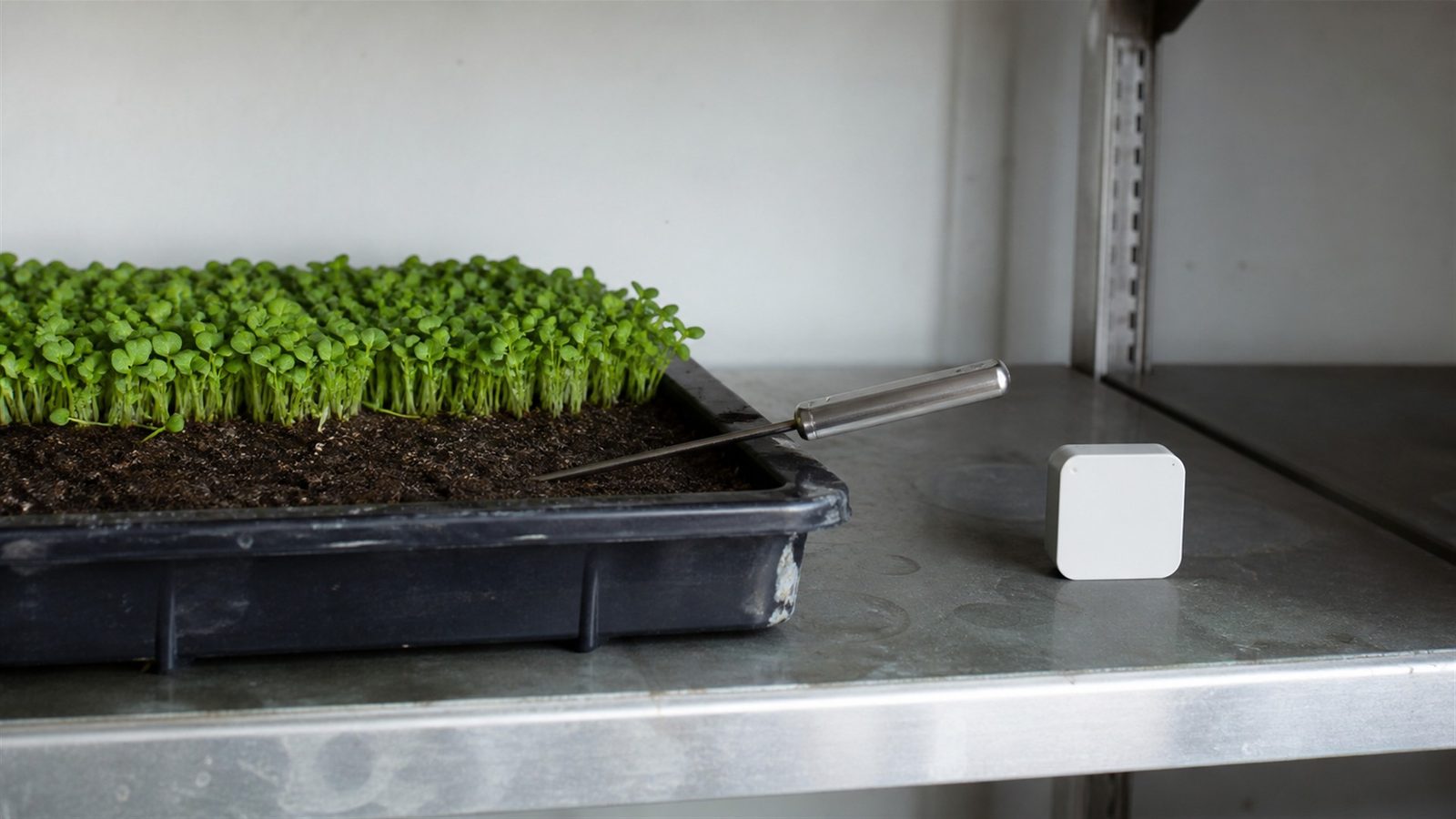
Temperature has to be read in the medium at seed depth, near the center and at an edge. Almost every instrument sold to microgreen growers measures air instead.
That is not a small mismatch. Air temperature, medium temperature and surface temperature are three different measurands, and a peer-reviewed greenhouse measurement guideline keeps them formally separate: substrate temperature belongs at the center of the root matrix, air temperature at canopy level, surface temperature at the plant tissue. A room combo cannot answer a root-zone question, because it senses air.
Six classes are sold, and they answer different questions: an instant-read contact probe, a long-stem soil probe, a room thermometer and hygrometer combo, a wireless app sensor, an infrared gun, and a data logger.
What to actually do
- Buy one tip-sensing contact thermometer for the medium and one air sensor for the room, and do not expect either to do the other's job. They are different measurements, and it is the first one that tells you what the seed is sitting in.
- Check where the sensor sits before you buy. If the page does not say, you cannot know whether a shallow reading is real. This is the single specification that decides the purchase, and only one product page in ten publishes it. Checked against what the soil probe category actually sells on 2026-08-12, the shortest stem readily available is about 5 inches, the range runs out to 12 and 20 inch compost probes, and not one listing in the top results says where along that stem it senses.
- Do not buy an infrared gun for this. It reads a surface, and its ±4°F is wider than the entire published temperature band on nine crops.
- Do an ice bath before you trust it, then record the offset rather than correcting it silently. It costs nothing and it is the only verification most of these instruments will ever get.
- Put the air sensor at canopy height near the middle of the shelf, away from the lamp, the fan jet and the humidifier plume. Label its log "air."
- Only put a sensor under the dome if you want to know about dome air, and accept that the reading sits outside the accuracy band its maker published.
- If you log anything, log at the tray. Temperature is the only lever with published day counts on how fast a crop finishes, and it costs a thermometer to use.
- Read a $10 hygrometer as a direction, not a number. It will tell you the room got wetter. It will not tell you it is at 62%.
- Treat an instrument as monitoring, not as a treatment. Sticky card monitoring is the one pest intervention with no pesticide label question attached, and a thermometer sits in the same class: it tells you what is happening and changes nothing on its own.
Nobody has ever validated one of these in wet medium
Across the opened manufacturer pages for ThermoWorks, Luster Leaf, REOTEMP, SensorPush, HOBO, Klein, Lascar, Elitech and AcuRite, no manufacturer publishes a validation that places its instrument in wet growing medium at a stated depth in a crop tray. Nine makers, zero validations. The instruction this whole site gives is not one that any manufacturer has tested its product against.
What the product pages do publish, audited across ten of them:
Hover or tap a row to highlight it.
| Specification | Published by |
|---|---|
| A measurement range | 9 of 10 |
| An accuracy number | 8 of 10 |
| Resolution | 5 of 10 |
| Response time | 5 of 10 |
| Probe length | 4 of 10 |
| An IP or water statement | 4 of 10 |
| Probe diameter | 3 of 10 |
| A calibration method or traceable reference for the shipped unit | 2 of 10 |
Read the bottom row against the top one. Nine of ten will tell you what range they cover. Two of ten will tell you why you should believe the number inside it.
And the specification that decides whether an instrument can do this job at all is the one nobody prints. To read at seed depth you need to know where inside the probe the sensor sits. Four pages publish a probe length, three publish a diameter, and exactly one publishes the sensing element's position: Thermapen ONE puts a micro-thermocouple at the tip and states it needs only 1/8 inch, 3 mm, of insertion. ThermoPop 2 supplies no sensor-location diagram. Luster Leaf's 9-inch soil probe and REOTEMP's 6-inch stem are built for garden soil and neither document says where along the stem it senses.
A 9-inch probe in a tray with an inch of medium is not a depth instrument, it is a long thermometer lying in the wrong plane.
What an error means against a crop's temperature band
An accuracy figure only means something next to the decision it has to survive. So, here it is against the published germination bands.
Forty-four crops publish a germination temperature band and 18 have none published. Those 44 bands have a median width of 10°F, spread across 21 distinct bands. That is the target an instrument has to land inside.
A plus-or-minus figure is a two-sided interval: at ±1°F the true value sits anywhere in a 2°F window.
Hover or tap a row to highlight it.
| Instrument | Stated accuracy | Uncertainty window | Share of the median band | Bands it swallows whole |
|---|---|---|---|---|
| SensorPush HT.w | ±0.2°C | 0.72°F | 7.2% | 2 of 44 |
| HOBO MX1101 | ±0.21°C | 0.76°F | 7.6% | 2 of 44 |
| Thermapen ONE | ±0.5°F | 1.0°F | 10.0% | 2 of 44 |
| ThermoPop 2 | ±1°F | 2.0°F | 20.0% | 2 of 44 |
| Klein IR5 | ±4°F | 8.0°F | 80.0% | 9 of 44 |
The infrared gun's permitted error is wider than the entire published band on nine of the forty-four crops that have one. It is also the wrong instrument on principle, because an IR thermometer reads a surface and cannot see through wet medium to the seed. The laser is an aiming aid, not a measurement.
Two crops make the point sharper than any specification does. Basil and bulls blood beet are published at a flat 75°F with no range at all. No instrument at any price can confirm you are inside a band that has no width, which is worth knowing before you buy precision you cannot use.
And the one field discrepancy anybody recorded is bigger than all of this. The single buyer review on the $14.99 soil probe reports it reading 4°F warmer than another thermometer. That is 40% of the median band, and it equals or exceeds the entire published band for 5 of the 44 crops.
And none of this touches the gap between the number you set and the number in the room. A grower walkthrough on the On The Grow channel reports a wall air conditioning unit set to about 72°F holding a grow space at closer to 67°F. That is grower practice from 2019 rather than a measurement anybody controlled, so treat it as an anecdote. But the size of it is the point: a 5°F gap between the setpoint and the space is half the median crop band, and it is invisible to anyone who reads the thermostat instead of the room.
For the band itself, the temperature and airflow page puts 70°F inside the published range for 39 of those 44 crops, and every crop entry carries its own figure. What matters when you are buying is whether the instrument in your hand can find it.
Prices, and where the price is not published
Hover or tap a row to highlight it.
| Class | Product and seller | Price observed | What it buys or lacks |
|---|---|---|---|
| Instant probe | ThermoPop 2, ThermoWorks | $39.00 | NIST-traceable certificate included |
| Instant probe | Thermapen ONE, ThermoWorks | Not displayed on the opened page | Tip thermocouple, 3 mm insertion, certificate |
| Instant probe | OEMTOOLS 24350, Famous Microgreens | $24.96 | Dial instant-read, no traceability shown |
| Soil probe | Luster Leaf 1625, Greenhouse Megastore | $14.99 | 9-inch probe, no numerical accuracy |
| Soil probe | Luster Leaf 1625, Lowe's | $20.02 | Same model, 33.6% more |
| Soil probe | REOTEMP HH0602F23PS, Grainger | $63.57 | 6-inch stem, ±1% claim |
| Room combo | AcuRite 00613, Home Depot | $12.99 | Indoor air only, not medium |
| Room combo | Unbranded LCD, Eat Your Microgreens | €6.95 | Indoor air meter, no accuracy shown |
| Wireless | SensorPush HT.w, SensorPush | $69.99 | Air temperature and RH, app history |
| Wireless | HOBO MX1101, Onset | $165.00 | Bluetooth logger, non-condensing only |
| IR surface | Klein IR5, Klein | Not displayed by the manufacturer | Surface only, 12:1 optics |
| Data logger | Elitech RC-5, Elitech | $31.00, or $86.00 certified | Temperature logger |
| Data logger | Lascar EL-USB-2, Lascar | £60.50 ex VAT | Temperature and RH logger |
The same soil probe is $14.99 at one seller and $20.02 at another, a 33.6% spread on one model, which is a reminder that a price on a recommendation page is not a market price.
Proving an instrument is right costs more than the instrument. Elitech sells the RC-5 at $31 with a factory calibration or $86 with an ISO 17025 laboratory certificate. The certificate is $55, or 1.8 times the logger it certifies. ThermoWorks includes a NIST-traceable certificate in the $39 ThermoPop, which is the cheapest honest answer in the category: the paperwork is bundled rather than sold back to you.
The range from cheapest to dearest room instrument is 12.7x, $12.99 against $165.00, and the expensive one is a logger rather than a more accurate display.
Humidity is worst exactly where you want it
The one place a grower most wants a humidity number is under the dome, and that is the one condition both logging sensors exclude from their accuracy specification.
- HOBO MX1101 is specified 0 to 95% RH non-condensing, measures 1 to 90% non-condensing, and degrades from a typical ±2% RH between 20 and 80% to a typical ±6% outside that band.
- SensorPush HT.w lists 0 to 100% RH, but its typical ±2% holds only from 10 to 90% at 25°C, and it warns that prolonged exposure above 80% RH can add up to a +3% offset that only gradually reverses.
A covered tray forms condensation and near-saturated air. So the number you would read there comes from a sensor operating outside the conditions its accuracy statement covers, and no source publishes an RH target inside a covered tray anyway: not a range, not a maximum, not a venting trigger. Two independent reasons that reading cannot drive a decision.
Where the instrument is trustworthy, there is a target. Virginia Cooperative Extension gives 50 to 70% RH for open growing conditions, a 20-point band that sits comfortably inside the 20 to 80% window where these sensors hold ±2%. That permitted error consumes 4 of the 20 points, or 20% of the band. Push the same sensor to a condensing dome and the ±6% figure consumes 12 of 20 points, or 60%.
Growers hit the out-of-spec condition routinely, and they say so. A grower on the Microgreens Master channel describes a rainy day in a greenhouse where "your humidity just skyrockets up to like a hundred percent and even with fans blowing around and everything it's not gonna keep your microgreens dry." At 100% RH every hygrometer on this page is outside the window its accuracy figure covers. The reading is not wrong in an interesting way, it is simply unspecified, and the grower already knows the answer without it.
Placement moves a reading more than the specification does. A greenhouse canopy study measured relative humidity about 25 percentage points higher at the canopy than in ambient air on sunny days, with peaks up to 40 points during humidification. That is not a microgreen dome measurement and it is not a correction you can apply, but it settles the principle: a hygrometer on the far wall is not measuring your trays.
Response time is not the number on the box
Response time is a route to equilibrium under stated conditions, not a property of the instrument. Thermapen ONE states 1 second, ThermoPop 2 states 2 to 3 seconds, the Klein IR5 states under 0.25 seconds for a surface.
The most instructive figure is HOBO's, because it publishes both sensors on one device. In 1 m/s airflow, its RH sensor reaches 90% of a step in 20 seconds and its air temperature sensor takes 7 minutes 30 seconds. The temperature sensor is 22.5 times slower than the humidity sensor in the same housing.
None of those figures transfers to a probe buried in wet coir, and the size of the error from a partly buried probe equilibrating with air and its own shaft instead of the medium is not published by anyone.
Calibration you can actually do, and what it does not prove
The ice point is a real check and it is free. NIST treats the ice melting point as a legitimate performance check for a narrow-range digital thermometer: crushed ice, just enough water to fill the gaps, stirred, with the sensing tip in the center and away from the wall and bottom. The reference is 0°C, 32°F. A careful procedure puts the bath itself at about ±0.1°F.
It is one point. It tells you the instrument is right at freezing, which is 38°F below where your crop lives. A second point needs the steam procedure, corrected for elevation and barometric pressure, with the probe in the steam space rather than the water, 10 to 15 cm of immersion and a 5 minute wait. That verifies a high point, not room temperature.
The salt test for humidity is practice, not calibration. A sealed container with a wet slurry of ordinary table salt settles at roughly 75% RH after about 24 hours. No opened source establishes the actual error contributed by kitchen salt, water purity, container leakage, temperature or sensor placement. It is good for finding a large offset and nothing more. Record the offset rather than assuming a non-adjustable display can be corrected.
Drift is the reason a one-time check expires. Texas Instruments is explicit that an initial humidity accuracy figure describes the sensor at shipment, and that aging, sustained heat and humidity, and contaminants all move it. HOBO publishes under 0.1°C per year and under 1% RH per year. Those are the two numbers most consumer meters simply do not have.
A room combo cannot answer a root-zone question
Four microgreen and seedling recommendation pages name an instrument for this job. Virginia Cooperative Extension is evidence; the other three are practice.
All four recommend or normalize an air temperature and humidity instrument. None of the four states a model-specific, range-bound accuracy figure for what it recommends. Virginia Tech names no model, one names an Inkbird without an accuracy figure, one gives a $10 to $20 budget, and one says "cheap."
The failure is not that they recommend air monitoring, which is genuinely useful. Virginia Tech supports daily recording of air temperature and humidity and notes that logging sensors can supply history a spot check misses. That is sound. The failure is the silent substitution: a room combo presented as though it answers a root-zone question, and a display resolution of 0.1° read as though it were an accuracy of ±0.1°.
Oddly, the product listings publish the figure those pages leave out. A WiFi room thermometer and hygrometer of the kind that fills this category states ±0.54°F and ±3% RH on its own detail page, in a table covering several models, at $31.99. That is a real specification, and better than any of those four pages supplies.
It is also an air sensor. Its ±0.54°F is a 1.08°F window, a tidy 10.8% of the median crop band, and its ±3% RH consumes 6 of the 20 points in the only published humidity target. Both figures are perfectly respectable and neither one tells you what the seed is sitting in. The category is not imprecise. It is precise about the wrong thing.
Who should skip this entirely
Anyone whose conditions are stable, whose room instrument has passed a check, and who is not changing anything. If no heat source, dome, humidifier or tray setup has changed, and no decision depends on knowing medium rather than air, a new instrument buys you a second opinion on a question already answered.
Do not skip the medium measurement when you are changing a heat source, comparing a center to an edge, diagnosing uneven emergence, or proving out a new tray and medium. Those are exactly the cases where the room reading and the seed's reading come apart, and they are the reason the heat mat page says to measure before buying anything.
And the cheapest route is no purchase at all. A borrowed tip-sensing thermometer, ice-checked before use, answers a one-time "is this spot unusually cold?" question. It cannot produce a humidity history, and it is not adequate for unattended monitoring.
What is still genuinely unknown
- Whether any of these instruments is accurate in wet medium at seed depth. Zero manufacturers have published a test. It would take a traceable reference at the same depth, replicate instruments and a stated equilibration time.
- Whether inserting a probe into a just-sown tray hurts emergence. No extension, manufacturer or peer-reviewed source has tested it. Common-sense disturbance is not a result.
- How far a partly buried probe reads toward air rather than medium in a thin wet layer, which is the everyday version of the same question.
- A typical tray fill and sowing depth across crops and media, which is what would make "seed depth" a number rather than a description.
- The failure rate of consumer hygrometers in humid grow spaces. One buyer report describes moisture entering a display and blacking it out; that is a documented failure mode, not a rate.
- Which is the cheapest instrument that can genuinely read at seed depth. The one that publishes its sensor position did not display a price, and the one that costs $14.99 does not publish a sensor position.
Terms on this page
Tap a term to see what it means.
Accuracy. The permitted closeness to a reference, under stated conditions and only inside a stated range. Always two-sided: ±1°F is a 2°F window.
Sources
Opened 2026-08-12. Prices are snapshots on that date, not price promises, and this page is rechecked at least every two months. The band arithmetic is computed from the germination temperature field on all 62 crop entries, of which 44 publish one.
- ThermoWorks ThermoPop 2 - $39.00, ±1°F in stated ranges, NIST-traceable certificate, IP67, probe dimensions and the 2 to 3 second response claim.
- ThermoWorks Thermapen ONE and its operating instructions (PDF) - the tip thermocouple, the 3 mm minimum insertion, ±0.5°F, the 4.3-inch stem and IP67. The opened product page did not display a price.
- NIST, thermometer verification - the ice melting point as a performance check, the elevation and pressure correction the steam point needs, and the 10 to 15 cm immersion and 5 minute wait.
- ThermoWorks, proper ice bath - the practical construction of the slurry and the stated bath uncertainty of about ±0.1°F.
- Fluke, what is an IR thermometer - that infrared measures surface and not internal temperature, which is why it cannot answer the medium question.
- Klein IR5 dual-laser infrared thermometer - ±4°F or ±2% above freezing, 12:1 distance-to-spot ratio and the sub-0.25-second response. No price displayed by the manufacturer.
- Luster Leaf digital soil thermometer at Greenhouse Megastore at $14.99 with a 9-inch stainless probe and a "calibrated for soil use" claim but no numerical accuracy, and the same model at Lowe's at $20.02, carrying the single one-star review reporting slow response and a reading 4°F warmer than another thermometer.
- REOTEMP soil dial thermometer at Grainger - $63.57, 6-inch stem, 0.25-inch diameter and a ±1% claim with no stated test reference.
- AcuRite accuracy page and the 00613 at Home Depot - the range-specific air temperature and humidity claim, the $12.99 price, and the review distribution of 38 one-star and 25 two-star out of 514.
- SensorPush HT.w - $69.99, typical ±2% RH and ±0.2°C, the 10 to 90% RH window that figure applies in, and the up to +3% offset after prolonged exposure above 80% RH, plus SensorPush on outdoor use for the water-resistant rather than waterproof limit.
- Onset HOBO MX1101 - $165.00, ±0.21°C from 0 to 50°C, RH measurement 1 to 90% non-condensing, ±2% typical from 20 to 80% degrading to ±6% outside it, drift under 0.1°C and under 1% RH per year, IP50, and the response times of 7 minutes 30 seconds for temperature against 20 seconds for humidity in 1 m/s airflow.
- Sensirion SHT4x datasheet (PDF) - individual component calibration traceable to NIST through an ISO/IEC 17025 laboratory, which is component evidence and does not certify a finished meter, and Texas Instruments on humidity sensor accuracy - that an initial accuracy figure describes the sensor at shipment and the mechanisms that move it afterwards.
- Greenhouse measurement guideline - the formal separation of substrate temperature at the center of the root matrix, air temperature at canopy level and surface temperature at the tissue, and the placement rule this page follows.
- Greenhouse canopy and ambient study - canopy relative humidity about 25 percentage points above ambient on sunny days with peaks to 40 points, used here as evidence that placement changes a reading and not as a microgreen correction.
- Virginia Cooperative Extension, microgreen production - the 50 to 70% relative humidity figure for open growing conditions and the recommendation that a digital thermometer and hygrometer, checked daily, are adequate monitoring.
- Elitech RC-5 data logger - $31.00 with factory calibration against $86.00 with an ISO 17025 laboratory certificate, and the Lascar USB logger range at £60.50 and £61.05 ex VAT.
- OEMTOOLS instant-read pocket thermometer at Famous Microgreens at $24.96 and an unbranded LCD temperature and humidity meter at Eat Your Microgreens at €6.95 - the two instruments actually sold by microgreen retailers, both general-purpose tools rather than crop-tested ones.
- Practice sample for the recommendation audit, checked 2026-08-12 for whether a model-specific accuracy figure accompanies a recommendation: Microgreens World growing tools, Toledo Indoor Garden propagation guide, Tomato Geek on germinating seeds, and Microgreens Silo tools and supplies, the last of which discloses that a product click redirects to the seller.
- Air Purifier Labs, how to calibrate a hygrometer - the salt-test convention of roughly 75% RH after about 24 hours, treated here as practice rather than laboratory evidence.
- Grower practice, surfaced 2026-08-12 and used as anecdote rather than measurement: On The Grow on grow-space climate control, reporting a wall air conditioning unit set to about 72°F holding the space closer to 67°F, and Microgreens Master on greenhouse growing, describing greenhouse humidity reaching about 100% on a rainy day with fans running.
Keep reading
Growing guides
Growing microgreens year round: what actually changes indoors between summer and winter
At the same outdoor temperature, measured indoor temperatures across 327 homes spanned 8 degrees Celsius in summer and more than 10 in winter. Three of six year-round guides never mention room temperature at all.
Read Growing microgreens year round: what actually changes indoors between summer and winterGrowing guides
Temperature, humidity and airflow: run the room at 70°F and it suits 39 of 44 crops
About 70°F sits inside the published germination range for 39 of the 44 crops that have one, so a single setting runs most of a mixed bench. No source publishes an airflow figure for a tray, so point a fan along the shelf rather than at the crop.
Read Temperature, humidity and airflow: run the room at 70°F and it suits 39 of 44 cropsGrowing guides
Do you need a heat mat? The arithmetic says probably not, and it can overshoot
A heated home runs about 68F and a mat adds 9 to 20 above ambient, which lands at 77 to 88. Spinach stops germinating at 75. Nothing shows a mat produces an earlier harvest or more crop in a room already in range.
Read Do you need a heat mat? The arithmetic says probably not, and it can overshootThe test bench
AeroGarden and Countertop Pod Gardens for Microgreens: Is It Worth It?
Pod count is holes for separated mature plants, not dense tray area. A $30 tray kit gives you more sowing surface for microgreens than a $250 pod garden.
Read AeroGarden and Countertop Pod Gardens for Microgreens: Is It Worth It?