Outdoors and under glass: the tunnel is hottest exactly when you need it coolest
Cal HewittPublished Checked
- method
- temperature
- troubleshooting
- food safety
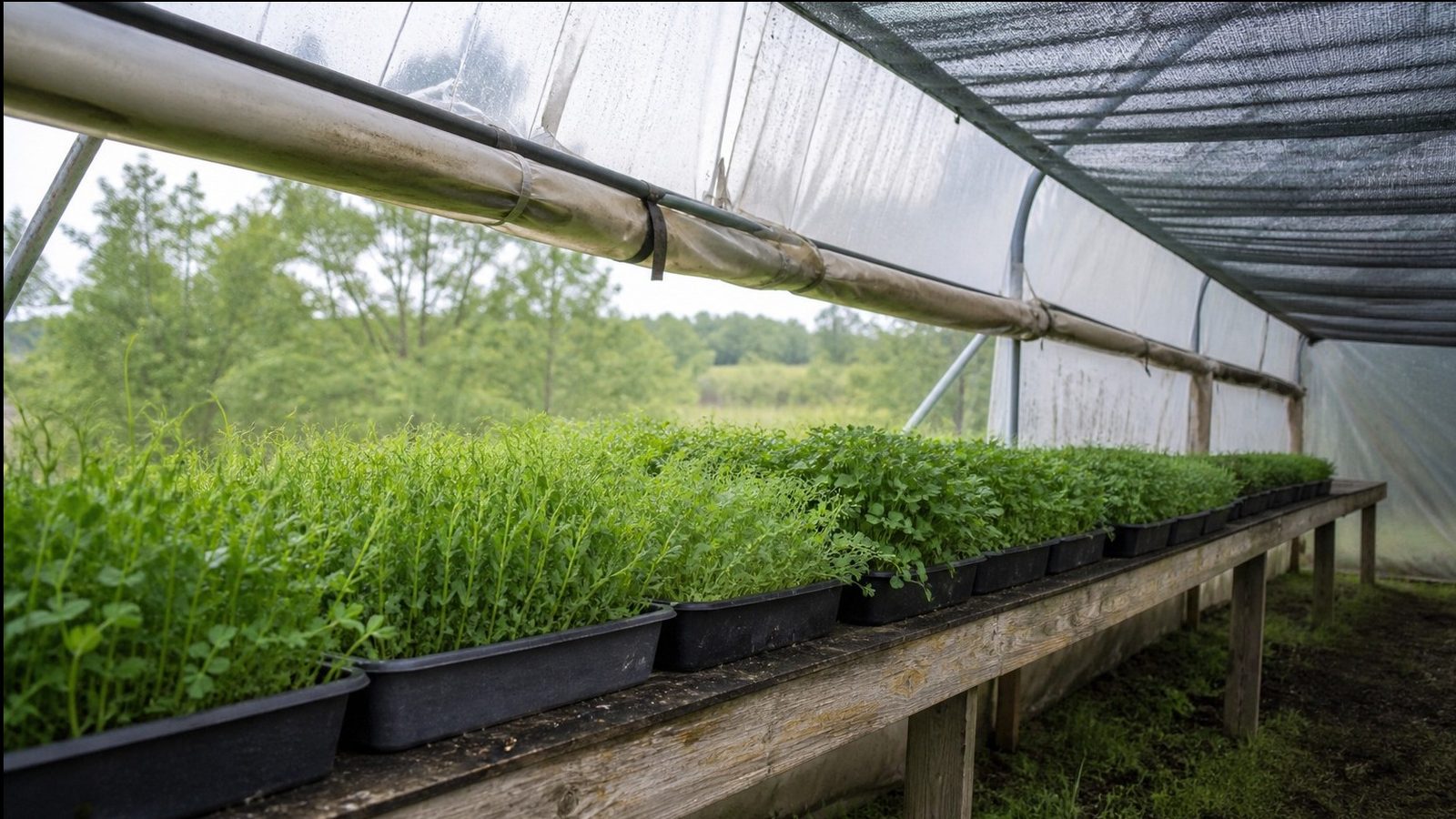
Growing microgreens outside or under cover is a real, published option. Extension guidance allows high tunnels, greenhouses and outdoor beds or containers outright, and calls the high tunnel the low-control end of that range.
The trouble is what "low control" means in numbers.
A well ventilated high tunnel typically runs 10 to 15°F warmer than outside during the day. The same structures have been recorded at 100°F in January with nights near 0°F, and at 120 to 140°F in March and April.
Set that against the production band for this crop, 18 to 24°C, which is 64.4 to 75.2°F.
Hover or tap a row to highlight it.
| Condition | Recorded | Against the 64.4 to 75.2°F band |
|---|---|---|
| March and April daytime peak | 120 to 140°F | 45 to 65°F above the top |
| January daytime | 100°F | 25°F above the top |
| January overnight | Near 0°F | 64°F below the bottom |
The crop wants a 10.8°F window. The structure has been observed across roughly 140°F. That is about thirteen times the width of the band, inside one building, and the extremes arrive in the same month.
Which is the point people miss about a tunnel: it is not a moderated version of outside. It amplifies sun-driven heat by day and moderates very little at night without added heat. It is hottest exactly when the crop needs cooling, and it is cold when the crop needs warmth.
What to actually do
- Put a logging thermometer and hygrometer at tray height before you move anything. A structure's temperature is not the weather forecast, and the recorded extremes are far outside the crop band.
- Expect the tunnel to be hotter than outside by day. Ten to fifteen degrees is typical and ventilation cannot invert it.
- Shade above 90°F, at 20 to 30 percent, and hold the cloth off the foliage. In summer you can afford the light loss easily.
- Take domes off at about half germination. A dome in direct sun is the highest-risk object in the whole setup.
- Measure the daily light integral at the tray rather than counting hours of sun. Summer under glass runs 2 to 5 times the target and a cloudy winter day runs a ninth of the minimum.
- Watch the roof, not the hygrometer, for condensation. What forms on the coldest surface lands on the canopy.
- Sow less densely outdoors than you would inside if humidity is uncontrolled, because density is the lever you still hold.
- Use floating cover on outdoor brassicas. It is the one pest control with microgreen-specific guidance behind it.
- Run one logged season before moving a customer-facing schedule outside. Trays seeded, trays sold, discards by cause, and the lamp energy you actually avoided.
- Do not read "possible" as "controlled" or "cheaper." Both are true of outdoor production and neither is established.
Free light is not a controlled input
The strongest argument for growing under daylight is that the light is free and abundant. Both halves are true, and the abundance is the problem.
Virginia Tech's general target for this crop is a daily light integral of 9 to 16 mol per m² per day. A sunny summer day outdoors delivers about 65 mol per m² per day, with about 2,000 µmol per m² per second at noon. A greenhouse transmits only 50 to 70 percent of that.
Hover or tap a row to highlight it.
| Condition | Delivered to the crop | Against the 9 to 16 target |
|---|---|---|
| Sunny summer day, inside a greenhouse at 50 to 70 percent transmission | 32.5 to 45.5 mol/m²/day | 2 to 5 times the target |
| Cloudy winter day, outdoors | About 1 mol/m²/day | A ninth of the minimum |
Same structure, same crop, two orders of magnitude apart. In July you are shading away most of what arrives; in December there is not enough to reach the floor of the range.
So "sun grown" is not a lighting solution, it is a lighting variable. Measure the daily light integral at the tray rather than judging by whether it looks sunny, and see lighting for what the crop is actually asking for.
Ventilation has a hard physical limit, and most advice ignores it
This is the sentence that should be on every greenhouse page and is on almost none: ventilation will never make the daytime air inside cooler than the air outside.
Moving more air narrows the gap between inside and outside. It cannot invert it. Cooling below ambient requires evaporative cooling or another conditioning method, which is equipment, not an open door.
The published air exchange figures show how much air that is. Winter needs at least two air changes per hour. Summer needs about one air change per minute, which is sixty times as much. Those are whole-building figures calculated from volume, and they are not the breeze over one tray. There is more on why a greenhouse air change cannot size a clip fan in temperature and airflow.
Shade is the tool that actually works on heat, and it has real numbers. Utah State reports 20 to 30 percent shade cloth going on once temperatures are consistently above 90°F, and coming off in early fall. Shade cloth is sold from 10 percent to more than 60 percent, and it must be held off the foliage, because cloth resting on leaves transfers heat into them.
The cost of shading is light, which is the resource you moved outside to get. On a summer day with 32.5 to 45.5 mol arriving, 30 percent shade still leaves 23 to 32 mol against a 9 to 16 target, so summer shading is nearly free in light terms. In shoulder seasons it is not, and that is when the shade cloth decision gets difficult.
Direct sun is a heat problem, not a light problem
The most repeated outdoor claim is that microgreens want full direct sun because they need light. The published guidance says close to the opposite for warm months.
Purdue says outdoor microgreens in warm months usually need shading from direct sunlight. UC guidance says full sun in spring and partial shade in summer, because the heat is too intense for seedlings. Perennia warns that overhead sun with high temperature and radiation during domed germination can roast the crop and sharply reduce successful germination, and recommends taking domes off once about 50 percent of the seed has germinated.
Note what that last one is describing. A humidity dome in direct sun is a small greenhouse on top of a small greenhouse. The germination stage, when the tray is most vulnerable, is the stage the dome is trapping heat over.
No microgreen-specific light threshold for photodamage was found. The documented harm route is heat load and drying, not photons. Which means the fix is shade and ventilation, not less light for its own sake, and a shaded tray in summer can still hit its light target comfortably.
Nobody has measured how much faster a tray dries outdoors. The guidance says frequent watering is often needed in bright light, and that is a practical warning rather than a rate. No study weighs matched trays indoors and out.
Under cover, the humidity problem inverts
A greenhouse traps humidity as well as heat, and the two are coupled in a way an indoor room's are not.
Humid interior air has to be exchanged with outside air to prevent excessive condensation, and increasing winter ventilation increases heating demand. So under cover you cannot dry the air without paying to reheat it, whereas a dehumidifier indoors addresses humidity on its own. That trade-off is the real difference between the two settings, more than temperature is.
Condensation is a surface problem, not a room problem. Warm humid air meeting a colder glass, plastic or structural surface condenses once that surface is below its dew point. The worked example is 70°F air at 70 percent relative humidity meeting a surface at 60°F or colder. In a tunnel, the coldest surface is the roof, and what forms there drips onto the canopy underneath.
Dense sowing is what makes that matter. Densely sown microgreens are more susceptible to damping off and other humidity-linked problems, and the recommendation is 40 to 60 percent relative humidity, with disease pressure rising above it. Greenhouse studies in other crops find relative humidity above 90 percent fosters rapid fungal disease development, with tomato leaf mold pressure above 80 percent and only slight problems below 70.
Do not convert those into a microgreen loss rate. They are other crops, and no study has compared damping off or discard rates between weather-exposed and matched indoor microgreen trays. See mold or root hair and sowing and seed density.
What comes in from outside
The insects named for protected vegetable production are aphids, thrips, whiteflies and cutworms, and even a seven-day crop is advised to have monitoring with sticky cards. For outdoor brassica microgreens specifically, UC ANR recommends a floating cover against cabbageworms, which is the one microgreen-specific pest control in the reviewed guidance.
Row cover excludes insects and some rabbits, birds and deer, and it needs checking frequently for pests, moisture, and overheating past 90°F. A grower account adds squirrels, drawn to cilantro and sunflower, handled with mesh. That is an observation, not a frequency: no published animal-incidence survey for microgreen trays exists.
On the rules, location changes nothing about your classification. Microgreens harvested above the substrate line are covered produce and are not under the sprout subpart, wherever they grew. Building requirements apply to greenhouses, and there is a requirement to take reasonable precautions against foreseeable animal contamination. The thresholds are set out in microgreens under the FDA Produce Safety Rule. Outdoor exposure does not create a different category, it just makes the animal and water clauses matter more.
What "free sun" actually costs
The lighting saving is real and it is precisely one thing: the lamp energy you did not run. Greenhouses and high tunnels can produce this crop with no supplemental lighting, and on a summer day the arithmetic above shows why.
The costs on the other side are structural. High tunnel establishment has been put near $1.50 per square foot plus labor, and greenhouse establishment at $8 to $30 per square foot - a five to twentyfold range depending on what you build. Then ventilation, shading and any cooling are operating costs that an indoor rack under LEDs does not separately pay.
No general saving per tray or per pound has been published, and it could not be: it depends on your electricity price, your climate, and how much crop you lose to the weather.
Nobody publishes the number the decision turns on. Across the pages that come up for this question, some give a temperature, none gives an outdoor-against-indoor tray loss rate and none gives a numeric light or heat saving. Several of them are written by businesses selling greenhouse structures, including the source of the "eight hours of direct sun" framing that extension guidance contradicts for summer.
So, run the arithmetic on your own site before you commit to it. Log one season: trays seeded, trays sold, discards by cause, and the lamp energy you actually avoided. That will tell you what no page can.
What nobody has measured
- How much faster a tray dries outdoors than a matched tray indoors.
- A heat-tolerant microgreen list with replicated field evidence behind it. The species claims in circulation are seller assertions.
- A failure temperature for any species outdoors, as opposed to a production range.
- Mold and damping-off rates outdoors against matched indoor trays, which is the number the whole decision turns on.
- A vent area or fan capacity for a microgreen tunnel validated against crop outcome, rather than borrowed from general greenhouse figures.
- A condensation-to-loss rate for this crop.
- Any audited facility move, indoor to greenhouse or back, with before and after yields, discards and costs. The one public account is a structure seller describing its own customer.
- A tray loss comparison by setting. Without a denominator, no rate exists.
Terms on this page
Tap a term to see what it means.
High tunnel. An unheated plastic-covered tunnel, also called a hoop house or polytunnel. Shelter and solar gain, not climate control.
Sources
Opened 2026-08-12. The comparisons against the 64.4 to 75.2°F band and the 9 to 16 daily light integral target are arithmetic on the published figures and both sides are shown. Indoor temperature, humidity, lighting and pest identification are covered on their own pages, linked above, rather than re-derived here. Two Penn State pages and one UC ANR page returned errors and are not used.
- Utah State Extension, extending the garden season - a well ventilated high tunnel typically 10 to 15°F warmer than outside in daytime, 100°F recorded in January with nights near 0°F, 120 to 140°F recorded in March and April, 20 to 30 percent shade cloth deployed once temperatures are consistently above 90°F and removed in early fall, and aphids, thrips, whiteflies and cutworms named as concerns.
- Perennia, microgreens fact sheet (PDF) - 18 to 24°C and 40 to 60 percent relative humidity, the crop usually produced under cover for consistency, dense sowing raising susceptibility to damping off and humidity-linked problems, the warning that overhead sun with high temperature and radiation during domed germination can roast the crop and sharply reduce successful germination, and removal of germination domes once about 50 percent of seed has germinated.
- Virginia Cooperative Extension, introduction to microgreen production - high tunnels, greenhouses and indoor vertical farms all named as production settings with the high tunnel as the lower-control and the vertical farm as the higher-start-up-cost option, a general daily light integral target of 9 to 16 mol per m² per day with its own 18 hour setup at about 250 µmol per m² per second delivering 16.2, the statement that greenhouses can produce microgreens with no supplemental lighting, and the recommendation of integrated pest management with sticky card monitoring even on a short cycle.
- UF/IFAS, greenhouse ventilation - that ventilation will never make daytime inside air cooler than outdoors and below-ambient cooling requires evaporative or other conditioning, a general summer minimum of about one air change per minute against a winter minimum of at least two per hour, humid interior air needing exchange to prevent excessive condensation with winter ventilation increasing heating demand, the worked condensation example of 70°F air at 70 percent relative humidity on a 60°F surface, shade curtains, exterior whitewash or low-transmission glazing as solar heat controls, and greenhouse studies in other crops finding relative humidity above 90 percent fosters rapid fungal disease with tomato leaf mold above 80 percent and slight problems below 70.
- Cornell, greenhouse lighting (PDF) - about 2,000 µmol per m² per second at summer noon, about 65 mol per m² per day over a sunny summer day, greenhouse transmission of 50 to 70 percent, and about 1 mol per m² per day on a cloudy winter day.
- UC ANR, growing microgreens - outdoor beds or containers permitted, outdoors year-round except where winters are too cold, 6 to 8 hours of sun in every season, frequent watering often needed in bright light, and a floating cover recommended to protect outdoor broccoli and kale microgreens from cabbageworms.
- UC ANR, it's easy to grow microgreens indoors - full sun in spring but partial shade in summer for outdoor containers, because the heat is too intense for seedlings.
- Purdue Extension, grow microgreens at home - that microgreens grown outdoors in warm months usually need shading from direct sunlight.
- UNH Extension, using row covers - shade cloth available from 10 percent to more than 60 percent shade and the requirement to hold it off foliage to avoid heat-transfer injury, row cover as a physical barrier excluding insects and some rabbits, birds and deer, and the instruction to check frequently for pests, moisture and overheating past 90°F.
- UNH Extension, supplemental lighting run time worksheet - the greenhouse daily light integral calculation and measuring method.
- University of Kentucky, microgreens crop profile (PDF) - high tunnel establishment near $1.50 per square foot plus labor and greenhouse establishment at $8 to $30 per square foot.
- FDA, FSMA frequently asked questions - microgreens harvested above the soil or substrate line as covered produce and not subject to the sprout subpart, building requirements applying to greenhouses, and the requirement to take reasonable precautions against foreseeable animal contamination.
- FDA, small entity compliance guide, September 2024 - the Produce Safety Rule baseline.
- Practice sample, audited 2026-08-12 for whether a temperature, a loss rate or a saving is published: Sunshine Greenhouse and Ceres Greenhouse, both structure sellers, the first being the source of the eight hours of direct sun and 60 to 70°F framing and the second a customer case study claiming higher propagation rates after a sunlight-only conversion; Wind River Greens, a seed seller and the source of the amaranth and corn shoot heat-tolerance claim at 75 to 85°F; Kat the Farmer, a grower tunnel account with a course promotion; Microgreens World, counted in the audit and carrying a qualitative saving claim with no figure; and a Reddit outdoor greenhouse discussion, the source of the squirrel and mesh-door account.
Keep reading
Growing guides
Growing microgreens year round: what actually changes indoors between summer and winter
At the same outdoor temperature, measured indoor temperatures across 327 homes spanned 8 degrees Celsius in summer and more than 10 in winter. Three of six year-round guides never mention room temperature at all.
Read Growing microgreens year round: what actually changes indoors between summer and winterGrowing guides
Microgreens with kids: the crops that finish inside a two-week unit, and covering the weekend
Pick from the 5 crops that reliably finish inside a two-week unit, and plan for the weekend, because every published protocol assumes daily care and a school week is five days in seven.
Read Microgreens with kids: the crops that finish inside a two-week unit, and covering the weekendGrowing guides
Pests and mold on a tray: isolate it, do not spray it, and fix the next crop
For a tray that is already affected the answer is isolate and dispose, then clean the system before the next crop. Spraying is not an option on a seven-day crop, and prevention is where all the leverage actually is.
Read Pests and mold on a tray: isolate it, do not spray it, and fix the next cropGrowing guides
Growing microgreens in a small space: what fits, and what a jar actually gives you
A windowsill and a shallow tray will grow microgreens; a rinsed jar grows something else. Jars produce sprouts, eaten whole, which FDA treats as a distinct risk category, so the method decides what you end up with.
Read Growing microgreens in a small space: what fits, and what a jar actually gives you