Yellowing, wilting and collapsing microgreens
Cal HewittPublished Checked
- troubleshooting
- damping off
- beginner
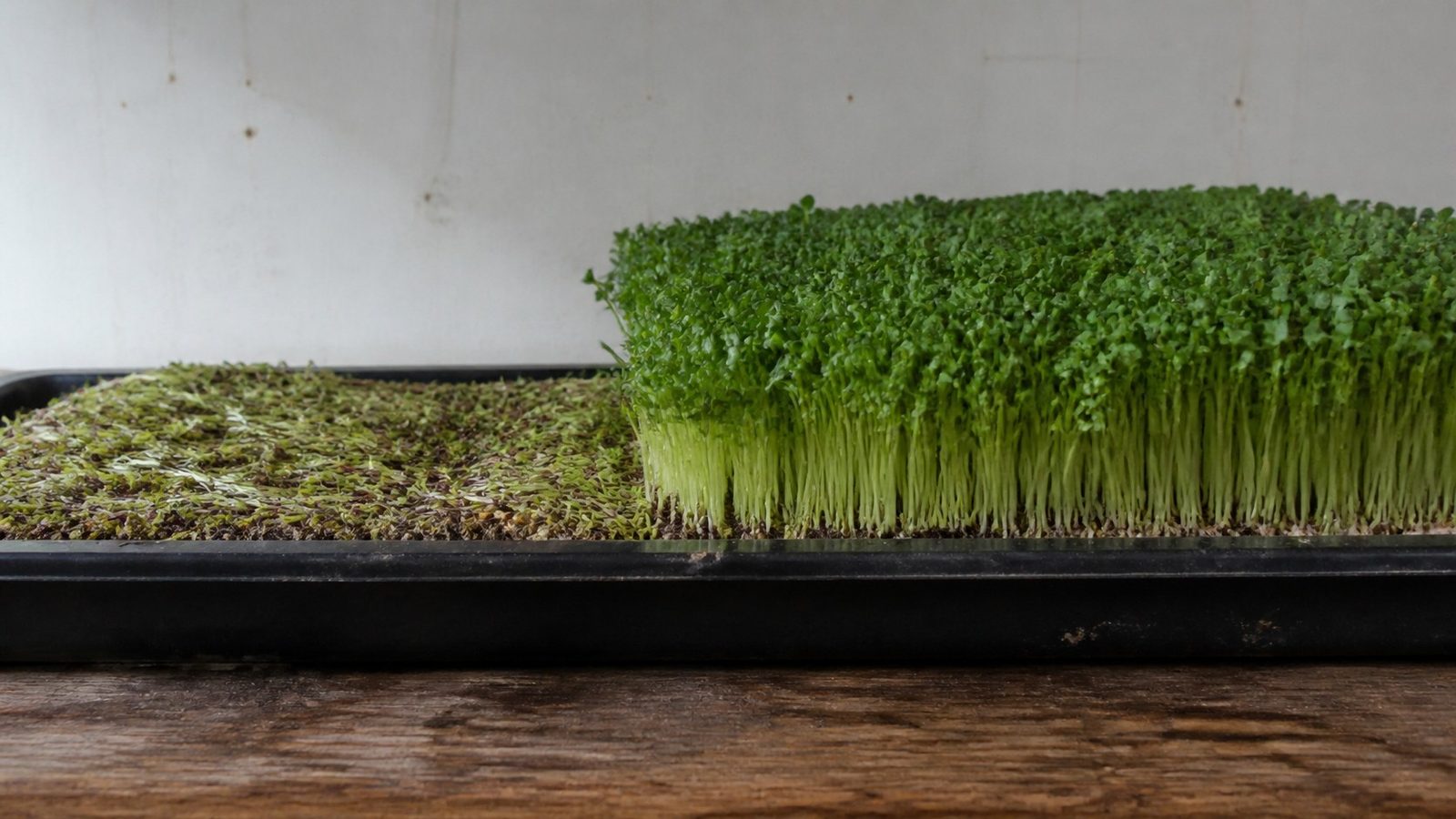
A tray lying down is the end state of four different problems, and their remedies are opposites. Water one and you save it. Water another and you finish it off.
So, this page is not really about the collapse. It is about telling the four apart before you act, and the good news is that one place on the plant does most of the work.
Look at the collar
The collar is where the stem meets the medium. Almost everything you need is there.
Four faults, one place to look
Hover or tap a card to highlight it.
Water stress
The medium is genuinely dry. Stems and leaves are limp because the cells have lost the pressure that holds them up, but the collar is FIRM and clean. A living plant may stand back up after re-wetting, which is the single most useful diagnostic in this whole subject.
Damping-off
The collar is soft, pinched, brown or gray, water-soaked, or gone entirely. A pathogen has decayed the stem or root and the shoot topples because nothing is holding it. Re-wetting does nothing.
Etiolation
Long, thin, pale shoots from too little light, mechanically too weak to hold themselves up. The collar is CLEAN. This is a light problem and it has its own page.
Just out of blackout
Pale but firm and unrotted. Nothing is wrong. It has not greened yet because it has not had light yet.
Firm collar, limp plant: think water. Soft or discolored collar: think disease. That distinction is the page.
The five-minute sequence
What to check, in order
- 1
Is it just out of blackout?
Pale but firm and unrotted means uncover, give normal light, and reassess after it greens. Do not water or fertilize reflexively because it looks pale.
- 2
Is the medium genuinely dry and the collar firm?
Water carefully enough to re-wet the root zone, drain the excess, and watch. If it stands back up, that was water stress and you have your answer.
- 3
Is the collar soft, pinched, brown or gray, water-soaked, or missing?
Stop treating it as thirst. Isolate the tray and treat it as probable damping-off or root rot. More water makes this worse.
- 4
Is there a spreading mat, a rotten smell, or many plants going down at once?
Do not harvest it and do not eat it. Discard the affected product and keep it away from your other trays.
- 5
Is the tray WET but the collar intact?
Do NOT jump to overwatered. Check temperature, humidity, drainage, how long it stayed covered, sowing density, any recent feeding, and light. Then change only the condition you actually observed.
- 6
Still unclear?
Photograph it and send an intact affected plant WITH its medium to a plant disease clinic. Visual inspection cannot name the organism, and nothing on this page can either.
That order is a tray-side synthesis built on the lesion evidence. It is not a validated diagnostic algorithm, and the last step is there because sometimes the honest answer is that you cannot tell from looking.
What you can get back
Hover or tap a row to highlight it.
| What you have | Recoverable? | What it needs |
|---|---|---|
| Pale from blackout, firm | Fully | Light. Nothing else |
| Wilted, firm collar, dry medium | Often, to reduced or full quality | Careful re-wetting and drainage. Standing back up confirms the diagnosis |
| Collapsed, rotted collar or root | No | Nothing. Infected seedlings rarely survive to become vigorous |
| Widespread collapse, smell or spreading growth | No | Discard, and protect the other trays |
On a crop this fast, "recovery" from disease is not curing a seedling. It is salvaging the unaffected plants or starting again, and on a 10-day cycle starting again is usually the cheaper answer.
What growers are actually saying
Sampled from public posts and videos, July to August 2026. Every line links what it is quoting. How often something is repeated is not evidence that it is true, so every line also says what the sources actually establish.
Bottom water once or twice a day, less water more often, and they will tell you if they need more or less
Circulating u/jackbenway in r/microgreens, 3 upvotes
PRACTICE, and it is a better instinct than the usual "water less" because it reads the PLANT rather than following a schedule, which is what the collar test on this page does too. No published study establishes a volume or a frequency for any crop.
Two pieces of standard advice that make it worse
Where the usual answers fail
Hover or tap a card to highlight it.
"Water less" as the universal fix
Unsupported as a general rule, and actively harmful on a tray that is genuinely dry. Disease also occurs in conditions nobody would describe as overwatered. Match drainage and moisture to what you actually observe, not to a schedule.
"Feed it to green it up"
This can make things worse rather than better. High salts from overfertilizing are associated with INCREASED damping-off, and microgreens are a short crop that does not need high fertilizer rates in the first place. A pale tray usually needs light, not nutrients.
The second one is worth dwelling on because the instinct is so strong. Yellow leaves read as hunger. On a crop that lives ten days off its own seed reserves, they almost never are.
Preventing it
Most of what prevents collapse is the same handful of decisions that prevent everything else on this pillar.
Uncover on majority germination, typically 2 to 5 days, so the crop is not sitting warm, dark and wet for longer than it needs. Drain properly and do not leave standing water. Bottom water where you can, so the canopy stays dry. Do not crowd the tray, since density concentrates moisture and slows drying. Keep tools, trays and hands clean between crops, because pathogens travel on all three.
None of that is exotic, and none of it is a treatment. There is no home remedy that cures an infected microgreen tray, which is why the prevention list is the whole list.
If a tray does go down, the useful thing to do is write down the conditions: seed lot, medium, temperature, humidity, how long it was covered, how it was watered. A single collapse is bad luck and a pattern is a cause, and you can only see the pattern if you recorded the first one.
Related: mold or root hair covers the white fuzz question, which is the other thing people find at the collar, and leggy and pale covers the light version of a tray that will not stand up.
Terms on this page
Tap a term to see what it means.
Collar. Where the stem meets the growing medium. The single most informative place on a failing tray, because disease shows there first.
Sources
- UC IPM, damping-off in nurseries and in the garden - seed and seedling rot at or below the medium line, Pythium root-tip infection distinguished from other damping-off pathogens, and the point that matching drainage and moisture to the observed disease and system beats a universal watering rule.
- University of Minnesota Extension - that infected seedlings rarely survive to become vigorous plants, and that high salts from overfertilizing are associated with increased damping-off.
- Virginia Tech Extension (PDF) - microgreens as a short-cycle crop that does not require high fertilizer rates, and uncovering when a majority have germinated at typically 2 to 5 days.
Keep reading
Growing guides
Pests and mold on a tray: isolate it, do not spray it, and fix the next crop
For a tray that is already affected the answer is isolate and dispose, then clean the system before the next crop. Spraying is not an option on a seven-day crop, and prevention is where all the leverage actually is.
Read Pests and mold on a tray: isolate it, do not spray it, and fix the next cropGrowing guides
Growing microgreens in a small space: what fits, and what a jar actually gives you
A windowsill and a shallow tray will grow microgreens; a rinsed jar grows something else. Jars produce sprouts, eaten whole, which FDA treats as a distinct risk category, so the method decides what you end up with.
Read Growing microgreens in a small space: what fits, and what a jar actually gives youGrowing guides
Leggy, pale and leaning microgreens
Long thin stems and pale leaves are a light problem, not a water problem. The stems will not shorten once stretched, and the internet's usual answer is not supported by any source that says so.
Read Leggy, pale and leaning microgreensGrowing guides
Microgreens with kids: the crops that finish inside a two-week unit, and covering the weekend
Pick from the 5 crops that reliably finish inside a two-week unit, and plan for the weekend, because every published protocol assumes daily care and a school week is five days in seven.
Read Microgreens with kids: the crops that finish inside a two-week unit, and covering the weekend