Microgreen Powder Against Fresh: What You Gain, What You Lose, and What Nobody Can Tell You
Cal HewittPublished Checked
- comparison
- powder
- supplements
- evidence
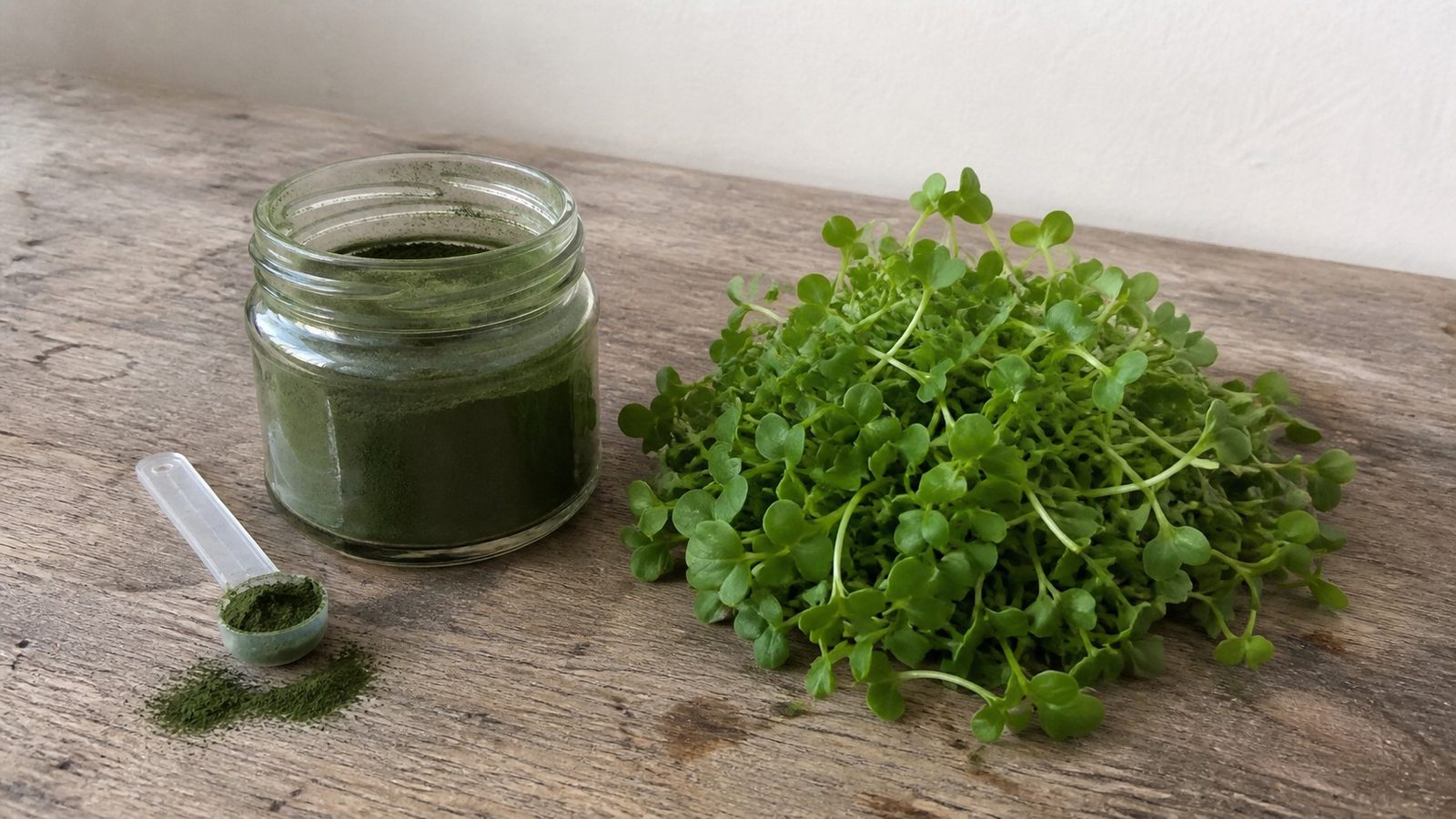
Every powder seller has a number for how much survives drying. They do not agree, and none of them links to an experiment on their own product.
One says more than 95% of the nutritional value. One says approximately 80 to 90% of the nutritional profile. One says losses are negligible, one says all nutrients are preserved, and one says losses are miniscule.
The often-repeated "around 85%" could not be traced to any primary microgreen study. It appears to be traveling marketing shorthand rather than a reproducible result.
What to actually do
- Ignore any single retention percentage. In the one study with a full panel, retention ran from 4.42 to 97.86 percent depending on which nutrient you ask about.
- Compare on a dry basis or not at all. A gram of powder stands in for roughly 8 to 17 grams of fresh, and that conversion is the whole price argument.
- Buy powder for shelf life and portability, which are real and are what it is actually good at.
- Do not buy powder for a specific crop's benefit. No product tells you how much of that crop is in it.
- Do not expect the pigment. Chlorophyll was the least durable thing measured, by a wide margin.
- Check whether you are buying microgreen powder or a greens blend. They are different products and the front labels look alike.
- If you want flavor, texture or a salad, none of this applies. Buy or grow it fresh, and what fresh actually costs per ounce is its own question.
Why a single percentage cannot exist
The actual research does not report a "nutrients" number, because different nutrients behave completely differently.
A 2023 broccoli microgreen experiment compared shade, oven and microwave drying against fresh:
Hover or tap a row to highlight it.
| What was measured | Best result | Worst result |
|---|---|---|
| Potassium | 97.86% | |
| Iron | 96.14% | |
| Calcium | 95.57% | |
| Zinc | 92.97% | |
| Vitamin C | 86% (microwave) | |
| Beta-carotene | 72% (shade) | 62% (microwave) |
| Antioxidant activity | 74.4% | 36.4% |
| Chlorophyll | 33.4% (microwave) | 4.42% (tray) |
From 4.42% to 97.86% in one crop, in one study. That is a 22-fold spread between the worst and best result, and any single headline percentage is picking a number out of that range and calling it the answer.
Two other findings from the same work are worth knowing. Total phenolic content increased after drying, and total flavonoids decreased. So, drying is not uniformly a loss even within one sample.
A 2025 radish microgreen study is more directly relevant because it used freeze-dried material as its control and compared hot air at 45, 65 and 95°C. At 45 and 65°C total phenolics were 9% and 21% lower; at 95°C they did not change. Glucoraphenin fell 21% only at 95°C. B1 and folate were stable, while B2, B3 and vitamin C fell by up to 35%, 36% and 63%.
Read that last study carefully, because its percentages are hot-air against freeze-dried, not fresh against powder. It tells you how drying methods compare to each other. It does not tell you what a jar of powder retains against a fresh tray.
What every product page leaves out
All seven products audited say freeze-dried. None says air-dried, tray-dried or spray-dried.
And none publishes the things that would make the method mean something: drying time, product temperature, final water activity, oxygen exposure, milling conditions, or any validated nutrient-retention result on the finished lot.
So, freeze-dried on a label is an identity claim, not a quality certificate, and there is no basis for assuming a commercial process matches the parameters used in the studies above.
The bigger omission is dose. Zero of seven publish the proportion of each crop. Six of the seven are multi-microgreen blends and every one names its crops without a percentage, a milligram figure, or a crop-by-crop analysis.
That matters more than it sounds. A blend can legitimately list broccoli on the front and contain too little broccoli to support any broccoli-specific claim. Ingredient names solve identity; they do not establish dose.
And a microgreen powder is not the same object as a general greens supplement, which may combine vegetables with seaweed, grasses, fruit, herbs, added vitamins and minerals, and pre or probiotics. The front label can look identical.
The price gap is mostly water
Gram for gram, powder looks absurd. A gram of powder at $1.50 against a gram of fresh at about 6 cents is 25 times the price.
That comparison is meaningless, because it sets a gram of leaf against a gram of water.
Fresh microgreens run 87 to 94% water. So, one gram of dry matter represents 7.7 grams of fresh at 87% water and 16.7 grams at 94%. A one gram serving of powder therefore stands in for 7.7 to 16.7 grams of fresh, and a 0.4 gram serving for 3.1 to 6.7 grams, before any solids lost in washing, drying, milling and handling.
Put both on a dry basis and the gap almost disappears:
Hover or tap a row to highlight it.
| Per gram of dry matter | |
|---|---|
| Fresh, cheapest observed retail at 87% water | $0.46 |
| Fresh, cheapest observed retail at 94% water | $0.99 |
| Powder, cheapest observed | $1.50 |
| Powder, dearest observed | $2.00 |
| Fresh, dearest observed retail at 87% water | $0.95 |
| Fresh, dearest observed retail at 94% water | $2.06 |
Powder sits inside the fresh price range once the water is taken out, at the upper end of it. Against the dearest fresh at high moisture it is actually cheaper.
So, the honest verdict on price is: powder is not a scandalous markup, and it is not a saving either. It is roughly what the same dry matter costs fresh, with the convenience and the shelf life priced in.
Observed powder prices, for the record: $45 for 30 one-gram servings, $49.99 one-time or $44.99 on subscription for 30 servings, $39.99 for 20 grams of a single-crop pea powder, and a per-serving price of $1.97 at one seller's standard 30-serving tier.
What powder genuinely gives you, and what it cannot
It keeps. Fresh microgreens are a few days of shelf life; a jar is months. That is the real product.
It is portable and it needs no growing, no washing and no timing. For a smoothie or a travel routine those are honest advantages.
What it cannot give you is a known dose of a named crop, because no product publishes proportions. It cannot give you chlorophyll, on the evidence above, where retention was as low as 4.42%. And it cannot give you the texture, flavor or the culinary use, which is most of why people eat microgreens at all.
Nor should a "30-day supply" be read as a nutritional statement. It describes how the jar is packed, not a validated daily requirement, and no regulator sets a microgreen intake at all.
What is still genuinely unknown
- Fresh-to-powder retention for any commercial product. The studies measure drying methods against each other or against fresh in a lab, not any jar on sale.
- Whether commercial freeze-drying matches the study parameters. No product publishes time, temperature, water activity or oxygen exposure.
- The crop proportions in any blend. Zero of seven publish them.
- Whether freeze-drying beats air drying on these products. The one study that tested both found it depends entirely on the analyte, and glucoraphenin was not significantly different at moderate temperatures.
- Storage loss after the jar is opened. Everything above concerns the finished powder, not the powder three months later.
- Bioaccessibility differences between powder and fresh. The one study measuring it found 13 to 68 percent across compounds and no difference by drying treatment, which is a comparison among dried samples rather than against fresh.
Terms on this page
Tap a term to see what it means.
Dry basis. Comparing foods with the water removed. The only fair way to price a powder against a fresh leaf, and the reason the naive 25x figure is wrong.
Sources
Opened 2026-08-12. Product prices and claims are label evidence: what a seller says and charges, not proof it is true. Every dry-basis conversion and per-gram figure is arithmetic performed for this page, using the 87 to 94 percent moisture range and the observed fresh retail band already published on this site.
- Bhatt and colleagues on drying broccoli microgreens, 2023 - fresh at 95.01 percent moisture and powder at 8.55 percent; beta-carotene retention of 72, 71 and 62 percent for shade, oven and microwave drying; the best vitamin C result at 86 percent by microwave; chlorophyll at 33.4, 14 and 4.42 percent; antioxidant activity at 74.4, 45.8 and 36.4 percent; zinc 92.97, iron 96.14, calcium 95.57 and potassium 97.86 percent in the microwave treatment; and total phenolics rising while flavonoids fell.
- Jauregui and colleagues on hot-air drying of radish microgreens, July 2025 - hot air at 45, 65 and 95°C against a freeze-dried control, with total phenolics 9 and 21 percent lower at the two lower temperatures and unchanged at 95°C, glucoraphenin down 21 percent only at 95°C, B1 and folate stable, B2, B3 and vitamin C down by up to 35, 36 and 63 percent, and in-vitro bioaccessibility of 13 to 68 percent with no difference by drying treatment. The full text at PMC returned a reCAPTCHA block, so the figures come from the accessible institutional record.
- Cleveland Clinic on powdered greens - what a general greens supplement can contain, which is the basis for distinguishing it from a microgreen powder.
- Product pages supplying the prices, crop lists and retention claims, all observed 2026-08-12 and all label evidence: BeMicro, 100 percent freeze-dried red cabbage, broccoli and radish, with negligible losses claimed and no one-time price displayed; Seattle Elderberry, seven microgreens, a 30-day supply framing, and an "all nutrients" claim; Daily Elements at $1.97 a serving for 30, $2.79 for 14 and $1.77 for 60, describing losses as miniscule; Ferndale at $45 for 30 one-gram servings; PICK'D at $49.99 one-time or $44.99 on subscription for 30 servings; SYNERGIC from €49.60, claiming more than 95 percent of the nutritional value; and Robby Ds, a single-crop pea powder at $39.99 for 20 grams claiming approximately 80 to 90 percent of the nutritional profile.
Keep reading
The journal
What Is a Microgreen? A Young Seedling, Cut Above the Soil at First True Leaf
A young edible seedling, grown densely and cut above its medium at about the first true leaf, usually 1.5 to 3 inches and 7 to 21 days. That cut is what separates it from a sprout.
Read What Is a Microgreen? A Young Seedling, Cut Above the Soil at First True LeafThe journal
AeroGarden vs LetPot: Specs, Warranty and Running Costs
See AeroGarden vs LetPot lined up on price, pod count, light hours, monthly power cost and warranty terms to match a garden to your kitchen and crops.
Read AeroGarden vs LetPot: Specs, Warranty and Running CostsThe journal
Best Microgreen Seed Suppliers for Every Grower Scale
Find the best microgreen seed suppliers for your crops by weighing germination, organic certification, pathogen testing, pack sizes, and shipping costs.
Read Best Microgreen Seed Suppliers for Every Grower ScaleThe journal
Best Sprouting Trays and Jars for Home Sprouting
Compare the best sprouting trays, jars, sacks and automatic sprouters by format, price and cleaning needs, plus which seeds and buyers each one suits.
Read Best Sprouting Trays and Jars for Home Sprouting