Can you reuse the medium? Reuse clean loose coir, replace the mat, never reuse a failed tray
Cal HewittPublished Checked
- growing medium
- cost
- food safety
- sanitation
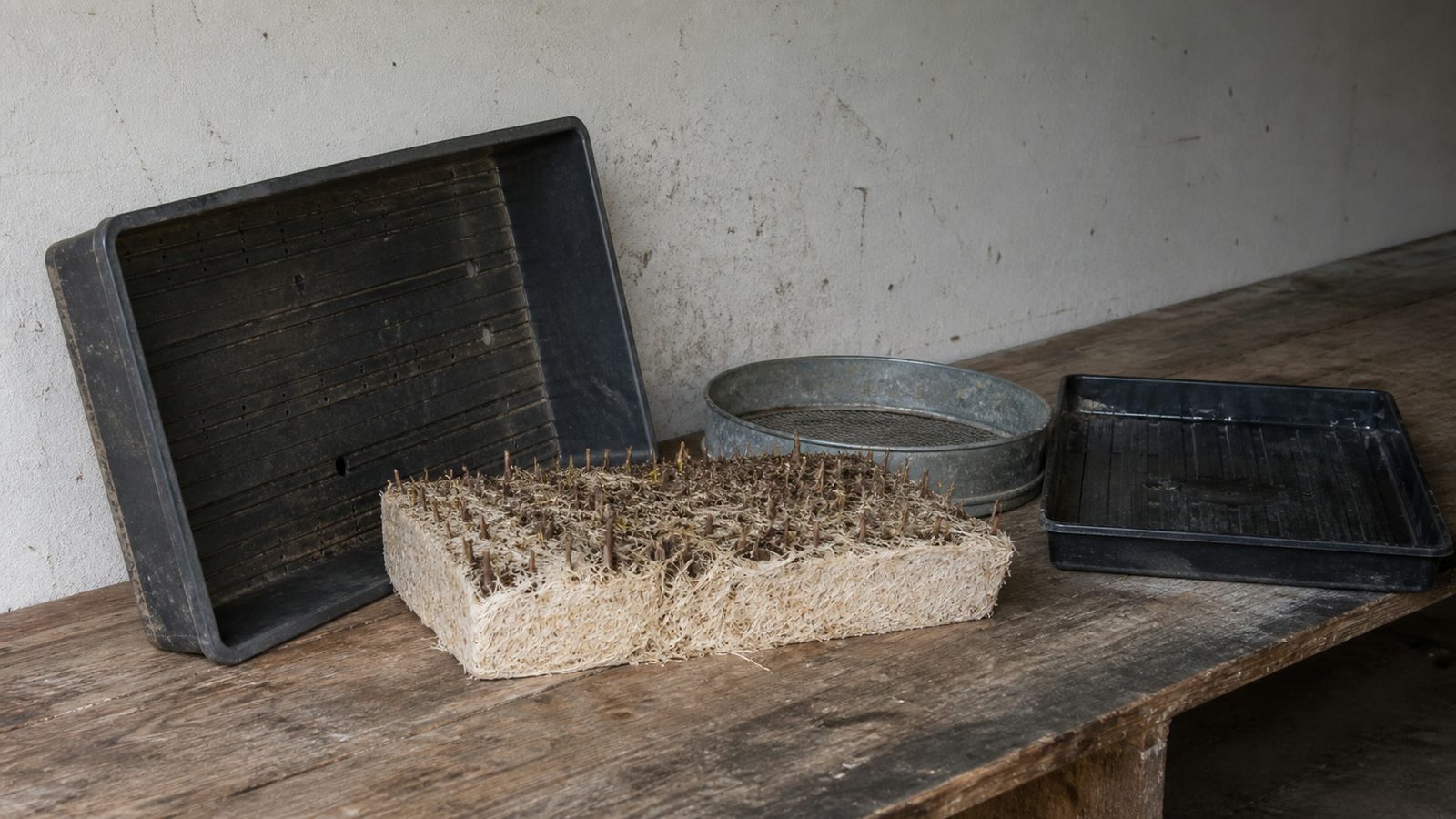
Reuse loose coir or peat from a clean, normal tray, screened and refreshed half and half with new mix. Throw fiber mats away, and never reuse anything from a tray that failed. That is what the extension guidance supports.
Priced out, it allows reuse on the cheapest material and rules it out on the most expensive one.
Hover or tap a row to highlight it.
| Material | Cost per tray | What the sources say | What reuse saves |
|---|---|---|---|
| Loose coco coir, 1 inch fill | $1.04 to $1.30 | Reuse it, screened and refreshed | $0.52 to $0.65, because the refresh is half new material |
| Jute mat, at 100 units | $1.18 | Single use | Nothing. Nobody recommends it |
| Hemp mat | $2.90 | Single use, roots make it impractical | $2.90, and this is the one with the measured problem |
Prices come from the growing medium review, checked 2026-08-11. The reuse saving on coir is half the tray cost rather than all of it, because the one extension protocol that describes reuse also tells you to refresh half the material.
So, the mat, where reuse would save the most, is the material the evidence most argues against reusing. If cost is why you are looking at reuse, switching to loose coir saves more than reusing a mat would, without the risk.
What to actually do
- Decide by material, not by principle. Loose coir and peat have a described reuse protocol and the better pathogen behavior. Fiber mats have neither.
- If you reuse loose medium, do the whole protocol. Dry the roots, screen it, refresh half with new mix. Half of it is new material and the saving is about 52 to 65 cents a tray.
- Price that saving against your crop before spending the labor. On turnip, mizuna, lentil, arugula, broccoli raab and parsley, the seed in the tray costs less than the reuse saves. On the other 44 crops with a costed tray it does not.
- Do not reuse a fiber mat for an edible crop. The roots make it impractical and the one measurement in existence shows hemp and BioStrate holding both test organisms near their starting level at ten days.
- Never reuse anything off a tray that failed, molded or smelled. Every source below is describing a tray that produced a normal crop, and so is this page.
- Compost the root mat if your system takes it, and treat that as disposal rather than as clearance.
- Reuse the tray itself every time. Clean it, then sanitize it with a food contact product at its labeled dilution. That is the one part of this subject with real guidance behind it.
- If you want the reuse saving without the uncertainty, buy the cheaper medium instead. Loose coir at a one inch fill runs $1.04 to $1.30 against $1.18 for the cheapest jute mat, and choosing well costs nothing in risk.
The one experiment, and the eight materials it does not cover
Everything anybody knows about pathogens in these media comes from a single 2020 study, and it is a good one. Four soil-free cultivation matrices were inoculated with a cocktail of Salmonella Javiana and Listeria monocytogenes at a final concentration of 10⁶ CFU per ml, then held at room temperature and sampled on days 0, 1, 3, 6 and 10.
Hover or tap a row to highlight it.
| Material | Water held at saturation | Salmonella by day 10 | Listeria at 24 hours | Listeria by day 10 |
|---|---|---|---|---|
| Hemp mat | 8.9 mL per gram | Persisted, about 6.15 log | Rose 2 log | About 6.75 log |
| BioStrate mat | 10 mL per gram | Highest of the four, about 6.86 log | Rose 1 log | About 6.17 log |
| Coco coir | 3.3 mL per gram | Fell about 2 log, to 4.67 | No growth | Below the detection limit |
| Peat and vermiculite | 3.3 mL per gram | Fell, to 4.99 log | No growth | Fell to 1.70 log |
The two mats held both organisms near where they started. The two loose media let both fall. The authors point at moisture retention and carbon as the plausible reason rather than proving it, and the mats hold roughly three times the water per gram.
That is the strongest thing anyone can say here, and it is worth being precise about what it is not. It is a plant-free challenge experiment on deliberately inoculated fresh material. Nothing in it reused anything. It tells you which material would carry a contamination event, not that your mat has one.
Now the coverage problem. Virginia Cooperative Extension's microgreen production guide names twelve substrate materials: soil, compost or vermicompost, peat, vermiculite and coco coir for tray systems, and mats of bamboo, burlap, coco coir, hemp, jute, rockwool, silicone and steel mesh.
Four of those twelve appear in the one experiment. Coco coir, peat, vermiculite and hemp. Eight do not: soil, compost, bamboo, burlap, jute, rockwool, silicone and steel mesh.
Two of the eight matter more than the rest. Soil is what most people growing at home actually use, and jute is the joint-cheapest mat in the price table above. Neither has ever been measured for this.
And the same Virginia Tech page tells you to choose a substrate partly on "reusability," then says nothing about how to reuse one.
The protocol that does exist, and the half of it people drop
University of Maryland Extension is the one extension source that describes reuse as a procedure rather than a verdict. Let the remaining roots dry, screen the medium, then refresh it 50:50 with new potting mix before the next sowing. The same page calls hemp, wood fiber, coir, bamboo and jute mats single use, and notes silicone mats as reusable.
The 50:50 is the part that disappears when the advice gets repeated. A "reused" tray under this protocol is half new material, which is why the saving in the table at the top is half the tray cost and not all of it.
And it directly contradicts the other extension source. UC Master Gardeners of Contra Costa County say to compost the remaining plant material, discard the old medium and sanitize the trays. Two university sources, opposite recommendations, and neither one cites a study of reuse, because there is not one to cite.
Some of the pages answering this question are published by businesses selling a growing medium or a kit, and the sources below say which. Keep that in mind when a page calls its own product reusable and a competing material single use.
What has never been measured
No study has compared a reused medium against a fresh one, on any endpoint. Not germination, not yield, not quality, not microbial load. The 2020 work inoculated fresh material. A 2021 University of Arkansas experiment went a step further and grew sunflower and pea shoots for 10 days in deliberately contaminated BioStrate and peat, recovering a mean 5.29 log CFU per gram transferred to sunflower from BioStrate against 2.64 from peat. That establishes that a contaminated medium can transfer to the crop. It says nothing about a normally harvested tray sown again.
So, whether reuse is safe has not been tested in either direction. The mechanism and the transfer are documented, but sowing again into medium from a normally harvested tray has never been measured. Until it is, reuse loose media only, follow the Maryland protocol, and never reuse from a tray that failed.
The root mat, and why removal is a labor problem
The root mat is the compact layer left after cutting: roots, cut stems, hulls and medium bound together. Every source agrees on the physical facts. Loose medium has to be screened to separate it. Fiber mats hold roots through their whole structure, which is why the sellers of those mats say to bin them after one crop.
What nobody has quantified is how much medium you actually get back. No published figure exists for usable medium remaining after harvest, by volume or by dry weight, or for how much leaves with the roots. That number decides whether the 50:50 refresh is a refresh or a top-up, and it has never been measured for any crop or material.
The flip trick is practice, not evidence. One grower guide recommends turning the whole harvested tray over so the cut roots sit underneath and the newly exposed surface is sown, claiming at least two uses. Nothing tests germination, yield or transfer after it.
Composting it, which is the route that actually works
For a plant-based medium off a normal tray, composting is documented and uncontroversial. UC Master Gardeners say to compost the plant material. Practice from a grow-supply business puts breakdown at 2 to 10 months depending on conditions and climate. Utah State Extension says a new worm bin generally produces a useful amount of vermicompost in 2 to 3 months.
Two cautions, both about not overreading it. Check what your municipal system accepts, especially for engineered mats, because "compostable" on a label frequently means industrially compostable. And composting a spent tray is a disposal decision, not a food-safety clearance for the finished compost around a raw-eaten crop. An Ohio extension response said spent peat and perlite mix from a known source with no other additions would likely be fine as a bed amendment, with rain leaching the fertilizer salts. That is a reasoned answer about a garden bed, not a validated protocol for growing salad in.
Heat treatment is real and it is borrowed. Oregon State puts pasteurization of barely moist potting media at 140°F for 30 minutes for Phytophthora, and Missouri gives 160°F for 30 minutes for most pathogenic fungi, bacteria, insects and nematodes. Both are nursery pathogen control. Neither has been validated on a spent microgreen medium going into another raw crop.
The tray is a different question, and it has an actual answer
Reusing the tray is not the same decision as reusing what is in it, and unlike everything above, this one is settled.
Clean first, then sanitize, and they are two different operations. The North Carolina Department of Agriculture's microgreen fact sheet defines cleaning as the physical removal of dirt and debris, and requires sanitizing only on an already cleaned surface, with an approved sanitizer used according to its label. University of Minnesota Extension gives the sequence: remove debris, scrub with warm soapy water, rinse, sanitize, air dry.
The concentration comes off the product label, not off a web page. Minnesota's practical bleach option is 150 to 200 ppm, about a tablespoon of unscented 5.25 to 6 percent sodium hypochlorite per gallon, not rinsed and left to air dry. Virginia Tech's food safety publication reports the FDA no-rinse ceilings on food contact surfaces as 200 ppm chlorine, 25 ppm iodophor and 100 to 200 ppm peroxyacetic acid.
One number not to move across. Minnesota also describes running that bleach solution through a recirculating system for up to three hours. That is a system flush followed by a rinse cycle, and it is not a soak time for a hand-washed tray.
What nobody has measured
- Fresh against reused, on any endpoint. No germination, yield, quality or microbial comparison exists for any crop or material.
- Carryover from one normally harvested tray to the next. Both existing studies inoculated fresh material on purpose.
- How much usable medium a harvested tray actually returns, which is the number the 50:50 refresh depends on.
- Anything at all for eight of the twelve materials Virginia Tech names, including soil and jute.
- Whether heat treating a spent medium makes it safe for another raw crop. The temperatures are validated for nursery pathogens, not for this.
- Whether a root mat changes how the medium holds water, which is the practical question behind every "it drains badly the second time" claim.
Terms on this page
Tap a term to see what it means.
Growing medium. The material supporting the roots and holding water and air. Container potting mixes are usually soilless rather than field soil.
Sources
Opened 2026-08-12. The per-tray medium prices come from the growing medium review linked above, checked 2026-08-11. The seed costs and the counts drawn from them were recomputed for this page on 2026-08-12 across the 50 of 62 crops that carry a costed tray; the other 12 have no established seed cost and are excluded from every count above.
- Journal of Applied Microbiology, pathogen survival on soil-free cultivation matrices, 2020 - the four materials tested, the 10⁶ CFU per ml inoculum, the day 0, 1, 3, 6 and 10 sampling, the water retention capacities of 3.3 mL per gram for coco coir and for peat and vermiculite against 8.9 for hemp and 10 for BioStrate, the 2 log and 1 log Listeria rises at 24 hours on hemp and BioStrate, and the declines on the two loose media including Listeria falling below the detection limit on coco coir.
- University of Arkansas, pathogen transfer from cultivation matrix to microgreens, 2021 - sunflower and pea shoots grown for 10 days in deliberately inoculated BioStrate and peat, with mean transfer to sunflower of 5.29 log CFU per gram from BioStrate against 2.64 from peat.
- University of Maryland Extension, growing microgreens and baby greens indoors - the only described reuse protocol: dry the remaining roots, screen the medium, refresh 50:50 with new potting mix. Also the single-use classification of hemp, wood fiber, coir, bamboo and jute mats.
- UC Master Gardener Program of Contra Costa County, growing microgreens - compost the remaining plant material, discard the old medium, sanitize the trays. The direct opposite recommendation to Maryland's, from the same tier of source.
- Virginia Cooperative Extension, introduction to microgreen production - the twelve substrate materials counted on this page, and the instruction to select a substrate partly on reusability, cost, accessibility and the potential for plant and human pathogens, with no guidance on how to reuse one.
- North Carolina Department of Agriculture, microgreen produce safety fact sheet - cleaning defined as physical removal of dirt and debris, sanitizing required only on cleaned surfaces with an approved sanitizer used per its label, and the warning that substrate can introduce potential pathogens.
- University of Minnesota Extension, small scale hydroponics - the clean, rinse, sanitize, air dry sequence, the 150 to 200 ppm bleach option at a tablespoon per gallon, and separately the up to three hour recirculating system flush that should not be read as a tray soak time.
- Virginia Tech, sanitizers for food contact surfaces - the FDA no-rinse ceilings of 200 ppm chlorine, 25 ppm iodophor and 100 to 200 ppm peroxyacetic acid.
- Oregon State Extension, preventing Phytophthora infestations - pasteurization of barely moist potting media at 140°F for 30 minutes, and the caution that 176 to 212°F destroys beneficial organisms.
- University of Missouri Extension, steaming soil - 160°F for 30 minutes for most pathogenic fungi, bacteria, insects and nematodes, and 182°F for resistant weed seed.
- Utah State Extension, vermicomposting - that a new worm bin generally produces a useful amount in 2 to 3 months.
- Ask Extension, spent Pro-Mix as a garden amendment, 2022 - an Ohio extension response that spent peat and perlite mix from a known source with no other chemical additions would likely be safe as a bed amendment, with rain leaching fertilizer salts.
- Grower and seller pages, used as practice only: Coco and Coir on growing medium, which recommends reusing loose coir while selling coir and calls mats single use; Purslane Microgreens on reusing coir; DIY Greens, the source of the flip claim and of "at least two uses"; Microgreen Shop's hemp mat FAQ, which says to remove the mat every use because roots remain; Zestigreens growing FAQ; and On The Grow on used grow medium, the source of the root mat description and the 2 to 10 month composting figure.
Keep reading
Growing guides
Cleaning trays between crops: the sequence, and how long the sanitizer actually needs
Published chlorine figures for food contact run 50 to 200 ppm depending on the job, and the required wet contact time is measured in seconds rather than minutes. The number that governs is the one on the bottle in your hand.
Read Cleaning trays between crops: the sequence, and how long the sanitizer actually needsGrowing guides
Hydroponic and soil-free microgreens: the same swap costs a third of the pea crop and gains on radish
In one replicated trial, moving from peat-perlite to coir cost pea 32.7 percent of its yield and gained radish 4.5 percent. Two extension services cannot even agree whether a mat counts as hydroponic, and the word is doing two jobs at once.
Read Hydroponic and soil-free microgreens: the same swap costs a third of the pea crop and gains on radishGrowing guides
What to grow microgreens in: the medium barely moves yield and roughly doubles nitrate
Every medium comparison argues about yield, where the honest spread between reasonable media is 13 to 16 percent. The measurement nobody quotes is nitrate, which moved about twofold across three crops in two independent trials, and not always in the same direction.
Read What to grow microgreens in: the medium barely moves yield and roughly doubles nitrateGrowing guides
Growing microgreens for animals: no species has a published dose, and one tray costs ten pounds of layer pellets
No veterinary source sets a microgreen dose for any companion species, and the published guidance comes in four units that will not convert. Plus an on-farm tray weight of 7.31 oz, and why fodder did not cut hen feed costs.
Read Growing microgreens for animals: no species has a published dose, and one tray costs ten pounds of layer pellets