Hydroponic and soil-free microgreens: the same swap costs a third of the pea crop and gains on radish
Cal HewittPublished Checked
- method
- growing medium
- food safety
- equipment
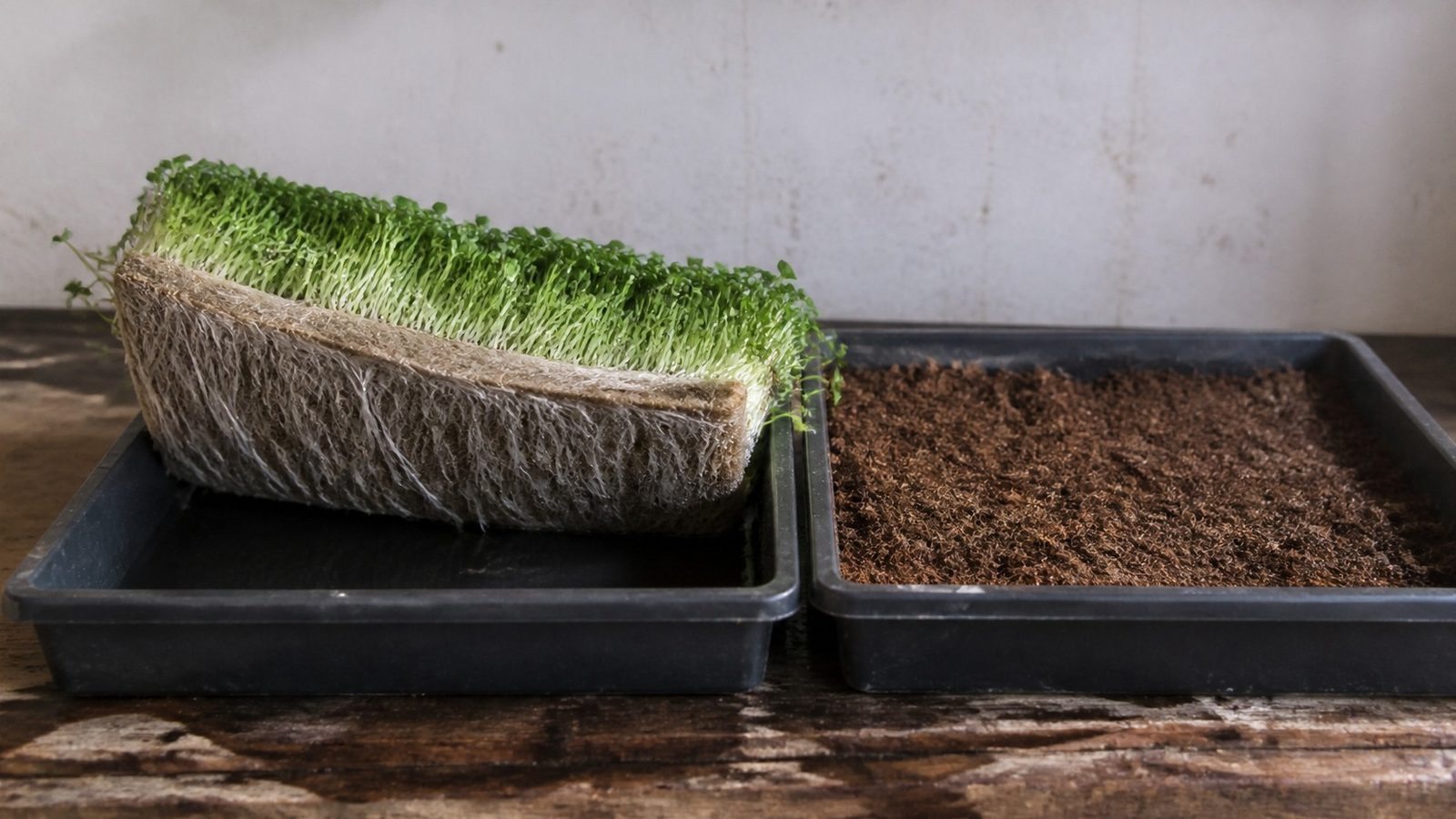
Before comparing anything, two words in the question are broken.
"Soil" is almost never soil. A commercial potting mix is a soilless container substrate of peat, coir, perlite and other components. So, the classic "soil against hydroponic" comparison is usually one soil-free medium against another soil-free medium.
And "hydroponic" is doing two different jobs at once. Virginia Tech reserves it for deep water culture, ebb and flow, NFT and aeroponics. University of Maryland calls microgreens grown on hemp, wood fiber, coir, bamboo or jute mats "hydroponically" grown. Two extension services, one word, two meanings.
A fiber mat watered with plain water is certainly soil-free. Whether it is hydroponic depends on which of those two definitions you picked up, and a mat given only water is not being fed at all: the seed reserves carry the crop. Calling that hydroponic and then reasoning about nutrient solutions is how most of the confusion in this subject starts.
So, this page compares named materials and named water delivery, and never "hydroponic against soil."
What to actually do
- Say which material and which water delivery, and stop using "hydroponic against soil." Most comparisons under that heading are one soil-free medium against another.
- Pick the medium for the crop, and expect the ranking to flip. The one trial that tested two crops found a third of the pea yield riding on a swap that helped radish.
- Start with a nested tray, not a pump. A drain-holed tray of coir or a mat sitting in a solid tray, water into the bottom, pour off what is not taken up. No plumbing, no shared water.
- If you are choosing between a mat and loose coir, run both. Two small trays, same seed lot, same density, same light, weighed at harvest. Nothing published will answer it for your crop. The two sides of that test are hemp and jute grow mats and coco coir bricks.
- Read the coir bag for washed or buffered. Salinity is a real, documented failure mode and it looks like nothing else.
- Cover any lit reservoir. Algae is a light problem that presents as a water problem.
- If a tray dries out, top water once to re-establish the wick. Filling the reservoir alone will not reconnect a broken capillary path.
- Do not recirculate unless you are deliberately learning that system. The virus study is the reason: two hours to the edible tissue and twelve days of persistence.
- Judge "cleaner" as a handling benefit only. Less loose medium on the shoot is genuine and is not a safety claim.
The finding: there is no medium ranking, there is a crop by medium interaction
A replicated 2023 trial compared peat-perlite, coir, composts and 50:50 mixes on pea and radish. The same swap went opposite ways.
Hover or tap a row to highlight it.
| Crop | Peat-perlite | Coir | What the swap does |
|---|---|---|---|
| Pea | 4.37 kg/m² | 2.94 kg/m² | Coir gives 32.7 percent less |
| Radish | 2.66 kg/m² | 2.78 kg/m² | Coir gives 4.5 percent more |
One medium change costs a third of the pea crop and slightly improves the radish crop. The authors report a significant crop by medium interaction, which is the statistical way of saying the ranking depends on what you are growing.
And the same experiment did it twice. Its 50:50 mix of peat-perlite and compost was 14.74 percent lower than peat-perlite on pea and 28.5 percent higher on radish. Same mix, same trial, opposite sign.
This is why "coir yields less" and "hydroponics yields more" are both unusable. Neither one survives being asked "on which crop."
Peat does win where it has been tested head to head, and the exception is instructive. In a controlled study of coriander, kohlrabi and pak choi across agave fiber, coir, peat moss, capillary mat and cellulose sponge, peat moss produced mean fresh yield 55.1 percent above the other four combined and dry yield 35.7 percent above. Coir came second for kohlrabi and pak choi but not for coriander, and the authors attribute coriander's delayed germination and slower growth to high initial coir EC rather than to coir as a material.
A third comparison found the medium mattered and picked a different winner again. In a floating system with green basil, red basil and rocket across coconut fiber, vermiculite and jute, medium significantly affected yield and dry matter, with rocket on jute reaching 3,201.09 g/m² and red basil on jute the lowest at 2,008.38 g/m².
Three studies, three different best media, and every one of them crop dependent.
The medium moves nitrate by about two, and this is now the fourth time
The basil and rocket trial measured nitrate, and coconut fiber came out lowest: 687.37 mg/kg fresh weight in red basil, against 1,191.12 to 1,363.13 mg/kg across the species on vermiculite and jute.
That top-to-bottom ratio is 1.98x, and it lands where the others did. The growing medium page reported three comparisons from two other studies: rapini at 2.08x, sunflower at 2.59x and water spinach at 1.91x.
Hover or tap a row to highlight it.
| Crop | Study | Ratio between the two media |
|---|---|---|
| Water spinach | 2023 waste media trial | 1.91x |
| Red basil | 2021 floating system trial | 1.98x |
| Rapini | 2017 alternative media trial | 2.08x |
| Sunflower | 2023 waste media trial | 2.59x |
Four crops, three independent studies, three different pairs of materials, and every result between 1.9 and 2.6. That is not a formal meta-analysis and the comparisons are not like for like. It is still the most consistent thing anybody has measured about growing media, and it is a variable that no medium guide mentions and no nutrition label carries.
The other composition results do not line up nearly so tidily, which is worth saying plainly. Coir was associated with pigments, carotenoids, total phenols and antioxidant activity in the pea and radish trial while peat-perlite was associated with pea yield, and anthocyanins in the basil trial were driven mainly by species rather than substrate. There is no general nutritional premium for any medium, hydroponic or otherwise.
Recirculation changes the safety question entirely
This is the one place where the choice of system, rather than the choice of material, has a hard measured consequence.
In a hydroponic pad experiment, kale and mustard microgreens were exposed to murine norovirus, a surrogate for the human virus. Virus was detectable in the roots and in the edible tissue after two hours. The recirculated water retained infectious virus, and cross-contamination persisted in a previously contaminated system for up to 12 days.
Two hours to the edible part, twelve days of memory in the system. That is a mechanism rather than a claim that any particular reservoir is contaminated, and it is the clearest reason a shared water path is a different proposition from a nested tray.
FDA's guidance on sprouts explains the same shape of risk, that recirculating water can spread a pathogen through a production lot, and while microgreens are a distinct product, the water-path logic transfers. Its investigation of a Salmonella outbreak in packaged leafy greens from a controlled environment found water management and sanitation failures among the potential contributors without establishing a single root cause.
Practically: start with clean water and sanitized trays, keep hands and tools out of the reservoir, never carry a used solution into a new crop, and clean and sanitize between crops. The cleaning page covers how, and the water quality page covers what the water itself has to meet.
Do not add recirculation because you have a sink. It adds a shared-water contamination route and a monitoring burden, and it buys nothing this page can point to.
Four failure modes that all get called "too much water"
Soil-free does not remove physical failures. It makes the water path more visible and less forgiving, and it fails in specific ways.
- A broken capillary connection. If the mat or substrate dries out, the capillary path breaks and water stops moving into the tray no matter how much is in the reservoir. The fix is documented and counterintuitive: re-seat it on the wet mat and top water once to re-establish the connection. Refilling the reservoir alone will not do it.
- An unlevel wicking path. Low spots and a tilted bench give uneven irrigation across one tray. The tell is one edge paler, drier or less anchored than the other, rather than a uniformly poor tray.
- Coir salinity. Coir is not a uniform product. Husks soaked in salt water carry sodium and chloride and need washing, often with calcium and magnesium management. High initial EC is what delayed the coriander in the study above, not overwatering. If a coir tray stalls uniformly, read the bag for pre-washed or buffered status before changing anything else.
- Algae. Light plus shallow, stagnant, nutrient-rich water grows algae, which clogs equipment and competes with the crop. Cover exposed reservoirs from light. It is a lighting problem as much as a water problem.
Each of those has a different fix, and "you overwatered it" solves none of them.
Anchorage is the other thing a thin mat changes. A mat gives less bulk than a deep loose medium, so seed contact and root attachment matter more, and large or slow-germinating crops may not behave the same way. Test the crop in your system rather than assuming a mat suits everything.
What "cleaner" does and does not mean
Mats do produce a harvested product with less loose substrate stuck to it. Penn State notes cleaner harvested microgreens on a seeding mat, and Maryland describes roots growing into the pad. That is real handling information and it is the honest version of the claim.
It is not a microbial safety claim, and the evidence above is the reason. Less visible medium on the shoot says nothing about what is in the water, and a shared wet mat can spread organisms easily.
In five commercial system-comparison pages opened for this research, three sell the medium or system they recommend on the same page or through its shop link. That is commercial context rather than an accusation, and it is worth knowing when a page tells you its own product is cleaner, faster and more consistent.
Two claims from those pages do not survive contact with the studies. "Heavy seeds do best in soil, small seeds do best in hydroponics" is a categorical rule that the pea and radish result contradicts directly. And a general speed advantage is not established: the nearest evidence is a mustard trial where peat was harvested at 5 days and jute at 8, in which jute also needed a modified protocol, so medium and irrigation management are not separated.
Waste, reuse and what a mat actually costs
Each method leaves a different thing behind. Loose peat or coir leaves a root-filled bulk medium, a one-use fiber mat leaves a root-filled pad, and a reusable silicone or steel support leaves roots to remove and a surface to wash.
Purdue's guidance is the conservative end: substrates other than stainless steel screens are not reusable for microgreens, and reusing them can raise mold risk. Maryland separately identifies silicone mats as reusable, and mat sellers describe their coir mats as reusable after drying and root removal.
That framing is now a step behind the market, which is worth saying plainly. As of early 2026 the reusable option growers and vendors actually talk about is silicone, quoted at 20 to 30 or more grow cycles, with some suppliers dropping stainless steel alternatives. Nothing has been measured about it, so this is a note about what is being sold and used rather than evidence that silicone performs better or is safer. Maryland naming silicone as reusable is still the only extension support, and the reuse question in the section above remains untested on any material.
Two things the marketplace tells you that the guidance does not. Checked on 2026-08-13, what is actually sold is mesh sheets around 11 by 8 inches, sized for sprouting trays rather than as a 10 by 20 drop-in, so any per-1020 figure will not transfer to one without cutting or doubling up. And the listings carry small rating counts and mixed scores, which is what a young product category looks like. Neither of those is a verdict on quality. They are reasons to buy one pack and test it before you standardize on it.
That is a third voice in an argument nobody can settle. Maryland publishes a 50:50 refresh protocol and UC says to discard, as reusing medium and trays sets out, and neither cites a study of reuse, because there is not one. Purdue is offering guidance too. Nobody has compared a reused medium against a fresh one on any endpoint at all.
And "compostable" describes the material, not what your municipal program will take. Check the local service before assuming a mat has a compost route.
On cost, there is no location-free number and the pack size is most of the answer. A dated seller example advertised five 10 by 20 coir mats for $9.99, about $2.00 a mat before tax and delivery. The growing medium review prices a jute mat at $1.18 at 100 units and loose coir at $1.04 to $1.30 per tray at a 1 inch fill. Those are not in conflict: a five-pack and a hundred-pack are different products commercially. The only honest way to cost your own tray is the delivered price divided by the usable trays in the package, plus disposal, plus any share of a pump or reservoir.
What nobody has measured
- Whether soil-free as a class beats a soil mix on anything. Every measured difference so far is crop and material specific.
- A days-to-harvest advantage for any method, using one prespecified harvest endpoint.
- Water use. No microgreen study meters what goes in, what drains, what is recycled and what is harvested. "Hydroponics uses less water" is borrowed from longer crops.
- Disease incidence across peat, coir and mats, holding seed lot, density, humidity, water and sanitation constant.
- Whether a mat that dried out completely recovers, at any crop stage or dry-down duration.
- A safe recirculation protocol for microgreens, at any treatment or interval.
- Delivered cost per tray, which changes with pack size, shipping and how much equipment one tray has to carry.
- What share of commercial production uses each method. There is no census, and kit sales are not one.
Terms on this page
Tap a term to see what it means.
Hydroponic. Growing without field soil by supplying water, usually with dissolved nutrients. Used narrowly for deep water culture, ebb and flow, NFT and aeroponics, and broadly for a seeded mat watered from below. The two usages are the source of most confusion here.
Sources
Opened 2026-08-11. The percentage differences between media are arithmetic on the published yields and are shown alongside them. The nitrate ratio table combines four comparisons from three separate studies, and is presented as a consistency observation rather than a meta-analysis, since the crops, media pairs and laboratories all differ. The seller price is a dated example, not a benchmark.
- Poudel, Duenas and Di Gioia, substrate comparison in pea and radish microgreens, 2023 - pea fresh yield of 4.37 kg/m² on peat-perlite against 2.94 on coir, radish at 2.66 on peat-perlite against 2.78 on coir, a significant crop by medium interaction, the 50:50 peat-perlite and compost mix at 14.74 percent below peat-perlite on pea and 28.5 percent above on radish, 100 percent spent mushroom compost trays germinating poorly and not being harvested, coir associated with pigments, carotenoids, total phenols and antioxidant activity, and coir carrying lower EC than the composts.
- Controlled substrate comparison in coriander, kohlrabi and pak choi - agave fiber, coir, peat moss, capillary mat and cellulose sponge compared, peat moss giving mean fresh yield 55.1 percent and dry yield 35.7 percent above the other four combined, coir second for kohlrabi and pak choi but not coriander, and high initial coir EC identified as the reason for coriander's delayed germination and slower growth.
- Bulgari and colleagues, substrate in a floating system for basil and rocket, 2021 - coconut fiber, vermiculite and jute significantly affecting yield and dry matter, rocket on jute at 3,201.09 g/m² and red basil on jute at 2,008.38 g/m², nitrate lowest at 687.37 mg/kg fresh weight in red basil on coconut fiber against 1,191.12 to 1,363.13 across the species on vermiculite and jute, and anthocyanins and phenolic index driven primarily by species.
- Wang and Kniel, norovirus surrogate in hydroponically grown microgreens, 2016 - kale and mustard microgreens on hydroponic pads with murine norovirus detectable in roots and edible tissue after 2 hours, recirculated water retaining infectious virus, and cross-contamination persisting in a previously contaminated system for up to 12 days.
- Virginia Cooperative Extension, introduction to microgreen production - deep water culture, ebb and flow, NFT and aeroponics listed as the hydroponic systems, its own vertical NFT tower using hemp and burlap mats, nested 1020 trays with hemp mats, the selection factors of start-up and maintenance cost, recirculation choice, labor, water-holding capacity and crop, and the instruction to test a substrate with the specific crop and system.
- University of Maryland Extension, growing microgreens and baby greens indoors - microgreens on hemp, wood fiber, coir, bamboo or jute mats described as hydroponically grown, roots growing into the pad, silicone mats identified as reusable, and that fertilizer is not normally needed because the crop is cut before seed reserves are exhausted.
- Utah State Extension, grow your own microgreens - the nested tray method of coir in a drain-holed 1020 above a solid tray with 2 cups of water and the remainder discarded after 30 minutes.
- Penn State Extension, growing microgreens - cleaner harvested microgreens on a seeding mat, successful crops on clear water with occasional iron deficiency symptoms, and 50 to 100 ppm nitrogen when fertilizing.
- University of Arkansas greenhouse guidance, subirrigation - that capillary and subirrigation systems retain and can recycle solution and may reduce water and fertilizer use against overhead irrigation, that a dried medium breaks its capillary connection and has to be re-wet from above to restore the water path, that an unlevel surface produces uneven capillary irrigation, and that keeping foliage dry can matter for disease while a shared wet mat can spread organisms.
- Oklahoma State University, soilless growing mediums - coir holding moisture while allowing root aeration, sources and processing varying, and coir made from salt-water-soaked husks carrying sodium and chloride and needing washing with calcium and magnesium management.
- Oklahoma State University, algae control for greenhouse production - light plus shallow or stagnant nutrient-rich water promoting algae, which clogs equipment and competes with crops, and covering exposed reservoirs from light.
- Purdue Extension, grow microgreens at home - that substrates other than stainless steel screens are not reusable for its microgreen guidance, that many can be composted, and that reusing substrates can increase mold risk.
- Mustard microgreens on peat and jute, 2023 - peat harvested at 5 days and jute at 8 days under the first protocol, with jute requiring a modified protocol to reach a similar product, which is why this does not isolate medium from irrigation management.
- FDA, draft guidance on the produce safety rule - the distinction between microgreens and sprouts, and why recirculating hydroponic sprout water can spread a pathogen through a production lot.
- FDA, report on a Salmonella outbreak in packaged leafy greens from a controlled environment - water management and sanitation failures among the potential contributing factors, with no single root cause established.
- Royal Horticultural Society, peatlands - that peat extraction destroys peatland functioning and is not sustainable, and that peat forms over very long time scales.
- Practice sample, opened 2026-08-11 and used only as a record of what is recommended and by whom: Aquager, the source of the "cleaner, faster and more consistent" wording and of the five coir mats for $9.99 and $24.99 starter kit, which sells both; City Cultivator, the source of the categorical heavy-seeds-in-soil and small-seeds-in-hydroponics claim; Coir.com and Coco and Coir, both recommending coir mats they sell, the former describing them as reusable after drying and root removal.
Keep reading
Growing guides
What to grow microgreens in: the medium barely moves yield and roughly doubles nitrate
Every medium comparison argues about yield, where the honest spread between reasonable media is 13 to 16 percent. The measurement nobody quotes is nitrate, which moved about twofold across three crops in two independent trials, and not always in the same direction.
Read What to grow microgreens in: the medium barely moves yield and roughly doubles nitrateGrowing guides
Can you reuse the medium? Reuse clean loose coir, replace the mat, never reuse a failed tray
Reuse loose coir or peat off a clean tray, screened and refreshed half with new mix, and throw fiber mats away. Reuse itself has never been tested, and the one pathogen study covers 4 of the 12 materials an extension service names.
Read Can you reuse the medium? Reuse clean loose coir, replace the mat, never reuse a failed trayGrowing guides
Cleaning trays between crops: the sequence, and how long the sanitizer actually needs
Published chlorine figures for food contact run 50 to 200 ppm depending on the job, and the required wet contact time is measured in seconds rather than minutes. The number that governs is the one on the bottle in your hand.
Read Cleaning trays between crops: the sequence, and how long the sanitizer actually needsGrowing guides
Do microgreens need fertilizer? It is worth 8 to 47 percent of the yield and up to 227 times the nitrate
In one peat trial, taking the feed away cost cabbage 7.9 percent of its yield and arugula 47.4 percent, while cutting nitrate in the cut crop by 98 to 227 fold. Feeding is the largest lever anyone has measured on either number.
Read Do microgreens need fertilizer? It is worth 8 to 47 percent of the yield and up to 227 times the nitrate