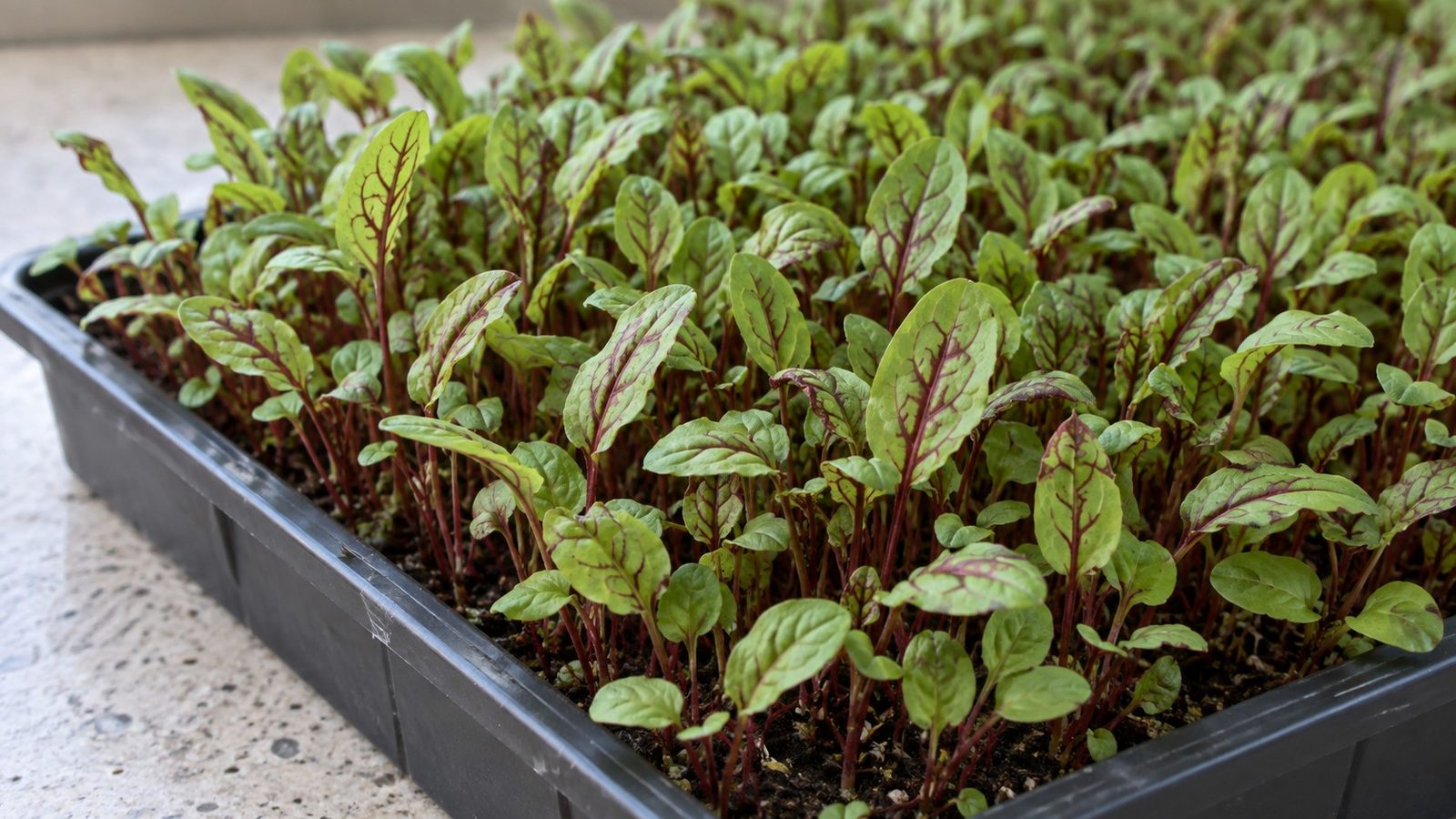
If you mean buying them, red-veined sorrel sits at the top of the direct farm price lists checked on 2026-09-12: WesleyLife/Nourish Iowa listed a 0.5 oz pack for $10, which is $20 an ounce. If you mean growing them, it depends on whether you count seed by the pound or by the tray.
By the pound, Gem marigold seed was $483.45 in Johnny's 2023 chart ($535.40 live on 2026-09-12), and red-veined sorrel was $351.35. By the tray, sorrel's seed costs $2.71, while barley grass seed at $19.99 a pound costs $9.69 a tray. The priciest crop to buy and the priciest tray to grow are often different crops.
Buying and growing are separate price questions
When a shopper calls a microgreen expensive, they mean the price per ounce of the cut greens. When a grower says it, they usually mean the seed, and that splits again into the price per pound on a catalog page and the cost of the seed you actually sow on one 10 by 20 inch tray. Those three numbers do not rank crops the same way. A small seed sown at a few grams can be costly by the pound and cheap by the tray, and a big, cheap seed sown thickly can be the reverse.
None of the prices below is a national average or a selling price. Profit is a separate question, covered in the most profitable microgreens guide.
The most expensive microgreens to buy
A grocery shelf won't settle this for you, because grocery listings mostly carry mixes rather than single specialty crops. Direct farm price lists are where specialty crops appear by name, and red-veined sorrel, nasturtium and shiso sit at the top of them. These listings were checked on 2026-09-12 and divided out to a price per ounce:
Hover or tap a row to highlight it.
| Farm and crop | Pack | Listed price | Arithmetic | Per ounce |
|---|---|---|---|---|
| WesleyLife/Nourish Iowa red-veined sorrel | 0.5 oz | $10 | 10 ÷ 0.5 | $20.00 |
| microGREEN FX red-vein sorrel | 4 oz | $40 | 40 ÷ 4 | $10.00 |
| Unlikely Farms nasturtium | 1 oz | $8.99 | 8.99 ÷ 1 | $8.99 |
| Kirbys red-veined sorrel | 1 oz | $7 | 7 ÷ 1 | $7.00 |
| Sunburst Chef & Farmer shiso | 2, 4 or 6 oz | $13.50, $27, $40.50 | 13.50 ÷ 2 | $6.75 |
Several of those items were out of stock or unavailable when checked, so read them as asking prices rather than proof of what customers paid.
The cleanest comparison comes from one seller using one pack size. microGREEN FX sells 4 oz packs and prices them by crop: broccoli at $10 ($2.50 an ounce); basil, garnet amaranth, onion, dill and fennel at $20 ($5 an ounce); chia at $24 ($6 an ounce); and red-vein sorrel at $40 ($10 an ounce). At that farm, one ounce of sorrel costs the same as four ounces of broccoli. That is one farm's tiering, not an industry scale, but because the pack stays the same, the crop is the only thing changing.
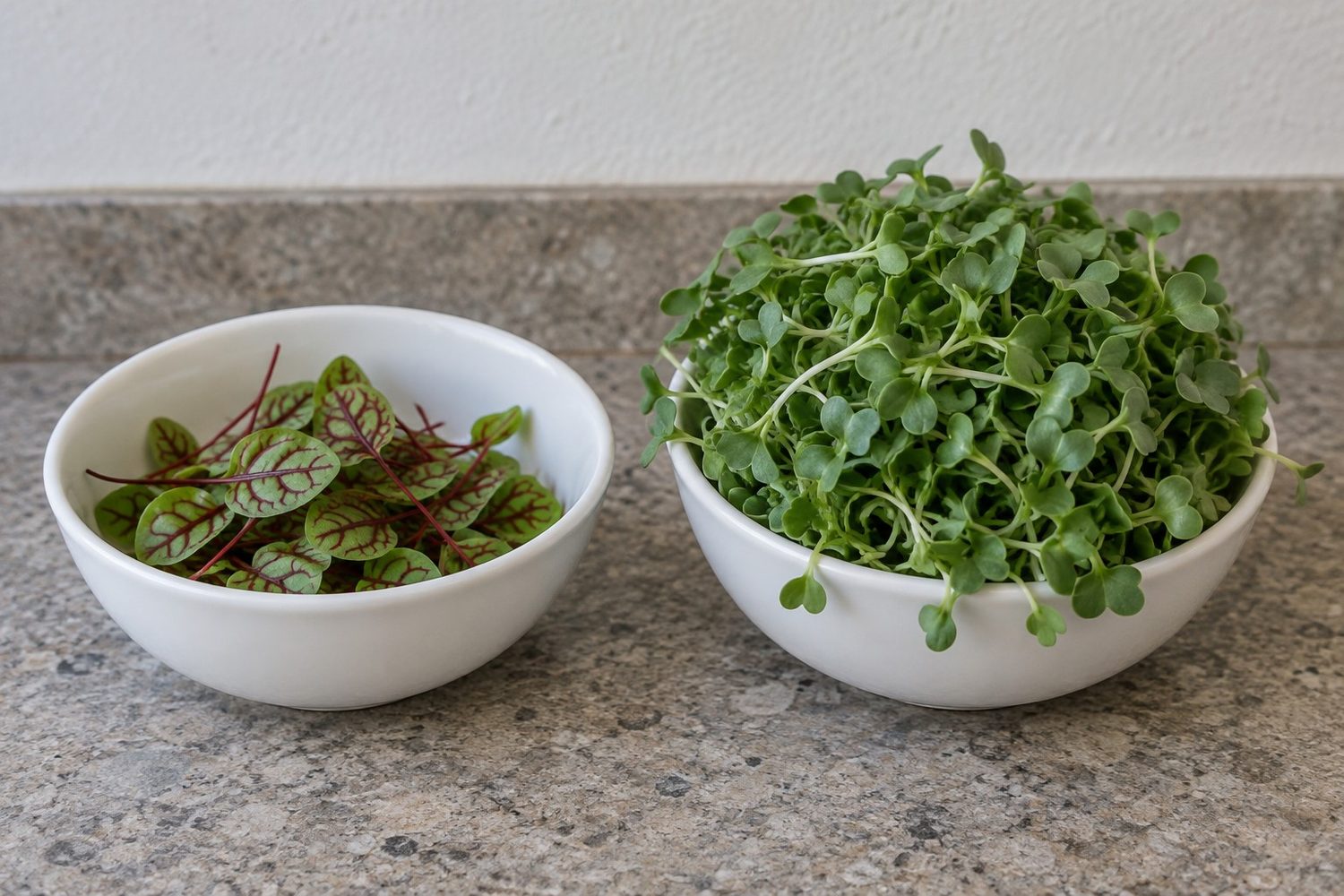
Across different pack sizes the gap gets harder to read. At WesleyLife, the 0.5 oz sorrel pack worked out to $20 an ounce, while a 2 oz pack of mixed microgreens was $5, or $2.50 an ounce. That is eight times the price per ounce, but some of it may belong to the smaller pack. At Walmart on 2026-09-12, a 0.5 oz clamshell of fresh basil was $1.78 ($3.56 an ounce) and a 1.5 oz clamshell was $3.63 ($2.42 an ounce), 47% more per ounce for the small pack.
That is mature basil, so it shows the packaging effect rather than proving it for microgreens, and Sunburst's shiso held at $6.75 an ounce in all three packs. One commenter in a wholesale thread on r/microgreens reported nasturtiums and red-vein sorrel going for $5 to $6 an ounce in their own market.
Edible flowers can cost more, but they are a different product. WebstaurantStore listed Fresh Origins Premium Confetti edible flowers at 1.5 oz for $28.37 ($18.91 an ounce) on 2026-09-12, against $35.46 for 8 oz of the Micro Fiesta Blend ($4.43 an ounce) (WebstaurantStore). Fresh Origins sorts microgreens and edible flowers into separate product groups, and True Leaf sells nasturtium as a 12 to 14 day microgreen that takes 55 to 70 days to reach edible flowers. Leave the flowers out when you compare microgreen prices.
The most expensive microgreen seed per pound
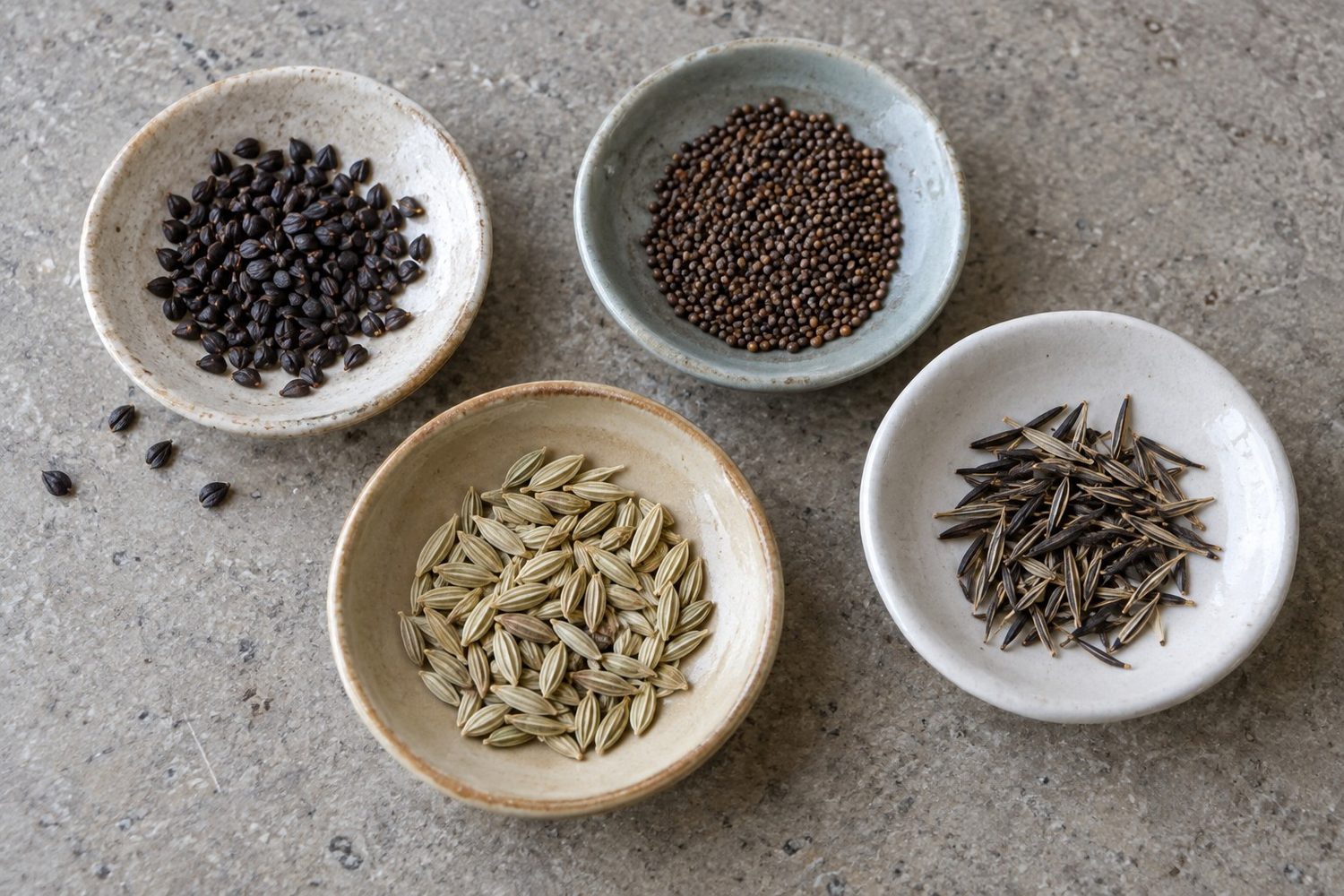
Seed catalogs are where the biggest numbers live. No supplier-wide index is kept, so treat this as a snapshot of some of the dearest seed at Johnny's Selected Seeds and True Leaf Market, not a complete ranking, every row at the 1 lb pack. Where a price comes from Johnny's comparison charts (slow-growing, fast-growing), the chart dates from 2023 and the live price on 2026-09-12 sits beside it.
Hover or tap a row to highlight it.
| Crop | Seller | Price per lb | Date |
|---|---|---|---|
| Gem marigold | Johnny's | $483.45 | 2023 chart; $535.40 live on 2026-09-12 |
| Red-veined sorrel, organic | Johnny's | $351.35 | live, 2026-09-12 |
| Bronze fennel, organic | Johnny's | $229.50 | live, 2026-09-12 |
| Anise hyssop | Johnny's | $211.70 | live, 2026-09-12, backordered |
| Red shiso, organic | True Leaf / Kitazawa | $197.74 | live, 2026-09-12 |
| Green shiso | True Leaf / Kitazawa | $164.49 | live, 2026-09-12 |
| Lemon balm | Johnny's | $156.00 | 2023 chart; $106.50 live on 2026-09-12 |
| Shiso 'Britton' | Johnny's | $140.40 | 2023 chart; $155.50 live on 2026-09-12 |
| Kale KX-1 | Johnny's | $136.85 | 2023 chart; $210.00 live on 2026-09-12 |
| Mizuna 'Red Kingdom' | Johnny's | $118.65 | 2023 chart; $131.40 live on 2026-09-12 |
| Basil 'Red Rubin' | Johnny's | $90.25 | 2023 chart; $99.95 live on 2026-09-12 |
The live rows come from Johnny's listings for red-veined sorrel, bronze fennel and anise hyssop, and True Leaf's for red shiso and green shiso. Prices move in both directions, as lemon balm shows, so recheck before you order.
Across the 50 costed crops in the Microgreens Guru crop directory, the dearest seed per pound was sorrel at $351.35 (Johnny's Red Veined organic, listed 2026-08-08), then shiso at $155.50 (Johnny's Britton, listed 2026-08-08) and onion at $113.30 (True Leaf Crystal White Wax, 1 lb size, listed 2026-08-09).
The most expensive trays of seed to grow
Price per pound tells you what a bag costs. What a tray costs depends on how many grams go on it. The sum is the same for every crop: grams per tray, divided by 453.592 grams in a pound, times the price per pound. It only works where a seed rate has been published; where none has, sow a tray, weigh the seed you used, write it down, and run the sum on your own invoice.
Hover or tap a row to highlight it.
| Crop | Seed rate per 10x20 tray | Seed price | Arithmetic | Seed per tray |
|---|---|---|---|---|
| Red-veined sorrel | 3.5 g, Johnny's yield trial | $351.35/lb, Johnny's, 2026-09-12 | 3.5 ÷ 453.592 × 351.35 | $2.71 |
| Red-veined sorrel | about 3 g, Mountain Valley / True Leaf | $243.72/lb sale price, True Leaf, 2026-09-12 | 3 ÷ 453.592 × 243.72 | $1.61 |
| Shiso 'Britton' | 11.5 g | $155.50/lb, Johnny's, listed 2026-08-08 | 11.5 ÷ 453.592 × 155.50 | $3.94 |
| Green shiso | 17 g, Scintilla Farms as reported by Paperpot | $164.49/lb, True Leaf, 2026-09-12 | 17 ÷ 453.592 × 164.49 | $6.16 |
| KX-1 kale | 28 g, USU's rate for kale in general | $136.85/lb, Johnny's 2023 chart | 28 ÷ 453.592 × 136.85 | $8.45 |
| Red Rubin basil | 28 g, USU's rate for basil in general | $90.25/lb, Johnny's 2023 chart | 28 ÷ 453.592 × 90.25 | $5.57 |
The rates come from Johnny's sorrel listing, Mountain Valley / True Leaf, Paperpot's shiso growers notes, which present the 17 g figure as one farm's crop data, and Utah State University Extension.
Read the bottom two rows with care. USU's 28 g is a crop-level rate for basil and kale on a 1020 tray, a fair starting point but not proof that KX-1 or Red Rubin needs that density. KX-1 has also moved from $136.85 in the 2023 chart to $210.00 live on 2026-09-12, so the same 28 g costs more now than the $8.45 shown. For contrast, the basil page costs Johnny's Italian Large Leaf organic at 6.5 g and $57.68 a pound, listed 2026-08-08, which comes to $0.83 a tray. The grams you sow can matter as much as the cultivar. The kale page has its own costed tray.
The dearest trays are often the cheapest seed
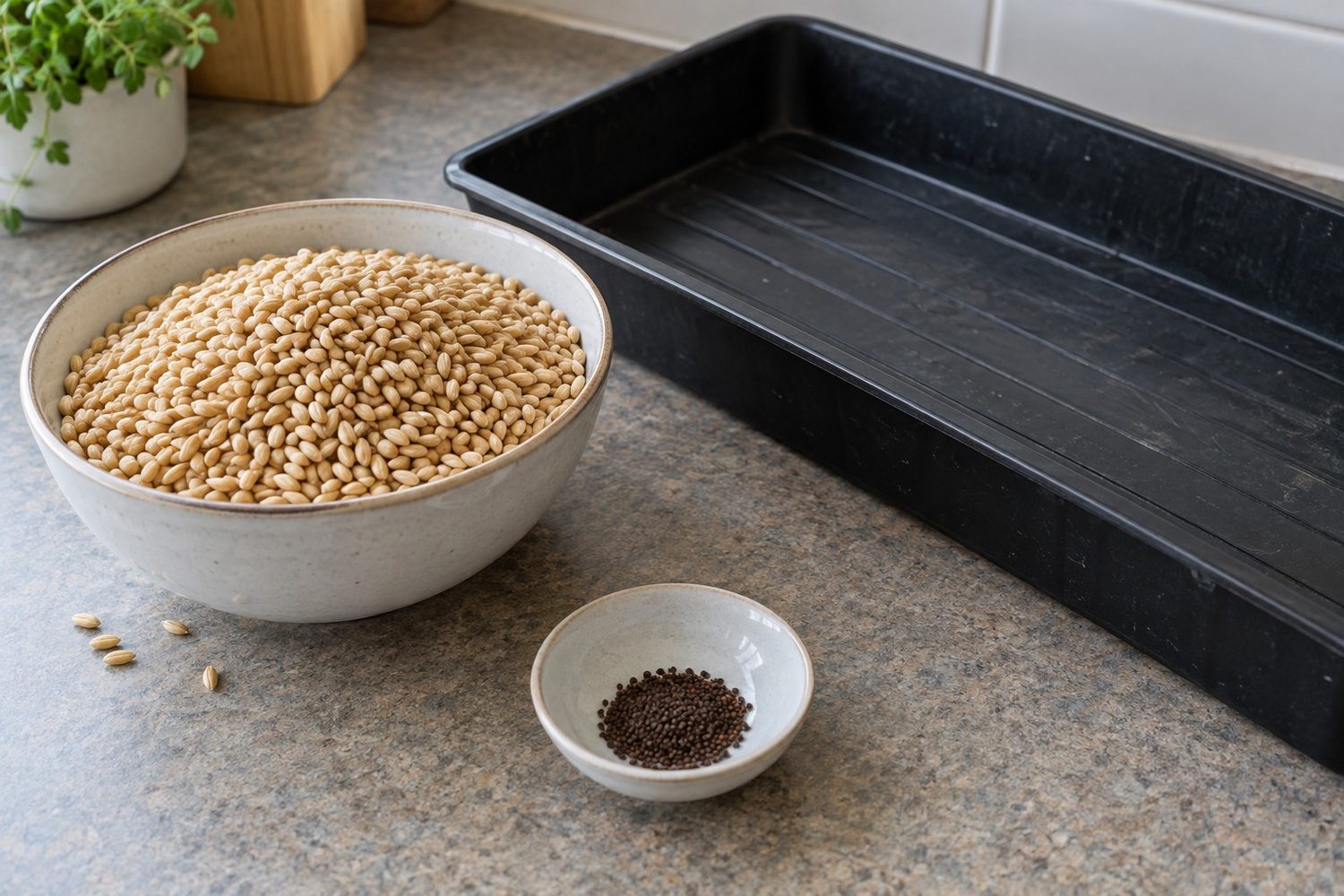
This is where the two meanings split hardest. Sorrel has the dearest seed per pound in the crop directory and still costs only $2.71 a tray. The most expensive trays of seed there belong to big seeds sown heavily, most of them under $20 a pound:
Hover or tap a row to highlight it.
| Crop | Seed per lb | Seed rate | Seed per tray | Seller and date |
|---|---|---|---|---|
| Barley grass | $19.99 | 220 g | $9.69 | SeedsNow organic, 1 lb, listed 2026-08-08 |
| Popcorn shoots | $18.55 | 8 oz | $9.28 | Johnny's organic, 1 lb size, listed 2026-08-09 |
| Nasturtium | $19.58 | 133 g | $5.74 | True Leaf Jewel Mix, 1 lb size, listed 2026-08-09 |
| Borage | $49.60 | 36 g | $3.94 | Johnny's, listed 2026-08-08 |
| Shiso | $155.50 | 11.5 g | $3.94 | Johnny's Britton, listed 2026-08-08 |
Barley grass works out as 220 ÷ 453.592 × 19.99, and popcorn as half a pound at $18.55. The rate moves these trays more than the price does: popcorn drops to $5.80 at the 5 oz end of its range. For scale, the median seed cost per tray across all 50 costed crops was $1.08. All of these are seed only, with no medium, tray, labor, light or loss.
Match the product and pack before comparing, too. On 2026-09-12, True Leaf's organic nasturtium microgreen seed was $40.43 for 4 oz, or $161.72 a pound, far above the Jewel Mix at $19.58, but those differ in product, organic status and pack, so the gap says little about nasturtium itself. Buying microgreen seed covers reading price ladders.
Premium varieties against their common relatives
Some colored or specialty forms do cost markedly more than their plain relatives, as long as you compare the same seller, date and pack. In Johnny's 2023 charts, all at 1 lb:
- Bronze fennel against green fennel: $207.25 against $48.65, so 207.25 ÷ 48.65 = 4.26 times. Live on 2026-09-12 they were $229.50 and $53.90. The live bronze fennel listing is organic, so check the green fennel listing's status before reading the whole gap as color.
- Red Kingdom mizuna against conventional green mizuna: $118.65 against $33.75, or 3.52 times. Live on 2026-09-12 they were $131.40 and $18.76. The mizuna page costs a tray of the common form.
- Red Rubin basil against conventional Genovese basil: $90.25 against $27.05, or 3.34 times. Live on 2026-09-12 they were $99.95 and $38.71.
- KX-1 kale against Bright Green Curly: $136.85 against $71.70, or 1.91 times. Live on 2026-09-12 they were $210.00 and $79.40.
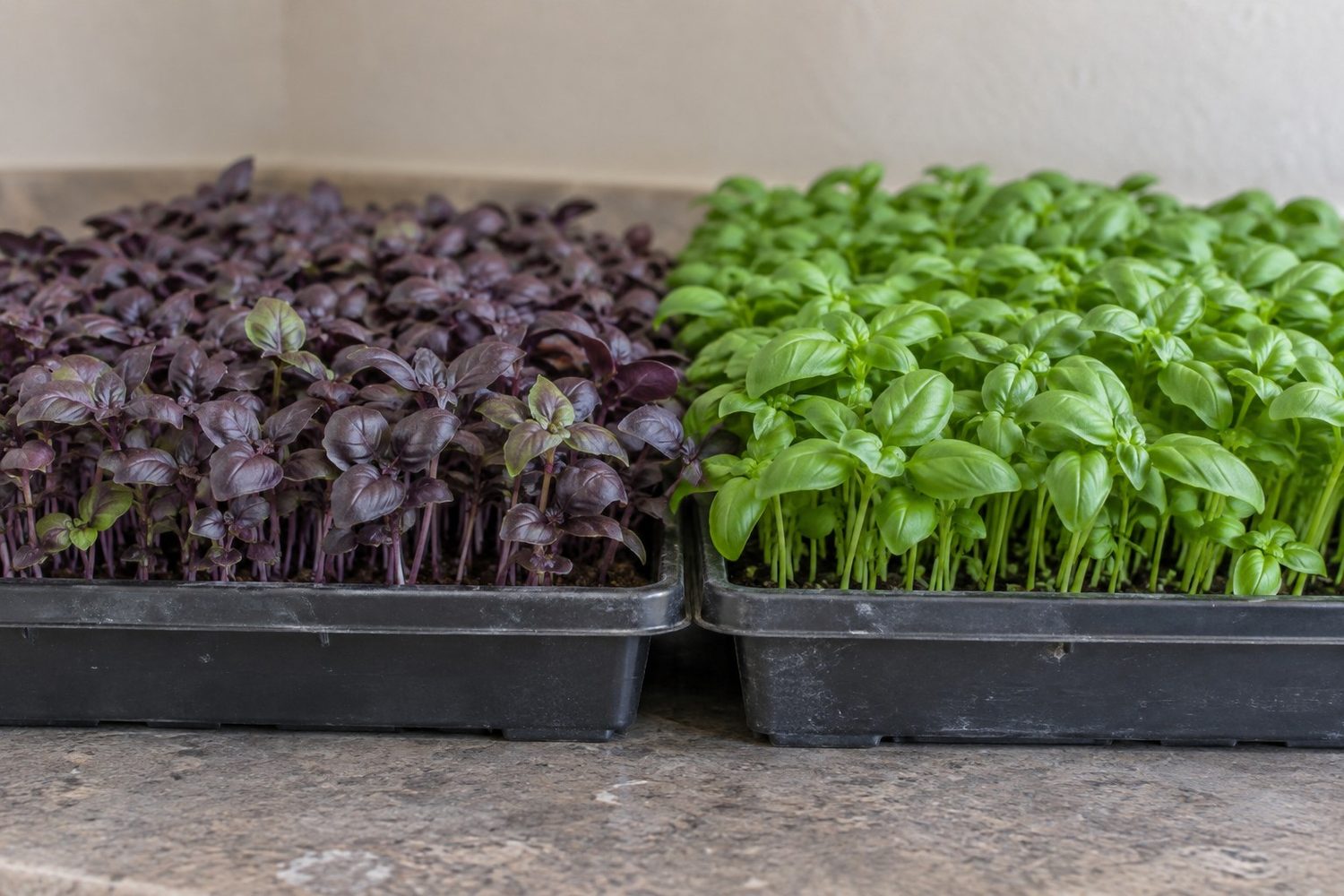
Shiso is the modest one. At True Leaf on 2026-09-12, organic red shiso was $197.74 a pound and organic green shiso $155.30, so 197.74 ÷ 155.30 = 1.27 times (organic green, organic red). That is a real premium, not a dramatic one. These ratios describe asking prices; they don't explain why the gaps exist.
Why some seed costs more
No one has published a breakdown of what makes up the price of red sorrel, shiso, special kale or colored mizuna seed, so treat what follows as possible reasons, not proven causes.
The most concrete one is for bronze fennel. Johnny's notes that seed production usually requires wintering the plant over, and that excess moisture at bloom can prevent seed forming (Johnny's). A crop like that plausibly costs more to multiply, though Johnny's doesn't say how much of the price it accounts for.
Beyond that, three explanations are reasonable. Slow or weather-sensitive seed production can restrict supply. Certified organic handling may add cost, although organic seed is not consistently dearer: True Leaf's organic green shiso at $155.30 a pound was cheaper than its non-organic green shiso at $164.49 on 2026-09-12. And a small specialty market misses the volume discounts that broccoli or radish seed gets.
Seed is only one line on a tray's cost
What a crop costs to grow also depends on shelf time and yield. Missouri Extension's 2024 budget put a cabbage tray at $4.00 in seed, $3.00 in medium, $0.98 in electricity and $5.00 in labor, before labels, packaging, marketing, overhead and capital costs. It assumed 15 minutes of labor at $20 an hour and $0.12 a kWh from March 2024 forecasts, so it is a dated planning model, not a quote for any specialty crop.
Grow time varies a lot. USU lists arugula at 6 to 8 days, kale at 8 to 12, basil at 12 to 16 and cilantro at 21 to 28, with 18 hours of light. Johnny's lists red-veined sorrel at 26 to 30 days, and Paperpot's Scintilla Farms notes give shiso 25 to 30. A four-week tray holds the shelf and the lights far longer than a kale tray, which may add to its real cost, though grow time alone doesn't prove a price premium.
Yield is one more possible factor. A Penn State greenhouse trial averaged 46.8 g of cilantro, 70.6 g of Ruby Red chard and 162.9 g of sorrel per tray across 2016 and 2017, and Scintilla Farms targets 160 g of shiso per 10x20 tray. Those figures belong to their own trial and system, not a ranking for every setup, and sorrel yielded well in that trial, so low yield isn't what makes sorrel dear. Weigh every tray at harvest and record it beside the seed grams; your own numbers are the ones to use.
Questions about expensive microgreens
These come up once the price gap sinks in.
Are the most expensive microgreens the most nutritious?
Price is not a nutrition ranking. A 2012 study of 25 microgreens found red cabbage highest in vitamin C, cilantro highest in carotenoids, garnet amaranth highest in vitamin K1 and green daikon radish highest in vitamin E. Nothing in it shows red sorrel, shiso or fennel are more nutritious because they cost more.
What can I grow instead of a pricey colored crop?
Choose the substitute for flavor or color. USU describes purple radish as nutty and spicy and arugula as peppery, so purple radish or red cabbage can give red and purple contrast, basil gives herb character, and mustard or arugula give heat. Nothing is a one-for-one stand-in for shiso's mint, anise and clove notes or sorrel's lemony tartness.
Is a backordered seed a sign of a shortage?
Not by itself. Anise hyssop was backordered at Johnny's on 2026-09-12, but a backorder can reflect inventory timing or demand as easily as short supply.
Where to go from here
If you are shopping, sorrel, nasturtium and shiso are the names to expect at the top of a farm's price list, and a same-pack comparison from one seller is the fairest way to rank them. If you are growing, do the tray sum with a real seed rate, because the dearest trays of seed in the crop directory are barley grass and popcorn, not sorrel. Each crop's costed tray sits on its own page, such as sorrel or shiso, and why microgreens are expensive covers the retail side. The exact reasons behind the biggest gaps haven't been published, so trust the arithmetic you can check and your own tray records.
Sources
Prices, stock and specifications are as the linked pages showed them on 2026-09-12.
- WesleyLife/Nourish Iowa
- microGREEN FX
- Unlikely Farms
- Kirbys
- Sunburst Chef & Farmer
- 0.5 oz clamshell of fresh basil
- 1.5 oz clamshell
- wholesale thread on r/microgreens
- WebstaurantStore
- Fresh Origins
- True Leaf
- slow-growing
- fast-growing
- red-veined sorrel
- bronze fennel
- anise hyssop
- red shiso
- green shiso
- Mountain Valley / True Leaf
- Paperpot's shiso growers notes
- Utah State University Extension
- organic green
- Missouri Extension's 2024 budget
- Penn State
- 2012 study of 25 microgreens
Keep reading
The journal
The Most Popular Microgreens, Ranked by Different Measures
Learn which crops top a US grower survey, a global market report and a seed retailer's best sellers to see the most popular microgreens three ways.
Read The Most Popular Microgreens, Ranked by Different MeasuresThe journal
Best Microgreen Seed Suppliers for Every Grower Scale
Find the best microgreen seed suppliers for your crops by weighing germination, organic certification, pathogen testing, pack sizes, and shipping costs.
Read Best Microgreen Seed Suppliers for Every Grower ScaleThe journal
Bulk Microgreen Seeds: Cost Per Tray by Bag Size
Buying bulk microgreen seeds cuts cost per tray, but only if the bag gets used fast enough. Compare 5 and 25 pound prices, shipping, and weekly tray needs.
Read Bulk Microgreen Seeds: Cost Per Tray by Bag SizeGrowing guides
How to buy microgreen seed, and what the label cannot tell you
Pathogen testing of microgreen seed is a supplier practice, not a rule, food grade is not a certification, and organic makes no measured difference to the microbes. What matters is a traceable, explicitly untreated lot, and the six ways a seed search goes wrong.
Read How to buy microgreen seed, and what the label cannot tell you