Are Grow Lights a Fire Hazard? A Checklist for Tonight
Cal HewittPublished Checked
- equipment
- safety
- growing
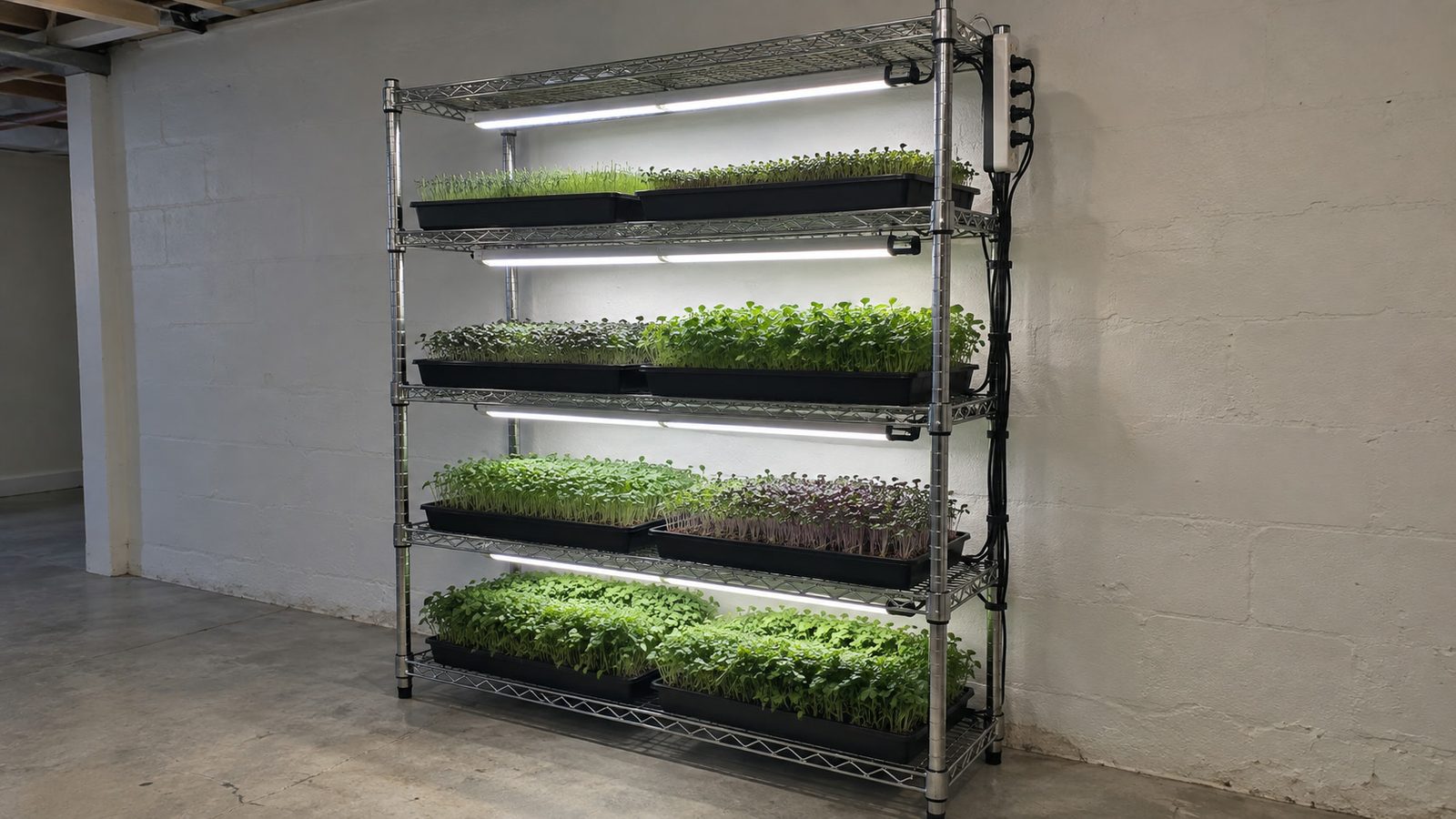
Grow lights can start a fire the same ways any plugged-in equipment can: too much load on a strip, timer or circuit, a damaged or loose connection, trapped heat, or water reaching a plug. No national fire count separates microgreens racks from other home electrical fires, so the numbers that matter are the ones printed on your own equipment.
Before you turn the lights back on tonight, add up the ratings on the light, mat and fan labels, compare that total with your circuit and your timer, get every connection out of the drip path, and take out of service anything that is hot, discolored, buzzing or wet.
Before you turn it back on: the checklist
You need a flashlight, a pencil and the labels already on your equipment.
- Unplug the rack and look at every plug, strip, timer and cord. Anything warm, discolored, cracked, loose, buzzing, flickering or wet stays unplugged tonight.
- Write down the watts and amps printed on each light, heat mat, fan and anything else that shares the strip.
- Add them up and compare the total with the 80 percent figure for your circuit, and compare each item with its own limits.
- Check the timer's rated load, including the rating for the type of load you are switching.
- Take apart any chain of strips, timers and extension cords so one listed strip plugs straight into the wall.
- Move plugs, strips and timers above and away from where water drips or spills, and give each cord a drip loop.
- Find out whether the outlet has GFCI protection, and press its test button.
- Test the smoke alarm on that floor.
Add up the rack's load from the labels
Start with the nameplate on each item. Feit lists its 4-foot 4,000-lumen LED shop light at 52 W and 120 V (Feit). Sunco lists its 4-foot Industrial Frosted plug-and-play shop light at 40 W and 120 V (Sunco). Hydrofarm lists its Jump Start MT10006 heat mat at 17 W and 120 V (Hydrofarm). Vornado lists the VFAN Jr. fan at 15 W on low and 30 W on high, at 120 V (Vornado). Those are maker ratings as of September 12, 2026, not measurements of your fixtures.
Take a four-shelf rack with two shop lights per shelf, two heat mats and one fan on high. Using the 40 W Sunco rating, the 17 W mat rating and the 30 W fan rating, the rack adds up to 8 × 40 W + 2 × 17 W + 30 W = 384 W. At a nominal 120 V, 384 W ÷ 120 V = 3.20 A. Swap in Feit's 52 W rating for the lights and the same layout becomes 8 × 52 W + 34 W + 30 W = 480 W, or 4.00 A at 120 V. That covers the rack alone, not a dehumidifier, heater, pump or anything else sharing the circuit.
Dividing watts by volts is a planning shortcut, and it can come in low. When a label prints amps, use the amps. The Vornado VFAN Jr. above is rated 30 W at 120 V on high, which works out to 0.25 A by division, but Vornado lists it at 0.59 A (Vornado), so 0.59 A is the number to add. So, total the printed amps for everything that lists them, and fall back on watts divided by volts only for items whose labels give you nothing else.
To see what the rack pulls in practice, plug a properly rated power meter between the wall outlet and a device or the whole strip, and read watts and amps with the lights on, the fan on high and the mat heating. The P3 P4400 meter, for example, displays volts, current, watts, VA, power factor and accumulated kWh (P4400 manual). Don't open the breaker panel or clamp onto wires; that is electrician work. The same watts feed your electricity and water costs.
Compare the total with your circuit and your timer
At a nominal 120 V, a 15 amp household circuit corresponds to 1,800 VA and a 20 amp circuit to 2,400 VA. Those are breaker ratings, not spare room. The National Electrical Code sets a circuit's overcurrent protection at no less than the noncontinuous load plus 125 percent of the continuous load, and 1 ÷ 1.25 = 0.80 is where the familiar 80 percent planning figure comes from (NFPA NEC public record). For planning, treat lights, mats and fans that run through a long daily cycle as continuous. That gives you 12 A, or 1,440 W, on a 15 amp circuit and 16 A, or 1,920 W, on a 20 amp circuit.
The same code record also says that any single cord-and-plug item that isn't fastened in place, on a 15 or 20 amp branch circuit, may not be rated above 80 percent of that circuit's rating (NFPA NEC public record). So, the 80 percent figure does two jobs. It limits the rack's combined continuous load against the circuit, and it separately limits the rating of each individual plug-in appliance. Passing one check doesn't cover the other.
The example rack's 384 W or 480 W sits well under 1,440 W, but the rack is seldom alone on its circuit. The Electrical Safety Foundation International (ESFI) recommends labeling panel circuits properly (ESFI), and you can map yours without opening anything. Switch one breaker off, note which outlets and plug-in lamps lose power, label it, and switch it back on. Add everything else on that circuit, such as a refrigerator, freezer, vacuum, printer, dehumidifier or outlets in nearby rooms, to the rack total before you compare. If the labels don't match what you find, have a licensed electrician sort it out.
The timer has its own limit, and it depends on the model and the type of load. Hydrofarm rates its single-outlet Autopilot analog timer at 15 A, 1,725 W and 120 V (Hydrofarm timer), and its eight-outlet timer strip at 15 A and 1,875 W (Hydrofarm timer strip). Intermatic's TN311 specifications list separate ratings of 15 A resistive or ballast, 1,875 W incandescent, and 1/3 hp motor (Intermatic catalog). Read the rating that matches what you are switching; a timer marked 15 A resistive isn't automatically good for 15 A of motors or LED drivers. Models are compared in timers and controllers.
For cords, go by the printed amp and watt rating rather than the gauge alone. The Consumer Product Safety Commission (CPSC) gives 1,625 W for a standard 16-gauge extension cord and says the total wattage connected to a cord can't exceed its rating (CPSC checklist).
Power strips, extension cords and linked shop lights
The U.S. Fire Administration (USFA) says not to overload power strips, to use strips with internal overload protection, to use extension cords only temporarily, and to keep cords out from under rugs where they can be pinched or damaged (USFA handout). ESFI adds that a strip must be rated for its products, plug directly into a wall outlet and never be chained; that an extension cord takes one appliance; and that heavy reliance on extension cords means you need more outlets (ESFI). CPSC says cords under carpet can't release heat (CPSC).
On a rack, that comes down to one listed, undamaged strip plugged straight into the wall, and no ladder of strip to timer to extension cord to strip. A surge protector doesn't add circuit capacity, and it doesn't make a wet spot safe.
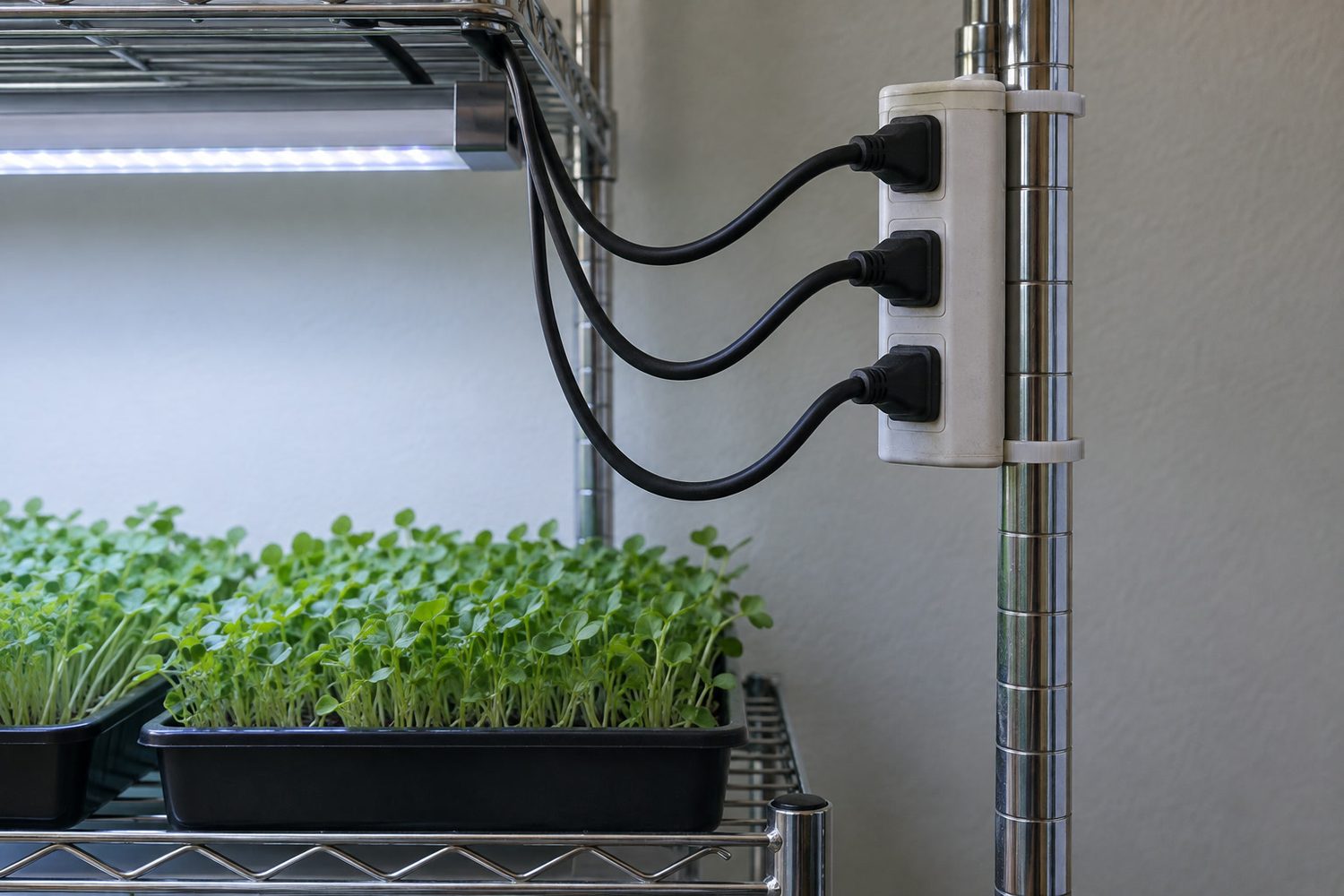
Many plug-and-play shop lights link end to end through their own plugs. Those linking plugs feed the next light and are not general outlets; Sunco's listing says its plugs are "intended for linking only not for use as an outlet" (Sunco). So, don't plug a heat mat or fan into one, and follow the light's instructions on linking.
Water, trays and GFCI protection
If you bottom water, put the strip, the timer and every plug connection outside the splash and drip path, and above the level a spill would reach, never under trays or on the floor. Route each cord so it dips below the outlet before rising to the equipment. That low loop, called a drip loop, lets water drip off before it can run into the plug.
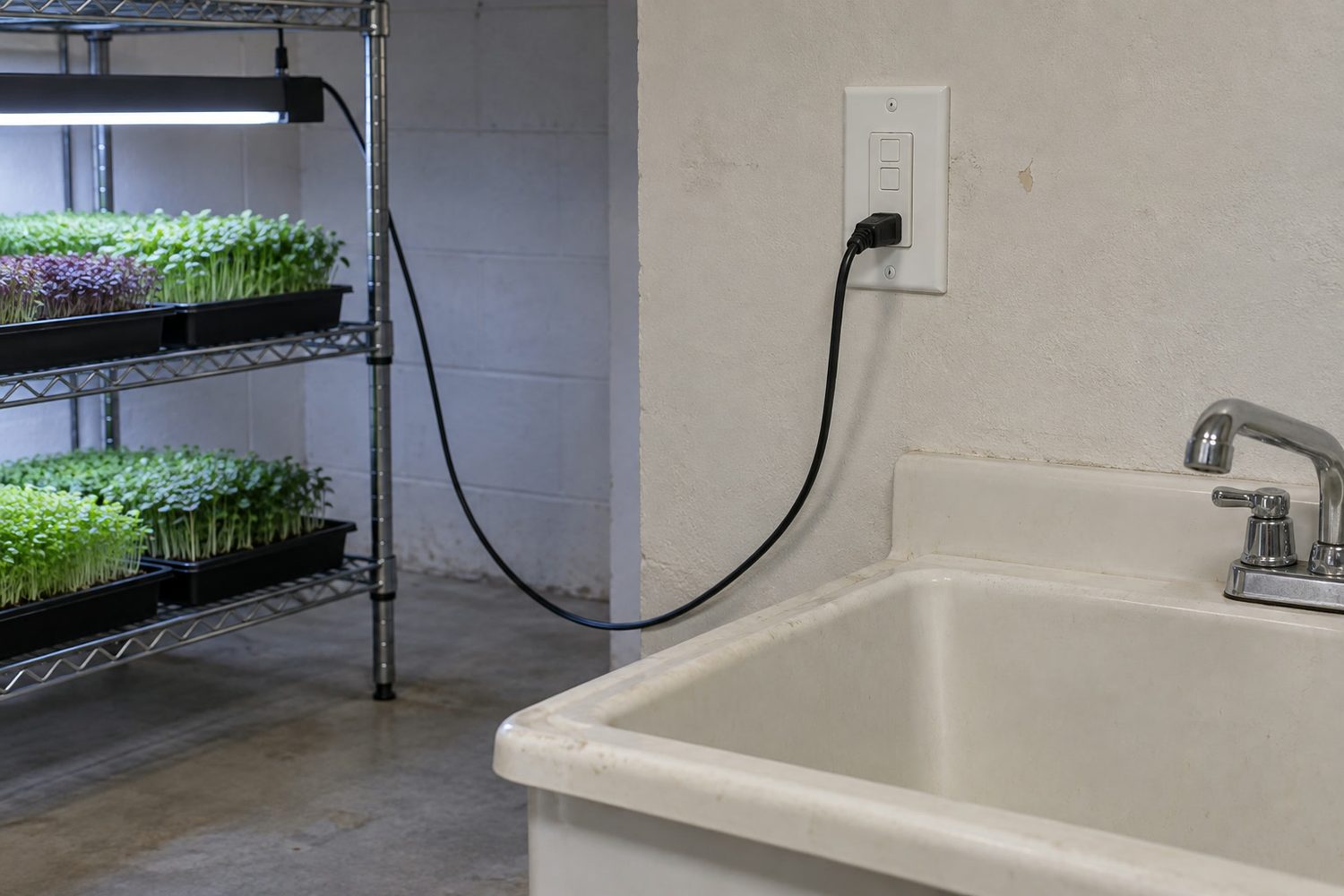
A ground-fault circuit interrupter (GFCI) can open a circuit in as little as 1/40 second when it senses a ground fault, according to OSHA (OSHA). It reduces shock risk, but it doesn't make a light or mat that isn't rated for damp locations safe to get wet.
Whether code requires GFCI protection where your rack sits depends on which National Electrical Code edition your town adopted. The 2020 edition extended dwelling GFCI protection to receptacles in 11 listed locations (ESFI). The 2023 edition lists 12, adding areas with a sink and permanent provisions for food preparation, beverage preparation or cooking (NFPA second-revision record).
A rack in a garage or basement commonly falls within the listed locations. A dry spare bedroom isn't automatically one because it holds plants, but if watering makes it damp or splashes reach the outlets, have a licensed electrician determine what your local code requires rather than changing the wiring yourself. ESFI advises pressing the test button on GFCI outlets monthly (ESFI).
OSHA's electrical rules are workplace rules for employers, not a home code. Its standard says portable equipment and cords used where workers are likely to contact water must be approved for those locations, and that hands must not be wet when plugging or unplugging energized equipment (OSHA 1910.334). Treat condensation on plugs and drivers as a problem, too; OSHA says electrical equipment that has gotten wet should be inspected by a qualified electrician before it is energized again (OSHA).
Heat mats, lights and what surrounds them
Hydrofarm says its 17 W Jump Start mat is waterproof and UL-listed and warms the root area 10 to 20°F above the surrounding air, and rates its matching thermostat at 8.3 A and 1,000 W (mat, thermostat). Use a mat only under the tray as its manual allows, and keep the plug and controller dry and within reach. Don't stack mats, cover them with insulation, or set weight on them unless that exact manual says you can. More on setup is in using heat mats for microgreens.
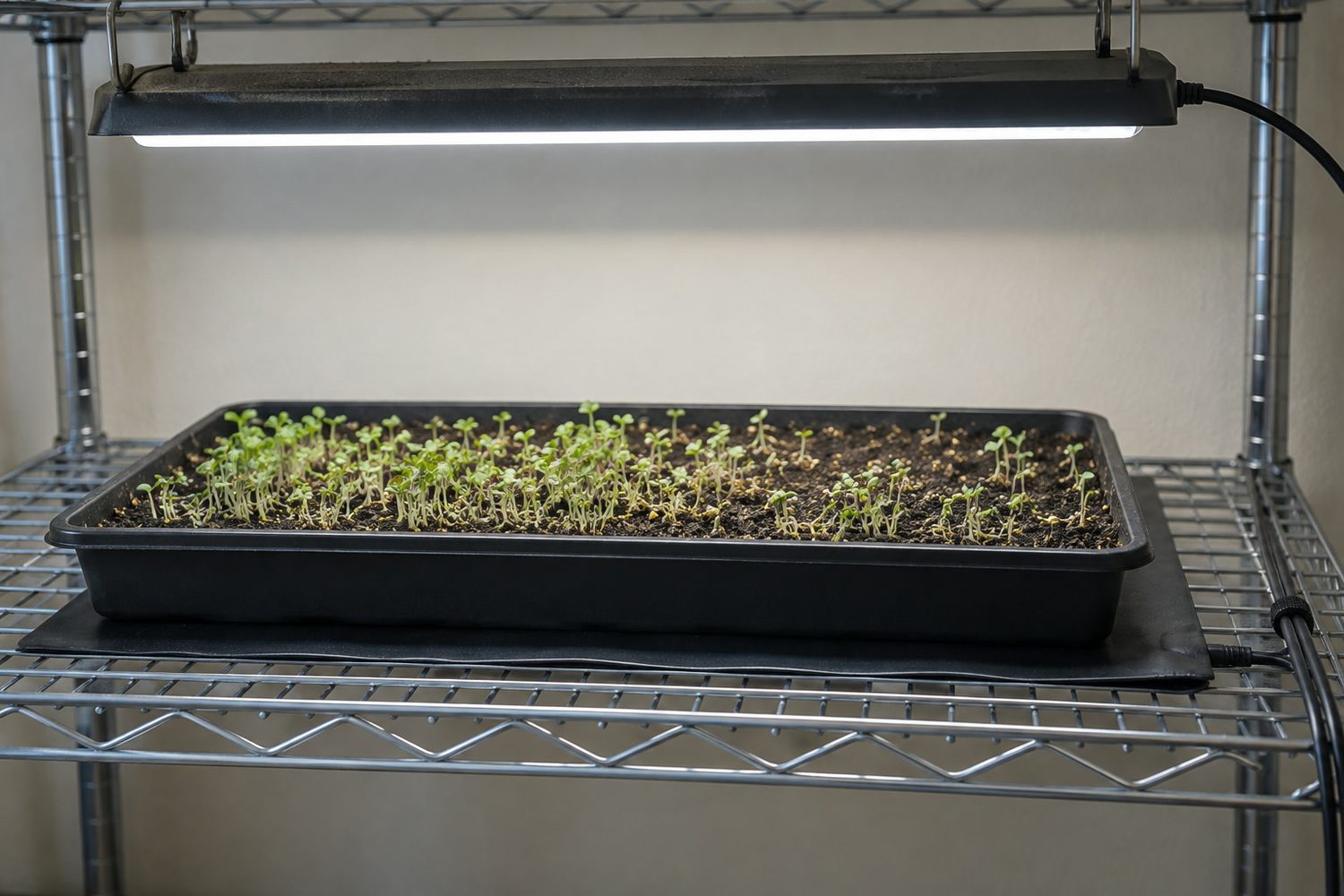
LEDs can run cooler than older lamps, within limits. A 2017 controlled comparison measured an LED bulb at 32.6°C, a CFL at 58.7°C and an incandescent bulb's surface at 134°C after three minutes (E3S conference paper). That describes the bulbs tested; a shop light's temperature depends on its wattage, heat sink, room temperature, clearance, dust and airflow. Don't cover a fixture or block its heat sink because it is LED, and keep fabric, reflective film, cord jackets and trays away from anything running hot. Fans for moving air around the shelf are in air circulation and fans.
Hang each light with the mounting hardware it came with, and stay within the shelving maker's stated load limits. If a change means drilling, a new outlet or a cable through a wall, stop and bring in a licensed electrician. Fixtures are covered in grow lights and lighting microgreens, and racks in shelving and racks.
Check the model, the listing mark and the recall list
UL and ETL are third-party certification marks. Intertek says an ETL Listed mark means independent testing and certification to applicable safety requirements by an OSHA-recognized lab (Intertek). Look up the exact manufacturer and model in UL Product iQ or the ETL directory. A retailer photo, a logo in the listing copy, or "tested to UL standards" is not the same as a listed light, timer or mat.
Then search CPSC recalls for your exact model. CPSC recalled CCCEI power strips on March 26, 2026 because they lacked supplementary overcurrent protection, with two sparking or melting incidents reported (CPSC). It recalled about 50,000 Homemaster outdoor lighting timers on December 13, 2001 for reversed polarity and a shock hazard (CPSC).
Signs that mean stop and call a licensed electrician
Unplug the affected equipment and call a licensed electrician, rather than adding a strip, when:
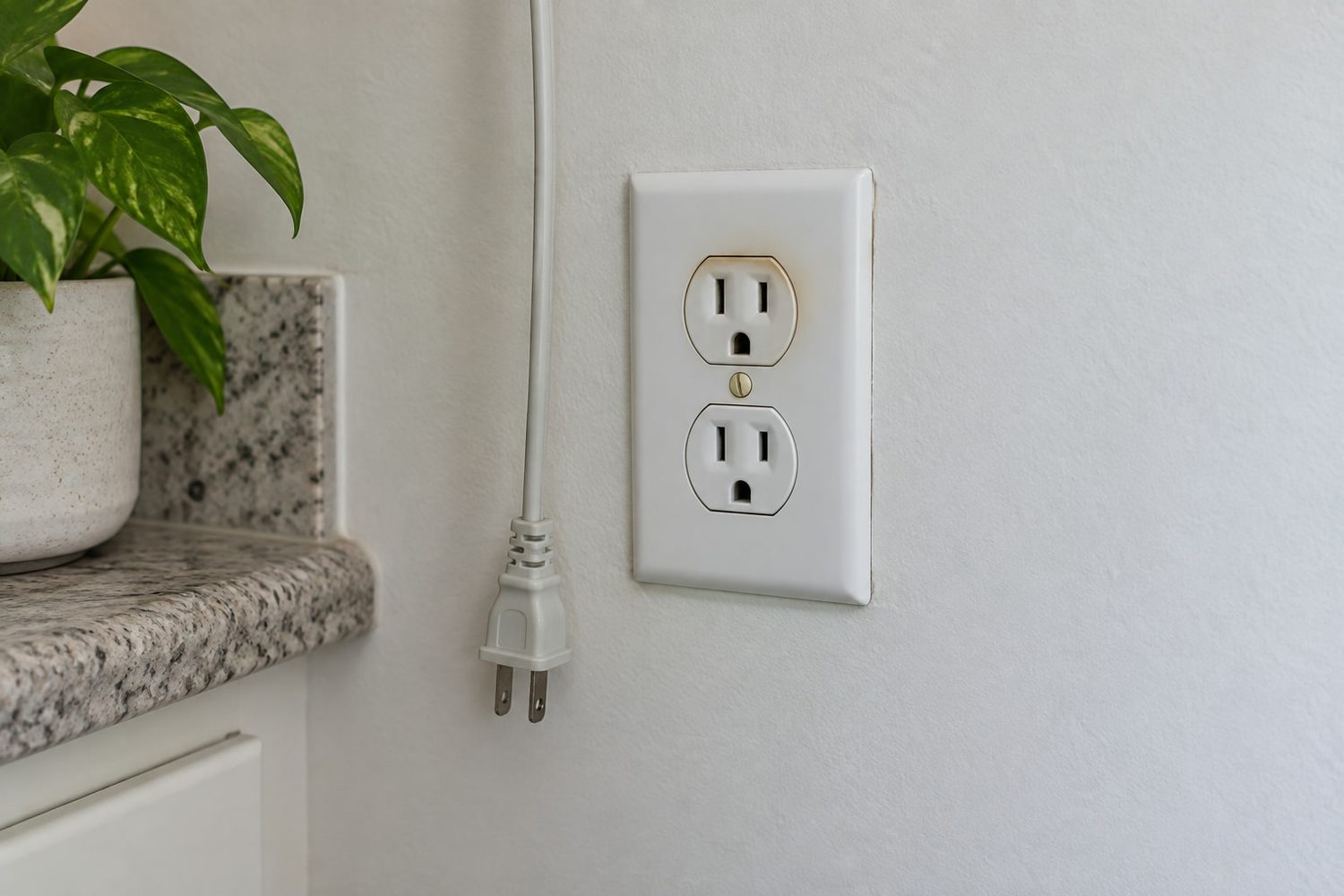
- a breaker trips, especially more than once
- a plug, outlet, cord or timer feels hot, is loose, looks discolored or is damaged
- a connection buzzes, crackles or flickers, or you smell something
- water or condensation has reached any electrical part
- the rack plus everything else on the circuit is getting close to 1,440 W on a 15 amp circuit or 1,920 W on a 20 amp circuit
- the setup needs another outlet or its own circuit
ESFI names frequent breaker trips, warm outlets or switches, and crackling or buzzing as reasons to call an electrician (ESFI). Don't repair a cord, open an LED driver, or put in a bigger breaker. No single rack wattage calls for a dedicated circuit in every home; an electrician's load assessment of your circuit and local code settles that.
While you are at it, check your smoke alarms. USFA recommends alarms inside every bedroom, outside each sleeping area and on every level including the basement, tested monthly and replaced 10 years from the manufacture date (USFA), and a basement alarm should be interconnected with the others (USFA).
Questions growers ask about rack wiring
How much does a dehumidifier add to the rack's load? There isn't a single figure. ENERGY STAR reports dehumidifier capacity in pints per day and efficiency in liters per kWh, not one wattage for every model (ENERGY STAR). Read the amps on your unit's nameplate, or meter it while the compressor is running, and add that to the circuit total.
How often should I look the rack over? Weekly, unplugged where practical. Look for frayed or pinched cords, loose plugs, cracked cases, blocked fixture vents, dust near lights, a missing ground pin, and any new tripping, flickering or buzzing. USFA says to replace cracked, damaged or loose appliance cords (USFA).
Do fire reports about indoor grow rooms apply to a microgreens rack? The causes carry over; the equipment differs. Massachusetts investigators said an October 2024 house fire began in an illegal cannabis grow room, likely from an overloaded power strip running lights, fans and other appliances (Massachusetts DFS), and Oregon investigators tied a May 2017 fire to improper extension cord use for high-power grow lamps (Sweet Home Fire District). A paper by a Washington fire officer, hosted by USFA, describes metal-halide and high-pressure sodium lamps on circuits from 110 to 480 V (USFA), and Michigan's advice to hire a licensed electrical contractor and call the utility first is written for marijuana home grows (Michigan CRA).
I rent. Can I add an outlet for the rack? Read your lease and get the landlord's permission in writing first. In Delaware, for one example, landlords must maintain the electrical facilities they supply and certain tenant alterations are allowed only by a conspicuous separate agreement (Delaware Code). Travelers also advises tenants to treat extension cords as temporary (Travelers).
Turning the rack back on
Turn the rack on only when every plug came through the look-over cool and dry, the circuit total sits under 1,440 W or 1,920 W, the timer's rating fits the load, one listed strip goes straight into the wall, and the connections sit above the water. If any step turned up heat, discoloration, tripping, buzzing or moisture, leave that part unplugged and call the electrician before the next grow cycle.
Sources
Prices, stock and specifications are as the linked pages showed them on 2026-09-12.
- Feit
- Sunco
- Hydrofarm
- Vornado
- P4400 manual
- NFPA NEC public record
- ESFI
- Hydrofarm timer
- Hydrofarm timer strip
- Intermatic catalog
- CPSC checklist
- USFA handout
- ESFI
- CPSC
- OSHA
- ESFI
- OSHA 1910.334
- OSHA
- thermostat
- E3S conference paper
- Intertek
- UL Product iQ
- ETL directory
- CPSC
- CPSC
- USFA
- USFA
- ENERGY STAR
- USFA
- Massachusetts DFS
- Sweet Home Fire District
- USFA
- Michigan CRA
- Delaware Code
- Travelers
Keep reading
The journal
Microgreen Seeds vs Regular Seeds: What the Label Must Say
Microgreen seeds vs regular seeds: garden packets, dried beans, and birdseed follow different label rules. Know what to check before you sow any bag to eat.
Read Microgreen Seeds vs Regular Seeds: What the Label Must SayThe journal
Best Potting Soil for Microgreens: Cost per Tray
Compare the best potting soil for microgreens by ingredients, bag size, trays filled per bag, and cost per tray, plus problems to expect from each mix.
Read Best Potting Soil for Microgreens: Cost per TrayThe journal
Can You Grow Microgreens in an AeroGarden? What Owners Do
The AeroGarden MicroGreens Kit is hard to find. Learn how owners still grow microgreens in an AeroGarden with a simple tray beside the light.
Read Can You Grow Microgreens in an AeroGarden? What Owners DoThe journal
Growing Microgreens Without a Grow Light on a Windowsill
A sunny windowsill can grow microgreens without a grow light for many crops, though stems run longer and paler. Learn which window and crops work best.
Read Growing Microgreens Without a Grow Light on a Windowsill