Best hydroponic system for microgreens by scale and budget
Cal HewittPublished Checked
- growing
- equipment
- hydroponics
- letpot
Disclosure: some links on this site are affiliate links, and we may earn a commission if you buy through them. Product details below are the makers' claims unless a study or extension publication is named.
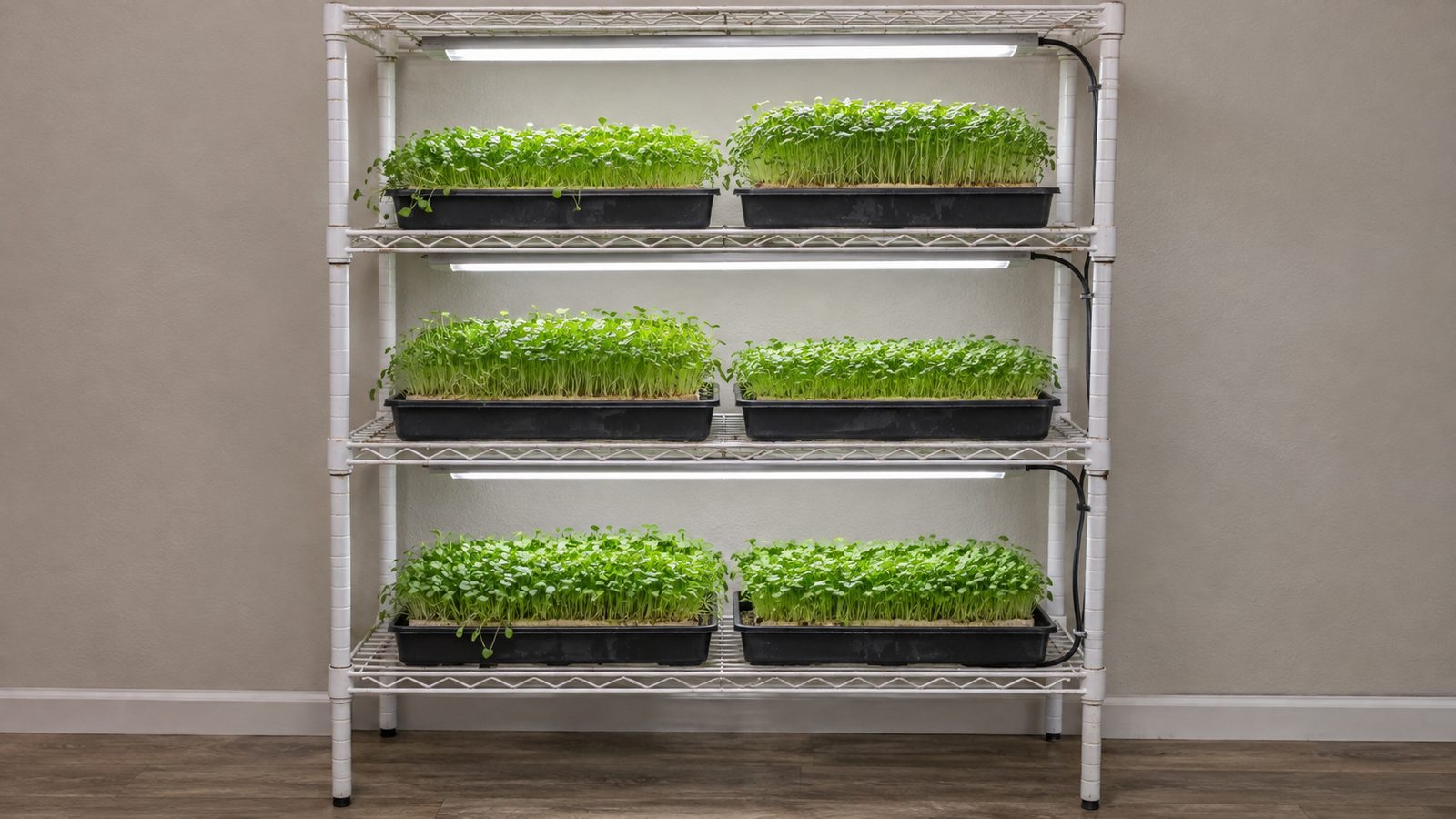
The best hydroponic system for microgreens is the one that matches how many trays you grow each week. For one tray at home, that is a mat in a 10 by 20 inch tray with bottom watering. For a shelf of trays, it is a small flood and drain or NFT rack. For a countertop garden such as the LetPot, it is a small experiment rather than a tray-a-week plan.
The prices below were visible on November 7, 2026, and they will move, so confirm them before you buy.
Match the system to your scale
Five types cover almost everything a home or small commercial grower will consider. A mat in a tray is the simplest and cheapest. Flood and drain and NFT (nutrient film technique, where a thin film of nutrient solution runs through channels) suit a shelf of trays or a small sale. A countertop garden holds individual pods. A DIY build can be a passive tray or a pump-driven NFT rack.
One caution applies to every type. The research on hydroponic microgreens says results depend on the crop, the mat, the nutrient strength and the irrigation method. A study by Bantis and Koukounaras in Scientia Horticulturae did not find one best treatment for all crops, so plan to test on your own tray.
A mat in a tray: one tray at home
This is the setup Sun Hydroponics recommends for beginners. You put a hemp, jute, felt or silicone mat, or a layer of coco coir, in a 10 by 20 inch tray, sow, blackout for 2 to 3 days, and water from the bottom. Sun Hydroponics describes this as a Kratky-style windowsill tray, harvested at roughly 7 to 14 days. That is grower guidance, not a trial.
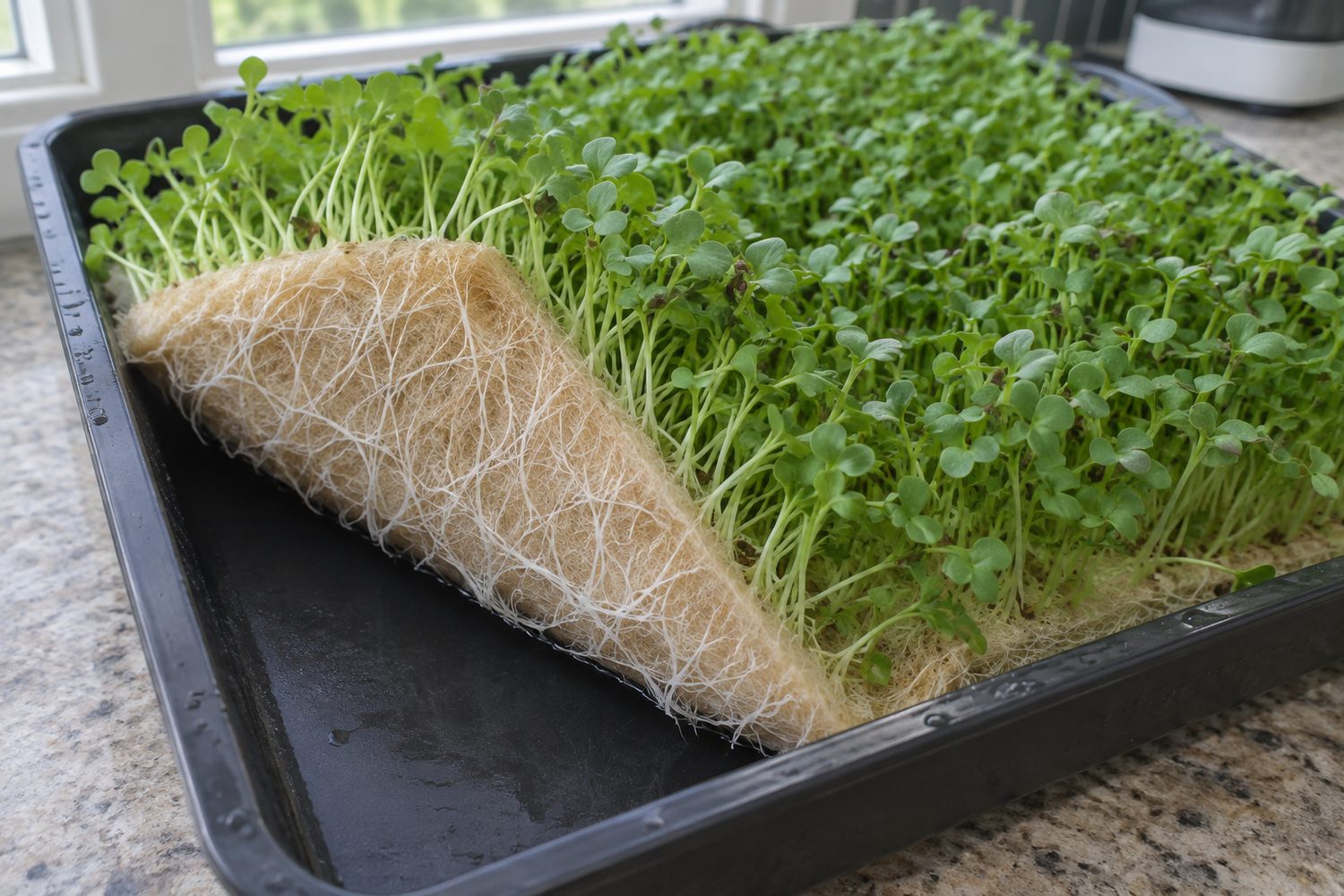
Each week you buy or cut a fresh mat, weigh and sow the seed, refill the water, and clean the tray. Bootstrap Farmer sells hemp grow mats for $2.90 each and says they are pre-cut for 1020 trays and biodegradable. On The Grow sells a 7x14 tray kit at $32.97 with reusable silicone sheets that the maker rates for 20 to 30 or more cycles. It was listed as sold out on November 7, 2026.
Which mat should you pick? The studies do not crown one. In the 2024 fiber-mat study (Treadwell et al., Horticulturae), hemp, jute, BioStrate and MicroMat each did better for some herbs or measurements. Virginia Cooperative Extension's SPES-756 advises testing water-holding capacity, reusability, cost and pathogen risk within your own crop and system. Buy two mats, run the same seed weight on both, and keep the one that harvests cleaner.
Flood and drain and NFT: a shelf of trays
These systems add a pump, a reservoir, a timer and plumbing. In return, they water a stack of trays without you doing it by hand. The tradeoff is more to clean and more that can fail.
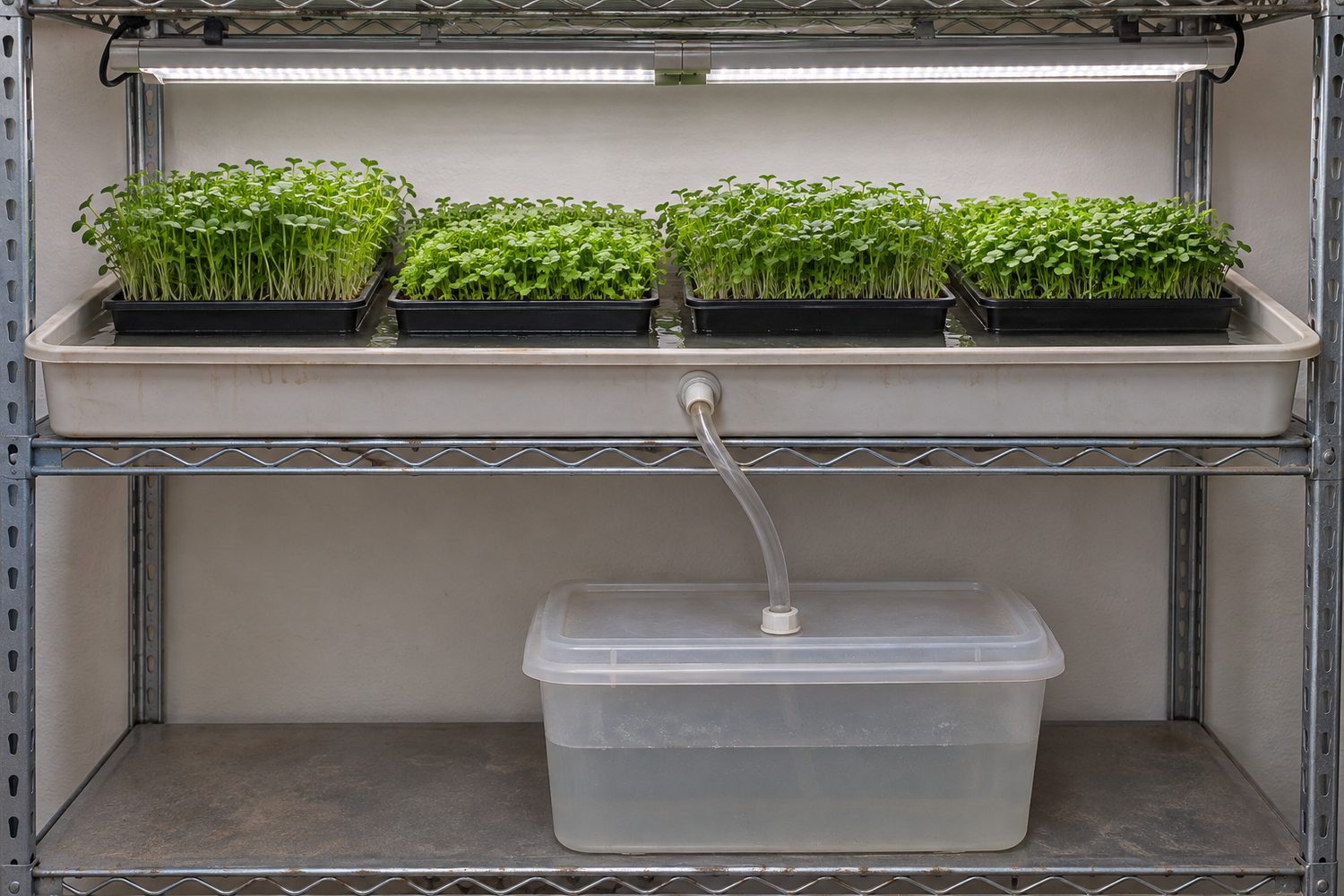
The CropKing Microgreen Rack is one example. It costs $3,225 on the product page, with freight shipping quoted separately. CropKing says it holds up to 96 standard 10 by 20 inch trays in its widest channels, and it includes sixteen 12-foot channels, a steel support rack, plumbing, a 1,900 GPH pump, a timer and burlap rolls. The reservoir and lights are not included. CropKing says its timed irrigation, rather than continuous flow, reduces the chance of disease and pests getting established. That is the maker's claim, not a measured result.
In the United Kingdom, V-Farm lists a five-layer flood and drain system at £6,400 and a four-layer NFT system at £6,000, with larger systems up to £31,900. Tray capacity and shipping need a quote.
For evidence, Virginia Cooperative Extension reports that its Controlled Environment Agriculture Innovation Center grew carrot, broccoli, mizuna, radish and beet on hemp and burlap mats in NFT towers. A study by Ciuta et al. found a vertical hydroponic system produced slightly better results than ebb-and-flow benches for most species. It changed the system and the substrate together, though, so it cannot tell you what hydroponics alone adds.
Each week on a rack you check the reservoir, test and adjust nutrients if you use them, replace the mats, wipe down channels, and inspect each tray before harvest. Ask the maker for current capacity, lighting, reservoir and shipping details before you pay. Ask CropKing in writing for the crops, yields, lighting and reservoir the rack is specified for.
A countertop garden such as the LetPot
A countertop garden is built for individual plants. The LetPot LPH-SE starts at $119.99 and has 12 pods, a 5.5 liter tank and a 24 W light board. The LPH-Max is $251.99 on sale with 21 pods, a 7.5 liter tank and a 36 W light. LetPot lists peas, kale, bok choy, lettuce, spinach and herbs as suitable crops.
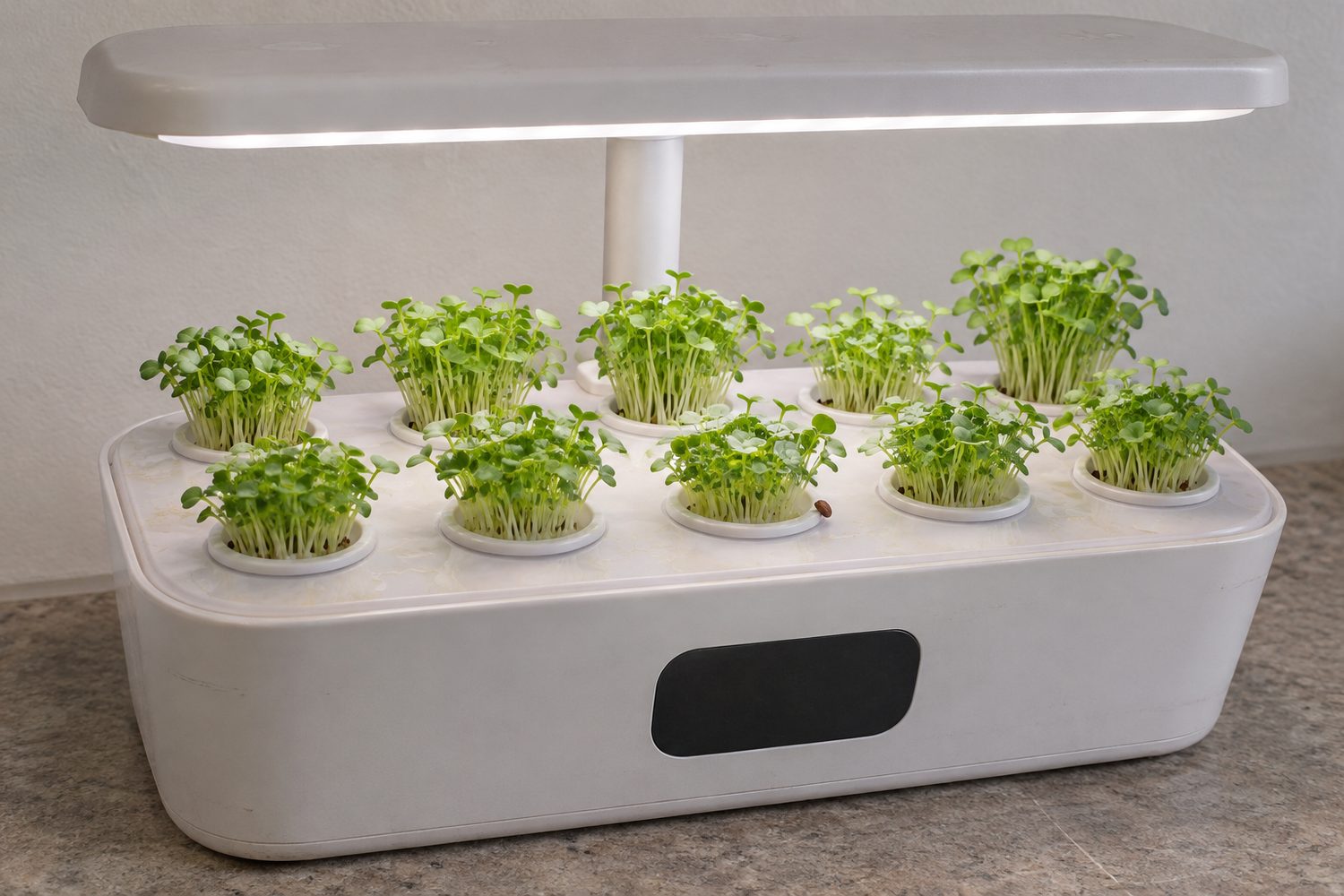
The LPH-SE manual has you push 2 to 3 seeds into each of 12 sponges, cover the baskets, and keep the pump on a 30 minutes on, 30 minutes off cycle, with the light 4 to 5 inches from the plants. That is a different job from a dense, flat canopy across 200 square inches. Amazon's listing for the LPH-SE gives the unit's size as 16 by 7 by 9.8 inches, a footprint of 112 square inches for the whole unit, not the planting area.
Where does it fit? If you already own a LetPot or an AeroGarden, it can host a small test, or you can run a separate tray beside the light. Our AeroGarden owner reports record owners growing spicy mixes, mustard, cat grass and wheatgrass, and also flooding, mold and rot when trays were adapted to the pump. Those are individual reports, not yield data.
It does not fit if you want a full tray each week. Treat it as an experiment: weigh what a tray-sized test gives you before you count on it. For a countertop format that matches the crop, a shallow passive tray with a reservoir is the closer fit.
A DIY build
The cheapest DIY is passive. Sun Hydroponics prices its windowsill tray at $8 to $13 in total: a 10 by 20 tray ($2 to $4), a mat or coco ($2 to $3), a one-ounce seed mix ($3 to $5) and a spray bottle ($1). One grower on Reddit described a wick system, with one 1020 tray as a reservoir under a second tray and wicks between them, for about $8 to $9 in wicks. That is grower practice, not extension evidence.
A pump-driven DIY rack costs more and asks more of you. Sun Hydroponics' NFT rack plan estimates $130 to $190 for a basic build and $569 for the full parts list, which includes a four-tier rack, eight four-foot channels, a 20 gallon reservoir, a pump and a backup pump, lights, a timer and meters. Those are the plan's estimates, with affiliate-linked retail examples, not a cost study.
A lower-complexity pattern from Virginia Cooperative Extension nests 1020 trays that have holes inside trays that do not, with hemp mats and a separate lighted rack. Passive trays need manual attention but have fewer parts to fail. NFT and flood and drain automate watering and add pumps, plumbing, electrical equipment and water-quality work.
What one 10 by 20 inch tray costs each week
Prices were visible on November 7, 2026. Electricity, shipping, taxes, water, light and replacement losses are left out. Seed uses Sun Hydroponics' $3 to $5 per one-ounce mix, so weigh the seed you actually sow and adjust.
- Passive DIY tray: mat or coco $2 to $3 plus seed $3 to $5 gives $5 to $8 a week once you own the tray and spray bottle.
- Hemp mat from Bootstrap Farmer: $2.90 plus $3 to $5 is $5.90 to $7.90. Buying the 1020 tray, from $5.99, the same week brings it to $11.89 to $13.89.
- Coco coir: a brick from $11.99 fills about three shallow 1020 trays, per Bootstrap Farmer. $11.99 divided by 3 is $4.00 a tray, plus $3 to $5 seed, so $7.00 to $9.00. A first tray adds $5.99, making $12.99 to $14.99.
- On The Grow kit: $32.97 divided by 20 to 30 cycles is $1.10 to $1.65 a cycle if you assign the whole price to the silicone, plus seed. The tray is smaller than 10 by 20, about 98 square inches against 200.
- CropKing rack: $3,225 divided by 96 trays is $33.59 of equipment per tray position, before reservoir, lights, shipping, seed, media, nutrients, water and power. That is a capacity share, not a weekly cost.
- LetPot and DIY NFT: Weigh each harvest, record what you spent on seed, mat, nutrients and power for the cycle, and divide the purchase price by the cycles you really run.
Which crops to try
Pea, sunflower, radish, broccoli, mustard, wheatgrass, carrot, mizuna, beet and several herbs all appear in studies, extension work or grower guidance on hydroponic or soil-free growing. Virginia Cooperative Extension reports carrot, broccoli, mizuna, radish and beet on hemp and burlap in NFT towers. Bantis and Koukounaras grew mustard, radish and pea. Mustard did well on cannabis mat and coco coir, while radish and pea gave higher yields on peat with nutrient solution than on plain water or cannabis mat.
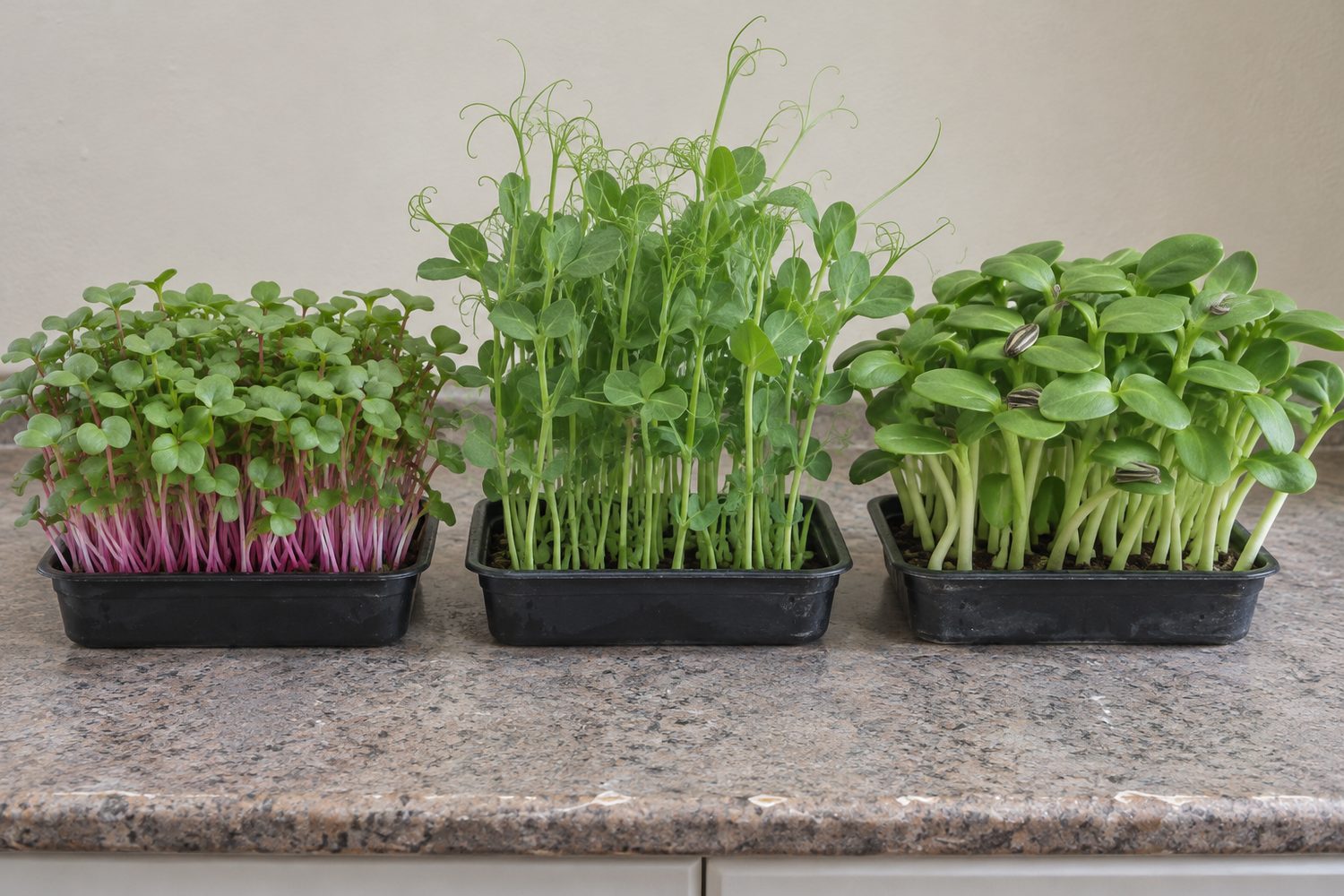
Sun Hydroponics lists sunflower, pea shoots, radish, broccoli, wheatgrass and beet as beginner crops, and On The Grow says pea shoots root hard enough to grow on mesh alone. Both are grower practice. The 2024 fiber-mat study found chives gave 1,999 to 2,431 g/m² fresh shoot weight in one experiment, while parsley on BioStrate or hemp gave 463.3 and 578.1 g/m², so herbs vary a lot by crop.
Broccoli, mustard, radish, mizuna, pak choi and kohlrabi were all grown in soil-free systems in the studies. Test each crop on a marked patch of the tray, with the same seed weight and the same mat, before you commit a whole tray or a customer order to it.
One supplier warning is worth noting. On The Grow says Swiss chard, beets and cilantro may do poorly on silicone unless you use soil or coco coir. That is a supplier's practice claim, not independent evidence, so test those three on coco coir beside silicone.
Nutrients: start with water
No one nutrient strength fits all crops and systems. Sun Hydroponics says many first crops can run on plain water because seeds carry stored nutrients through a 7 to 14 day crop, while its NFT rack guide says plants grown in water need dissolved nutrients. Its two guides cover different cases: a short tray crop on seed reserves, and a recirculating rack on dissolved nutrients.
Bantis and Koukounaras tested 0%, 50% and 100% Hoagland solution. Plain water and cannabis mat generally slowed growth, and full-strength solution or half-strength with peat gave promising yield and nutritional value. Their solutions measured about 1.5 mS/cm at 50% and 2.6 mS/cm at 100%, per a Frontiers review. Those figures belong to that experiment's water and recipe. Germinate on water, then try a measured program on a marked patch and write down the result.
What you give up compared with soil
A mat means you manage watering and wetness yourself. The research makes a few concrete points. In Bantis and Koukounaras, peat gave the strongest yield potential, and plain water slowed growth. Xiao et al. in Horticulturae measured nitrate-nitrogen in sunflower and pea shoots of 4,550 and 1,925 mg/kg on peat versus 375 and 125 mg/kg on BioStrate. Those figures apply to those crops, that substrate and those conditions.
Peat and coco coir are soilless media, so they are not a head-to-head with garden soil. You control the conditions: use clean trays, keep standing water off the canopy, move air across the trays, and inspect before harvest. The LetPot manual says to discard any sponge touched by mold. If you want a real answer for your kitchen, run soil and your mat in matching trays for two cycles and compare weight and cleanliness.
FAQ
How long does a hydroponic tray take? Sun Hydroponics lists 2 to 3 days of blackout and harvest at roughly 7 to 14 days. In the Bantis and Koukounaras trial, mustard and radish were harvested at about 8 days and pea at about 10 days.
Can I reuse a mat? Bootstrap Farmer sells its hemp mats as biodegradable and compostable sheets. On The Grow says its silicone sheets last 20 to 30 or more cycles with proper care, which is the maker's claim. Follow On The Grow's care instructions for the silicone sheets.
Can I fit a microgreen tray into a pod garden? Owners who tried it report flooding, mold and rot when a tray was adapted to the pump. Read the AeroGarden owner reports before modifying anything, and keep a separate tray beside the light as the safer test.
What should I ask a maker before buying a rack? Ask for the current price, stock, shipping, warranty and the replacement media you will need. Also ask for tray capacity, lighting and reservoir specifications in writing.
Where to start
If you grow one tray, buy two mats and a tray and run a side-by-side test this week. If you grow a shelf, price your own electricity, water and seed before comparing racks. If you own a countertop garden, use it for one small trial and keep the tray method for volume. Whatever you pick, weigh every harvest and keep the numbers.
Sources
Prices, stock and specifications are as the linked pages showed them on 2026-11-07.
Keep reading
The journal
Can You Grow Microgreens in a LetPot? Pods vs a Plain Tray
Can you grow microgreens in a LetPot? Set its 16 x 7 in overall size against a 10 x 20 in tray, watch the pods for seed mold, and test one batch.
Read Can You Grow Microgreens in a LetPot? Pods vs a Plain TrayThe test bench
AeroGarden and Countertop Pod Gardens for Microgreens: Is It Worth It?
Pod count is holes for separated mature plants, not dense tray area. A $30 tray kit gives you more sowing surface for microgreens than a $250 pod garden.
Read AeroGarden and Countertop Pod Gardens for Microgreens: Is It Worth It?The journal
Using your own seeds in a LetPot: sponges, seed count and light
Using your own seeds in a LetPot instead of pods? See the seed count per sponge, the light height for germination, and the failures owners have reported.
Read Using your own seeds in a LetPot: sponges, seed count and lightThe journal
LetPot Review: Max, SE, Lite, Air and Mini Compared
This letpot review sets the current LetPot range side by side: pod count, light power, maximum light height, tank size, warranty and owner-reported faults.
Read LetPot Review: Max, SE, Lite, Air and Mini Compared