LetPot Review: Max, SE, Lite, Air and Mini Compared
Cal HewittPublished Checked
- equipment
- letpot
- pod gardens
- buying
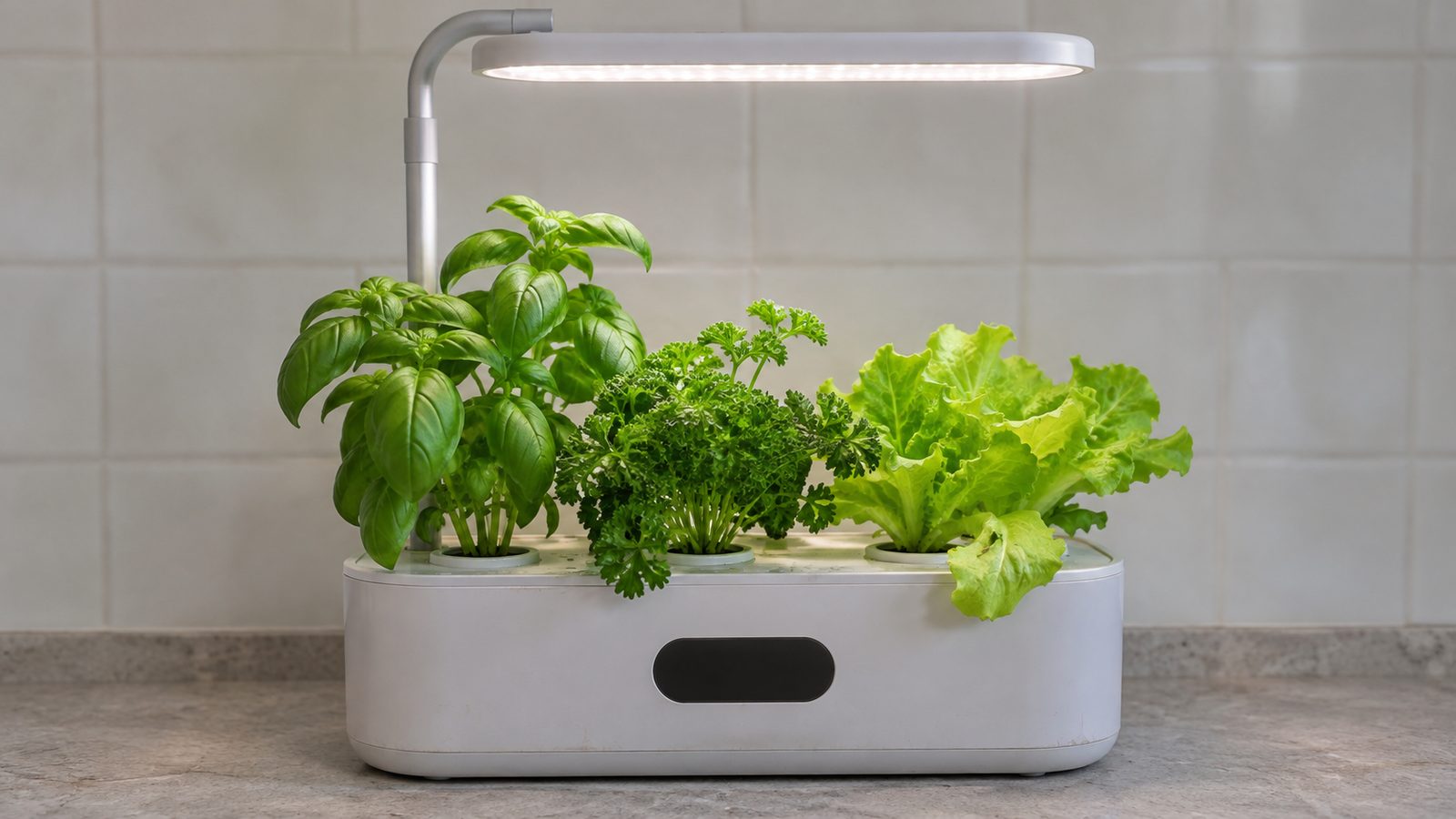
LetPot sells five indoor gardens right now: the LPH-Max, LPH-SE, LPH-Lite, LPH-Air and LPH-Mini. They differ in pod count, light height, tank size and controls.
The Max has the highest light rating at 36 W; the SE, Lite and Air are rated 24 W, and the Mini 10 W. Match the model to the space on your bench and the crop you want to grow, then check the price on LetPot's own product page the day you buy.
Disclosure: this page is monetized. Some links may earn Microgreens Guru a commission if you buy, at no extra cost to you. The specifications below come from LetPot's own product pages and manuals; what owners and reviewers say is labeled as their report.
The current LetPot range
LetPot's indoor-garden collection lists the five models above. Its user-manual page also lists the Mini-W, the Wi-Fi version of the Mini. The SE is also called the Senior.
You may have seen an LPH-Home in recent videos. It is a Kickstarter campaign, LetPot LPH-Home 2-Tier Smart Indoor Garden, with estimated delivery in February 2027. The rest of this page covers the five models on LetPot's product pages.
Here is the range side by side, with every figure taken from LetPot's pages.
Hover or tap a row to highlight it.
| Model | Pods | Light | Max light height | Tank | Controls | Warranty |
|---|---|---|---|---|---|---|
| LPH-Max | 21 standard plus a separate 2-pod large-plant tray | 36 W | 30 in | 7.5 L | App, 4.6-inch touchscreen, automatic refilling and nutrient dosing | 1 year |
| LPH-SE (Senior) | 12 | 24 W full-spectrum LED | 30 in | 5.5 L | App and touch panel | 1 year |
| LPH-Lite | 12 | 24 W full-spectrum LED | 16 in | 5.5 L | App and Wi-Fi, 0 to 24 hour light schedule | 1 year |
| LPH-Air | 10 | 24 W | 14 in | 4 L | App and Wi-Fi plus touchpad | 1 year |
| LPH-Mini | 5 | 10 W, two light modes | 16.3 in, adjustable from 4.3 in | 1.5 L | App, remote control | 1 year |
Sources: Max, SE, Lite, Air and Mini product pages. LetPot's customer FAQ states a 1-year warranty and a 30-day return policy for all its products.
What separates one model from the next
A "pod" is a planting position: a basket holding a sponge. Every LetPot garden grows in pods, so match the pod count to how many separate plantings you want running at once. LetPot says the SE tank supports up to three weeks of growth.
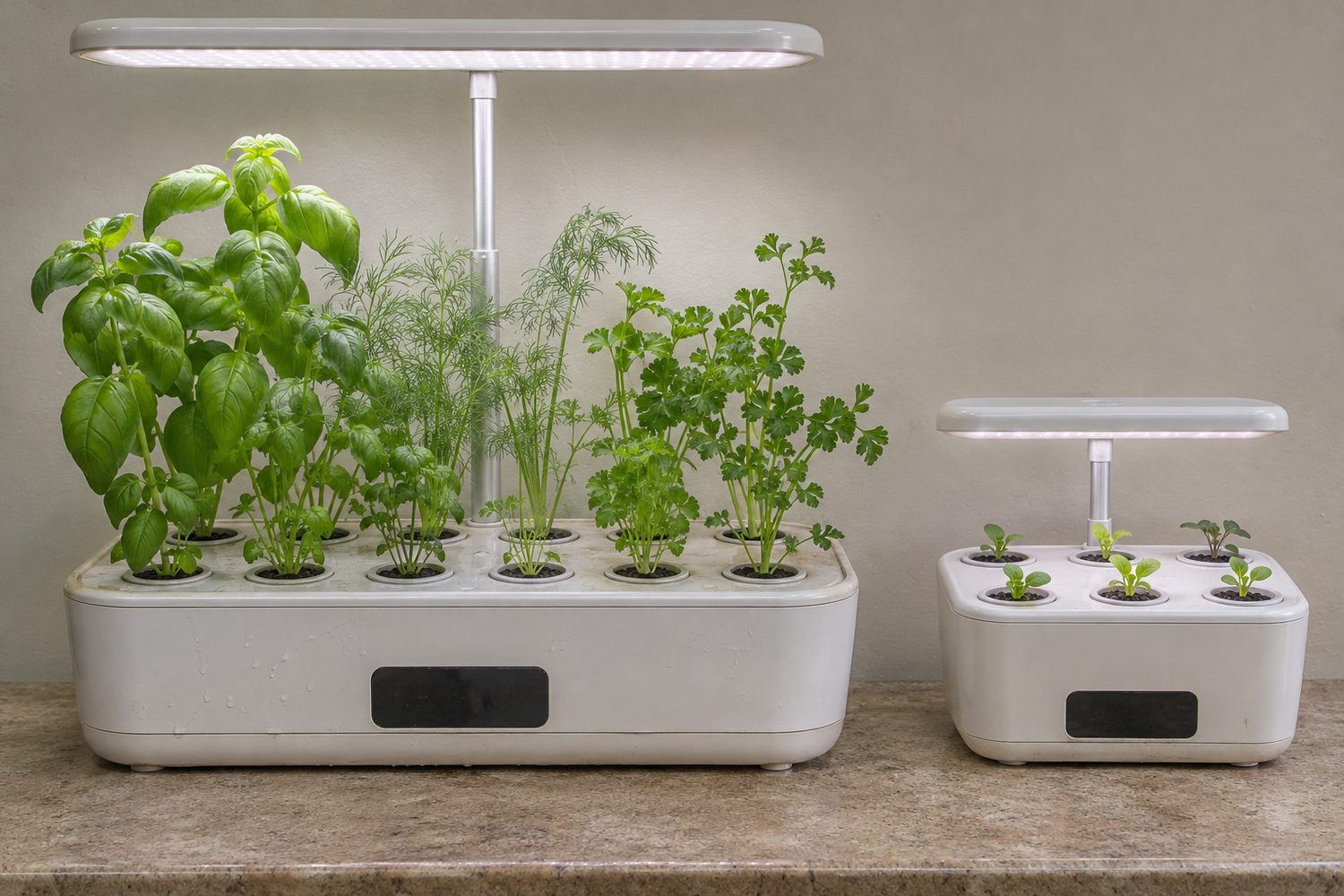
The Max adds a lot over the SE. It has 21 pods instead of 12, a second tray for two larger plants, a 7.5 L tank instead of 5.5 L, and a 36 W light instead of 24 W. Among the SE, Lite and Air, only the Max has automatic water refilling and nutrient dosing, and the Mini's listed controls do not include it. According to the Max manual, the automatic mode connects by pipe to an outer reservoir, refills when the level drops to about 2.3 inches (3.25 L), stops at about 3.9 inches (7.15 L), and then doses plant food from the nutrient box.
The Max and SE share the same 30 inch maximum light height, so the Max's extra pods and automation do not come with extra light height. Gardening Know How, which tested a Max, reports it used manual mode and skipped automatic mode because that mode needed a separate reservoir and more space. If you plan to use the automation, plan the bench space for that reservoir too.
The Air and Lite both use 24 W lights and have no automatic refilling or dosing. The Lite gives you 12 pods instead of 10, a 5.5 L tank instead of 4 L, and a 16 inch light height instead of 14 inches. LetPot lists the Lite at a higher price, so check both pages before you decide whether the extra room is worth it to you.
The Mini holds 5 pods and has a 1.5 L tank, and its light is rated 10 W.
Measure your bench before you order
Dimension listings for two models are unclear, so do not rely on them for a tight fit.
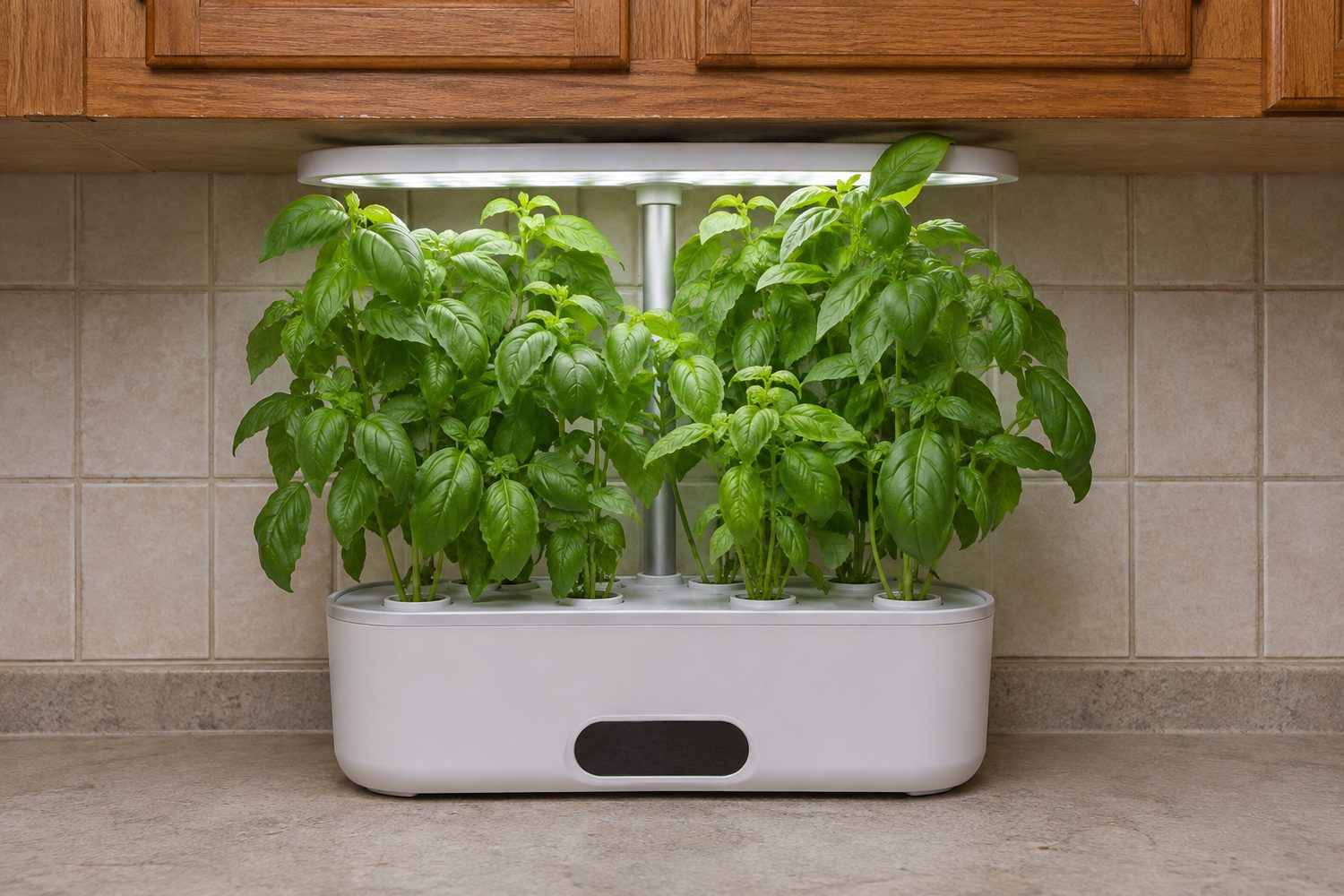
Product listings for the Air show conflicting sizes, including 17 x 8 x 4 in and 15 x 5 x 7 in. For the Lite, check the footprint on the listing for your exact version. For both, measure the counter or shelf you have in mind, then confirm the figures for the exact color and version against the listing, or ask LetPot for the current dimensional drawing.
The other listed sizes are: Max 17 x 11.5 x 7.2 in, SE 16 x 7 x 9.8 in, and Mini 8.7 x 5.3 x 4.3 in at the base, with the light extending to 16.3 in. The light panel rises as high as the maximum light height in the table, so measure the headroom above your bench as well as the footprint.
If you grow microgreens in standard flat trays, hold your tray against the deck size too. These gardens are built around pods, and a later part of this LetPot series covers microgreens in a LetPot.
Prices and running costs
LetPot's prices change with sales and variants, and the figures differ between its US and UK pages. Open the model's product page linked in the table and read the price on the day you buy. If you shop on Amazon, compare the exact model and adapter variant right before ordering.
Electricity for the light is small. The U.S. Energy Information Administration projected an average residential price of 18.2 cents per kWh for 2026. LetPot's Air manual gives a general light range of 12 to 16 hours a day, depending on the plant. Using watts x hours per day x 30 days / 1,000 x $0.182, the light alone costs about:
Hover or tap a row to highlight it.
| Model | 12 hours a day | 16 hours a day |
|---|---|---|
| LPH-Max, 36 W | $2.36 a month | $3.15 a month |
| LPH-SE, Lite and Air, 24 W | $1.57 a month | $2.10 a month |
| LPH-Mini, 10 W | $0.66 a month | $0.87 a month |
These figures leave out the pump, so read the rated input on your unit's label and add it to your estimate. They also leave out water, nutrients, replacement parts, and any utility charges beyond the rate above.
LetPot sells replacement pods, grow sponges, nutrient plant food, pumps and light panels, and says its systems are open systems without pod subscriptions. According to Gardening Know How's hands-on report, seeds are not included in the Max kit, so budget for seed.
What owners say goes wrong
These are reports from individual owners and reviewers, not controlled tests. They show that these problems happen to some people. They cannot show how often.
Pump or circulation trouble is one thread. Owners describe a pump that would not start, one that worked only above or below certain water levels, a connector that was not fully seated, and a Max whose automatic water-level system needed customer service help. One example is this Reddit post asking if a pump is broken.
App and Wi-Fi setup is another. Owners describe difficult onboarding, pairing problems, and lights or schedules that did not run as expected, such as lights turning off daily and a thread about difficult onboarding. The Gadgeteer, reviewing two SE units, reported scheduling problems and one light that failed to turn on automatically. WIRED's reviewer, who tested an SE for several months, called the app awkward and said it was unnecessary once the timer was set.
Algae, mold and rot are a third. LetPot's FAQ gives instructions for algae and mold on sponges, and one owner described seeds and sponges rotting in an LPH-Lite. Some owners report needing customer service, and some describe difficulty with it.
Not every report is negative. Mary's Test Kitchen used an SE for nine months and three planting rounds, and described the 12-pod Senior as a good balance of features and beginner accessibility. WIRED's reviewer reported successful repeated harvests of baby chard from an SE.
Steps that cut the risk
Each common problem has a step you can take before it starts.
Check your Wi-Fi first. LetPot's manuals specify a 2.4 GHz network, so confirm your home network offers that band before you start pairing. Check your router settings or ask your internet provider if you are not sure.
For algae and mold, follow LetPot's FAQ and the LPH-SE manual. The manual says to drain and rinse the tank, discard sponges or plants touched by mold or algae, and clean the baskets and covers. It also says to cover sponges and basket tops with the seed pod stickers during planting and seedling stages, and to use blackout covers on unused pods so light does not reach the water.
The Air manual says pump faults are often impurities or roots clogging the pump, and says to rinse the pump sponge. The SE manual says the pump needs no regular cleaning in normal use, but to clean the pump and its filter sponge after at least six months, with clean water and no detergents.
Test early. LetPot lists a 30-day return policy, so run the pump and lights through a full day-and-night cycle in the first week. Set the schedule, watch that the light switches on and off when it should, and listen to the pump. The SE manual's default is 16 hours of light on and 8 off, with the pump running 30 minutes and resting 30 minutes.
If something fails, write down the model, purchase date and exact symptom before you contact LetPot support. Some owners report needing LetPot support, so having those details ready makes your report clearer. The 1-year warranty is worth knowing before you buy, so keep your receipt and order number.
FAQ
Can I buy the LPH-Home I saw in videos? It is a Kickstarter campaign with estimated delivery in February 2027, according to the campaign page. LetPot's product pages cover the Max, SE, Lite, Air and Mini.
Which LetPot has the strongest light? The Max, rated 36 W. The SE, Lite and Air are rated 24 W, and the Mini 10 W. Rated power is not the same as how well a crop grows, so also check the maximum light height for the plants you want.
Do LetPot gardens have a subscription for pods? LetPot states that its systems are open systems without pod subscriptions. It sells refill pod kits, nutrient plant food and replacement parts separately.
How long is the warranty, and can I return one? LetPot's customer FAQ states a 1-year warranty and a 30-day return policy for its products. Use the 30 days to test the pump, the lights and the app.
Where to go from here
Pick the pod count and light height that fit your bench, measure the space, confirm 2.4 GHz Wi-Fi, and test the unit in its first week. Then check the price on the model's LetPot page. Later parts of this series cover microgreens in a LetPot, using your own seeds in a LetPot, LetPot against Click and Grow, and the best hydroponic system for microgreens.
Sources
Prices, stock and specifications are as the linked pages showed them on 2026-11-07.
Keep reading
The journal
LetPot vs Click and Grow: Plant Count, Pod Costs and Upkeep
LetPot vs Click and Grow on plant count, US prices and the cost of each pod you buy, plus how much upkeep each countertop garden needs from you.
Read LetPot vs Click and Grow: Plant Count, Pod Costs and UpkeepThe journal
Can You Grow Microgreens in a LetPot? Pods vs a Plain Tray
Can you grow microgreens in a LetPot? Set its 16 x 7 in overall size against a 10 x 20 in tray, watch the pods for seed mold, and test one batch.
Read Can You Grow Microgreens in a LetPot? Pods vs a Plain TrayThe journal
Using your own seeds in a LetPot: sponges, seed count and light
Using your own seeds in a LetPot instead of pods? See the seed count per sponge, the light height for germination, and the failures owners have reported.
Read Using your own seeds in a LetPot: sponges, seed count and lightThe journal
AeroGarden Bounty Review: Basic, Bounty and Elite Specs
This AeroGarden Bounty review compares the Basic, Bounty and Elite by watts, features, price, stock, running cost estimates, and warranty terms.
Read AeroGarden Bounty Review: Basic, Bounty and Elite Specs