Best Microgreen Seeds for Beginners: Which Crops to Order First
Cal HewittPublished Checked
- growing
- seeds
- beginners
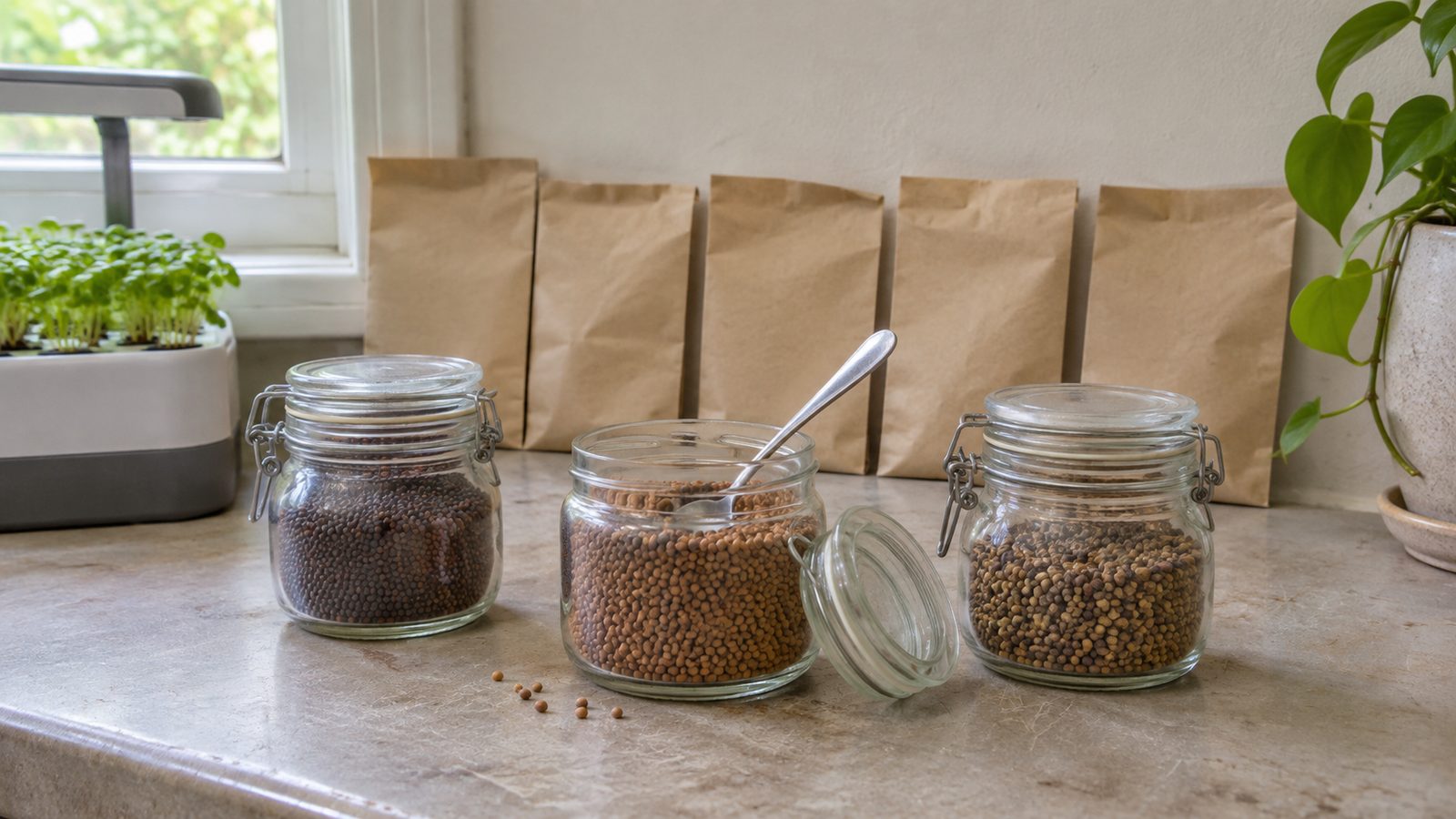
Order radish first, then broccoli or kale, then pea or sunflower. Radish, broccoli and kale all finish in roughly 8 to 12 days, according to the Utah State University Extension table, and none of them needs soaking before you sow.
Pea and sunflower are good third crops, but each needs a soak first. That is one extra step, and it is worth planning for before the seed arrives. Arugula is a fourth crop that needs no soak and is the quickest of the group, at 6 to 8 days.
For a standard 1020 tray, Utah State's figures work out to 42 g of radish seed, 28 g of broccoli or kale, 48 g of sunflower and 150 g of pea. A three-tray example order of radish, arugula and sunflower from True Leaf Market (4 oz, 1 oz and 4 oz packs) came to $24.51 in US dollars on November 9, 2026, before tax and shipping.
Why the order runs radish, broccoli or kale, then pea or sunflower
Radish comes first because it is fast and needs no soak. Utah State University Extension lists radish at 8 to 12 days to harvest with no presoak, and a Johnny's Selected Seeds trial of its Hong Vit radish averaged 9.5 days to first true leaf.
Broccoli or kale comes second. Both are mild, familiar crops. Tennessee Extension names broccoli, kale, cabbage and lettuce as the mild, familiar crops to try first. Utah State lists both at 8 to 12 days, no soak, and 28 g of seed per tray.
Pea or sunflower comes third because the seed is larger and takes more preparation. Tennessee Extension describes both as larger-seeded crops that are commonly soaked before planting. They are worth adding once the first two have worked.
Johnny's Selected Seeds also lists kales, mustards, broccoli, cabbage, arugula, mizuna, pac choi, tatsoi, radishes, pea and sunflower as good varieties for beginners in its production slide deck. That is a seller's list, which agrees with the extension sources. For the reasoning behind each crop, see which microgreens suit a beginner.
Days to harvest, soaking and seed per 1020 tray
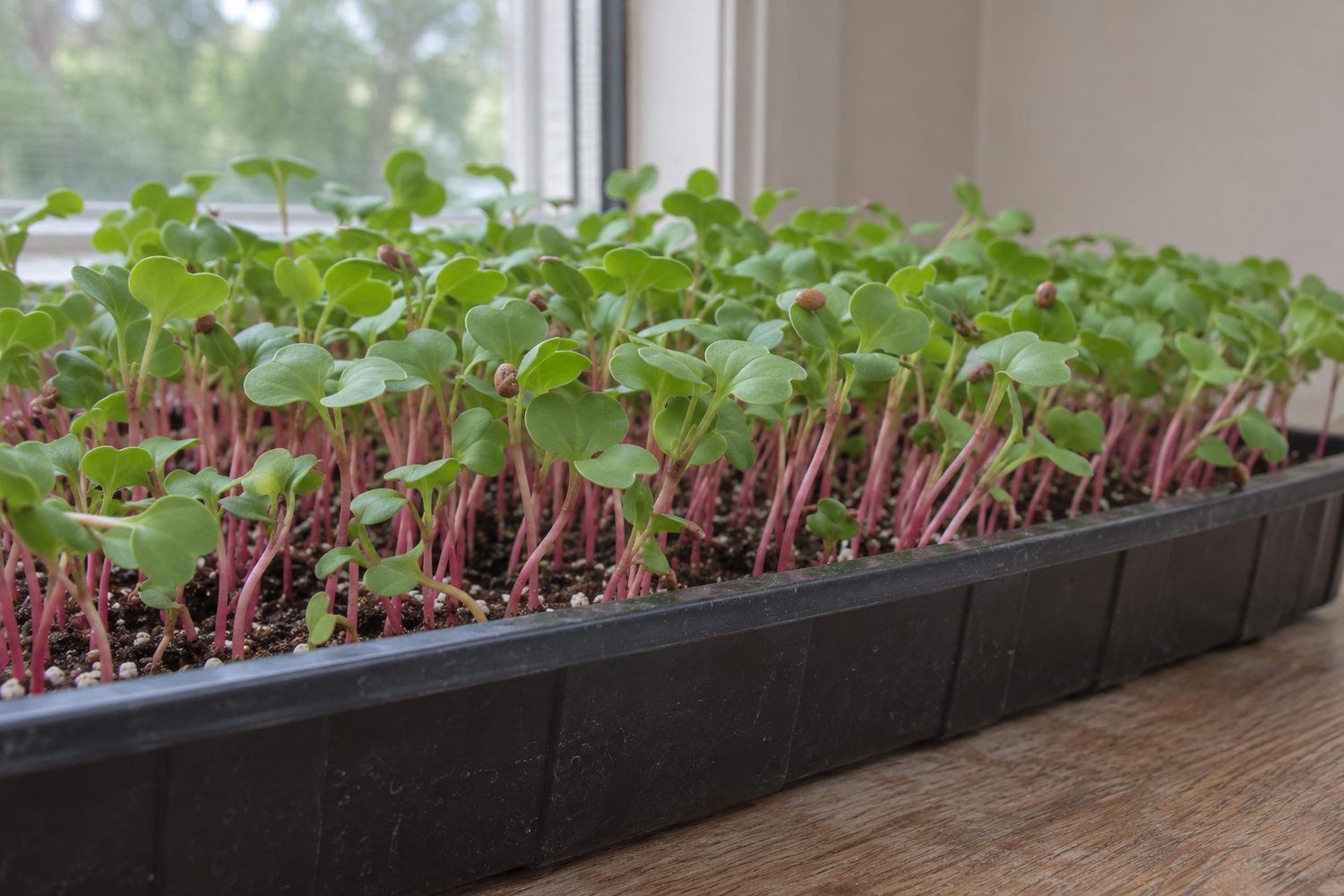
A 1020 tray is the standard tray, about 10 by 20 inches. The table below comes from the Utah State University Extension guide, updated January 2026. Its timings assume about 74°F during germination, 72°F with the lights on, 68°F with the lights off and 18 hours of light, with harvest at or near the first true leaves.
Hover or tap a row to highlight it.
| Crop | Days to harvest | Soak | Seed per 1020 tray |
|---|---|---|---|
| Arugula | 6 to 8 days | No | 10 g |
| Radish | 8 to 12 days | No | 42 g |
| Broccoli | 8 to 12 days | No | 28 g |
| Kale | 8 to 12 days | No | 28 g |
| Pea | 8 to 10 days | 6 hours | 150 g |
| Sunflower | 9 to 10 days | 12 hours | 48 g |
| Mesclun greens mix | 12 to 14 days | No | 28 g |
If your room is cooler than those temperatures or your lights run fewer hours, expect your days to stretch. Treat every figure above as a starting point and write down what your own tray does.
Rates also differ between sources, and that is normal. Johnny's Hong Vit radish trial used 28.5 g per tray, against Utah State's 42 g for radish generally. True Leaf Market recommends about 9 oz of sunflower for a full 1020 tray, far above Utah State's 48 g. Method, variety and tray depth all change the number. The full set of rates is in the microgreen seeding rate chart.
Soaking pea and sunflower, the one extra step
Soaking means leaving the seed in water before sowing so it takes up moisture and germinates sooner. Utah State's table gives pea 6 hours and sunflower 12 hours. The University of Maryland Extension says soaking pea and sunflower for 6 to 12 hours speeds germination, so the two sources agree on the range.
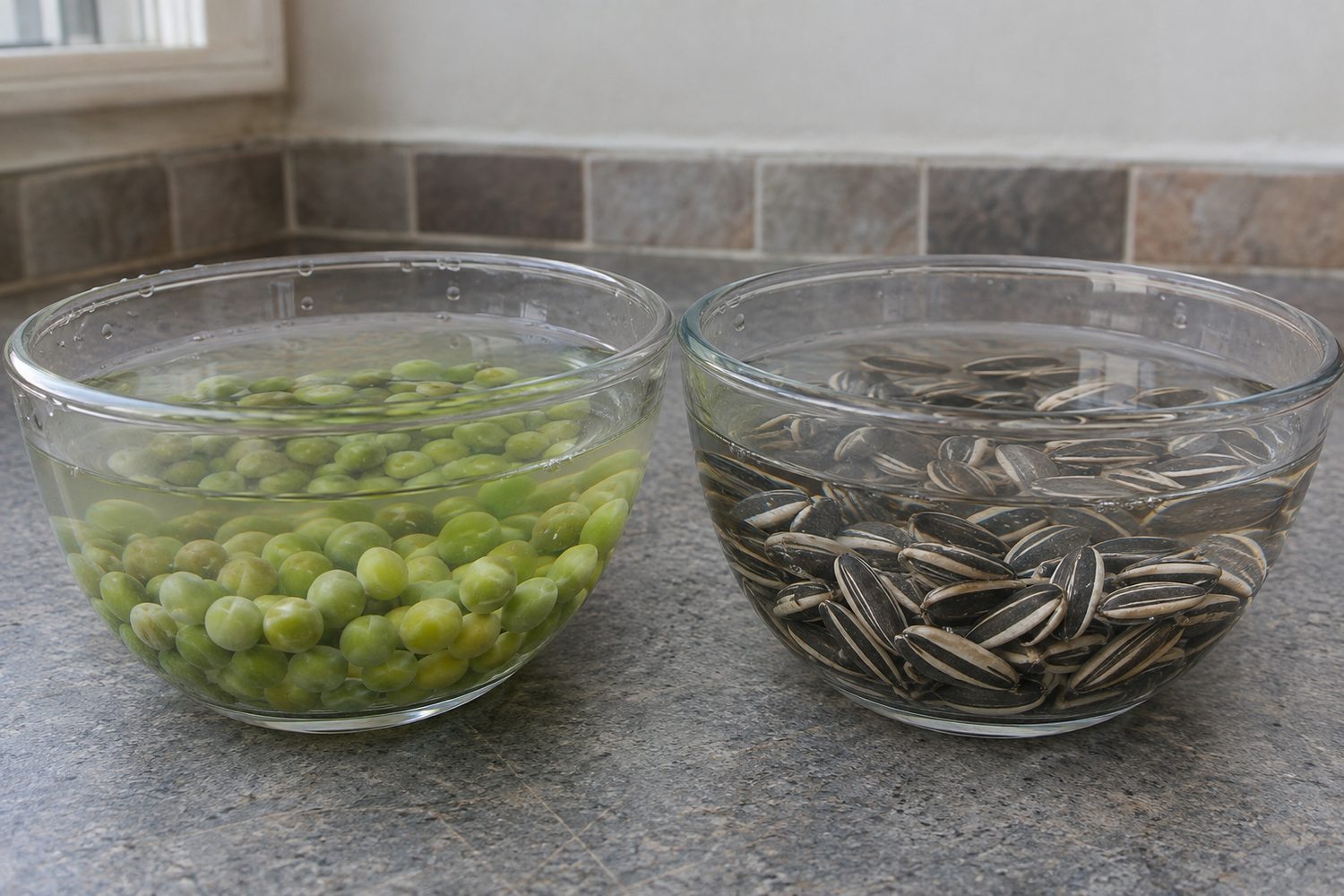
In practice that means starting the soak the evening before you plan to sow. Sunflower at 12 hours fits an overnight soak. Pea at 6 hours fits a soak that starts after breakfast and ends before an evening sowing.
Radish, broccoli, kale and arugula skip this step in the Utah State table, which is a large part of why they suit a first tray. You measure, spread, mist and cover.
A mild mix, and what to do about mustard
A mix can be a reasonable choice if you would rather grow one tray with several flavors. Utah State lists a mesclun greens mix at 12 to 14 days and 28 g per tray. Maryland Extension, though, advises against mixing species whose germination and growth rates differ.
So, a mix is a fair option, but its parts will not all be ready on the same day. A commercial mix designed for synchronized growth is a different case; check the seller's description. If you are unsure, start with single crops.
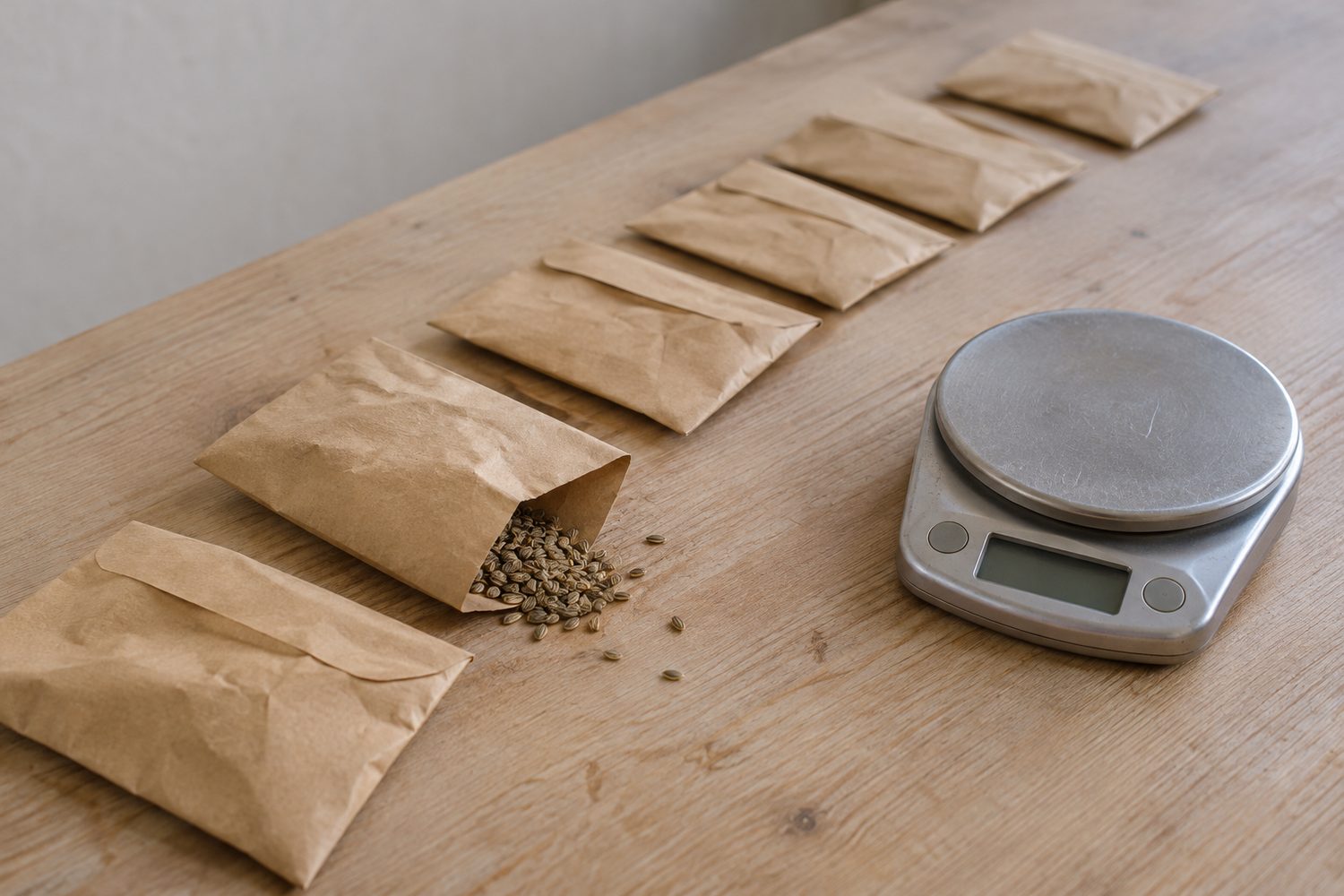
Mustard needs a different approach. For mustard, start with the tray rate printed on your seller's packet or product page. Then mark off a test patch on your first tray, measure the seed for that patch on a kitchen scale, sow it, and write the number down along with the days to harvest. Your second tray can then run on your own figure.
Crops to leave for later
Some crops are slower or need more preparation, and they can wait until you have a tray or two behind you. Utah State lists basil at 12 to 16 days and cilantro at 21 to 28 days, with cilantro covered for 7 to 14 days. Those are long waits compared with a radish.
Beet is a larger seed that Tennessee Extension and Maryland Extension both list among the seeds that are often soaked. Maryland's seed-count table lists about 1,500 beet seeds per ounce against about 8,000 for broccoli, so you cannot carry a small-seed tray rate across to beet.
Tomato, pepper, eggplant, potato, tomatillo and ground-cherry shoots are a separate matter. The Associated Press reports that these should not be eaten as microgreens because of toxic alkaloids, so keep them off your order entirely.
What the seed label should say
Seed sold for microgreens is eaten, so the label matters more than it does for a garden packet. Tennessee Extension says raw seed that has not been treated with fungicides, and is not pelleted, is essential for home microgreen production. The True Leaf Market sunflower page makes the same point from the seller's side, warning that garden sunflower seed may be chemically treated and advising you to buy seed sold for microgreens.
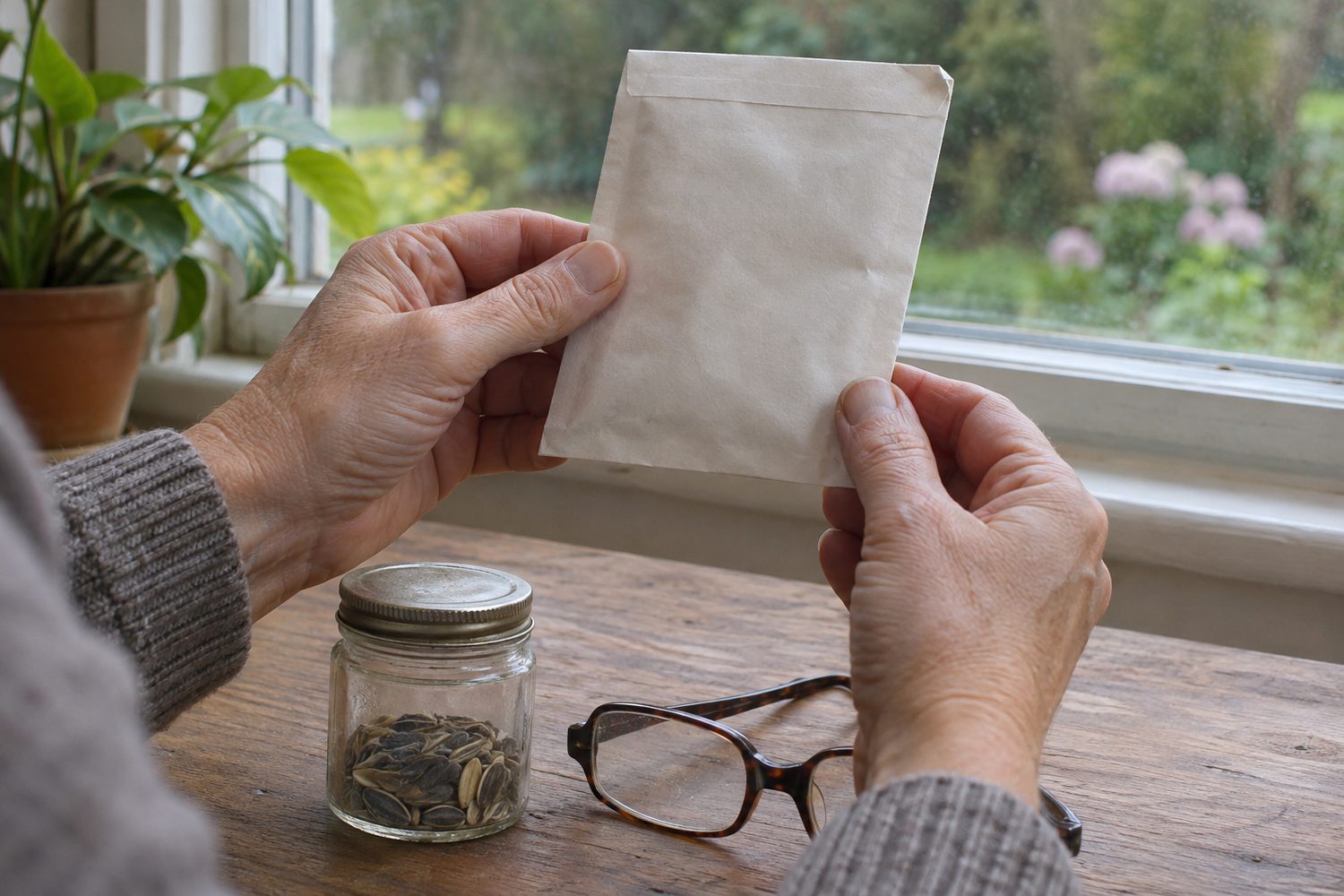
Before you pay, look for these on the listing or the packet:
- The crop and variety, and a statement that the seed is untreated.
- The pack weight.
- A lot number.
- The germination percentage.
- The month and year of the germination test.
The USDA-NRCS seed-label guide lists lot number, germination percentage, test date, purity and the responsible company as standard label components. The Minnesota Department of Agriculture says retailers and labelers are responsible for keeping germination test dates current.
The words "microgreen seed" describe the intended use. They do not by themselves tell you the seed is untreated, freshly tested or traceable. If a product page leaves out the lot number or germination figure, email the seller and ask for the label details for the exact lot before you buy. Organic and non-GMO claims are separate from treatment, lot and germination information, so check each on its own.
What a starter order costs
The prices below were listed on each seller's own product page on November 9, 2026. Pack sizes are as listed, and prices are in US dollars before tax and shipping.
Hover or tap a row to highlight it.
| Seller | Seed | Pack size | Price |
|---|---|---|---|
| True Leaf Market | Rambo radish | 4 g | $3.59 |
| True Leaf Market | Rambo radish | 4 oz | $13.67 |
| True Leaf Market | Slow Bolt arugula | 1 oz | $5.04 |
| True Leaf Market | Slow Bolt arugula | 4 oz | $6.21 |
| True Leaf Market | Black Oil sunflower | 5 g | $2.99 |
| True Leaf Market | Black Oil sunflower | 4 oz | $5.80 |
| Johnny's Selected Seeds | Hong Vit radish | 1 oz | $8.30 |
| Johnny's Selected Seeds | Broccoli | 1 oz | $5.94 |
| Johnny's Selected Seeds | Kale KX-1 | 1 oz | $10.40 |
Sources: True Leaf Market Rambo radish, True Leaf Market Slow Bolt arugula, True Leaf Market Black Oil sunflower, Johnny's Hong Vit radish, Johnny's broccoli, Johnny's kale KX-1.
Here is how that adds up for three separate trays of radish, arugula and sunflower at Utah State's rates, using True Leaf Market prices from November 9, 2026. Radish needs 42 g, so a 4 oz pack of Rambo radish at $13.67 covers it with seed left over. Arugula needs 10 g, so a 1 oz pack of Slow Bolt arugula at $5.04 is plenty. Sunflower needs 48 g, so a 4 oz pack of Black Oil sunflower at $5.80 covers it. The seed subtotal is $24.51.
That subtotal leaves out trays, growing medium, lights, shipping and tax. True Leaf Market's page showed free shipping in the lower 48 only above a $60 order, so a small order may carry a shipping charge. Add your seller's checkout shipping and your local tax to the $24.51 before you decide.
A cheaper sampler is possible. The 4 g radish packet, the 1 oz arugula packet and the 5 g sunflower packet total $11.62 at the same prices. That is enough to try the crops, but not enough for three full trays at Utah State's rates, so think of it as a test rather than a first production order.
Johnny's gives its own tray figure for broccoli, about 2.5 flats per ounce, with a 10 to 15 day range on the product page. Its tray size and method may differ from Utah State's, so measure your own and write it down.
Where to buy small packs of microgreen seed
Prices and stock change.
True Leaf Market sells microgreen seed in a wide range of pack sizes, from a few grams to 25 lb, which suits a first order because the smallest packs cost only a few dollars. Its Rambo radish page labels the seed organic, heirloom and non-GMO. For the lot number and germination figure on any listing, ask the seller for the label details of the exact lot.
Johnny's Selected Seeds sells microgreen seed in 1 oz, 1/4 lb, 1 lb, 5 lb and 25 lb sizes, and publishes tray rates and days to maturity on its product pages. Its smallest pack is 1 oz, which is closer to a tray than a sampler. Some larger kale sizes were out of stock on November 9, 2026.
Mumm's Sprouting Seeds is a seller that states its seed is certified organic and that each lot undergoes extensive testing. Its 125 g packs were shown by a reseller, Sun Parlour Home Grower, on November 9, 2026, at CAD 4.95 for daikon radish and CAD 11.47 for broccoli, both marked out of stock. Confirm pack size, stock and shipping with Mumm's or the reseller before you plan around them.
For more on choosing a source, see buying microgreen seed.
Frequently asked questions
How many trays does one pack make?
Divide the pack weight in grams by the tray rate. A 4 oz pack is about 113 g, so at Utah State's 42 g for radish it covers roughly two and a half trays. Your own measured rate may differ, so work from it once you have one.
Which crop is ready soonest?
Arugula is quickest in the Utah State table, at 6 to 8 days with no soak. True Leaf Market's Slow Bolt arugula page also lists 6 to 8 days. Radish, broccoli and kale follow at 8 to 12 days.
Why do two sources give different seed weights for the same crop?
Rates depend on the variety, the seed size and the grower's method. Utah State gives 42 g for radish and Johnny's trial used 28.5 g, while True Leaf Market suggests about 9 oz for sunflower against Utah State's 48 g. Pick one source, measure your first tray, and adjust.
Can I sow garden seed if it is cheaper?
Not without checking it. Tennessee Extension says untreated, unpelleted seed is essential for microgreens, and garden packets can carry a fungicide treatment. Buy seed sold for microgreens, or confirm in writing that the lot is untreated.
Before you order
Start with radish, add broccoli or kale, and bring in pea or sunflower once you are comfortable with the soak. Measure the seed for each tray on a kitchen scale, write the weight and the days to harvest in a notebook, and use those numbers for the next order. For the full rate table, see the seeding rate chart, and for the reasoning behind each crop, read the beginner crop post.
Sources
Prices, stock and specifications are as the linked pages showed them on 2026-11-09.
- Tennessee Extension
- production slide deck
- Utah State University Extension guide
- True Leaf Market
- University of Maryland Extension
- The Associated Press
- USDA-NRCS seed-label guide
- Minnesota Department of Agriculture
- True Leaf Market Rambo radish
- True Leaf Market Slow Bolt arugula
- Johnny's Hong Vit radish
- Johnny's broccoli
- Johnny's kale KX-1
- True Leaf Market
Keep reading
The journal
Using your own seeds in a LetPot: sponges, seed count and light
Using your own seeds in a LetPot instead of pods? See the seed count per sponge, the light height for germination, and the failures owners have reported.
Read Using your own seeds in a LetPot: sponges, seed count and lightThe journal
What Seeds Should Not Be Used for Microgreens
Wondering what seeds should not be used for microgreens? Nightshades, raw kidney beans, treated seed, buckwheat, alfalfa and borage, each with its reason.
Read What Seeds Should Not Be Used for MicrogreensThe journal
True Leaf Market Reviews: Ratings, Returns and Seed Germination
True Leaf Market reviews vary by platform: Trustpilot shows 2.7 out of 5 from 14 reviews, Google shows 4.2 out of 5 from 175. Check the return policy first.
Read True Leaf Market Reviews: Ratings, Returns and Seed GerminationThe journal
Are Grow Lights a Fire Hazard? A Checklist for Tonight
Wondering if your grow lights are a fire hazard? Add up the actual watts and amps on your rack, then check them against your circuit and timer limits tonight.
Read Are Grow Lights a Fire Hazard? A Checklist for Tonight