Fans for Microgreens: Buy a Small Clip Fan, and Check the Watts Not the CFM
Cal HewittPublished Checked
- equipment
- airflow
- buying
- mold
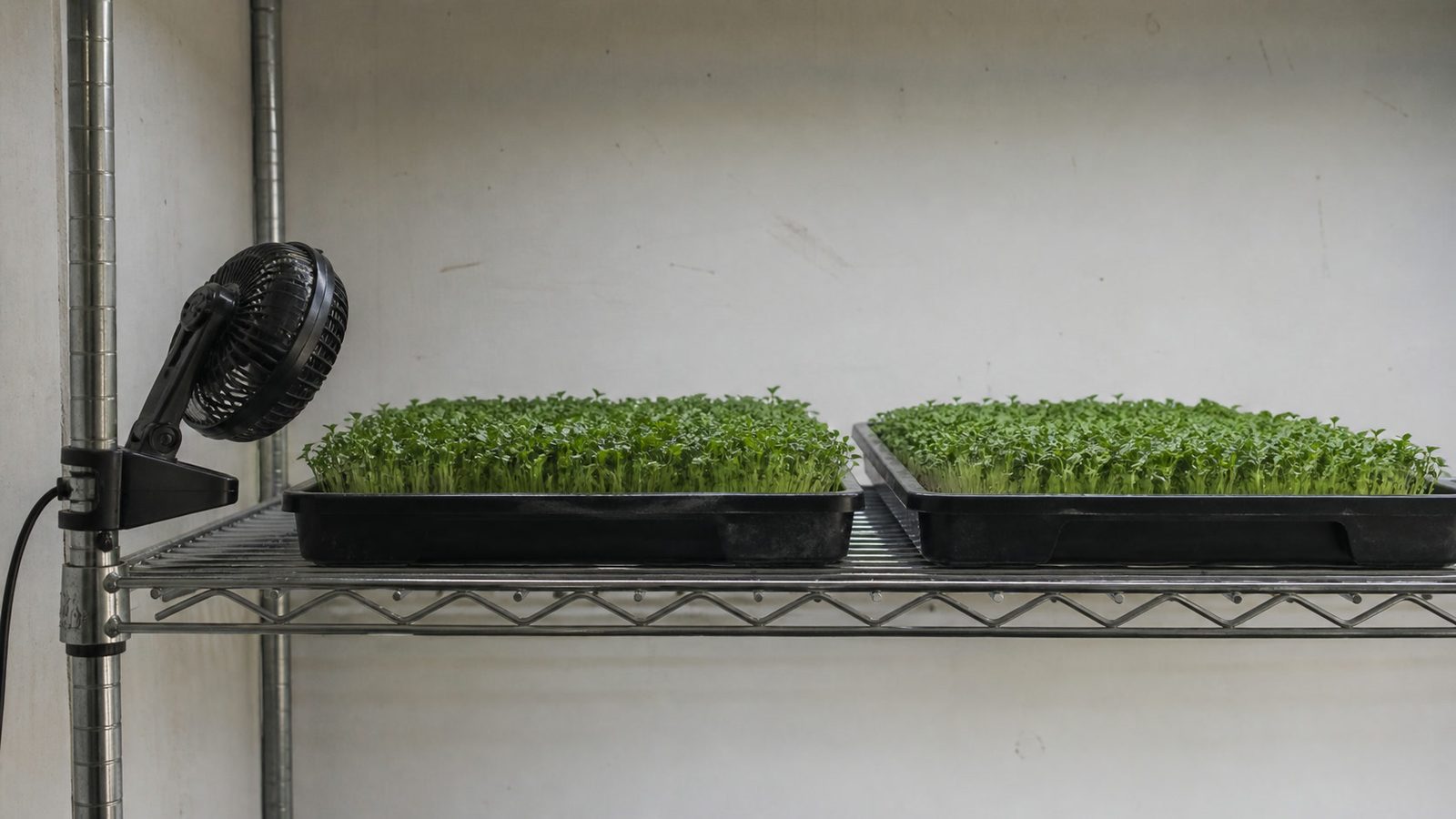
There is no fan for microgreens. Nobody makes one, nobody tests one against a seedling tray, and nobody warrants one for the job. What growers buy is a grow-tent clip fan, a USB desk fan, a tower fan or an inline duct fan, and the closest anything comes to being marketed for this is a product page that says "grow tent."
No air speed at a microgreen canopy exists anywhere in the literature, as temperature and airflow works through. This page is about what you can actually buy against that gap, and the first thing to notice is that the category's own recommendation does not survive contact with its own products.
What to actually do
- Buy a small clip fan and point it along the shelf, not at the crop. That is what the practice consensus says and it is not a measurement, but it is free advice and the failure it avoids is real.
- Do not chase a CFM figure. No CFM number on any listing tells you what your tray is experiencing, and the one published target for this crop would take four to twelve of these products.
- Check the watts before the price. The A6 costs $61.38 a year to run against the E9's $29.08, and it is the cheaper fan.
- If it is going where somebody sleeps, buy a clip and not a duct fan. 35 to 38 dBA against 49 to 60.
- If you want the real answer for your shelf, buy the $30.99 anemometer, which costs less than the fan, and map the canopy at the distance you actually mount it. That is the measurement nobody has published.
- Buy a thermal probe instead if your question is about very still air, because a vane cannot resolve below about 0.30 m/s.
- Do not treat a fan as a treatment for mold. There is more in temperature and airflow, and the short version is that it changes the conditions that favor disease and does not cure one.
The only published figure, priced in real fans
One microgreen page in this category publishes an airflow calculation. It proposes exchanging a room every 3 to 5 minutes and works an example of 1,188 cubic feet times 2, arriving at 2,376 CFM. Those two claims describe different rates, so treat the figure as unvalidated practice rather than as a target.
Take it at face value anyway and see what it asks for.
Hover or tap a row to highlight it.
| Product | Published CFM | How many it takes |
|---|---|---|
| Vivosun E9 clip fan, $54.99 | 580 | 4.1 |
| Vivosun A6 clip fan, $39.99 | 430 | 5.5 |
| Dreo 554S tower fan, $99.99 | 1,473 | 1.6 |
| Vivosun Z4 inline duct fan | 203 | 11.7 |
The one number this category publishes cannot be met by the equipment this category recommends. Four of the biggest clip fan sold for grow tents, or nearly twelve duct fans, for one home shelf. That is not a buying guide, it is a sign that the figure was never meant to be acted on.
CFM is not what your crop feels
A cubic-feet-per-minute rating is a volume measured at the fan in free air. It is not a speed at a tray eighteen inches away, and there is no honest conversion between them.
Air leaving a small fan forms a jet. It drags still room air along with it, spreads, breaks up around whatever is in the way, and loses speed with distance in a way that depends on the shelf, the trays and the room. The centerline is not the tray. Any page that divides a CFM figure by an area to give you a velocity is producing a number that looks convincing and means nothing.
No manufacturer publishes a measurement at a plant canopy, at any distance, for any crop. Not one of the products on this page. That is the specification a buyer actually needs and it does not exist anywhere in the category.
What does exist is for other crops, and it is a warning rather than a target. A 2024 lettuce plant-factory paper cites a canopy range of 0.3 to 1.0 m/s. Tomato graft-seedling work applied 2, 4 and 8 m/s for ten hours a day and found those treatments reduced growth, dried the medium and broke graft unions, with a later study reporting linear reductions from 0.5 to 4.0 m/s. Those are mechanical-stimulation experiments on other plants. They establish that air speed can hurt a seedling, and they do not authorize a setting for yours.
You can buy the missing number for less than the fan
Here is the part worth acting on. The measurement nobody has made is neither expensive nor difficult. It costs less than the equipment it would be measuring.
Hover or tap a row to highlight it.
| Instrument | Price | Lowest speed it reads | Claimed accuracy |
|---|---|---|---|
| BTMETER BT-100 vane | $30.99 | 0.30 m/s (0.67 mph) | ±5% |
| Extech FLIR AN100 vane | $224 | 0.40 m/s (80 ft/min) | ±3%, 0.01 m/s resolution |
The $30.99 instrument costs less than the $54.99 clip fan it would measure. So the reason this figure has never been published is not cost.
But read the third column against the lettuce range. The cheap vane's floor is 0.30 m/s and the only published canopy range for a leafy crop starts at 0.30 m/s. A vane anemometer cannot tell you the difference between the bottom of that range and nothing at all; it may simply display zero. If your question is whether the air is moving gently or not moving, a vane is the wrong instrument and you want a thermal probe with a documented low range.
Running cost, which is where one of these gets expensive
These run continuously, so the sticker price is the smaller number. At the EIA's May 2026 US residential average of 18.44 cents per kilowatt-hour, running 8,760 hours a year:
Hover or tap a row to highlight it.
| Product | Watts | To buy | A year of running | The year against the price |
|---|---|---|---|---|
| Vivosun D4 clip | 4 W | $16.99 | $6.46 | 0.38x |
| Vivosun E9 clip | 18 W | $54.99 | $29.08 | 0.53x |
| Dreo 554S tower | 35 W | $99.99 | $56.54 | 0.57x |
| Vivosun A6 clip | 38 W | $39.99 | $61.38 | 1.53x |
The A6 costs more to run for a year than to buy, and it is the middle option by price. It draws more than twice the wattage of the E9 that costs fifteen dollars more and moves 35 percent more air. Buying the cheaper fan in that pair is the expensive decision, and nothing on either product page tells you so.
That is arithmetic on published watt figures and a published electricity rate, so it is a calculation you can check rather than a measurement. It assumes continuous running, which is the worst case; a fan on a timer costs proportionally less.
Noise, which nobody rates comparably
These sit in a kitchen, a spare room or a bedroom and run all night, so noise is a buying criterion rather than a footnote.
Manufacturer claims seen 2026-08-12: Vivosun D4 35 dBA, E9 36 dBA, A6 38 dBA, Z4 inline 49 dB, AC Infinity's 4-inch duct booster 60 dBA. One tower fan advertises 20 dB with no test protocol attached.
None of those is comparable to any other, because a decibel figure without a measurement distance and method is not a rating. AMCA publishes laboratory methods and distinguishes sound pressure from sound power; product listings seldom supply the conditions either would need. Treat the numbers as ordering within one manufacturer's range and not across manufacturers.
What is comparable is the class. The duct fans are 49 to 60 dBA against 35 to 38 for the clips. If the fan is going in a room where somebody sleeps, that gap is the real decision.
Who should skip this entirely
Anyone whose trays are not showing persistent surface wetness or stale pockets. There is no published threshold you can reach, so there is no state you can buy your way into, and a fan aimed wrongly dries the medium unevenly and flattens light seedlings.
And the alternatives change the same variable for nothing. Opening a door, spacing trays further apart, running fewer trays per shelf, sowing thinner, or shortening the dome period all move the air or reduce the moisture load. None of them costs $39.99 and $61.38 a year.
What is still genuinely unknown
- Any air speed at a microgreen canopy, tied to any outcome. Still zero figures, from any source, including every manufacturer on this page.
- Whether a fan prevents mold, as opposed to reducing condensation, which is established in greenhouses and assumed here.
- A comparable noise ranking, because no listing publishes the test conditions a decibel figure needs.
- Duty rating or service life for continuous running. Almost no listing publishes an MTBF.
- What any of these does across a two-shelf rack, as opposed to at the fan. Every product figure is a free-air rating.
- A defensible three-product current price list for several classes, because general retail listings omit watts and decibels and disappear seasonally.
Terms on this page
Tap a term to see what it means.
CFM. Cubic feet per minute, the air volume a fan moves in free air, measured at the fan. Not a speed and not a figure for a tray.
Sources
Opened 2026-08-12. Prices are snapshots on that date, not price promises, and this page is rechecked at least every two months. The products-per-2,376-CFM table and the annual running costs are arithmetic on published figures, performed for this page.
- Utah State University Extension, grow your own microgreens - the recommendation of a gentle-blowing fan, with no product and no specification attached, which is the state of the extension guidance.
- Vivosun product listings, used as practice and as the source of the specifications and prices: AeroWave E9 at $54.99, 9 inch, 580 CFM, 18 W, 36 dBA, 10 speeds and IP54; AeroWave A6 at $39.99, 430 CFM, 38 W, 38 dBA; AeroWave D4 at $16.99, 4 W, 35 dBA; and the Z4 inline duct fan at 203 CFM and 49 dB.
- AC Infinity quiet USB fans - the MULTIFAN range at $13.99 to $17.99, which publishes dimensions and price but no crop-facing decibel figure or canopy speed, and the 4 inch duct booster at $99 and 60 dBA.
- Dreo 554S tower fan - $99.99, 35 W, 9 speeds, 1,473 CFM and a 28 ft/s claim, with no decibel figure attached to a test protocol.
- Lasko T36511 tower fan - $49.99 with timer and remote.
- BTMETER BT-100 vane anemometer - $30.99, stated minimum 0.67 mph or 0.30 m/s, claimed accuracy 5 percent.
- Extech FLIR AN100 at $224 and its published specifications - range from 0.40 m/s or 80 ft/min, resolution 0.01 m/s, claimed accuracy 3 percent.
- Air Movement and Control Association standard 301 - the distinction between sound pressure and sound power ratings and the laboratory methods behind them, which is what product listings omit.
- Lettuce plant-factory airflow study, 2024 - the cited canopy air speed range of 0.3 to 1.0 m/s, for lettuce and not for microgreens.
- Tomato graft seedling air speed study - measured growing-point speeds of 2, 4 and 8 m/s for ten hours a day, the reduced growth measures, the medium drying and the graft union breakage. Mechanical stimulation research, used here only to show that air speed can harm a seedling.
- US Energy Information Administration, average retail price of electricity - the May 2026 US residential average of 18.44 cents per kilowatt-hour used in the running-cost table.
- Procool SP640X rack fan at $199.99, AC Infinity Cloudplate T5 Pro at $179 and the Stego 19 inch fan tray at $603 - equipment-rack products rather than grow-rack products, listed here because they turn up in searches for rack fans and are not what a grower needs.
- Winix A231 air purifier manual (PDF) - the 55 W draw, for the purifier-as-circulator case.
Keep reading
Growing guides
Temperature, humidity and airflow: run the room at 70°F and it suits 39 of 44 crops
About 70°F sits inside the published germination range for 39 of the 44 crops that have one, so a single setting runs most of a mixed bench. No source publishes an airflow figure for a tray, so point a fan along the shelf rather than at the crop.
Read Temperature, humidity and airflow: run the room at 70°F and it suits 39 of 44 cropsThe test bench
AeroGarden and Countertop Pod Gardens for Microgreens: Is It Worth It?
Pod count is holes for separated mature plants, not dense tray area. A $30 tray kit gives you more sowing surface for microgreens than a $250 pod garden.
Read AeroGarden and Countertop Pod Gardens for Microgreens: Is It Worth It?The journal
AeroGarden Bounty Review: Basic, Bounty and Elite Specs
This AeroGarden Bounty review compares the Basic, Bounty and Elite by watts, features, price, stock, running cost estimates, and warranty terms.
Read AeroGarden Bounty Review: Basic, Bounty and Elite SpecsThe journal
AeroGarden Farm Review: Specs, Price and What It Grows
This AeroGarden Farm review breaks down the Plus and Basic models, last known list prices, running costs, warranty terms, and owner-reported problems.
Read AeroGarden Farm Review: Specs, Price and What It Grows