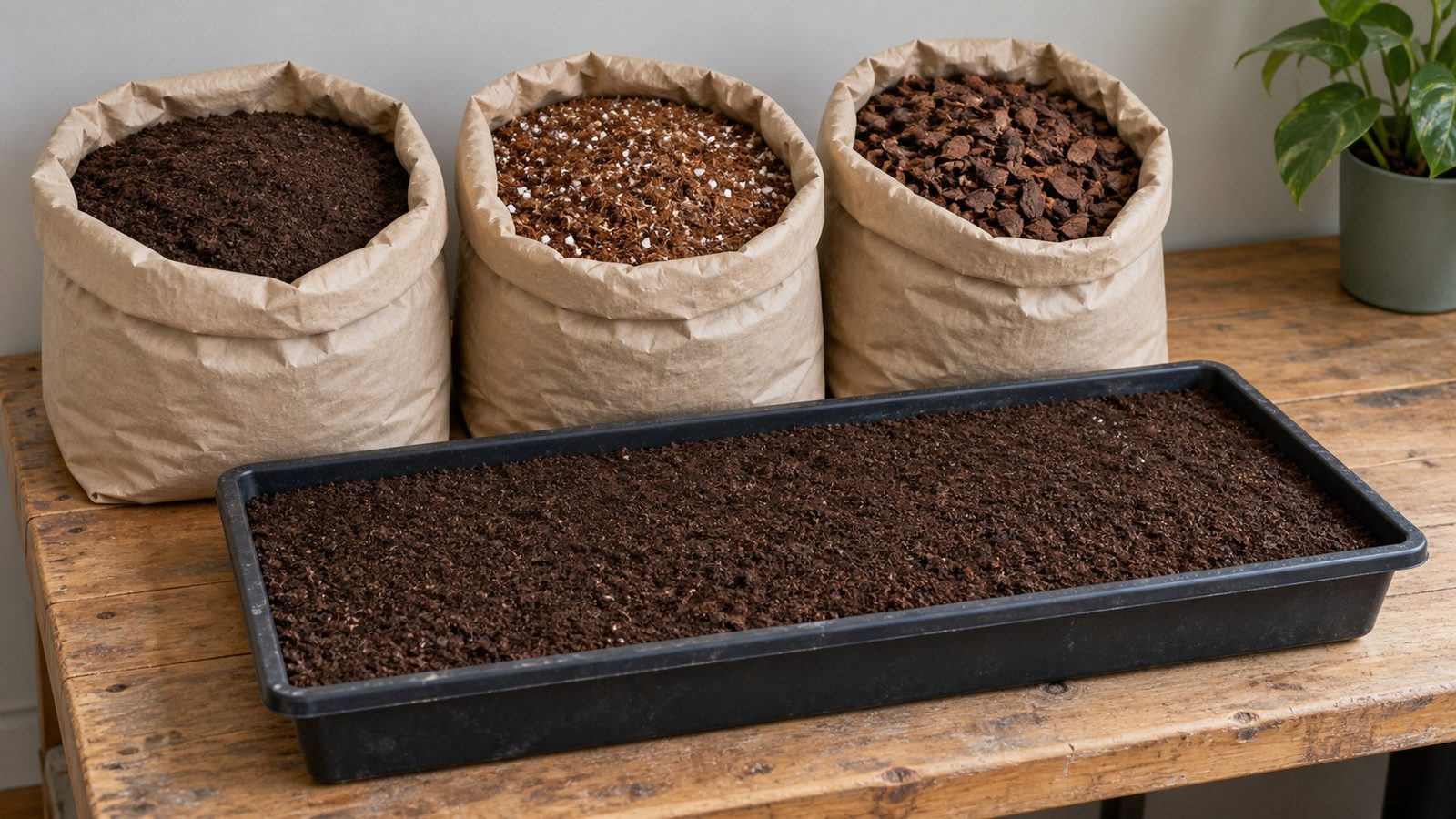
For a few home trays, a small bag of fine seed-starting mix is the easiest place to start. Black Gold Seedling Mix was $6.98 for 8 quarts at Lowe's on September 12, 2026, which comes to $2.60 per 10x20 tray at a 1-inch fill.
If you fill many trays, a 2 cu ft bag of FoxFarm Coco Loco or a compressed PRO-MIX BX bale costs less per tray, and a bale gets cheaper again once it loosens. Before you pay, check four things on the bag: the ingredient list, any fertilizer or biological additives, the bag volume, and whether it is a compressed bale.
Every cost below uses a standard 10x20 tray and names its fill depth, 1 inch or 1.5 inches, because depth moves the answer as much as price does. If you are still choosing between soil, coir and mats, start with choosing a soil or growing medium.
How many trays one bag fills
Bagged mix is sold in dry quarts, not the liquid quarts on a kitchen measuring cup. A dry quart is 67.2 cubic inches (1.101 liters), and NIST Handbook 130 requires the word "dry" on a dry-quart declaration, which is why Espoma's seed starter reads "8 DRY QT (8.8 L)" (retail listing).
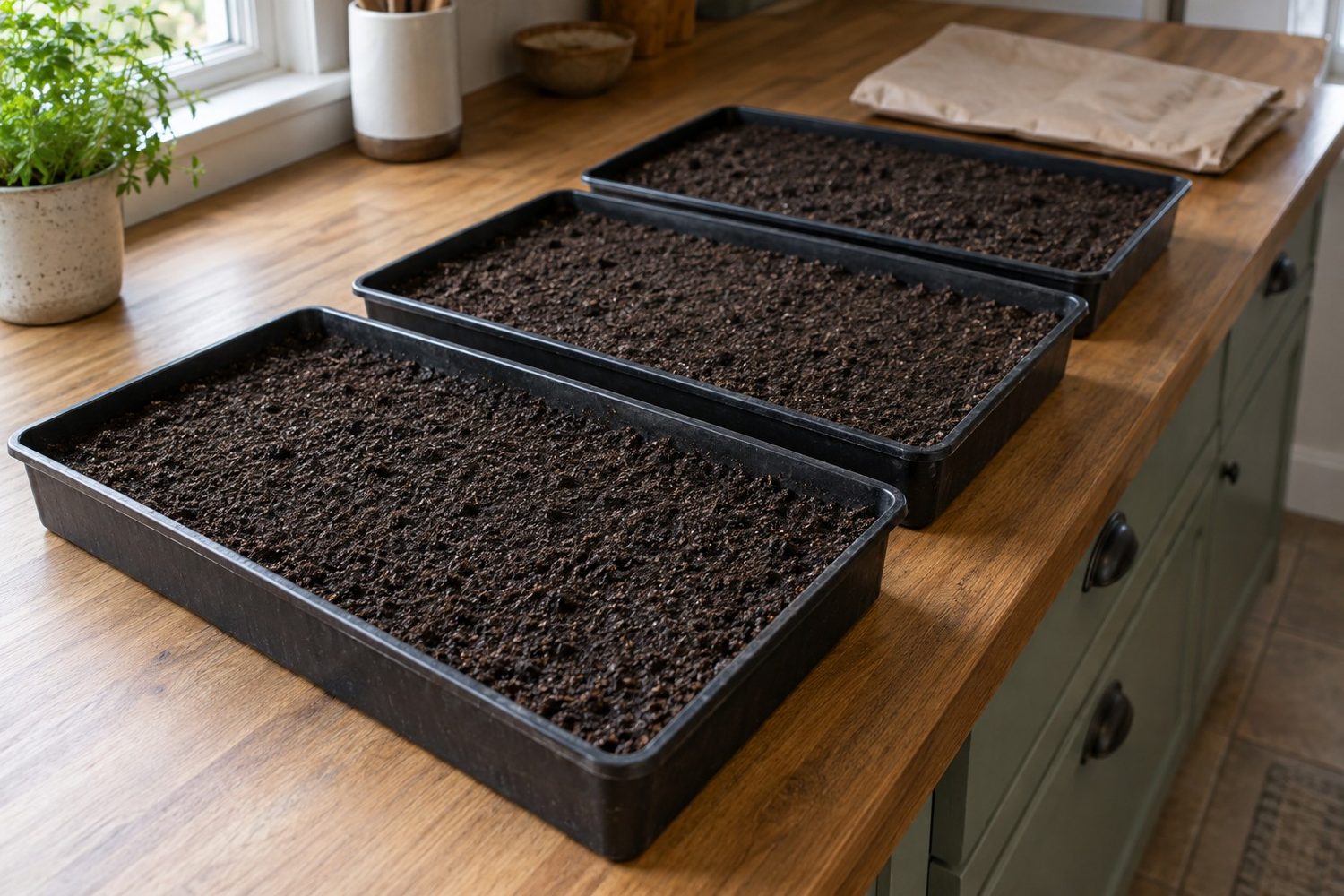
A 10x20 tray covers 200 square inches. A 1-inch fill uses 200 cubic inches, or 2.98 dry quarts (3.46 liquid quarts if you scoop with a kitchen quart). A 1.5-inch fill uses 300 cubic inches, or 4.46 dry quarts (5.19 liquid quarts). Miracle-Gro's microgreen instructions call for a 1-inch layer of seed-starting mix, though in a carry-out container or pie plate rather than a 1020 tray (Miracle-Gro guide, 2021). Check your tray's height, too: Bootstrap Farmer's shallow 1020 has an inner bottom of 19 3/4 by 9 1/2 inches and stands 1 1/4 inches tall, so a 1.5-inch fill will not fit it (Bootstrap Farmer).
Hover or tap a row to highlight it.
| Bag size | Trays at 1 inch | Trays at 1.5 inches |
|---|---|---|
| 6 dry qt | 2.02 | 1.34 |
| 8 dry qt | 2.69 | 1.79 |
| 12 dry qt | 4.03 | 2.69 |
| 1.5 cu ft | 12.96 | 8.64 |
| 2 cu ft | 17.28 | 11.52 |
| 3.8 cu ft | 32.83 | 21.89 |
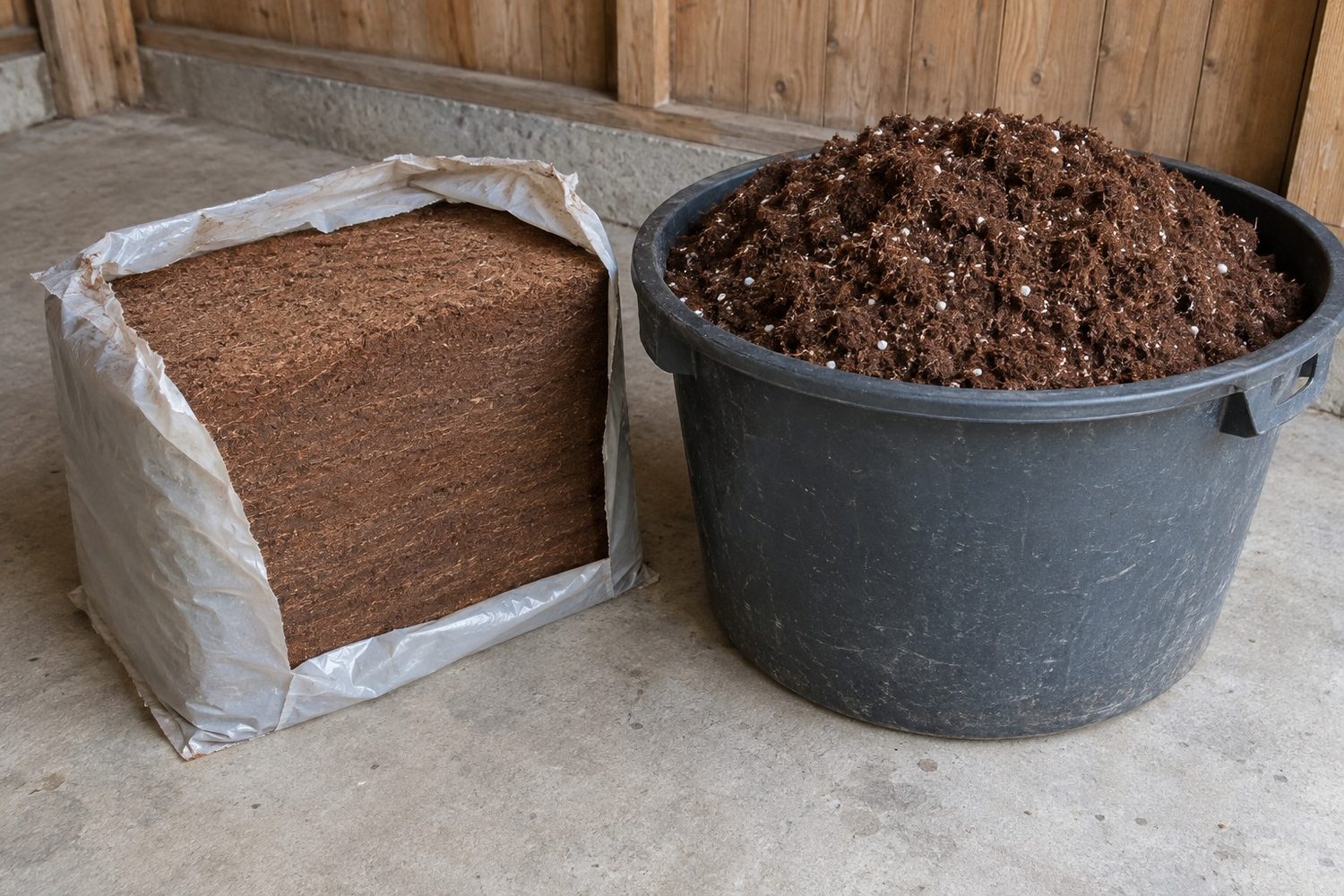
Round down when you plan a purchase, since some mix spills and some trays get filled heavy. A 3.8 cu ft PRO-MIX bale is also a compressed volume. Retailers say it loosens to over 6.5 cu ft (Blue Ribbon Farm) or about 7 cu ft (Greenhouse Megastore), roughly 56 to 60 trays at 1 inch and 37 to 40 at 1.5 inches. That expansion figure comes from retailers, not the maker. For the other half of the math, what each tray gives back, see what a tray actually yields.
Cost per tray, bag by bag
The table divides each bag's price by the trays it fills. The low number is a 1-inch fill at the lowest price seen, and the high number is a 1.5-inch fill at the highest price seen. Prices were read on September 12, 2026, exclude tax and freight, and change by ZIP code and seller.
Hover or tap a row to highlight it.
| Mix | Bag | Price on Sept. 12, 2026 | Cost per tray, 1 inch to 1.5 inch fill |
|---|---|---|---|
| FoxFarm Coco Loco | 2 cu ft | $40.99 for one bag, Walmart marketplace seller (Walmart) | $2.37 to $3.56 |
| Black Gold Seedling Mix | 8 qt | $6.98 Lowe's to $9.95 Brick House Acres | $2.60 to $5.55 |
| FoxFarm Ocean Forest | 1.5 cu ft | $35 Sprout Home to $35.63 Walmart | $2.70 to $4.12 |
| Back to the Roots Organic 3-in-1 | 6 qt | $6.99 maker store | $3.47 to $5.20 |
| Espoma Organic Seed Starter | 8 dry qt | $14.98, Walmart marketplace seller (Walmart) | $5.57 to $8.36 |
| PRO-MIX BX (plain) | 3.8 cu ft compressed | $50.38 SiteOne | $1.53 to $2.30 |
| PRO-MIX BX AGTIV REACH | 3.8 cu ft compressed | $56.99 Greenhouse Megastore | $1.74 to $2.60 |
| PRO-MIX HP BioFungicide + Mycorrhizae | 3.8 cu ft compressed | $92.59, Walmart marketplace seller (Walmart) | $2.82 to $4.23 |
| PRO-MIX HP Mycorrhizae | 3.8 cu ft compressed | $106.99, Walmart marketplace seller (Walmart) | $3.26 to $4.89 |
The PRO-MIX rows treat the compressed 3.8 cu ft as usable volume. On the retailer-stated 6.5 to 7 cu ft loose volume, plain BX and BX AGTIV REACH come to about $0.83 to $1.52 per tray across 1-inch and 1.5-inch fills, and HP BioFungicide + Mycorrhizae about $1.53 to $2.47, roughly half.
For a bag not listed, divide your receipt price by the trays its size fills. Back to the Roots at $6.99 fills 2.02 trays at 1 inch, about $3.47 a tray.
What is in each bag
These notes stick to what each maker states, and tell you what to check on the bag where it says nothing.
Black Gold Seedling Mix
Black Gold lists Canadian sphagnum peat moss, an organic wetting agent, perlite and RESiLIENCE (Black Gold). Sun Gro, its maker, calls the mix low-salt and "fine, yet porous and water-retentive" (Sun Gro), and its 2025 product info sheet says to fill seedling flats or pots. Lowe's lists the 8 qt bag at $6.98 (September 12, 2026) for germinating seeds "in flats, pots and plug trays." Black Gold's page calls the mix OMRI Listed; that is Black Gold's own statement. It names neither the wetting agent nor a fertilizer analysis, so read the bag for a guaranteed analysis and ask Sun Gro about the wetting agent if it matters to you.
Espoma Organic Seed Starter
Espoma lists 80 to 90% sphagnum peat moss, perlite, limestone to adjust pH and yucca extract, plus its Myco-tone blend of ecto- and endomycorrhizal fungi, and calls the product "100% Natural & Organic Approved" (Espoma). The page gives no fertilizer analysis, so check the bag. At $5.57 to $8.36 a tray it costs the most of the bags priced here. If the fungi are part of the appeal, grow one tray next to a plain mix and weigh both at harvest before you buy more.
Back to the Roots Organic 3-in-1 Seed Starting Mix
Back to the Roots describes coconut husks and coir, perlite, plant food and gypsum, and the bag image also names aged wood fines (Back to the Roots). Its FAQ names yucca extract as the wetting agent, gives a 0.07-0.02-0.02 analysis and calls the mix 100% organic and peat-free (FAQ). The page does not say where the plant food comes from, so ask the maker if you want to know whether any of it is animal-derived.
FoxFarm Ocean Forest
FoxFarm lists 50 to 60% aged forest products, sphagnum peat moss, perlite, sandy loam and fertilizer, with a guaranteed analysis of 0.30-0.45-0.05, and names fish emulsion, crab meal, shrimp meal, earthworm castings, bat guano and oyster shell (FoxFarm). No wetting agent is named. The Walmart listing at $35.63 is titled by weight (34 pounds) rather than volume, so confirm it is the 1.5 cu ft bag before you order.
FoxFarm Coco Loco
FoxFarm lists 50 to 60% coco coir, aged forest products, perlite and fertilizer, with a 0.50-0.15-0.20 analysis that includes 0.05% water-soluble and 0.45% water-insoluble nitrogen (FoxFarm). It names earthworm castings, bat guano and oyster shell, lists mycorrhizal species, and says the coir resists compaction and easily re-wets. At Walmart on September 12, 2026, it was one 2 cu ft bag for $40.99 from a marketplace seller, with other sellers from $57.40.
One grower has published a side-by-side basil test with it. Home Microgreens grew one tray each in pure coir, Coco Loco and Happy Frog, with 1.0 g of basil seed per tray, bottom watering and a 4,000K LED (Home Microgreens). The trays looked equal at day 9; at day 19 Coco Loco looked larger and better colored than pure coir and peat mix; at day 25 both bagged mixes grew well; and by day 31 Happy Frog had passed Coco Loco in size but not color. That grower concluded Coco Loco is better on average and Happy Frog suits slower crops, from one tray per mix with photos rather than weights.
PRO-MIX BX and PRO-MIX HP bales
One PRO-MIX name can cover several formulas, and the price follows the formula. Plain PRO-MIX BX was $50.38 at SiteOne on September 12, 2026, with a note that branch prices vary. PRO-MIX BX AGTIV REACH, the mycorrhizae version, was $56.99 at Greenhouse Megastore, whose listing gives 75 to 85% Canadian sphagnum peat moss, horticultural perlite, 5% vermiculite and Mycorrhizae PTB299.
The HP line splits the same way: at Walmart the same day, HP BioFungicide + Mycorrhizae was $92.59 and HP Mycorrhizae was $106.99. Per compressed cubic foot that is $13.26, $15.00, $24.37 and $28.16, and roughly half each once loose. For plain BX and both HP bales, read the ingredient list and any fertilizer analysis on the bale, or ask PRO-MIX for the current label, before you buy in quantity.
Other bags on the shelf
Happy Frog, Miracle-Gro Seed Starting Potting Mix, Coast of Maine Sprout Island, Root Organic Microgreens Starter Medium and Sun Gro Metro-Mix 360 also turn up in microgreen setups. A July 2010 Sun Gro bulletin says Metro-Mix 360 with Sun Coir contains Sun-Coir, a liming agent, a starter charge and a proprietary wetting agent (archived copy). For the rest, read the ingredient panel, fertilizer analysis and volume in the store and run the volume through the tray table. More media notes are in our growing medium reviews.
Problems to watch for in a thin tray
A fertilizer charge. Penn State Extension shows lettuce germinating more slowly and less completely in high-salt potting mix, and suggests a simple screen: sow 25 cress or lettuce seeds in the mix and see how they come up (Penn State Extension). That does not mean every charged bag burns seed; run the test on a bag with a stated analysis before committing a batch. Penn State gives pH 5.5 to 6.5 and EC of 1.5 to 3 mmhos/cm as reference ranges for premium potting mix, not a spec for these brands; none of these makers prints a pH or EC on its product page, so ask them or have the mix tested.
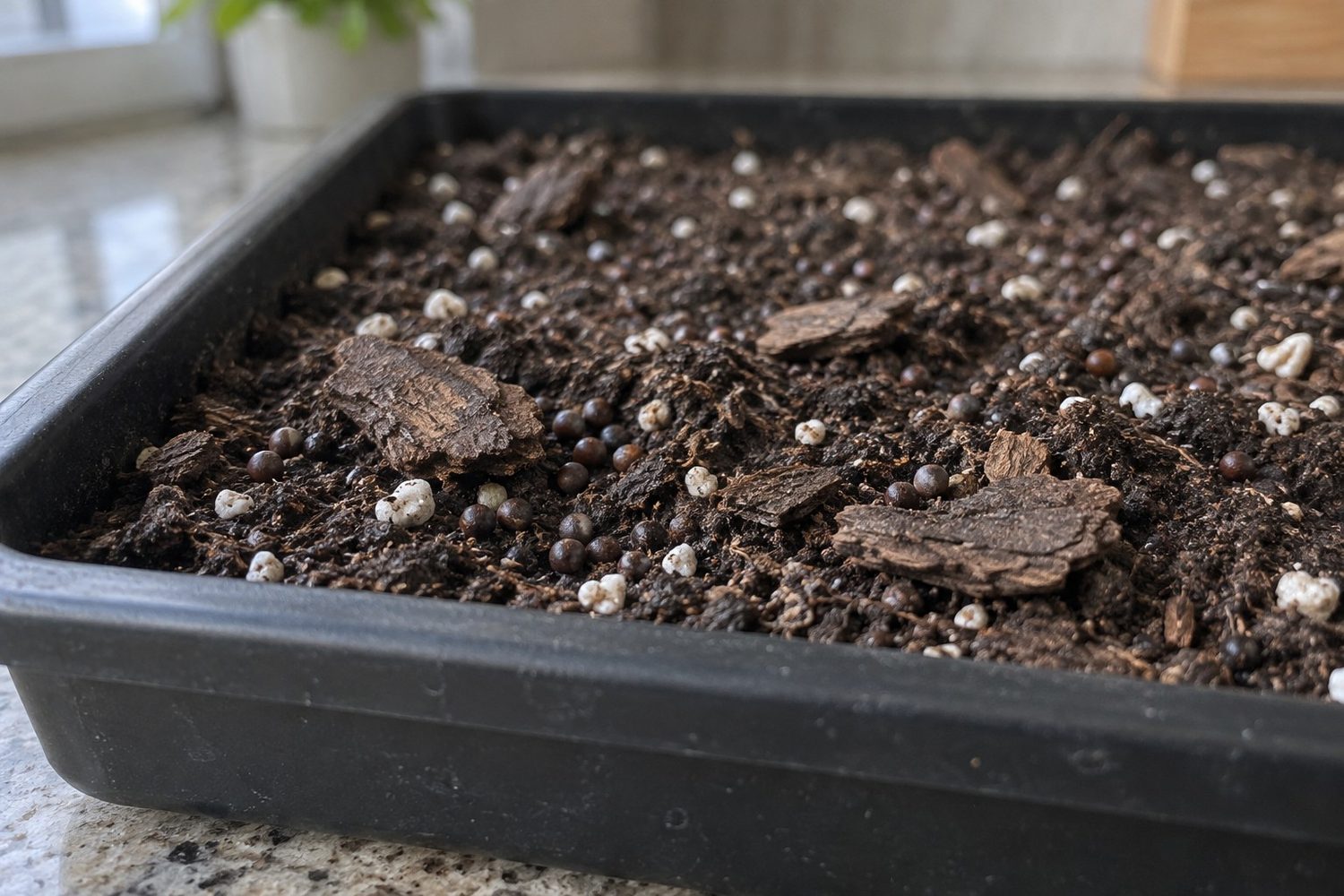
Chunks in a shallow layer. Ocean Forest and Coco Loco list aged forest products, and Back to the Roots' bag names aged wood fines. A 1-inch layer leaves little depth around a large piece, so a fine mix will probably level more easily. No maker here gives a particle size, so open one bag and look before you buy several.
Mix that sheds water. Coco Loco's maker says its coir re-wets easily, and Home Microgreens calls it less hydrophobic than peat-based mixes (Home Microgreens). Black Gold adds an organic wetting agent and Back to the Roots uses yucca extract. With a peat mix that names no wetting agent, water slowly and check that the whole layer is damp before you seed.
Mold and fungus gnats. No bag carries a mold or gnat rating, so watch your first trays and use pests and diseases and mold or root hair to sort out what you see.
Animal-derived ingredients. FDA treats compost ingredients with manure or animal byproducts such as shellfish waste and fish emulsion as biological soil amendments of animal origin, where treatment status matters (FDA), and says untreated or recontaminated manure can carry pathogens that reach crops grown close to the soil (FDA guidance). That is relevant to Ocean Forest and Coco Loco, because a microgreen is cut right above the mix.
It does not mean a sealed bag is contaminated, or that farm rules automatically apply to a home grower. Ask the maker for treatment or process documentation, keep mix from splashing onto leaves, and wash your hands and the harvest. Before reusing spent mix, read reusing medium and trays; none of these makers says its mix can be reused after microgreens.
Handling dry mix
In 2000, CDC investigated Legionnaires' disease cases linked to potting soil, and soil from two patients' homes tested positive for Legionella longbeachae; no brand was named (CDC MMWR). A New Zealand case-control study of 31 cases and 172 controls, published in CDC's Emerging Infectious Diseases, linked the bacterium to compost and potting mix (CDC journal). For a home tray, its advice comes to this:
- Open the bag away from your face.
- Keep the mix low when you pour or move it.
- Keep your hands away from your face until you have washed them.
- Take particular care if you smoke or have chronic lung disease.
The same study found that wearing a mask, wearing gloves and wetting the compost before use were not linked to lower risk, so do not count on any of them as protection. If you do wear gloves, wash your hands after removing them and before touching your face.
Which mix fits how you grow
A few home trays. An 8 qt bag fills about 2.69 trays at 1 inch. Black Gold at $6.98 and Back to the Roots at $6.99 keep the upfront cost low.
A shelf of flats. A 2 cu ft bag fills 17.28 trays at 1 inch. Coco Loco comes to $2.37 to $3.56 a tray, but both FoxFarm bags carry animal-derived inputs and a stated fertilizer charge, so read the problems above first.
A small commercial run. A PRO-MIX bale gives the lowest cost per tray, $1.53 to $2.30 for plain BX on compressed volume and about half that loose. Make sure the bale in your cart is the formula you priced.
No bagged mix. Pre-cut hemp mats ran $3.85 a tray at Urban Farmer (five for $19.25) and $2.50 a tray at Johnny's (ten for $24.95) on September 12, 2026. See hydroponic and soil-free growing.
Frequently asked questions
A few points come up once you have a bag in hand.
Is an OMRI or organic claim a sign a mix grows better microgreens?
No. OMRI Listed is a status used in organic production review, and claims like Espoma's "100% Natural & Organic Approved" describe the label, not how a tray performs.
Does any of these bags list a pH?
The maker pages do not. Walmart's retailer copy puts Ocean Forest at pH 6.3 to 6.8 (Walmart), but that is a retailer description, not a batch result. Ask the maker or have your lot tested for pH and EC.
How do I price a coco coir brick against a bag?
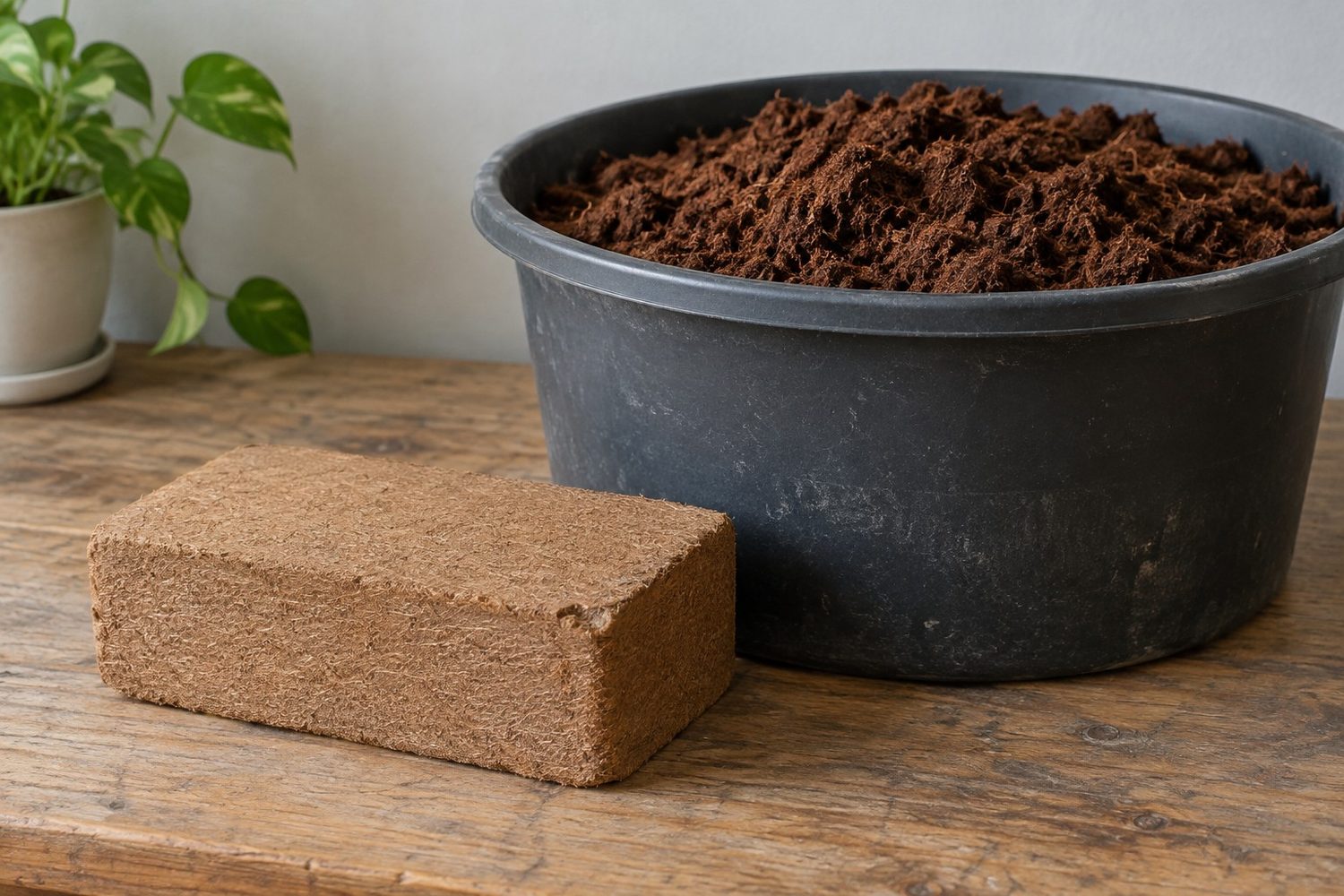
A coco coir brick's expanded volume is usually stated in liquid gallons or liters. Convert it to cubic inches, divide by 200 for a 1-inch fill or 300 for 1.5 inches, and divide the price by that tray count.
Has one of these mixes been recalled for Legionella?
The CDC potting-soil report did not name a brand or recall. To check a specific bag, search FDA's recall listings and the maker's notices for your product and lot code.
Picking your bag
Start with your tray count and fill depth, since those set how many bags you need. Read each bag for ingredients, fertilizer, additives and volume, divide the price by the trays it fills, and grow one tray before you stock up. Write down that tray's cost and harvest weight, and your next purchase will rest on your own numbers.
Sources
Prices, stock and specifications are as the linked pages showed them on 2026-09-12.
- Lowe's
- NIST Handbook 130
- retail listing
- Miracle-Gro guide, 2021
- Bootstrap Farmer
- Blue Ribbon Farm
- Greenhouse Megastore
- Walmart
- Brick House Acres
- Sprout Home
- maker store
- Walmart
- SiteOne
- Greenhouse Megastore
- Walmart
- Black Gold
- Sun Gro
- 2025 product info sheet
- Espoma
- FAQ
- FoxFarm
- FoxFarm
- Home Microgreens
- archived copy
- Penn State Extension
- Home Microgreens
- FDA
- FDA guidance
- CDC MMWR
- CDC journal
- Urban Farmer
- Johnny's
Keep reading
The journal
Are Grow Lights a Fire Hazard? A Checklist for Tonight
Wondering if your grow lights are a fire hazard? Add up the actual watts and amps on your rack, then check them against your circuit and timer limits tonight.
Read Are Grow Lights a Fire Hazard? A Checklist for TonightThe journal
Can You Grow Microgreens in an AeroGarden? What Owners Do
The AeroGarden MicroGreens Kit is hard to find. Learn how owners still grow microgreens in an AeroGarden with a simple tray beside the light.
Read Can You Grow Microgreens in an AeroGarden? What Owners DoThe journal
Growing Microgreens Without a Grow Light on a Windowsill
A sunny windowsill can grow microgreens without a grow light for many crops, though stems run longer and paler. Learn which window and crops work best.
Read Growing Microgreens Without a Grow Light on a WindowsillThe journal
How to Choose a Hydroponic System for Microgreens
Compare a still-water tray, ebb-and-flow table and NFT channel hydroponic system for microgreens, with setup costs, what each needs and problems to expect.
Read How to Choose a Hydroponic System for Microgreens