Can You Gut-Load Feeder Insects With Microgreens?
Cal HewittPublished Updated Checked
- feeder insects
- reptiles
- gut loading
- animal feeding
- safety
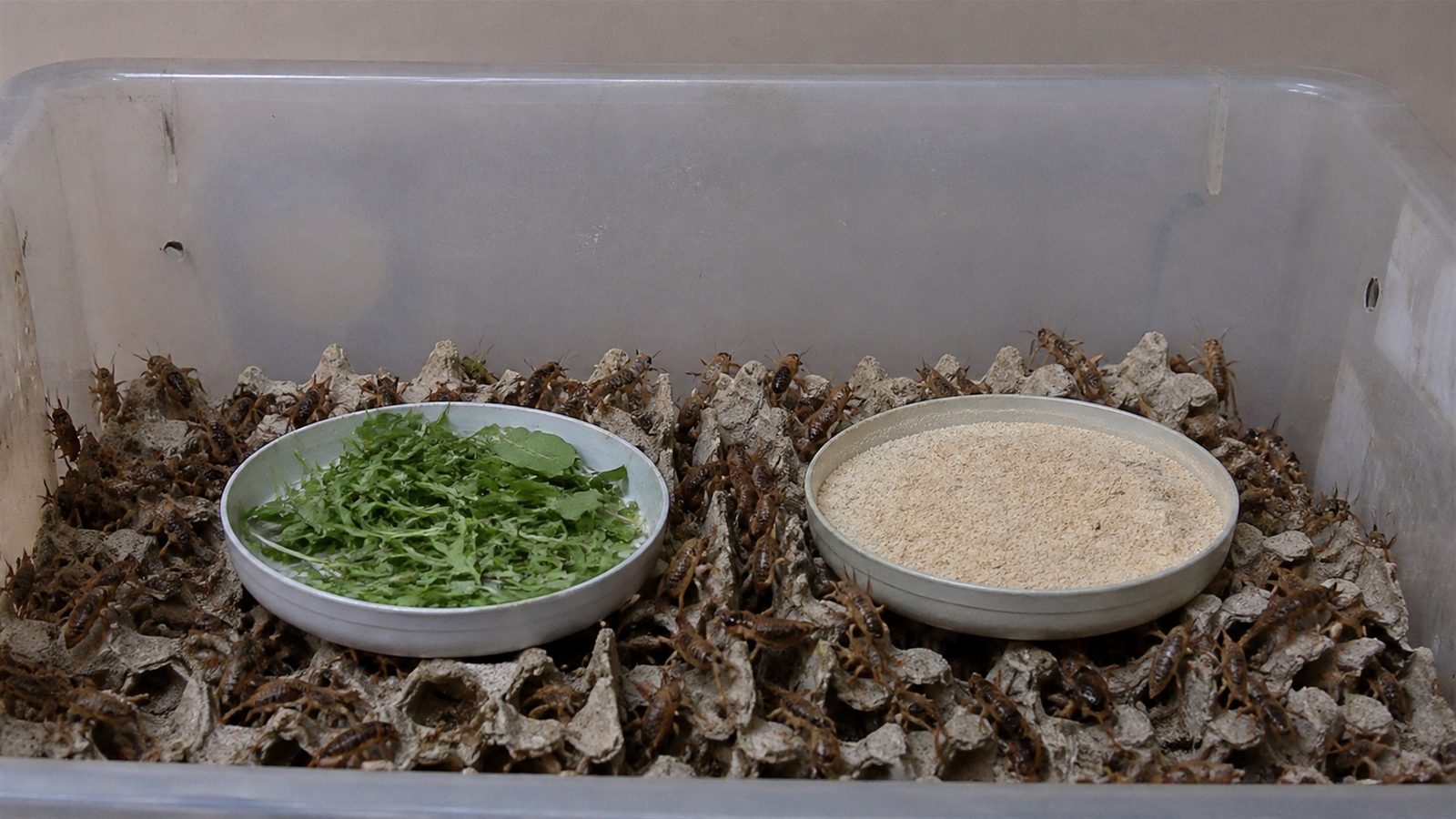
Yes, as a fresh component alongside a proper gut-load. No, as the calcium step, and calcium is the entire reason gut-loading exists.
The animal eating the microgreen is not the animal you care about. An insect eats the tray, a reptile eats the insect, and the answer only holds if the nutrient actually makes that second trip. So, the question is not whether a cricket will nibble a leaf. It is whether the leaf changes the cricket in a way the reptile can use.
What to actually do
- Use a proper high-calcium gut-load diet for the minerals. Nothing you grow substitutes for 8 to 11% calcium.
- Use microgreens as the fresh component alongside it, for moisture and palatability, which is how the published 48-hour work was actually done.
- Keep dusting. It is the only intervention in the published comparison that cleared the ratio, and it works within hours rather than days.
- Load 24 to 72 hours out, feed promptly, and take the colony back off the finishing diet.
- Stick to the feeders the work actually covers for a mixed fresh feed. Waxworms, hornworms and silkworms are specialists.
- Do not treat black soldier fly larvae as a calcium solution on the ratio alone. Less than half of that calcium was digestible whole.
- This is the insect step only. Species, UVB, D3 and the rest are in the bearded dragon guide and the tortoise and turtle guide.
The number the whole practice exists to fix
Ordinary feeder insects are calcium-poor and phosphorus-rich. Veterinary review figures put mealworm larvae, crickets and most insects at 0.03 to 0.3% calcium against 0.8 to 0.9% phosphorus. A typical cricket comes in around 0.15 parts calcium to 1 part phosphorus.
The stated target is the other way up. A 2020 feeder study calls 2:1 calcium to phosphorus or greater essential for reducing nutritional secondary hyperparathyroidism in insectivorous reptiles, and the general reptile figure is at least 1:1 and preferably 2:1, as the bearded dragon guide sets out.
Getting a cricket from 0.15:1 to 2:1 is a more than thirteen-fold change in the ratio. That is the size of the problem, and it is worth holding in mind before assessing any leaf.
What actually closes that gap, measured
Hover or tap a row to highlight it.
| Intervention | What it achieved | Does it clear the target? |
|---|---|---|
| Nothing, ordinary cricket | about 0.15:1 | No |
| 48 hour high-calcium gut-load diet | Calcium and ratio up three to four fold, and the ratio did not go above 1:1 | No |
| High-calcium diet for two days, veterinary review figure | about 1.2:1 | Above 1:1, still short of 2:1 |
| Calcium carbonate dusting at 10% of cricket weight | Calcium and ratio up more than 27 fold | Yes |
Only dusting cleared 1:1 in the direct comparison. A separate study found dusted crickets could hold above 1:1 for up to five and a half hours, with adult black field crickets the exception.
Now look at what the gut-load diets that managed three to four fold actually are. A commercial finishing diet's guaranteed calcium is 8 to 10%. A university thesis that measured the effect used a diet at 11.32% calcium on a dry-matter basis.
Those are mineral supplements with some plant matter in them. No leafy green is remotely in that range. So, the honest conclusion is that a microgreen cannot be the calcium step, not because anyone measured it and found it wanting, but because the intervention that barely works at 8 to 11% calcium is not going to work at a leaf's calcium.
The unmeasured link, and it is exactly where it matters
Nobody has published calcium-to-phosphorus ratios for most microgreens, which the bearded dragon guide sets out in full. That gap is awkward when a reptile eats the greens directly. Here it is fatal to the whole idea, because gut-loading is a calcium delivery mechanism and you cannot deliver a ratio nobody has measured for most crops.
And the transfer step is not established either. For fresh leafy microgreens specifically, uptake has not been published for house crickets, banded crickets, Dubia roaches, mealworms or superworms. That insects will nibble ordinary produce is keeper practice, not a measured result, and the endpoint that matters is the composition of the prey item at the moment it is eaten.
So, the chain has two unmeasured links in a row: what most microgreens contain, and what reaches the insect's gut. The keeper lists that recur online naming collard, mustard, kale, turnip, carrot, sweet potato and squash describe practice, and no trial shows that any of them corrects a feeder's final ratio. They should not outrank the high-calcium diet studies.
What microgreens can honestly do
There is a real, sourced role, and it is not the calcium one.
The published 48-hour regimes did not use a dry diet alone. A 2015 study fed mealworms and Dubia roaches a dry commercial gut-load plus fresh vegetables for 48 hours, which is exactly the shape a microgreen fits.
So, the defensible position is: dry high-calcium gut-load for the minerals, fresh material alongside it for moisture and palatability. A tray of microgreens is a reasonable fresh component in that pairing. It is not the gut-load. It sits next to the gut-load.
And the reptile still needs its dusting. Nothing on this page displaces that, and the reptile guides own the rest of the ruling.
Not every feeder is a candidate
The published gut-load work tests house crickets, mealworms, Dubia roaches and black soldier fly larvae. Do not silently generalize it.
- Crickets are the best-established recipient of a high-calcium finishing diet.
- Mealworms and Dubia roaches are named in the published 48-hour work.
- Black soldier fly larvae are the unusual one and get their own section below.
- Waxworms are reared on high-energy hive-like media. Hornworms are Solanaceae foliage specialists. Silkworms eat mulberry. None of these is a candidate for a mixed microgreen gut-load without a species-specific trial establishing intake, survival and final composition.
The black soldier fly exception, which comes with a catch
Black soldier fly larvae are reported at 2.5:1 calcium to phosphorus, based on the diet supplied. That is the one feeder with a naturally positive ratio, and it is genuinely different.
The catch is availability rather than content. In a frog comparison, calcium digestibility was 44% from whole larvae against 84% from dusted crickets, rising to 88% when the larvae were mashed. A high ratio on paper is not the same as calcium the animal can absorb, and the study's own authors say more research is needed before treating undusted larvae as adequate calcium in all consumers.
Timing, which has a published window
- Load 24 to 72 hours before feeding. That is the published window for formulated gut-loads.
- A veterinary review gives three days on a high-calcium diet, with the insect's gut filled within two.
- Peak whole-cricket calcium was measured at 48 hours in a controlled test running out to 120.
- Feed promptly after loading, and do not keep a breeding colony on the high-calcium finishing diet. It is a finishing step, not a maintenance ration.
What nobody has measured
- Whether feeder insects will eat microgreens in useful quantity. Not published for crickets, banded crickets, Dubia, mealworms or superworms.
- The calcium to phosphorus ratio of most microgreens, which is the number the entire practice turns on.
- Whether anything from a microgreen reaches the reptile. The endpoint is prey composition at feeding time, and no study has run that chain.
- Whether the fresh component in the published 48-hour regimes contributed anything measurable, as opposed to keeping the insects alive and hydrated.
- Calcium digestibility for most feeders. It exists for black soldier fly larvae and dusted crickets and not much else.
- How long a gut-load holds after feeding, in the way dusting retention has been measured.
Terms on this page
Tap a term to see what it means.
Gut-loading. Feeding a feeder insect shortly before it is offered, specifically so the predator gets what is inside it. The target is a measurable change in the prey at the moment it is eaten.
Sources
Opened 2026-08-12. This page covers the insect step only. Species-specific reptile feeding, UVB and supplementation belong to the reptile guides.
- RSPCA on gut-loading - the definition that explicitly includes the second transfer to the predator, the aim of correcting nutritional differences in captive feeder invertebrates, and the 24 to 72 hour window for formulated gut-loads.
- Merck Veterinary Manual on nutrition in lizards - the baseline of 0.03 to 0.3% calcium against 0.8 to 0.9% phosphorus in mealworm larvae, crickets and most insects, the operational description of feeding a high-calcium diet before offering the insect, three days on that diet with the gut filled within two, and the approximately 1.2:1 result.
- Schlegel, Renjifo and Valdes, AZA Nutrition Advisory Group proceedings - the direct comparison in which calcium carbonate dusting at 10% of cricket weight raised calcium and the ratio more than 27 fold while 48 hour commercial and custom high-calcium diets raised them three to four fold, with only dusting exceeding 1:1, and the typical cricket ratio of 0.15:1.
- Michaels, Antwis and Preziosi, Journal of Zoo and Aquarium Research, 2014 - that dusted crickets could remain above 1:1 for up to five and a half hours, with adult black field crickets the exception.
- Boykin and colleagues, PLOS ONE, 2020 (PDF) - the statement that 2:1 or greater is essential for reducing nutritional secondary hyperparathyroidism, the black soldier fly larva figure of 2.5:1 based on the diet supplied, and the frog digestibility comparison of 44% from whole larvae against 84% from dusted crickets and 88% from mashed larvae, together with the authors' own caution against treating undusted larvae as adequate calcium.
- Gorst and colleagues, Journal of Zoo and Aquarium Research, 2015 (PDF) - the 48 hour regime of a dry commercial gut-load plus fresh vegetables in Tenebrio molitor and Blaptica dubia, which is the published basis for the fresh-component role described above.
- Le Maxwell, Cal Poly thesis, 2018 - adult house crickets on an 11.32% calcium dry-matter diet for 120 hours, with peak whole-cricket calcium at 48 hours.
- dvm360 proceedings on insectivorous reptile nutrition and disease - that nutritional secondary hyperparathyroidism occurs especially in young growing insectivorous or herbivorous reptiles when calcium and vitamin D balance is inadequate, and Merck on providing a home for a reptile for the mechanism and outcomes including weak or bowed bones, soft jaws, fractures and deformities.
- Zoo Med Bug Balance label - the ingredient list and the guaranteed 8 to 10% calcium, 15,000 IU/kg vitamin A, 1,500 IU/kg D3 and 150 IU/kg vitamin E, used here to show what a working gut-load diet is actually made of. Product information rather than proof of delivered nutrient.
- Live retail and search observations on 2026-08-12, recorded as dated practice rather than as nutritional evidence: a commercial search result panel showing Mazuri Better Bug at $14.39 for 8 oz, Mazuri Hi Calcium at $14.65, TropicZone at $7.99 for 8 oz and a Zilla cricket drink at $6.99, and naming the recurring fresh list of collard, mustard, kale and turnip greens, carrots and sweet potatoes, squash and zucchini, and fruit in moderation.
Keep reading
Animals and microgreens
Can Bearded Dragons Eat Microgreens?
Probably, as part of the salad. No study has fed a microgreen to a bearded dragon, the one vet-reviewed teaspoon dose has nothing behind it, and calcium to phosphorus is unmeasured for most crops.
Read Can Bearded Dragons Eat Microgreens?Animals and microgreens
Can Tortoises and Turtles Eat Microgreens?
A sulcata and a box turtle cannot share an answer: one is a fiber-fermenting grazer, the other is half carnivore. And a microgreen is close to the opposite of what a grazing tortoise is built for.
Read Can Tortoises and Turtles Eat Microgreens?Animals and microgreens
Can Alpacas and Llamas Eat Microgreens?
It would take 50 to 90 trays to supply one alpaca's dry matter for a single day, and up to 250 for a llama. That settles the feed question, and leaves identity and suddenness as the only real risks.
Read Can Alpacas and Llamas Eat Microgreens?Animals and microgreens
Can Cats Eat Microgreens?
Some yes, four unsafe. Parsley is ASPCA-listed toxic to cats and the alliums have a published feline dose, while greens are enrichment for a cat rather than nutrition.
Read Can Cats Eat Microgreens?