Microgreens Humidity Domes: The Free Alternative Beats Most of Them
Cal HewittPublished Checked
- humidity domes
- germination
- equipment
- buying
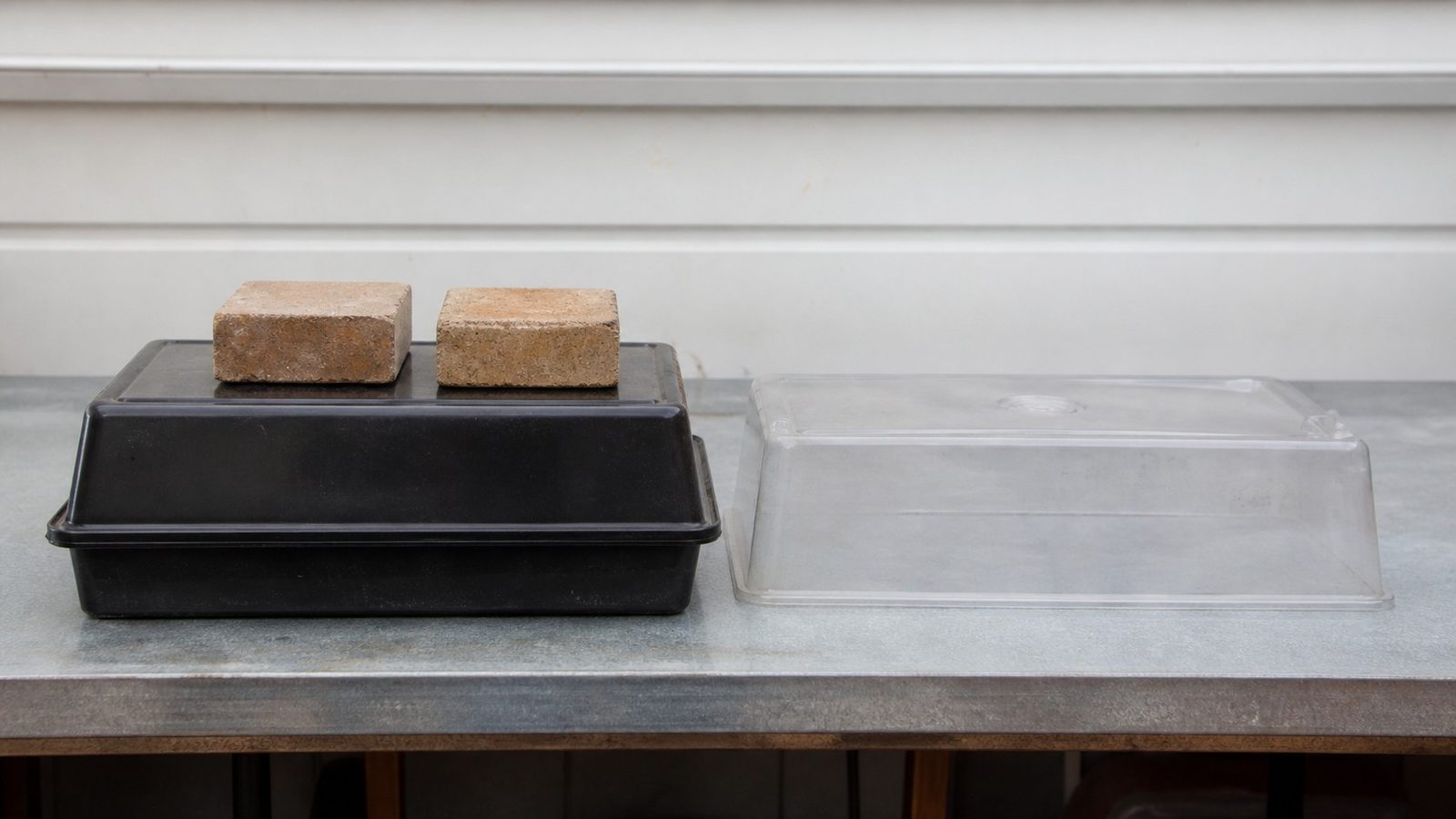
If you own two compatible 1020 trays and something flat and heavy, you already own the better tool. Invert the second tray over the seeded one, put 2 to 5 lb on top, and you have darkness, moisture retention, and the one thing a dome cannot give you: firm seed-to-medium contact.
That is Utah State University's published method, not a workaround. It uses the weight for the first part of the covered period, then flips the same tray over to finish as a non-contact cover. Marginal cost of the dome you did not buy: nothing.
A humidity dome is not a required category purchase. It is a niche tool for a specific situation, and the only question worth answering is whether you are in that situation.
The order to buy in
Where a dome fits, if it fits at all
Hover or tap a card to highlight it.
Start with the trays and the weight
Compatible shallow 1020 trays, accurate seed density, bottom watering, and a weighted dark cover. This is the method the universities publish and it costs nothing extra.
Watch the crop, not the calendar
USU covers pea and sunflower for about three days, and common brassicas for one to four. The removal point is the decision, not the cover.
Add a shallow blackout dome only for a named reason
A specific crop or a genuinely dry room where you have decided against weight. Fine-stemmed crops like amaranth and many mustards are where seller-publishers point.
Add a tall vented dome only for real height
If you are also propagating seedlings. Dense short-harvest microgreens do not need the headroom.
Never leave it on
Bootstrap Farmer's own page says remove it once seeds sprout. Home Microgreens says take a tall one off around 2 inches.
Scale changes the answer in the opposite direction from ordinary retail logic. At a few trays a dome is a convenient cover. At many trays the stackable tray-and-weight workflow is cheaper, standardizes the pressure across every tray, and saves you buying a dedicated cover for each one.
Against a fixed setup budget this ranks low: behind good seed, compatible trays, a safe controllable light, moisture and drainage, airflow, sanitation, and a scale for repeatable seeding.
Even the sellers tell you to take it off
Two of the clearest statements about when a dome stops helping come from people with something to sell.
Bootstrap Farmer's own humidity dome category page tells you to remove the dome once seeds sprout, to avoid mold. The seller of the product is telling you the window in which it is useful is short.
Home Microgreens, which also runs a microgreen supply store, says the weighted and buried blackout method is generally better than the domed method, and that a larger dome enclosure can condense and drip when surface and interior temperatures differ. It advises removing a tall dome at around 2 inches of growth.
When the sellers themselves point away from the product for most uses, that is worth more than any star rating, and it lines up with what the universities say. Virginia Tech says a dome or plastic cover can be used, not that it must be. Maryland Extension treats covers as something to vent periodically rather than permanent hardware.
What is claimed, against what has been measured
Hover or tap a row to highlight it.
| The claim | Who says it | What it actually establishes |
|---|---|---|
| 7 inch height, 1,148 cubic inches, four vent settings | T.O. Plastics | Fit, headroom and that a vent exists. Nothing about humidity or germination |
| 2.5 inch and 6 inch 1020 options | Bootstrap Farmer | The same. Physical fit only |
| "Maximize microgreen crops" | Bootstrap Farmer, repeated by True Leaf Market | Nothing checkable. No crop, density, temperature, duration, comparator or outcome |
| "Superior humidity control" | T.O. Plastics | No published humidity test accompanies it |
| "Prevents mold" style claims | Across the category | A vent is a real feature. Preventing mold is not a published result |
| BPA-free, Made in USA, star ratings, a warranty | Various | Material and commercial facts. None is a performance standard |
No independent, controlled comparison of a named dome against the weighted-tray method exists. Not for germination percentage, mold incidence, yield, rooting depth or harvest quality. The universities describe both covers and weighted trays without reporting a named-dome result, and the two publishers who do run demonstrations, Home Microgreens and On The Grow, both sell microgreen supplies.
The seller numbers do not compare with each other either. Heights of 2.5, 6 and 7 inches, vent counts, and stated cubic volume are different shapes measured differently, with no shared protocol for relative humidity, air exchange, leakage or condensation. Compare fit and clearance. Do not read a 7 inch dome's claimed volume as a prediction about germination.
The specification that would decide it is not height at all. It is whether your crop benefits from an enclosed unweighted microclimate instead of contact pressure. A dome covers and retains humid air. A weighted cover tray retains moisture, excludes light, and holds seed against the medium while giving emerging shoots something to push against. Those are different jobs, and the category sells the one that does less.
What actually fails
The failure mode is moisture, and it is the same story everywhere. The University of Saskatchewan says visible droplets inside a cover mean air it out, and names excess humidity, a cover left on too long, and inadequate air circulation as contributors to fungal disease. Maryland Extension says vent covers so excess moisture does not encourage mold.
A vent does not erase the problem. One grower reports mold concern while using a vented dome; another attributes mold during blackout to high humidity under a lightly vented one. That does not prove domes cause mold. It shows the marketing claim is incomplete without duration, moisture, temperature, seed density and airflow attached to it.
The microgreen-specific failure is subtler than a wet tray. It is substituting a humid cover for the pressure phase on a crop that benefits from firm contact, and then leaving the cover through the stretch period. The result is a shallow-rooted, overly tender crop rather than an obviously failed one. A grower's side-by-side reports poor, spotty germination on the unweighted dome tray against the weighted comparator. One report, not evidence, but it points the same way as the method the universities publish.
A dome also makes root hairs look alarming. The humidity makes them conspicuous, and root hairs mistaken for mold is the most common false alarm in this crop.
On hardware, cracking, warping and scratching are ordinary wear from handling, cleaning and repeated flexing. No model-specific failure-rate data exists, so treat any claim that one brand cracks sooner than another as a guess. Bootstrap Farmer states a one year warranty against manufacturing defects on its Extra Strength dome, requiring a photo or video and an order number, and limited to purchases from its own site or its Amazon storefront. That is a defect backstop for one model bought through two channels, not evidence of longevity.
What they cost, and the option that costs nothing
Prices move. Every figure here is what that listing showed on the check date at the top of this page, and this page is rechecked at least every two months.
Hover or tap a row to highlight it.
| Option | Price seen | Seen at | Worth knowing |
|---|---|---|---|
| A second 1020 tray plus a flat weight | $0 marginal | Trays you already own | USU's published method. Gives darkness, moisture AND seed contact |
| T.O. Plastics 7 inch vented, five pack | $35.00, or $7.00 each | Greenhouse Megastore | Lowest per-dome price seen. A propagation product, not a microgreen result |
| Bootstrap Farmer 1020 Extra Strength | from $8.19 | Bootstrap Farmer | The one with the stated one year defect warranty |
| Bootstrap Farmer Blackout dome, 2 pack | $24.95, or $12.47 each | True Leaf Market | Blackout rather than clear, for light-sensitive crops |
| Bootstrap Farmer Blackout, single | from $12.99 | Bootstrap Farmer | Same product, direct |
| Bootstrap Farmer 2.5 inch 1020 dome | from $15.99 | Bootstrap Farmer | The shallow one actually marketed for microgreens, and the dearest here |
| T.O. Plastics 7 inch vented, 25 pack | $154.00 | Greenhouse Megastore | Scale buying for a propagation operation |
The price ladder runs backwards. The dome explicitly marketed for microgreens is the most expensive single unit on the list at $15.99, and the cheapest per-dome option at $7.00 is a seedling propagation product borrowed into the category. Neither difference is backed by a published microgreen outcome.
The "from" prices are the seller's own word. A selected pack size or variant changes them, so treat them as a starting point rather than a price.
Both of the marketplace links above pay this site a commission. The row recommended here is the one that pays nothing: use a tray you already own.
What it costs to be wrong
The direct penalty is small, roughly $7 to $16 a dome. The real cost is a seeded tray lost to excess moisture, or a cover that does not fit the trays you own.
To size that against the crop rather than the hardware: USU lists seed at about $0.45 for sunflower through $1.95 for purple radish per 1020 tray at its stated January 2026 prices, before medium, labor and the sale you did not make. One owner reports losing two trays after a wet blackout-dome period, which does not establish causation or a dollar figure, and no published loss rate exists for this category at all.
The premature purchase is a multi-pack of tall seedling domes bought before demonstrating that a second tray and a weight cannot do the job. Height is not a substitute for choosing the right removal time.
Who should skip this entirely
Skip the category outright if you have two compatible 1020 trays and something flat to weight them with; if your grow room already manages moisture and airflow; or if your main crops are peas, sunflower, radish and broccoli, where a short weighted dark phase is already the protocol.
Skip the tall propagation domes if all you need is a one to three day blackout. You are buying headroom for a crop that does not use it.
A dome earns its place for a small grower with unusually dry ambient air, or on fine-stemmed crops where you have deliberately decided against weight. That is a real situation. It is just not the default one, and the category is sold as though it were.
What is still genuinely unknown
- Which fine-stemmed crops, dry rooms, media and seed densities gain enough from a non-contact dome to offset the condensation risk.
- What temperature and relative humidity actually develop under each dome in a real room, how fast condensation forms, and whether vent position changes it.
- The safest removal point by crop, especially amaranth, mustards, peas, sunflower, radish and broccoli.
- Whether premium thick domes outlast budget ones by enough to justify the price, across repeated washing and blackout cycles.
- Which named dome and tray combinations actually seat, seal and lift off without snagging shoots.
Settling any of it needs the same trial: one seed lot, one medium, one density, randomly assigned to uncovered, clear vented dome, blackout dome, inverted tray alone, and inverted tray with a stated weight, with logged temperature and humidity, confirmed mold identification, and replicates. Nobody has run it.
The terms on this page, in plain words
Tap a term to see what it means.
1020 tray. The nominal 10 by 20 inch propagation tray footprint that almost all of this equipment is built around.
Sources
Every price below was seen on the check date at the top of this page, and the prices on this page are rechecked at least every two months.
- Utah State University Extension, grow your own microgreens - the stacked tray method with 2 to 5 lb then a flipped tray, three covered days for pea and sunflower against one to four for common brassicas, and seed at about $0.45 to $1.95 per 1020 tray at January 2026 prices.
- Virginia Cooperative Extension, microgreens production - a dome or plastic cover can be used, stated as an option rather than a requirement.
- University of Maryland Extension, growing microgreens indoors - vent covers so excess moisture does not encourage mold.
- University of Saskatchewan, microgreens - droplets inside a cover mean air it out, and excess humidity, a cover left on and poor air circulation as contributors to fungal disease.
- Bootstrap Farmer, humidity domes - the 2.5 inch and 6 inch 1020 range, the blackout dome, the microgreen-directed labeling, the from-prices, and the instruction to remove the dome once seeds sprout.
- Bootstrap Farmer, warranty details - one year against manufacturing defects on the Extra Strength dome, photo or video and order number required, limited to its own site or Amazon storefront.
- True Leaf Market, 1020 blackout humidity dome - the $24.95 two pack, and the repeated crop-maximizing language.
- T.O. Plastics, 7 inch vented humidity dome - 7 inch height, 1,148 cubic inches, four vent settings, and the superior humidity control language with no published test.
- Greenhouse Megastore, T.O. Plastics vented dome - $35.00 for five and $154.00 for 25.
- Home Microgreens, the domed blackout method - weighted and buried blackout described as generally better, the condensation and drip explanation, removal around 2 inches, and the root hair against mold confusion. Published by a microgreen supply seller.
- On The Grow, why microgreens need weight during germination - a four tray weight demonstration, published by a seller.
- A grower's side-by-side on growing methods - poor, spotty germination reported on the unweighted humidity-dome tray against the weighted comparator.
- An owner reporting two lost trays - trays lost after a wet blackout-dome period, offered as one report rather than a rate.
- A mold discussion during blackout - mold attributed to high humidity under a lightly vented dome.
- A recent mold question - mold concern while using a vented dome.
- A weighted-cover discussion - the practical DIY mismatches: mesh inserts snagging shoots, non-nesting setups applying no pressure, and solid trays sagging under weight.
- A grower on when domes are needed - domes described as unnecessary except for specific greens or very dry conditions.
Keep reading
Growing guides
Do you need a heat mat? The arithmetic says probably not, and it can overshoot
A heated home runs about 68F and a mat adds 9 to 20 above ambient, which lands at 77 to 88. Spinach stops germinating at 75. Nothing shows a mat produces an earlier harvest or more crop in a room already in range.
Read Do you need a heat mat? The arithmetic says probably not, and it can overshootGrowing guides
How long to blackout microgreens, crop by crop
Take the blackout days from your crop, not from a general rule. Across the 55 crops here that publish a figure the range runs 0 to 14 days, and 29 of them top out at 4 or 5.
Read How long to blackout microgreens, crop by cropGrowing guides
Nothing came up: reading a failed tray instead of guessing at it
Old seed, dryness, wet, cold, heat, depth and poor contact can all empty a tray. Where the bare patch sits, and what a missed seed looks like when you lift it, rules most of them out in about two minutes.
Read Nothing came up: reading a failed tray instead of guessing at itThe test bench
AeroGarden and Countertop Pod Gardens for Microgreens: Is It Worth It?
Pod count is holes for separated mature plants, not dense tray area. A $30 tray kit gives you more sowing surface for microgreens than a $250 pod garden.
Read AeroGarden and Countertop Pod Gardens for Microgreens: Is It Worth It?