Microgreen Labels: Printers, Cost, and Cold Storage
Cal HewittPublished Checked
- selling microgreens
- equipment
- comparison
- buying
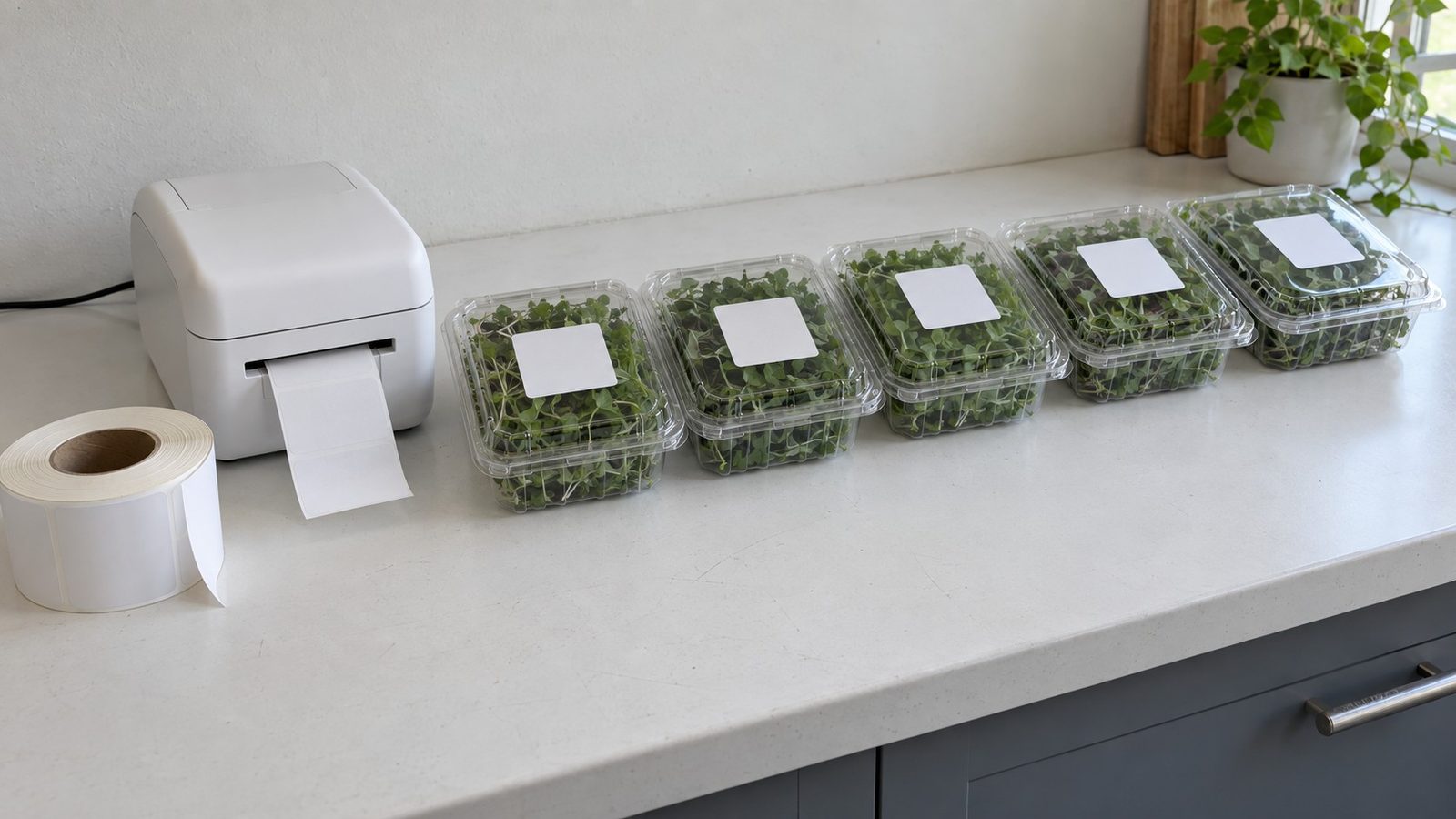
The cheapest way to label clamshells in-house is a direct thermal printer on weatherproof roll stock: a Rollo USB printer at $199.99 plus 1,000 labels at $13.77 comes to $213.76. A 2 by 2 in direct thermal label costs about $0.0379 in stock, thermal transfer about $0.0407 with ribbon, and printed rolls from $0.0806 to $0.248 depending on the order size.
Whatever you print on, put the label on a clean, dry pack before it goes cold, and run your own label on your own clamshell through your cooler before you buy a case. No produce PLU exists for microgreens, a single GS1 barcode number costs $30, and a scale that sets the net weight on a pack you sell falls under weights and measures law.
What has to be printed on the label is set by the microgreens FDA label requirements. Everything below is about getting that information onto a label that stays put.
The five ways to print a microgreen label
Sheet labels on an office printer cost the least to start, since you feed 8.5 by 11 in sheets through the inkjet or laser you already own. The stock and ink decide how they handle water: Avery says water and oil resistant papers should not be submerged, because liquid can get in at the edges and discolor them (Avery material guide). Buy a film or weatherproof sheet made for your printer type, and work out its cost per label from the pack price, label count and cartridge yield.
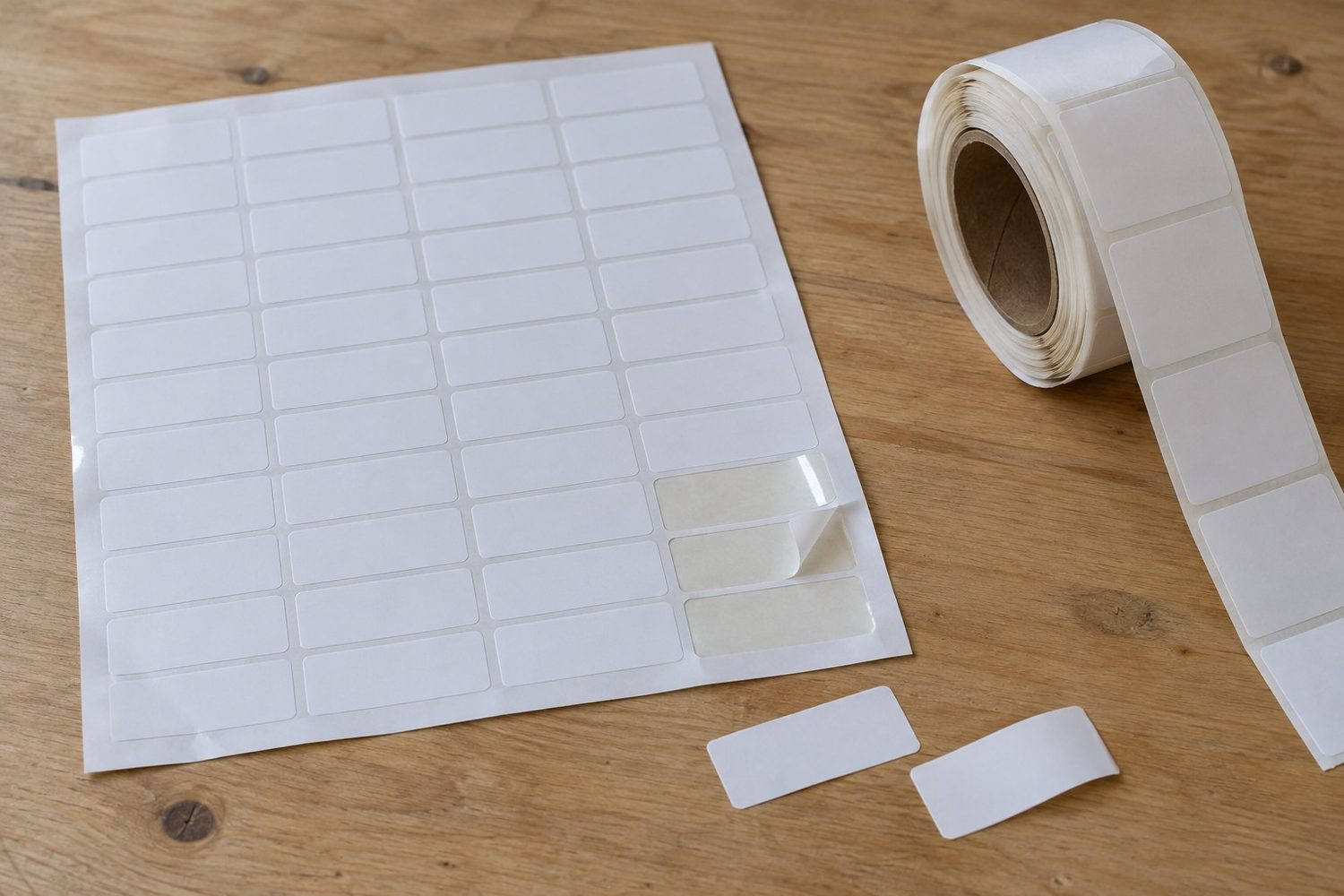
Direct thermal printing uses heat on a chemically coated label, with no ink and no ribbon (direct thermal label printers). Rollo describes its printer as printing "via heat using direct thermal technology" (Rollo). The tradeoff is permanence. OnlineLabels says direct thermal "May fade over time," can darken with extra heat or strong light, and isn't recommended for long-term use (OnlineLabels, direct thermal vs thermal transfer). Keep labeled packs out of hot sun.
Thermal transfer printing melts ink from a ribbon onto stock coated for it, so you buy two consumables instead of one. In return, OnlineLabels says thermal transfer print "Won't fade over time" and is much more durable than direct thermal (OnlineLabels). Its weatherproof BOPP (a polypropylene film) is top-coated specifically for thermal transfer (OnlineLabels thermal transfer stock).
Roll-fed color inkjet prints full color artwork on inkjet labels from a roll. The Primera LX610 is one example. It costs far more than a thermal printer, and Primera estimates its ink at $0.03 to $0.07 for a 4 by 3 in label at 50% coverage, not counting the label stock (Primera LX610).
Professionally printed rolls come from a label printer who runs your fixed artwork. You skip the printer and the ink, but you take on order minimums, and every artwork change means a new order. One way around that is a preprinted brand label plus a small thermal label for the mix name, lot and harvest date.
Label printers and what they cost to buy
The table below lists named printers with the price shown on the maker's page on 13 September 2026 unless a different date is given. It excludes freight, tax and discounts.
Hover or tap a row to highlight it.
| Printer | Method | Label width | Price |
|---|---|---|---|
| Rollo USB | Direct thermal | 1.57 to 4.1 in media | $199.99 (June 2026 page capture) |
| Rollo X1040 Wireless | Direct thermal | 1.57 to 4.1 in | $279.99 (August 2026 page capture) |
| Brother QL-1110NWB | Direct thermal | 4 in | $334.99 |
| Zebra ZD421 | Separate thermal transfer and direct thermal models | 4.09 in print width at 203 dpi | Ask a seller for a quote |
| Primera LX610 | Color inkjet | 4.1 in maximum cut width | $2,695 |
Two details in that table change what you can buy afterward. Brother's QL-1110NWB runs Brother DK rolls, and Brother warns that non-genuine replacement labels "may damage the Brother QL-1110NWB label printer and may not be covered under warranty" (Brother). The Zebra ZD421 comes as either a thermal transfer model, which loads a ribbon cartridge, or a direct thermal model, so decide which method you want before you order (Zebra ZD400 series spec sheet).
What a 2 by 2 inch label costs at your order size
Holding the size at 2 by 2 in puts the methods side by side. These are stock and ribbon costs only, with prices as listed on 13 September 2026; the printer, your time and shipping are left out.
Hover or tap a row to highlight it.
| Label | Order | Cost per label |
|---|---|---|
| Direct thermal, OnlineLabels RL938 weatherproof, 2 by 2 in | $27.65 for 730 | $0.0379 |
| Thermal transfer, OnlineLabels RL938 BOPP, 2 by 2 in, plus CSO ribbon TR2181 | $0.0317 stock plus about $0.0090 ribbon | $0.0407 |
| Sticker Mule printed BOPP rolls, 2 by 2 in | 500 for $124 | $0.248 |
| Sticker Mule | 1,000 for $181 | $0.181 |
| Sticker Mule | 5,000 for $532 | $0.1064 |
| StickerYou glossy paper rolls, 2 by 2 in | 500 for $111.10 | $0.2222 |
| StickerYou | 1,000 for $155.90 | $0.1559 |
| StickerYou | 5,000 for $403 | $0.0806 |
The ribbon figure assumes a 2 in label with a 0.125 in gap between labels, and you still need to confirm the ribbon fits your printer. The two printed roll suppliers aren't selling the same material, either. Sticker Mule says its roll labels are BOPP with a UV finish that protects them from food, oil, water, sunlight and refrigeration, which is the seller's claim rather than a cooler test (Sticker Mule). The StickerYou labels are paper.
If a smaller label fits your pack, the OnlineLabels RL2895 weatherproof direct thermal label at 2.25 by 1.25 in is $13.77 per 1,000, or $0.0138 each (OnlineLabels). It is sold as DYMO compatible, and neither Rollo nor Brother names it as a compatible roll, so run a single roll before you order more. The 3 by 3 in RL946 is $30.35 for 500, or $0.0607 each.
Over a year, the 2 by 2 in cost at three packing volumes looks like this, with printed rolls bought at the tier each volume would order (OnlineLabels, Sticker Mule).
Hover or tap a row to highlight it.
| Packs a week | Direct thermal a year | Thermal transfer a year | Sticker Mule printed a year |
|---|---|---|---|
| 20 | $39.39 | $42.30 | $188.24 |
| 100 | $196.96 | $211.52 | $553.28 |
| 500 | $984.79 | $1,057.61 | $2,766.40 |
Printed rolls close the gap as volume climbs, but the in-house thermal label stays cheaper in stock at every volume here. What printed rolls buy you is color without a $2,695 printer and no printing on packing day.
How to keep a label stuck through the cooler and condensation
Two things decide whether a label survives the cold: the adhesive and face stock, and the condition of the pack when the label goes on.
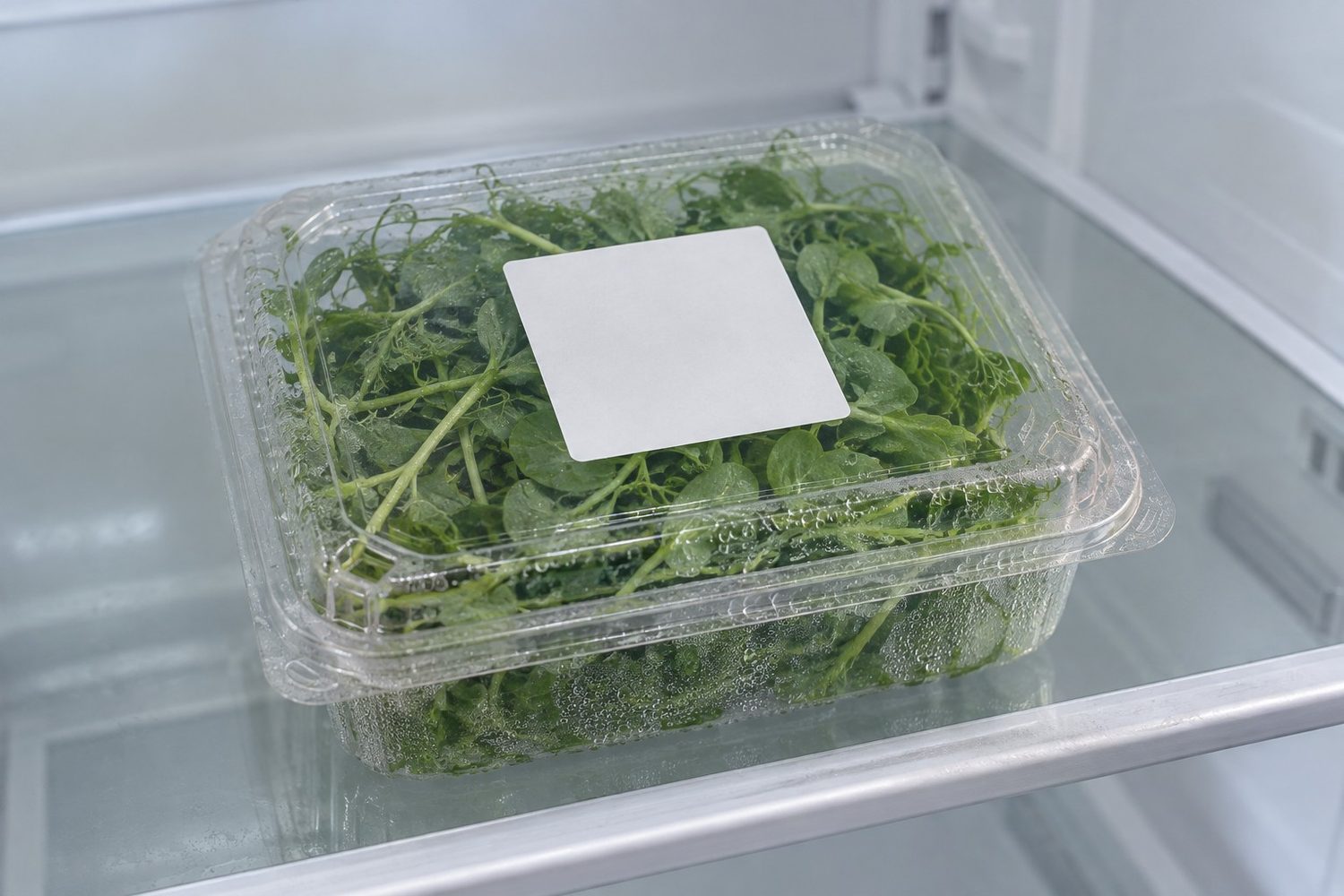
For stock, OnlineLabels lists freezer-permanent rubber adhesive on its weatherproof direct thermal and thermal transfer materials, with a service range of -65 to 147 F once applied (OnlineLabels freezer label guide). Its direct thermal product page also advises giving the label time to set in cold storage (OnlineLabels direct thermal stock). Avery draws a line between water resistant labels, meant for splashes and light condensation, and waterproof labels, which can handle prolonged water (Avery). A sweating clamshell sits closer to the first, but a pack that sits in pooled water in a cooler needs the second.
The pack matters as much as the label. Avery says most labels should be applied above 50 F, that cold surfaces compromise bonding, and that water, oil and dirt create a barrier that stops a label from bonding (Avery label-fail guidance). OnlineLabels says the same about freezer labels: apply them before the product goes cold, and if it is already cold, let condensation dry off first (OnlineLabels). In practice that means labeling empty clamshells at room temperature before you fill them, or labeling filled packs before they go into the cooler, and wiping any damp spot dry.
One grower on r/microgreens in 2019 used a DYMO thermal printer and reported no problems with the labels in home fridges or in a chilled delivery bag, and said they had not tried walk-in coolers (forum thread, 2019). Test labels cold and wet on your own PET, rPET or PLA clamshells.
So, test before you buy a case. Apply labels from a sample roll, such as 2 by 2 inch thermal labels, to the exact clamshell you sell in, at the temperature you pack at, and send those packs through the cycle your product goes through: into the cooler, out to a warm market table or truck, and back in. Check the edges for lift and the print for smearing after each round, write down what held, and buy that. If you are still choosing the pack, settle on the storage container first, and let the label follow your packaging and presentation rather than the other way around.
Free software for designing the label
You don't need to buy design software to start. Canva's free plan offers more than 1.6 million templates and exports PDF, JPG and PNG files (Canva pricing). Zebra's ZebraDesigner Essentials is a free label design tool (Zebra), and Brother offers free SDKs for its QL-1110NWB (Brother).
Whether a barcode is worth the GS1 fee
A scannable barcode matters when a grocery store or distributor asks for one, and it rarely matters at a market table. GS1 US charges $30 one time for a single GTIN (the number behind a barcode), with no renewal. Company prefixes that hold more numbers cost $250 plus $50 a year for 10 numbers, $750 plus $150 a year for 100, and $2,500 plus $500 a year for 1,000 (GS1 US pricing).
The arithmetic favors single GTINs for a small line. Up to 8 products, single GTINs cost less than the 10-number prefix in the first year, $240 against $250. Count products the way GS1 does, though: each size or pack count needs its own GTIN (GS1 US FAQ), so a sunflower mix sold in two clamshell sizes is two numbers. Before you buy any, ask your buyer in writing what code they accept, because retailers set their own requirements. That question belongs early in any grocery and wholesale conversation.
If you keep lot codes for food traceability records, a small variable label printed on packing day is a practical place to carry the lot and harvest date, even when the brand label is preprinted.
There is no produce PLU code for microgreens
Among the 1,548 approved codes in the IFPS PLU database, none is for microgreens (IFPS PLU database). PLU codes are also a loose produce tool; IFPS says they are used to identify bulk produce (IFPS PLU codes), not a packed clamshell.
IFPS does set aside retailer-assigned ranges, 3170 to 3270 and 4460 to 4469, for items without a standard code, but they are used only after the supplier makes specific arrangements with every retailer that will receive the item (IFPS retailer assigned numbers). Don't put a related leafy green or sprout code on your pack. If a store wants a PLU, let the store assign it.
When your scale has to be legal for trade
If you fill packs to a net weight printed on the label, the scale doing that job is likely commercial equipment. NIST Handbook 130's model law covers devices used in establishing the quantity of produce offered for sale, which reads on a scale used to fill packs labeled with a net weight. Its type evaluation regulation says a device must be traceable to an active NTEP Certificate of Conformance (NIST Handbook 130-2025). Handbook 130 is a model, and states adopt it in whole or in part, so the office that decides for you is your state or county weights and measures office. Call them before you sell by weight.
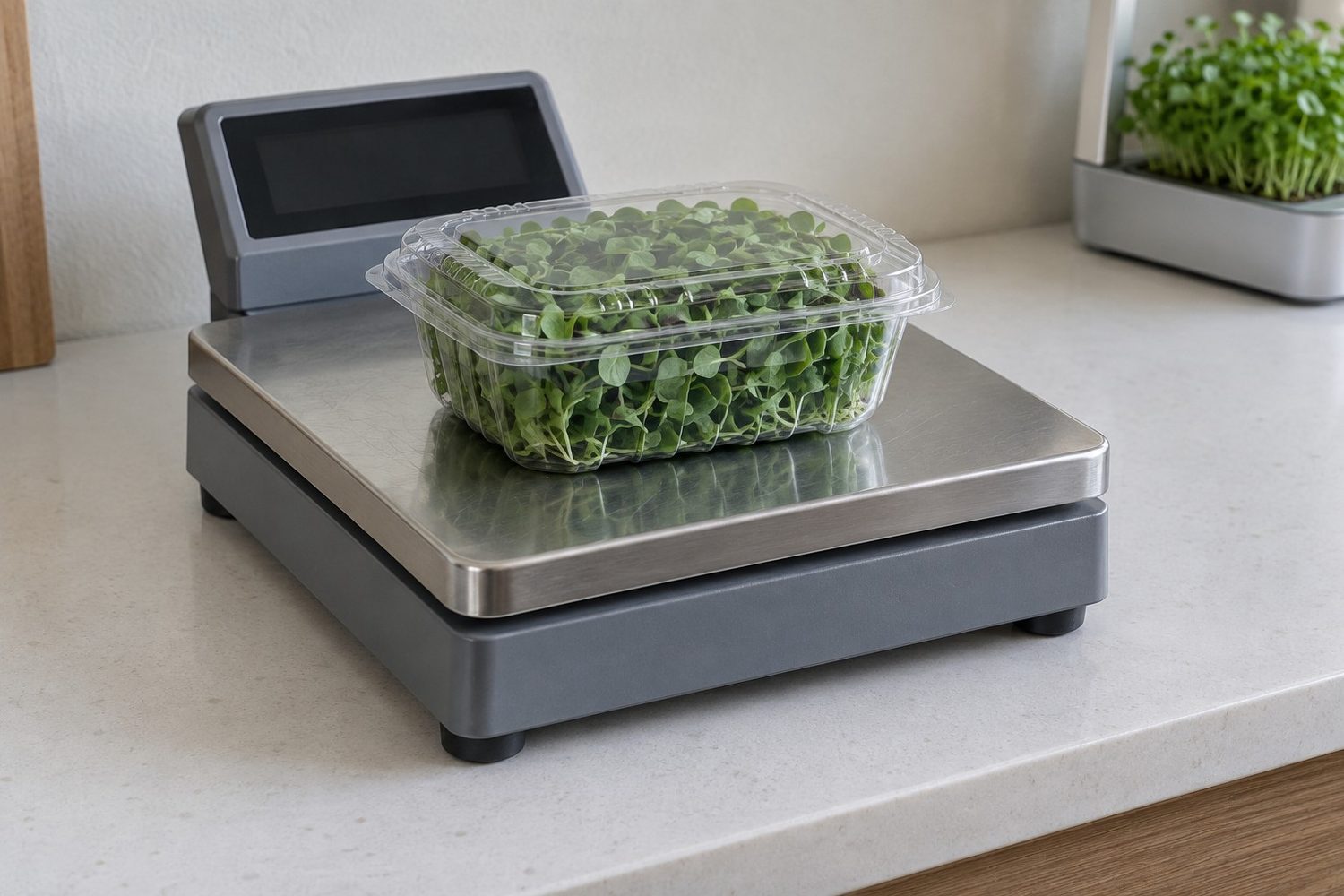
One county office puts it plainly. Madison County, New York says any device used to sell goods must be marked Legal for Trade, and points owners to the NTEP Certificate of Conformance (Madison County Weights and Measures). Don't count on a kitchen scale for packs you sell; look up whether your exact model has an NTEP certificate, and if it doesn't, get a scale that does.
One option covers the scale and the label in one machine. The CAS LP-1000N is NTEP approved and prints its own labels (CAS), and it lists at $1,479 (Certified Scale).
Three starter setups and what each costs
Each setup below leaves out containers, shipping, tax and your time. Pick the one that matches where you sell now.
Hover or tap a row to highlight it.
| Setup | What you buy | Entry cost |
|---|---|---|
| Farmers market, direct thermal | Rollo USB $199.99, Canva free plan, 1,000 RL2895 labels $13.77 | $213.76 |
| Farmers market, color | Primera LX610 $2,695, plus $30 to $70 of ink for 1,000 labels, plus label stock | $2,725 to $2,765 plus stock |
| Grocery-ready weight labels | CAS LP-1000N $1,479, 10-number GS1 prefix $250, a $52 case of scale labels | $1,781.00 buying the whole case |
The direct thermal setup suits a grower selling at farmers markets who wants black text, low running costs and the freedom to change a mix name the morning of market (Rollo, OnlineLabels). Confirm with one roll that RL2895, sold as DYMO compatible, runs in a Rollo.
The color setup makes sense when your artwork changes often enough that reordering printed rolls would cost more than the printer. The ink figure is Primera's estimate (Primera), so get a quote on inkjet label stock before you add up the total.
The grocery-ready setup is for packs sold by weight with a barcode. The scale label case is $52 for 12 rolls of 700, about $0.0062 a label (Certified Scale), and the prefix renews at $50 a year after the first (GS1 US). Grocery-ready describes the equipment, not a buyer's approval, so get the buyer's label specification in writing first.
Questions growers ask about microgreen labels
What size label fits a clamshell? There is no standard size chart tied to ounce capacity, so measure the flat, unobstructed panel on each clamshell you sell. Two common clamshell sizes are 4.5 by 4.5 by 2.75 in and 5 by 5.13 by 3.25 in. Print paper mockups at size before you order a roll.
Can I use a preprinted brand label and still print harvest dates? Yes. Leave a blank zone on the preprinted roll and add a small thermal label, or a stamp, for the mix name, lot and harvest or pack date. Eco City Farms used a microgreen bag label with blank lot and pack date fields this way (Eco City Farms guide), and it saves throwing out branded rolls when a mix changes.
Is there a compostable label that holds up in the fridge? Don't assume one does until you see proof. Ask the supplier for the certification and the adhesive technical data sheet, then run the same cooler test you would run on any other stock.
Before you order a case of labels
Buy one roll of the stock you think you want and run it through your own cooler on your own clamshell; if it holds and the print stays sharp, order in bulk. If you plan to sell by weight or into a store, call your weights and measures office and ask your buyer for their code requirements in writing before you spend money on a scale or a GS1 prefix.
Sources
Prices, stock and specifications are as the linked pages showed them on 2026-09-13.
- Avery material guide
- Rollo
- OnlineLabels, direct thermal vs thermal transfer
- OnlineLabels thermal transfer stock
- Primera LX610
- Rollo X1040 Wireless
- Brother QL-1110NWB
- Zebra ZD421
- OnlineLabels RL938 weatherproof
- CSO ribbon TR2181
- Sticker Mule
- StickerYou
- OnlineLabels freezer label guide
- OnlineLabels direct thermal stock
- Avery
- Avery label-fail guidance
- forum thread, 2019
- Canva pricing
- GS1 US pricing
- GS1 US FAQ
- IFPS PLU database
- IFPS PLU codes
- IFPS retailer assigned numbers
- NIST Handbook 130-2025
- Madison County Weights and Measures
- CAS
- Certified Scale
- Eco City Farms guide
Keep reading
The journal
Best Sprouting Trays and Jars for Home Sprouting
Compare the best sprouting trays, jars, sacks and automatic sprouters by format, price and cleaning needs, plus which seeds and buyers each one suits.
Read Best Sprouting Trays and Jars for Home SproutingThe journal
Microgreens Equipment List: What to Buy at Every Scale
See a microgreens equipment list priced at three scales, from one windowsill tray to a full rack, with what to buy, skip, or borrow from the kitchen.
Read Microgreens Equipment List: What to Buy at Every ScaleThe journal
AeroGarden vs LetPot: Specs, Warranty and Running Costs
See AeroGarden vs LetPot lined up on price, pod count, light hours, monthly power cost and warranty terms to match a garden to your kitchen and crops.
Read AeroGarden vs LetPot: Specs, Warranty and Running CostsThe journal
How to Choose a Hydroponic System for Microgreens
Compare a still-water tray, ebb-and-flow table and NFT channel hydroponic system for microgreens, with setup costs, what each needs and problems to expect.
Read How to Choose a Hydroponic System for Microgreens