Herb Microgreens: Slower and Harder, and They Use Less Seed Than Everything Else
Cal HewittPublished Checked
- growing
- buying
- economics
- method
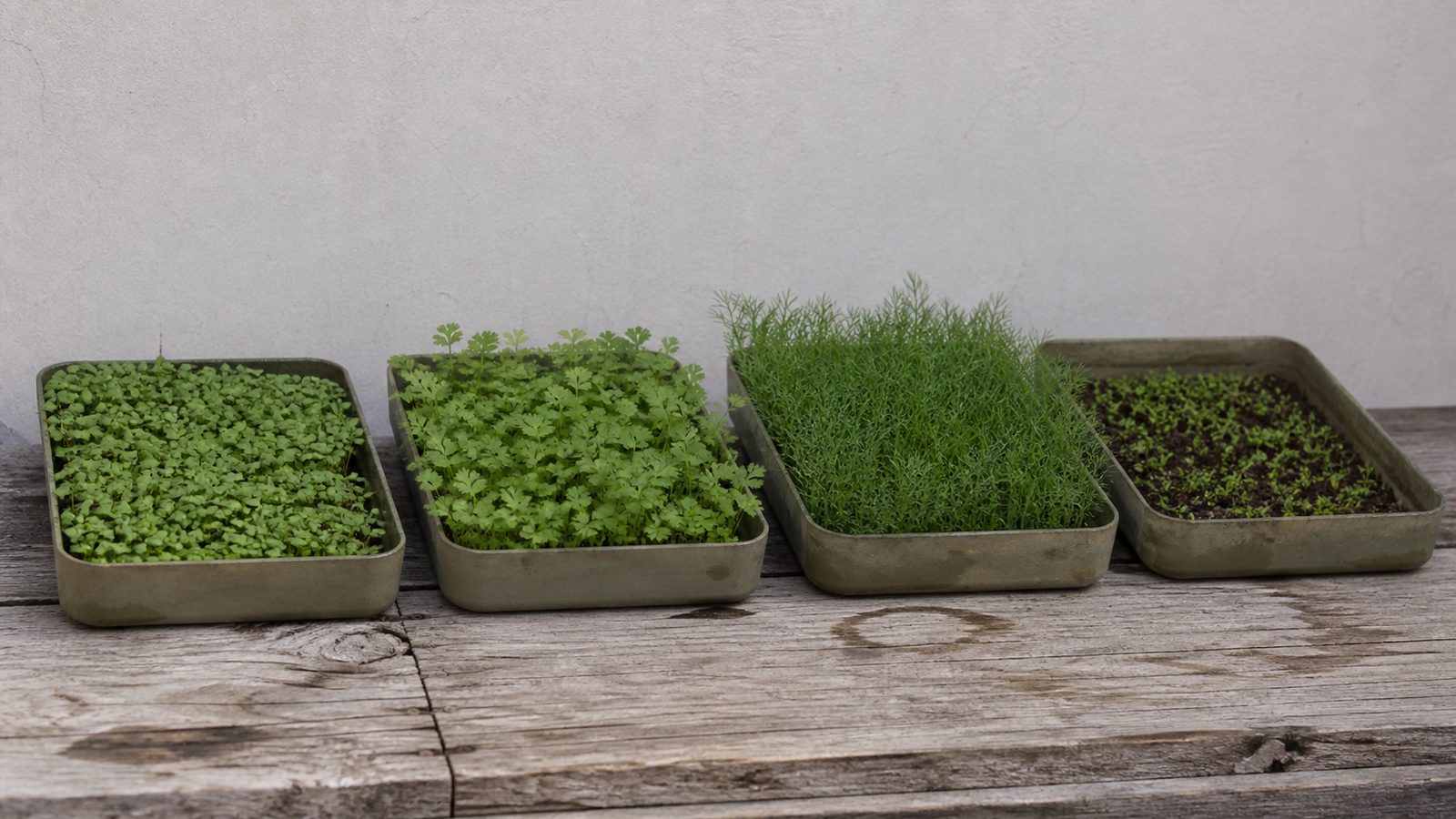
"Micro herb" is a culinary word, not a botanical one, and that is the first problem with every claim made about the category.
Cambridge defines a micro herb as young herb seedlings used to add to or decorate food, and says explicitly that young vegetable seedlings are sometimes called micro herbs too. Virginia Tech does not define herbs separately at all, describing the production stage instead: immature vegetables, herbs and grains harvested with the stem soon after first true leaves, sitting between sprouts and baby greens.
Supplier lists are inventories, not a species list, and they cross botanical families freely. One slow-growing chart's herb section holds basil, cilantro, dill, bronze and green fennel, anise hyssop, chervil, cutting celery, lemon balm, parsley, shiso and sorrel. A restaurant-supply fines herbes mix is parsley, chervil, chives and tarragon. And one farm's "herb" living-tray choice is basil, cilantro or wasabi mustard, which is a brassica. That last one is the warning: commercial "herb" can include anything.
So, the category cannot be tested directly. It can be approximated, by grouping the crops by botanical family instead.
What to actually do
- Budget the bench, not the seed. Herb seed is a fifth lighter per tray than everything else. The cost is the 19 to 25 days the tray is not producing something else.
- Do not start on a herb. Zero of the 18 herb-family crops are rated beginner, and 8 of the 9 rated Difficult are herbs. The beginner page covers what to start on instead.
- Cilantro is the cheap way in. At $4.89 a pound and $0.28 a tray in one dated table it is among the least expensive seeds anywhere, and it is still slow. Cheap seed and a slow crop are not a contradiction.
- Check the cut stage before you trust a day count. One catalog's 20-day cilantro is cut at first true leaf; two extension tables give basil 8 to 12 and 12 to 16 days. Same crop, different criterion.
- Treat "herb" on a product page as marketing. One farm's herb tray choice includes wasabi mustard, which is a brassica.
- Price per tray, never per pound. A $32.14 pound of basil is $1.84 a tray at 28 g, and a $19.58 pound of broccoli is $1.12. The per-pound ranking and the per-tray ranking are different rankings.
- Use species-specific covering and light. Cover cilantro and parsley, lightly cover basil, dill and fennel, and expect the light requirement to move by species rather than by category.
- If you sell, model the rotation. A published model turned a $25 tray into a $13.09 loss on basil and a $5.47 profit on broccoli, entirely through cycle length and labor.
Grouping by family, the claim holds decisively
The culinary herbs here fall into four botanical families: Apiaceae (cilantro, dill, fennel, chervil, parsley, celery, lovage), Lamiaceae (basil, lemon balm, mint, anise hyssop, shiso, thyme, oregano), Polygonaceae (sorrel) and Asteraceae (tarragon). Grouping by those four against everything else:
Hover or tap a row to highlight it.
| Measure | Herb families, 18 crops | Everything else, 44 crops |
|---|---|---|
| Median mid-window harvest | 19.0 days | 11.5 days |
| Median published maximum | 25.0 days | 15.0 days |
| Slowest crop | 35 days | 30 days |
| Rated Beginner | 0 of 18 | 20 of 44 |
| Rated Moderate | 10 of 18 | 23 of 44 |
| Rated Difficult | 8 of 18 | 1 of 44 |
| Median seed rate | 19.4 g | 24.2 g |
Herb-family crops take about 1.65 times as long to the middle of their window, and not one of the eighteen is rated a beginner crop. Eight of the nine crops rated Difficult sit in a herb family.
Ten of the twelve slowest crops are herb-family, against 18 of 62 crops overall: parsley at 21 to 35 days, thyme 20 to 35, celery 21 to 30, shiso 16 to 30, sorrel 17 to 30, basil 12 to 26, carrot 14 to 25, cilantro 13 to 25, dill 12 to 25 and fennel 16 to 25.
Two honest limits on that grouping, and both cut the same way. Carrot is Apiaceae and is not a culinary herb, so the family proxy sweeps in one crop that does not belong. And chives is a culinary herb that this grouping excludes, because it is Amaryllidaceae alongside onion and leek, and including that family would have brought two non-herbs with it. Chives runs 14 to 30 days and would have sat in the slowest twelve, so excluding it made the result more conservative, not less. This is the culinary-label problem in miniature: any grouping you choose is wrong at the edges.
The premium is bench time, and the seed is the part that is cheaper
Here is where the obvious explanation fails. "Herbs are the dear corner" invites the assumption that herb seed is the expensive input. The fields say herbs sow lighter: a median 19.4 g a tray against 24.2 g for everything else, about 20% less seed.
The extension tables agree there is no herb rate pattern. Utah State specifies 28 g a 1020 tray for basil and for cilantro, the same as broccoli and kale, against 42 g for radish and 150 g for pea. One catalog recommends 26 g a tray for its cilantro. Rate is crop-specific and it is not a herb property.
And per-pound seed price does not sort by herb either. In one dated table cilantro was $4.89 a pound and basil $32.14, on the same date at the same rate class. One 2023 chart lists parsley at $12.25 a pound against lemon balm at $156.00 and bronze fennel at $207.25. The spread inside the herbs is roughly 17-fold, which is wider than the gap between herbs and everything else. Cilantro is the exception that disproves "herb equals expensive."
A high price per pound is also not a high cost per tray. Utah State's basil is $32.14 a pound and $1.84 a tray at 28 g; its cilantro is $4.89 a pound and $0.28 a tray; broccoli is $19.58 a pound and $1.12 a tray. Do not combine figures from different dates or pack sizes into one ranking.
So, what actually costs money is the calendar. A 2018 Alberta concept model puts basil's extended cycle at nearly double other microgreens and costs it accordingly:
Hover or tap a row to highlight it.
| Line | Basil | Broccoli |
|---|---|---|
| Labor per tray | $19.00 | $6.67 |
| Total cost per tray | $38.09 | $19.53 |
| At its assumed $25 sale price | loses $13.09 | makes $5.47 |
Basil loses money in that model and broccoli makes it, on the same assumed price. The model assumes three crop cycles a month and allocates $6.25 of overhead a tray at 960 trays a month. It is a transparent 2018 scenario and not a transferable 2026 quote, and what it costs is exactly the thing the seed price does not: slow rotation.
That reconciles the picture. Labor is the largest input and the one nobody prices. Herbs are where that bites hardest, because a tray that occupies a bench for 35 days instead of 11 cannot be turned into three crops a month.
Why they are slow is not one thing
Germination and market stage both contribute, and the split differs by crop.
Utah State's cilantro line carries 7 to 14 covered days before a 21 to 28 day harvest, while basil has 4 to 7 covered days and a 12 to 16 day harvest. That is a real germination and establishment component for cilantro. Separately, one catalog reports cilantro at 20 days when cut at first true leaf rather than at cotyledon, so the chosen market stage adds time on top.
Published day figures for one crop disagree because the harvest criterion differs. Utah State gives basil 12 to 16 days; Clemson's older table gives basil 8 to 12. A day number without its source and its cut stage is not usable.
Cover treatment is species-specific rather than herb-specific. Florida directs a cover for cilantro and parsley and a light cover for basil, dill and fennel. Virginia Tech gives basil and parsley a crop-specific lighting recommendation, 16 hours at 231 PPFD raised to 300 for the final three days, and says its general 60 to 70°F and 50 to 70% humidity guidance is only general because light needs vary by species. All of that supports species-specific protocols. None of it demonstrates that every herb needs different conditions from every brassica.
What is claimed about herbs and is not established
- That herbs are a real experimental group. No comparative study treats culinary herbs as a group and tests whether they differ from brassicas or peas after accounting for species. Florida's slow list includes beet, carrot, chard and amaranth alongside the herbs, which is evidence against a herb-group effect rather than for one.
- That the longer crop gets more disease because it sits longer. Densely planted microgreens are prone to damping off with poor air circulation or saturated media, and above 75°F disease pressure rises. That is a production risk, not a time-in-tray measurement. An FDA surveillance program found pathogens on mature basil, cilantro and parsley, and that is neither microgreen nor duration evidence and must not be repurposed as either.
- Why herb seed costs what it does. The defensible mechanism is narrow: a commercial seed crop needs a plant that reliably flowers, sets seed and reproduces the cultivar. Tarragon must be propagated asexually because seed-grown plants lack the oils that give the flavor, and rosemary, thyme and oregano are commonly grown from stem cuttings, with chives, mint and lemon balm from division. That explains scarce or absent true-to-type seed for those specific types. It does not decompose any species' seed price into propagation, seed yield, cleaning, germination specification and demand, and nobody has published that.
- That herb buyers behave differently. The best demand evidence is about microgreens generally: a 2020 survey of 60 Belgrade restaurant managers found 87% familiar with microgreens, 60% using them for decoration and 2% in food preparation, with attractive appearance the most common reason at 69%. That is plating, and it is not a claim about herb buyers.
What nobody has measured
- Whether "herb" is a real category once species is accounted for. This needs one multispecies trial sampling named Apiaceae, Lamiaceae, Allium, Asteraceae and brassica crops under one protocol, reporting germination, days, yield, loss and labor.
- Whether a longer bench occupancy causes more disease, from parallel short and long-harvest cohorts with humidity, density and seed lot controlled.
- Why particular herb seed prices sit where they do, from supplier crop-yield, conditioning, germination-test and sales-volume data.
- A common-tray seed-rate dataset covering the herb subset, which is the only way to compare rate as a group rather than crop by crop.
- What herb buyers actually want, as opposed to what microgreen buyers generally do. The one survey available is 60 restaurant managers in one city and is about plating.
Terms on this page
Tap a term to see what it means.
Micro herb. A culinary and commercial label for young herb seedlings used to garnish or flavor food. It has no botanical definition and it crosses at least six plant families.
Sources
Opened 2026-08-12. The family grouping, the day and seed-rate medians, the difficulty split and the slowest-twelve list were computed for this page from the botanicalFamily, daysToHarvest, seedGramsPer1020, difficulty and moldRisk fields across all 62 variety entries. The herb grouping uses Apiaceae, Lamiaceae, Polygonaceae and Asteraceae and is imperfect in both directions, as the page states: it includes carrot, which is not a culinary herb, and excludes chives, which is, because its family also holds onion and leek. Prices are dated snapshots from named sources and are not combined across dates or pack sizes.
- Cambridge Dictionary, micro herb - young herb seedlings used to add to or decorate food, with the explicit note that young vegetable seedlings are sometimes called micro herbs too.
- Virginia Tech, introduction to microgreen production - immature vegetables, herbs and grains harvested with the stem soon after first true leaves, placed between sprouts and baby greens; crop-specific basil and parsley lighting of 16 hours at 231 PPFD raised to 300 PPFD for the final three days; and the statement that the general 60 to 70°F and 50 to 70% humidity guidance is general because light needs vary by species.
- Utah State University Extension, grow your own microgreens - seed priced at the 5 lb or more rate on 2026-01-08: basil $32.14 a pound and $1.84 a tray at 28 g, cilantro $4.89 a pound and $0.28 a tray at 28 g, broccoli $19.58 a pound and $1.12 a tray; basil 12 to 16 days with 4 to 7 covered days, cilantro 21 to 28 days with 7 to 14 covered days, broccoli 8 to 12 days; and rates of 28 g for basil, cilantro, broccoli and kale against 42 g for radish and 150 g for pea.
- Clemson Extension, growing microgreens - the 2018 table giving basil 8 to 12 days, against Utah State's 12 to 16, which is why a day figure has to keep its source and cut stage.
- UF and IFAS Gardening Solutions, microgreens - a cover for cilantro and parsley against a light cover for basil, dill and fennel, and a slow-crop list that also includes beet, carrot, chard and amaranth.
- Alberta Agriculture, microgreens concept model (PDF) - the 2018 analysis putting basil's cycle at nearly double other microgreens, with basil labor at $19.00 a tray and total cost $38.09 against broccoli at $6.67 and $19.53, an assumed $25 sale price producing a $13.09 basil loss against a $5.47 broccoli profit, three crop cycles a month and $6.25 overhead a tray at 960 trays a month.
- Virginia Tech, herb culture and use - culinary tarragon requiring asexual propagation because seed-grown plants lack the flavor oils, and rosemary, thyme, lemon verbena, scented geranium, oregano and wormwood named for stem cuttings.
- Cornell Cooperative Extension, propagating herbs - basil, oregano, lavender, rosemary, thyme and sage doing well from cuttings, and chives, mint and lemon balm from division.
- FDA, microbiological surveillance sampling of fresh herbs, FY17 to 21 - pathogens found on mature basil, cilantro and parsley. Neither microgreen nor bench-duration evidence, and named here so it is not repurposed as either.
- Božić and Milošević, 2020 - a survey of 60 Belgrade restaurant managers finding 87% familiar with microgreens, 60% using them for decoration and 2% in food preparation, with attractive appearance the most common reason at 69%.
- Practice, supplier and grower listings opened 2026-08-12 as records of what is offered rather than as evidence: one catalog's 30 November 2023 slow-growing comparison chart (PDF), listing the herb section and 1 lb prices including parsley $12.25, dill $29.60, basil lines $43.15 to $90.25, lemon balm $156.00 and bronze fennel $207.25, with anise hyssop, chervil, cutting celery, lemon balm and parsley at 26 to 30 days and basil, dill, fennel and shiso at 16 to 25; its cilantro page, reporting 20 days when cut at first true leaf, a 26 g rate, $19.25 a pound, and the damping-off guidance on air circulation, saturated media and temperatures above 75°F; a Fresh Origins fines herbes specification sheet (PDF) giving the mix as parsley, chervil, chives and tarragon; the restaurant-supply catalog showing Micro Italian Parsley at $5.50 an ounce, Micro Mint at $5.45, Micro Arugula at $4.05 and the fines herbes mix at $4.78; Hungry Gardens, listing cilantro from $6.50 an ounce, dill $7.50, chervil and mint at $15 an ounce and arugula from $5.50; and Nags Head Microgreens, whose 2026 herb living-tray choice is basil, cilantro or wasabi mustard.
Keep reading
The journal
Grow or Buy Microgreens? The Answer Is an Hourly Rate, and It Is $23.60
Seed alone makes home growing look eleven times cheaper. Add medium, power, a failure rate and your own time at $20 an hour and the saving against the cheapest retail is 8 percent.
Read Grow or Buy Microgreens? The Answer Is an Hourly Rate, and It Is $23.60The journal
Which Microgreens Should a Beginner Grow? Start With Broccoli, Radish or Mustard
Nearly every beginner list names radish, pea and sunflower. Pea and sunflower are the only two of that set not rated beginner: both carry high mold risk, both need a soak, and both sow at six times the median seed rate.
Read Which Microgreens Should a Beginner Grow? Start With Broccoli, Radish or MustardThe journal
Are Microgreens Sustainable? The Published Range Is 3.34 to 63.34 kg CO2e a Kilo, and Your Grid Decides Where You Land
One modeled crop spans a 19-fold carbon range. Indoor growing beats field lettuce on land by roughly 37 times and can lose on carbon, because the answer is a property of your electricity rather than of the crop.
Read Are Microgreens Sustainable? The Published Range Is 3.34 to 63.34 kg CO2e a Kilo, and Your Grid Decides Where You LandThe journal
The Cheapest Microgreens to Grow, Tray by Tray
Find the cheapest microgreens to grow by seed cost per tray and per ounce of harvest, plus how small a share seed is of the full cost of a tray.
Read The Cheapest Microgreens to Grow, Tray by Tray