Is AeroGarden Worth It for Kitchen Microgreens?
Cal HewittPublished Checked
- equipment
- buying
- pod gardens
- beginner
Disclosure: Microgreens Guru may earn a commission when you buy through some links on this page, at no extra cost to you. Prices below are the sellers' own, taken on September 26, 2026.
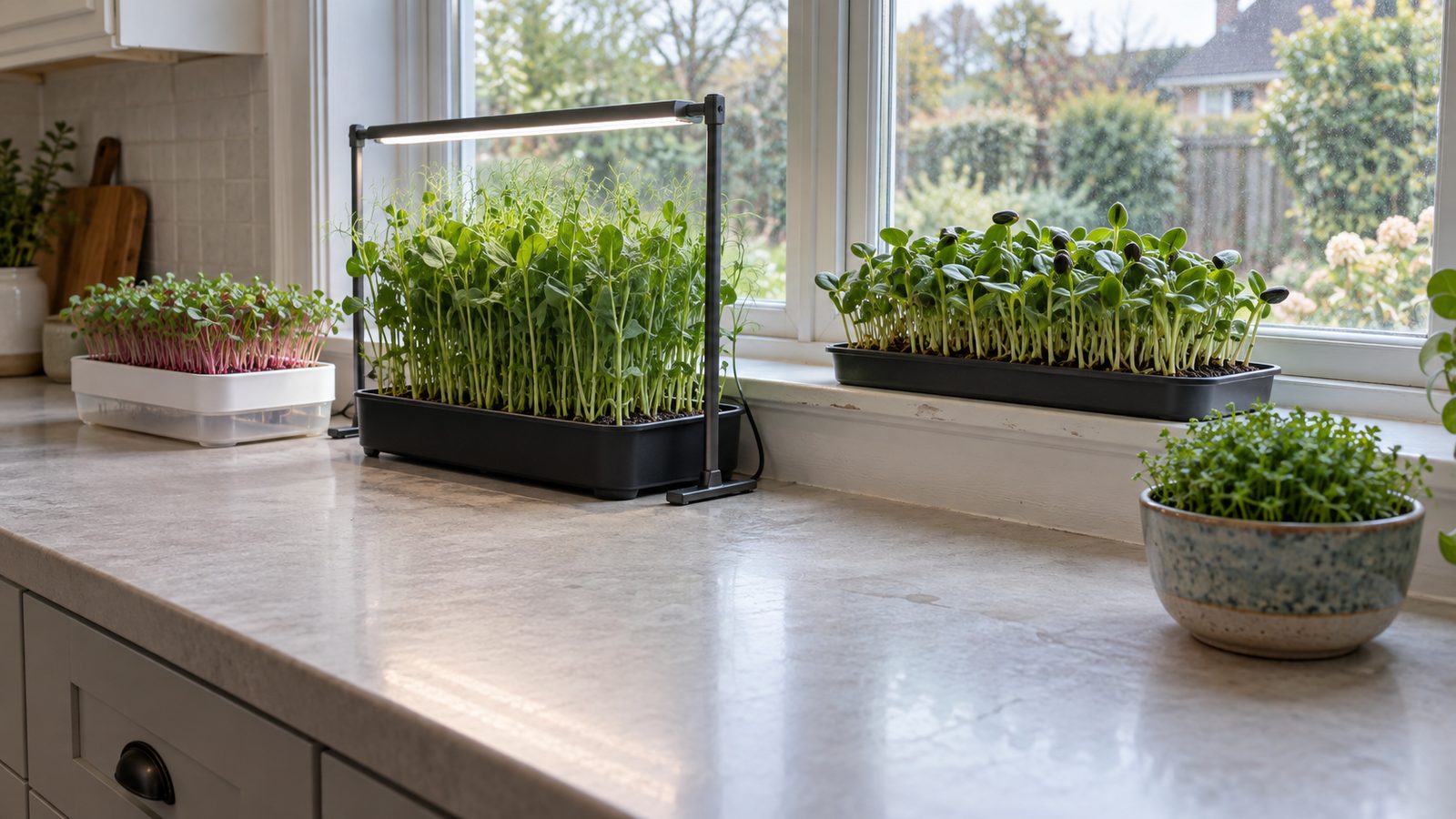
For a steady weekly supply of microgreens, a pod garden is the wrong shape of machine. An AeroGarden is built to grow a handful of separate plants, each in its own pod, for weeks or months: herbs, lettuce, tomatoes. Microgreens are sown thick across a continuous surface and cut in a week or two, and a tray does that job. The good news is that the tray setups cost less to start. A starter basket of trays, coir and radish seed from True Leaf Market came to $46.92 on September 26, 2026, before a light, and one tray asks about 8 minutes of your hands across planting, watering and harvest. Below are the four kitchen setups to choose between, what each costs, and what your first week looks like with each.
If you still want to try your pod garden first, can you grow microgreens in an AeroGarden covers what works in the pod deck, and the countertop units review compares the machines themselves.
The four setups side by side
Hover or tap a row to highlight it.
| Setup | What it holds | Price on 2026-09-26 | Refills | Light |
|---|---|---|---|---|
| Hamama tray kit | One 12.5 x 6.5 x 2 inch tray | $35 with 3 Seed Quilts (plastic); $79 (ceramic) | Hamama Seed Quilts only, $4.69 to $7.33 each | Maker says it works in low light |
| DIY 1020 tray with a grow light | One 10 x 20 tray per light | Trays $15.47 for 5, plus a light | Any seed, any medium | Grow light, 16 hours a day once sprouted |
| Windowsill tray | One tray or takeout container per sill | Trays $15.47 for 5, or a takeout container you already have | Any seed, any medium | Your brightest window |
| Small pot or jar | One 4.5 inch container (True Leaf mini kit) | $6.99 to $7.89 | Page states no refill terms | Window |
Every price there is a snapshot from the seller's page on September 26, 2026, and prices move, so check the listing on the day you buy.
How much a tray gives and what it asks of you
The best published per-tray figures for time and yield come from Penn State Extension's "Growing Microgreens" (updated December 16, 2025), and they come with limits you should keep in mind. They are from a university Hydroponics and Aquaponics course, grown in a greenhouse without added light over 2016 and 2017, on a 12 x 20 inch 10-row seeding tray rather than a 1020, and timed on students rather than a household.
With that said, the task times are a fair starting point. Penn State puts planting at 3.3 minutes a tray, watering and fertilizing at 0.5 minutes, and a scissors harvest at 4 minutes. That adds up to about 8 minutes per tray per crop cycle, or about 16 for two trays, before you count daily checking and washing up. The page also says most of the labor falls at planting and harvest, which matches how the week actually feels: two busy moments and a lot of glancing in between.
For yield, Penn State measured 121.8 g (0.27 lb) of Daikon radish per tray, averaged over 14 to 28 crop cycles at 10 to 15 g of seed on a two-week cycle. Across its 18 crops the range ran from 46.8 g for cilantro to 201 g for Red Rain mustard, with a course average of about 136 g per flat. The table has no sunflower, pea or broccoli. If those are what you want to grow, weigh your first few harvests on a kitchen scale and write the number down; that is the figure to plan your weeks around. What a tray actually yields goes further into tray sizes and crops.
Running cost from the same page: $0.67 a tray for the trays, peat-based potting soil and fertilizer, plus $0.47 to over $2.21 of seed depending on the crop, at a 10 g seeding rate. That is a course budget in a greenhouse and leaves out water and electricity, so treat it as the floor rather than your bill.
Hamama: the tray kit with the least to decide
The Hamama Microgreens Grow Kit is $35 for the plastic-tray version with three Seed Quilts, or $79 for a ceramic tray. A Seed Quilt is Hamama's pre-seeded sheet: you lay it in the tray, add water, and wait. The maker says the kit works in low light, and its FAQ says to set it near a window or in a room with regular ceiling lighting.
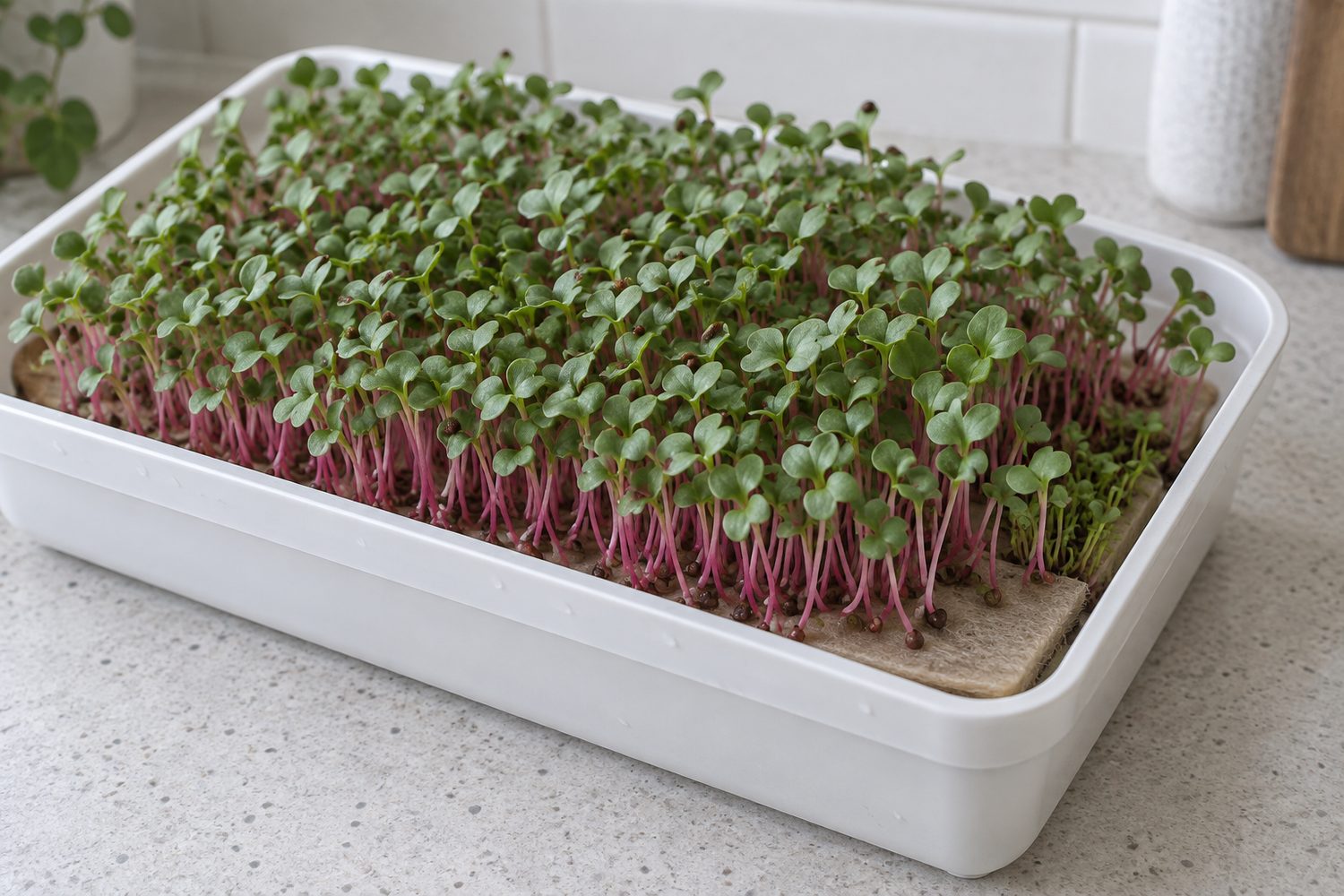
The trade is that you are buying into one maker's refills. Hamama's own page says its trays are "designed for use exclusively with patented Hamama Seed Quilts" (ceramic kit page). Refill Quilts cost $22 for 3, $59 for 9, $99 for 18 and $169 for 36, which works out to $7.33 down to $4.69 a Quilt, and the home page offers 3 Quilts a month for $17. Hamama claims each Quilt yields about 3.5 oz of greens; that is the seller's claim, not a trial, so weigh your own.
The tray is 12.5 x 6.5 x 2 inches, about 81 square inches, or roughly 0.41 of a standard 1020 tray. It fits a narrow counter or a deep windowsill.
Your week with Hamama: on day one you set the Quilt in the tray and add water, which takes a couple of minutes. Across the week you top up water and look in each morning. At harvest you cut with scissors. For a steady supply, start a second Quilt a few days after the first so one tray is always coming ready.
A DIY 1020 tray with a grow light: most control, open refills
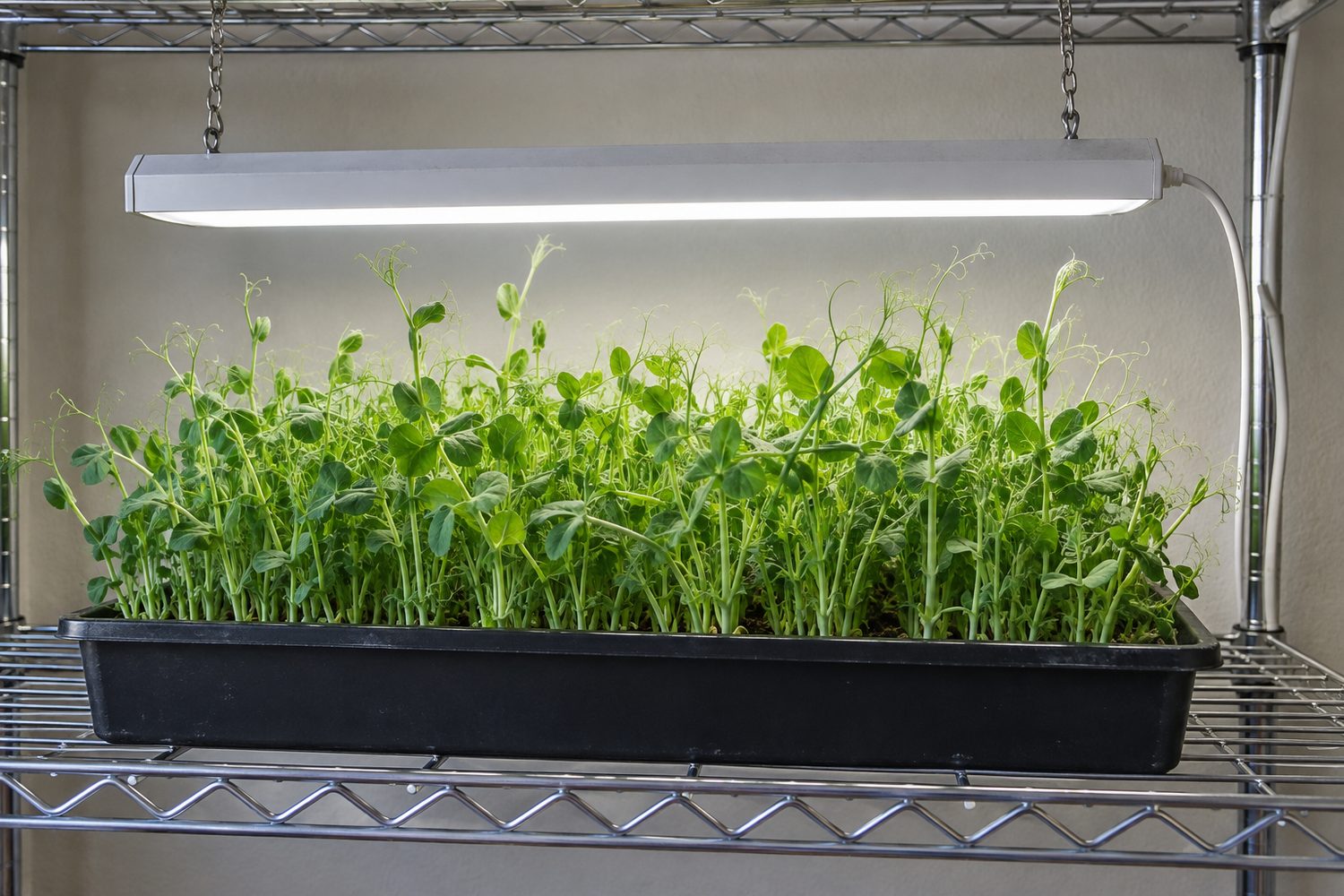
This is the setup to choose if you want to grow any crop from any seed company and keep the running cost low. You buy standard 1020 trays, a growing medium, seed, and a grow light, and nothing ties you to one brand.
From True Leaf Market on September 26, 2026:
- 1020 trays with drain holes: $15.47 for 5 ($3.09 a tray)
- 1020 trays without holes: $15.47 for 5, to sit underneath as a water tray
- Minute Soil compressed coconut coir: $10.38 for the 14 oz roll or $12.99 for the 26 oz roll (9 to 10 pucks)
- Rambo radish seed: $2.99 for a 4 g packet, $16.21 for 4 oz, $44.22 for 1 lb
A 5-pack of each tray type, the 26 oz coir roll and one 4 g radish packet come to $46.92 before a light, a shelf and shipping. That is a starter basket, not a finished working setup, because the light is the piece you still have to price. Once you are buying seed by the pound, Penn State's 10 g rate works out to about $0.97 of radish seed a tray at the 1 lb price. Penn State's own seeding rate is 10 to 15 g per 12 x 20 inch tray, so on a 1020 start in that range and adjust after your first harvest.
A 1020 is 20.5 by 10 1/8 inches at the top and 2 3/8 inches deep, per True Leaf's tray page, so measure the counter or shelf before the order goes in, and leave room above the tray for the light. The microgreens equipment list covers lights, shelves and the rest, and grow kits against DIY runs the cost comparison in detail.
Your week with a DIY tray: on day one, soak and rehydrate the coir, spread it in the tray with holes, sow the seed evenly, and cover it; that is the 3.3-minute job once you have done it a few times. For the first few days keep it covered and damp. Once the seedlings are up, run the light about 16 hours a day and water from below by adding water to the solid tray. Cut when the first true leaves appear. To keep the kitchen supplied, sow a fresh tray every week so a new one is always coming up behind the one you are eating.
A windowsill tray: the plain baseline
If you have a bright window and want to spend as little as possible, the home method the Associated Press described in January 2024 is the place to start. You need a dome-covered seed-starting tray, or a lidded takeout container about 2 inches deep with drainage holes poked in the bottom; a drip tray or rimmed baking sheet under it; seed-starting mix; a spray bottle; seeds; and a sunny window. A grow light and a small fan are recommended but optional. If you do add a light, run it 16 hours a day once the seeds have sprouted.
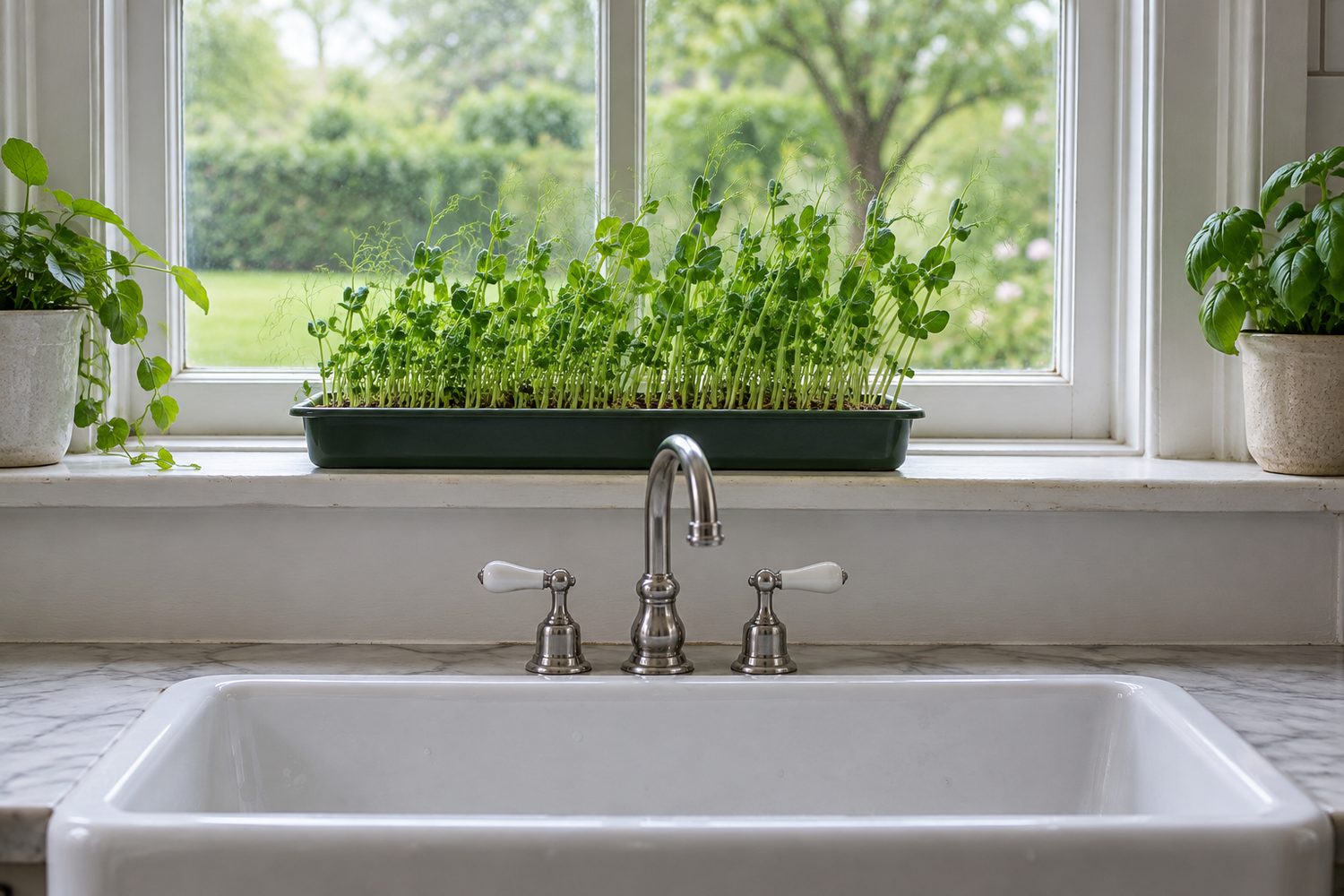
Penn State says much the same for home growers: natural light behind a window is generally enough, with a plant light as a supplement, and microgreens can be grown on a window ledge or a shelf in the kitchen. Penn State also calls microgreens a low-light crop, and its measured yields above came from a greenhouse with no added light. No source puts a number on how much a windowsill tray gives, and windows vary a lot by direction and season. Weigh your first tray, then your first tray in winter, and you will know whether your window is enough or whether a light belongs on the shopping list.
Your week on the windowsill: sow into moist mix and cover with the dome or lid. Mist daily, or add about half an inch of water to the drip tray. Once the seeds sprout, take the cover off and move the tray to your brightest window. Harvest with sharp scissors when the first true leaves appear.
A small pot or jar: for a garnish, not a salad
The smallest option is a single small container. True Leaf's Mini Microgreens Growing Kit was $6.99 to $7.89 on September 26, 2026, depending on variety, and holds a 4.5-inch-wide, 1.5-inch-deep container with a humidity lid, a soil puck, a mist sprayer and a pre-measured seed packet. Varieties include radish, mustard, salad mix, sunflower, arugula and pea shoots. That circle is about 16 square inches, or roughly 8 percent of a 1020, so expect a sprinkle for a sandwich rather than a weekly bowl. The page states no refill terms, so ask True Leaf whether ordinary seed and coir suit the container before you plan to reuse it.
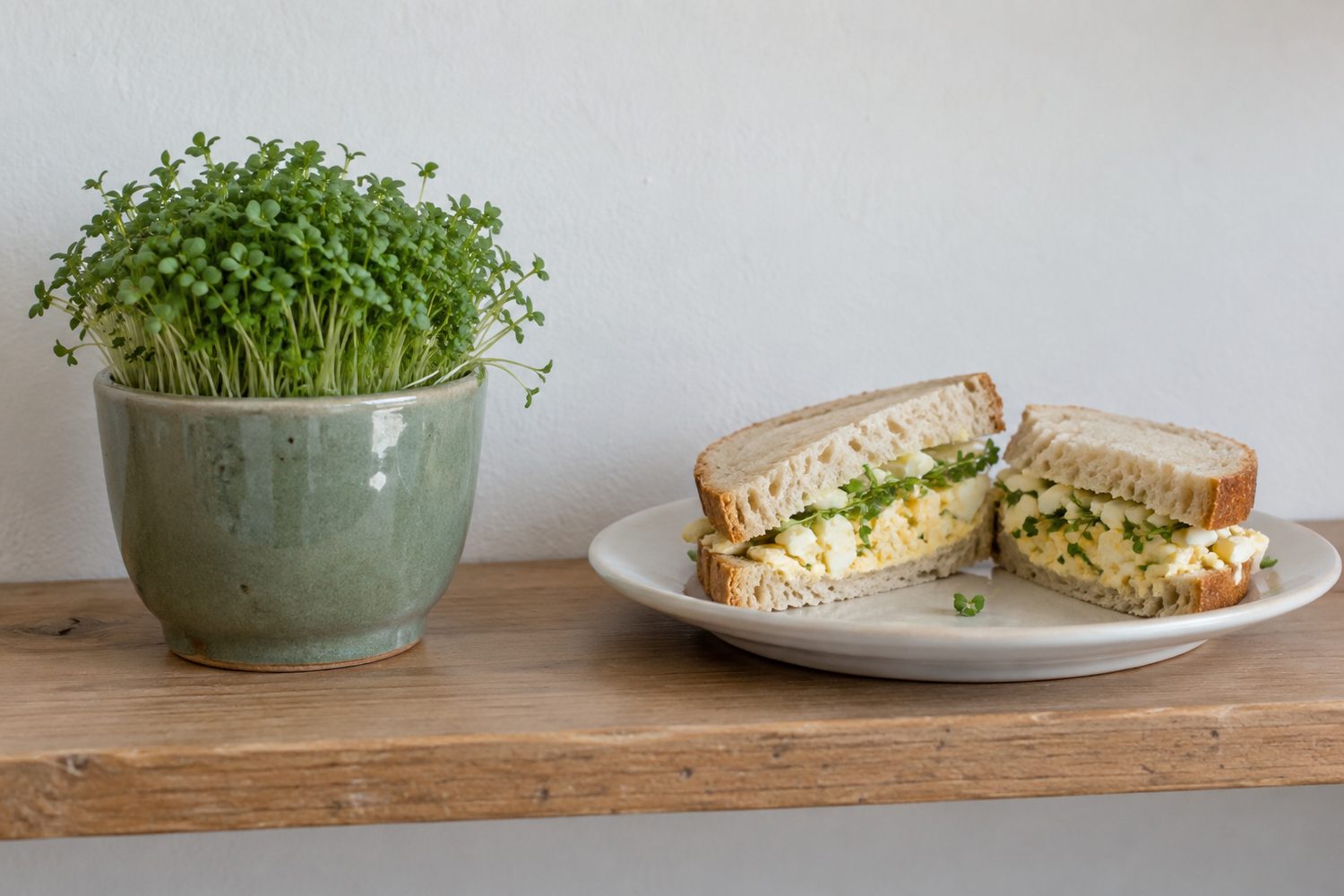
Back to the Roots also sells microgreens kits with a ceramic planter, but its kit with ceramic planter ($49.99) and its Variety 3-Pack ($39.99) were both sold out on September 26, 2026. Back to the Roots does sell a $9.99 Mighty Mix seed refill that it says covers 8 grows of its Ceramic kit, seed only with no growing medium listed, and it was sold out on September 26, 2026 as well.
For jars, sprouters and other ways to grow in a very small space, see small spaces and jars.
Which one fits your kitchen
Choose Hamama if you want the fewest decisions and are happy paying about $4.69 to $7.33 a tray to one maker for that. Choose a DIY 1020 with a light if you want any crop, the lowest running cost and a supply that does not depend on the weather, and you have a shelf where a light can sit above the tray. Choose the windowsill tray if you have a bright window and want to start this week with almost nothing to buy. Choose a small pot if you want a garnish and a feel for the routine before committing. The best microgreen growing kits compares more kits if none of these quite fits.
Questions kitchen growers ask
How many trays do I need for microgreens every week?
Penn State's crops ran on a two-week cycle, so plan on at least two trays going at once, sown a week apart. Weigh what one tray gives your household and add trays from there.
Can I use any seed in a Hamama tray?
Hamama says its trays are designed for use exclusively with its patented Seed Quilts. If you want to grow loose seed from any company, a 1020 tray or a takeout container is the setup built for that.
Is there a published yield for pea shoots?
A 2022 review in the Annals of Phytomedicine, quoting Ramya et al. (2022), lists peas at 40.56 g and green gram at 46.30 g per tray from 20 g of seed on cocopeat. It gives no tray size, so those figures cannot be set beside a 1020 or the Penn State tray. Weigh your own pea harvest and use that.
How much light does a tray need?
Virginia Cooperative Extension's SPES-756NP (January 30, 2026) gives a general range of 9 to 16 mol per square meter per day of total light, with arugula at the low end. A kitchen window has no printed rating, so if your trays come up thin and pale, add a light and run it about 16 hours a day.
Whichever you choose, the first tray teaches you most. Sow it, time it, weigh it, and let that number decide how many trays your kitchen needs.
Sources
Prices, stock and specifications are as the linked pages showed them on 2026-09-26.
- Penn State Extension's "Growing Microgreens"
- Hamama Microgreens Grow Kit
- FAQ
- ceramic kit page
- Refill Quilts
- home page
- True Leaf Market
- 1020 trays with drain holes
- 1020 trays without holes
- Minute Soil compressed coconut coir
- Rambo radish seed
- Associated Press
- natural light behind a window is generally enough
- a window ledge or a shelf in the kitchen
- Mini Microgreens Growing Kit
- kit with ceramic planter
- Variety 3-Pack
- $9.99 Mighty Mix seed refill
- Annals of Phytomedicine
- SPES-756NP
Keep reading
The journal
AeroGarden Bounty Review: Basic, Bounty and Elite Specs
This AeroGarden Bounty review compares the Basic, Bounty and Elite by watts, features, price, stock, running cost estimates, and warranty terms.
Read AeroGarden Bounty Review: Basic, Bounty and Elite SpecsThe journal
AeroGarden Farm Review: Specs, Price and What It Grows
This AeroGarden Farm review breaks down the Plus and Basic models, last known list prices, running costs, warranty terms, and owner-reported problems.
Read AeroGarden Farm Review: Specs, Price and What It GrowsThe journal
Is AeroGarden Still in Business? Ownership and Buying Facts
Is AeroGarden still in business? Yes, Scotts Miracle-Gro owns it. Learn the ownership facts, how to spot an impostor site, and which model fits your crop.
Read Is AeroGarden Still in Business? Ownership and Buying FactsThe journal
What Is an AeroGarden? Models, Pods, and Prices
What is an AeroGarden and what does it actually grow? See how the countertop hydroponic garden works, current models and prices, and who owns it today.
Read What Is an AeroGarden? Models, Pods, and Prices