Can Chinchillas and Rats Eat Microgreens?
Cal HewittPublished Checked
- chinchillas
- rats
- small pets
- animal feeding
- safety
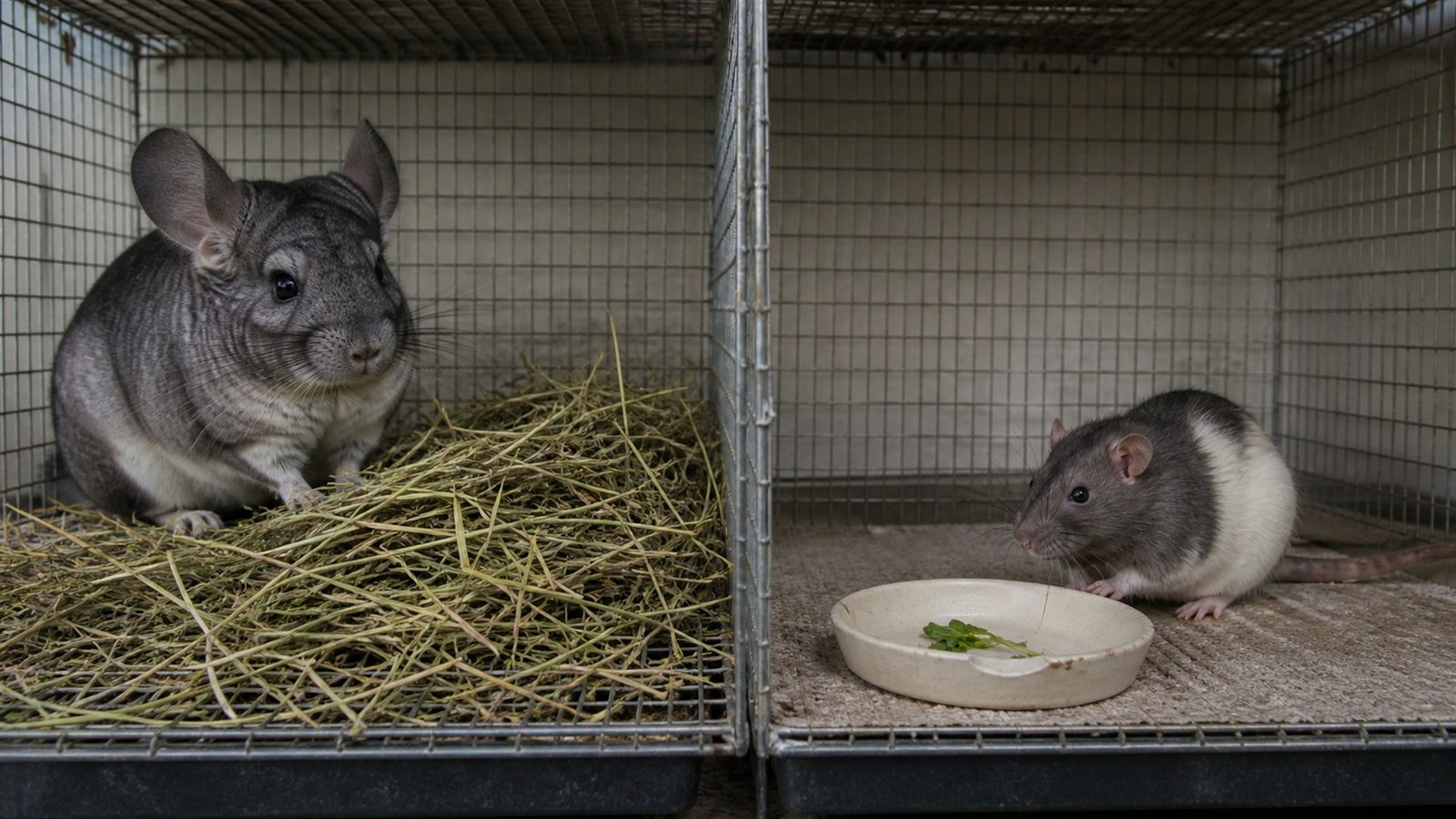
Rats, in tiny amounts, probably. Chinchillas, barely if at all. And the honest headline for both is that no veterinary or university source has evaluated microgreens as a class for either animal.
Keepers group these two as small caged pets, and that is exactly the mistake. A chinchilla is a strict herbivore and a hindgut fermenter built for high-fiber, low-energy plant material, with hay as the diet. A pet rat is an omnivore whose complete pellet or lab block is the base. They are not the same problem wearing different fur.
What to actually do
- Do not grow a tray for either animal. One tray is 83 to 145 days of a rat's entire non-pellet allowance and vastly more than a chinchilla's. Feed them from what you already grow, if at all.
- Keep the base diet intact. Hay free-choice for the chinchilla, a complete pellet or lab block for the rat. Microgreens displace nothing.
- For a rat, keep every extra combined inside 10% of the daily ration, and count the microgreen against that, not on top of it.
- For a chinchilla, keep anything fresh inside the existing tiny vegetable allowance, not in addition to it, and consider skipping it entirely. Treats are not a requirement for this animal.
- One named crop at a time, introduced slowly. Never a mixed clamshell, and never an unidentified green.
- Avoid high-calcium crops for chinchillas and Allium crops for both.
- Never feed the seed, the root mat or the growing medium. Seeds and grains are a named prohibition for chinchillas.
- Skip the trial completely for a chinchilla with prior gut disease, dental disease, unexplained soft stools, or that is pregnant or nursing. Bloat has been reported in lactating females two to three weeks after giving birth.
The portion is much smaller than a tray
The clearest way to see this is against the amount of green that actually exists on a tray. The median published yield is 7.055 ounces a 1020 tray, almost exactly 200 grams.
Now the rat's allowance, computed from published figures. A veterinary association gives 5 grams of complete feed per 100 grams of body weight daily, and a veterinary-reviewed care sheet says grains, vegetables, fruits, hay and treats together should be no more than 10% of the daily diet.
Hover or tap a row to highlight it.
| Rat | Complete feed a day | All extras at 10% | One 200 g tray is |
|---|---|---|---|
| 275 g female | 13.75 g | 1.375 g | 145 days of all extras |
| 480 g male | 24.0 g | 2.4 g | 83 days of all extras |
Read the last column carefully, because it is not a microgreen allowance. It is the whole budget for grains, fruit, hay and every treat combined. A microgreen is competing for a slice of one to two grams a day.
The chinchilla figure is smaller still and comes with a disagreement. One veterinary manual's care checklist gives about 1 teaspoon of fresh vegetables daily, with no body-weight qualifier attached. Another veterinary source is more conservative: hay free-choice as the main diet, treats are not required at all, and only an occasional low-calcium green if anything is offered.
Those two are not the same advice, and the gap between them is the whole answer. There is no veterinary basis in the opened material for claiming a cut microgreen is intrinsically poisonous to a chinchilla. There is strong reason to keep any fresh addition tiny, low in calcium, slow to introduce, and firmly secondary to hay.
So, growing a tray for either animal makes no sense as a feeding project. One tray is months of allowance for a rat and a great deal more than a chinchilla should ever see.
Why the chinchilla is the fragile one
Fresh greens are named by veterinary sources as a possible cause of soft feces in chinchillas, alongside sudden diet changes and high-carbohydrate diets. That is not a claim that greens are toxic. It is a claim that this animal's gut is easy to upset.
The mechanism that makes it serious is a cycle, not a poisoning. The chinchilla stops eating, its normal gut bacteria change, gas-producing bacteria may overgrow, and it becomes less willing to eat still. Gas can accumulate in static bowel loops within two to four hours. Veterinary sources call gastrointestinal stasis potentially life-threatening and give severe bloat a poor prognosis.
Moisture is the mechanism keepers blame, and it is not established. What the sources actually support is that sudden change and inappropriate fresh greens can cause soft feces, and that reduced intake and dysbiosis drive the stasis cycle. Nobody has separated water from fiber, sugar and plant type in a controlled study, so "microgreens are too wet" is a plausible story rather than a demonstrated one.
And do not import an allowance from the guinea pig. Both are hindgut fermenters and that is not a transfer license. No head-to-head tolerance comparison exists, and the chinchilla-specific sources are markedly more cautious about fresh food.
Signs to stop on
Chinchilla, and these are an emergency. Eating less or stopping altogether, fewer or smaller or soft droppings, lethargy, dehydration, abdominal swelling or pain, stretching or rolling, weakness, lying on one side, or labored breathing. Call an exotic veterinarian immediately for a chinchilla that has stopped eating or stopped passing droppings. Do not wait to see how a feeding experiment turns out.
Rat. Lethargy, hiding or sleeping more, eating or drinking less, weight loss, changed behavior, diarrhea, breathing trouble or choking. Remove the food and contact a veterinarian promptly, and treat any suspected toxic ingestion as urgent.
The crop table
Nothing is rated safe for either animal as a microgreen, because no source evaluated one.
Hover or tap a row to highlight it.
| Chinchilla | Rat | |
|---|---|---|
| Any microgreen, as a class | NOT ESTABLISHED | NOT ESTABLISHED |
| High-calcium crops such as kale and parsley | CAUTION, named for avoidance or strict limit in mature form | No calcium-specific caution found |
| Allium crops: onion, leek, chives | CAUTION to avoid, no rodent-specific microgreen evidence | AVOID, a care sheet names onion and garlic among foods not to offer |
| Seeds, nuts and grains | UNSAFE, named prohibition | Part of the 10% extras at most, never the base |
| Grass shoots: wheatgrass, barley grass, popcorn shoots | NOT ESTABLISHED | NOT ESTABLISHED |
| A mixed clamshell of unnamed microgreens | CAUTION, identity, calcium and amount are all uncontrolled | CAUTION, composition unknown |
The calcium point is the one that is specifically chinchilla. Veterinary guidance names high-calcium greens including kale and parsley for avoidance or strict limitation, and links calcium to urinary stone risk. That caution is written about mature vegetables, and whether a microgreen of the same crop carries the same calcium load is unpublished, so it stands as a caution rather than a measured verdict.
The mixed pack is worse than any single crop. A retail clamshell can contain several types, may include kale, and gives you no way to control identity, calcium, quantity or introduction rate. For a chinchilla in particular, do not use one.
Where the keeper communities and the veterinary sources disagree
On chinchillas, the community is stricter than the veterinarians. A large keeper thread repeats a flat "no fruit or vegetables" position, which conflicts with a veterinary manual's measured allowance of about a teaspoon of fresh vegetables daily. The veterinary sources govern, and because they disagree with each other, caution is as far as the evidence reaches.
On rats, the community is looser than the sources. Contributors in a rat-keeping thread dismiss onion and chocolate hazards, while a veterinary-reviewed care sheet says not to offer onion or garlic and an animal welfare charity says chocolate's theobromine is poisonous to rodents. The care and welfare sources govern. A forum consensus is not a dose study in either direction.
What nobody has measured
- Any microgreen fed to a chinchilla or a pet rat, at any dose, with an outcome recorded. Not one crop, for either animal.
- A fresh-greens percentage of daily intake for chinchillas. The teaspoon figure carries no body-weight denominator and cannot be scaled.
- Whether a microgreen carries the same calcium load as the mature crop, which is the entire basis of the chinchilla kale and parsley caution.
- Whether moisture is the actual mechanism behind fresh-greens digestive upset, as opposed to fiber, sugar or plant type.
- Any comparison between chinchilla and guinea pig tolerance, despite both being hindgut fermenters.
- Any commercial fresh microgreen product sold for either animal. The products found are human food; the two priced examples were a $5.00 two-ounce mix and a $5.99 blend, neither a pet product.
Terms on this page
Tap a term to see what it means.
Hindgut fermenter. An animal that ferments plant fiber in the cecum and colon rather than in a forestomach. Chinchillas are one, which is why fiber and steady intake matter so much.
Sources
Opened 2026-08-12. Every source below concerns mature foods or whole diets. None of them evaluated a microgreen, so read them as background rather than as a verdict.
- Merck Veterinary Manual on chinchillas - the professional page, giving the gastrointestinal signs, gas accumulating in static bowel loops within two to four hours, sudden diet change and overeating as causes, inappropriate feeding of fresh greens among the possible causes of soft feces, and bloat reported in lactating females two to three weeks postpartum.
- Merck on diet for a chinchilla - the owner-facing diet, the named high-calcium cautions including kale and parsley, and the daily fresh-food guidance. Its care checklist is the source of the roughly one teaspoon of fresh vegetables a day.
- VCA Hospitals on feeding chinchillas - hay as the free-choice main diet, the prohibition on seeds, nuts and grains, that treats are not required, and the allowance of only an occasional low-calcium green. This is the more conservative of the two veterinary positions quoted above.
- VCA on chinchilla health conditions - the stasis and bloat mechanism, that it is potentially life-threatening, and the poor prognosis of severe bloat.
- AZA Nutrition Advisory Group on hindgut fermenters - chinchillas as strict herbivorous hindgut fermenters adapted to high-fiber food, and the grouping with rabbits and guinea pigs that this page declines to treat as a transfer license.
- Canadian Veterinary Medical Association on pet rat health - the identification of the pet rat as Rattus norvegicus, its omnivore status, commercial pellets as the staple, and the 5 grams of complete feed per 100 grams of body weight figure used in the table above.
- PetMD rat care sheet - the statement that grains, vegetables, fruits, hay and treats together should be no more than 10% of the daily diet, which is the other input to the table, plus the list of foods not to offer including onion and garlic. This is a veterinary-reviewed care sheet rather than a primary source and is treated as such.
- NSW Department of Education on rat food and water - pellets or cubes of at least 16% protein as the base, the named suitable and no-feed foods, and that lactating females need at least four times normal food and water.
- University of Queensland veterinary service on rat care - the warning that pet-shop muesli mixes are not balanced, and the illness signs to act on.
- RSPCA on things poisonous to pet rats - theobromine and chocolate as poisonous to rodents, against which the forum discussion below is measured.
- PetMD on what chinchillas eat - the life-stage notes on pellets and alfalfa hay for growth, pregnancy and nursing, and the no-feed list. A care sheet rather than a primary source.
- National Academies, Nutrient Requirements of the Laboratory Rat - the maintenance, pregnancy and lactation intake assumptions, which are laboratory total-ration figures and not a treat schedule.
- Retail examples, recorded as practice and used only to show that no product is sold for these animals: a two-ounce microgreen mix at $5.00, a supermarket blend at $5.99, and a third mixed pack. All are human food.
- Keeper discussion, recorded as practice and not as evidence: r/chinchilla on fresh vegetables, where the community position is stricter than the veterinary one, and r/RATS on food myths, where it is looser.
Keep reading
Animals and microgreens
Can Alpacas and Llamas Eat Microgreens?
It would take 50 to 90 trays to supply one alpaca's dry matter for a single day, and up to 250 for a llama. That settles the feed question, and leaves identity and suddenness as the only real risks.
Read Can Alpacas and Llamas Eat Microgreens?Animals and microgreens
Can Bearded Dragons Eat Microgreens?
Probably, as part of the salad. No study has fed a microgreen to a bearded dragon, the one vet-reviewed teaspoon dose has nothing behind it, and calcium to phosphorus is unmeasured for most crops.
Read Can Bearded Dragons Eat Microgreens?Animals and microgreens
Can Cats Eat Microgreens?
Some yes, four unsafe. Parsley is ASPCA-listed toxic to cats and the alliums have a published feline dose, while greens are enrichment for a cat rather than nutrition.
Read Can Cats Eat Microgreens?Animals and microgreens
Can Chickens Eat Microgreens?
Yes, as a treat inside the 10 percent ceiling Cornell sets for all scraps combined. Not one microgreen crop has a chicken-specific safety study behind it, and the 15 percent figure in circulation is unsourced.
Read Can Chickens Eat Microgreens?