Can Ducks and Quail Eat Microgreens?
Cal HewittPublished Checked
- ducks
- quail
- poultry
- animal feeding
- safety
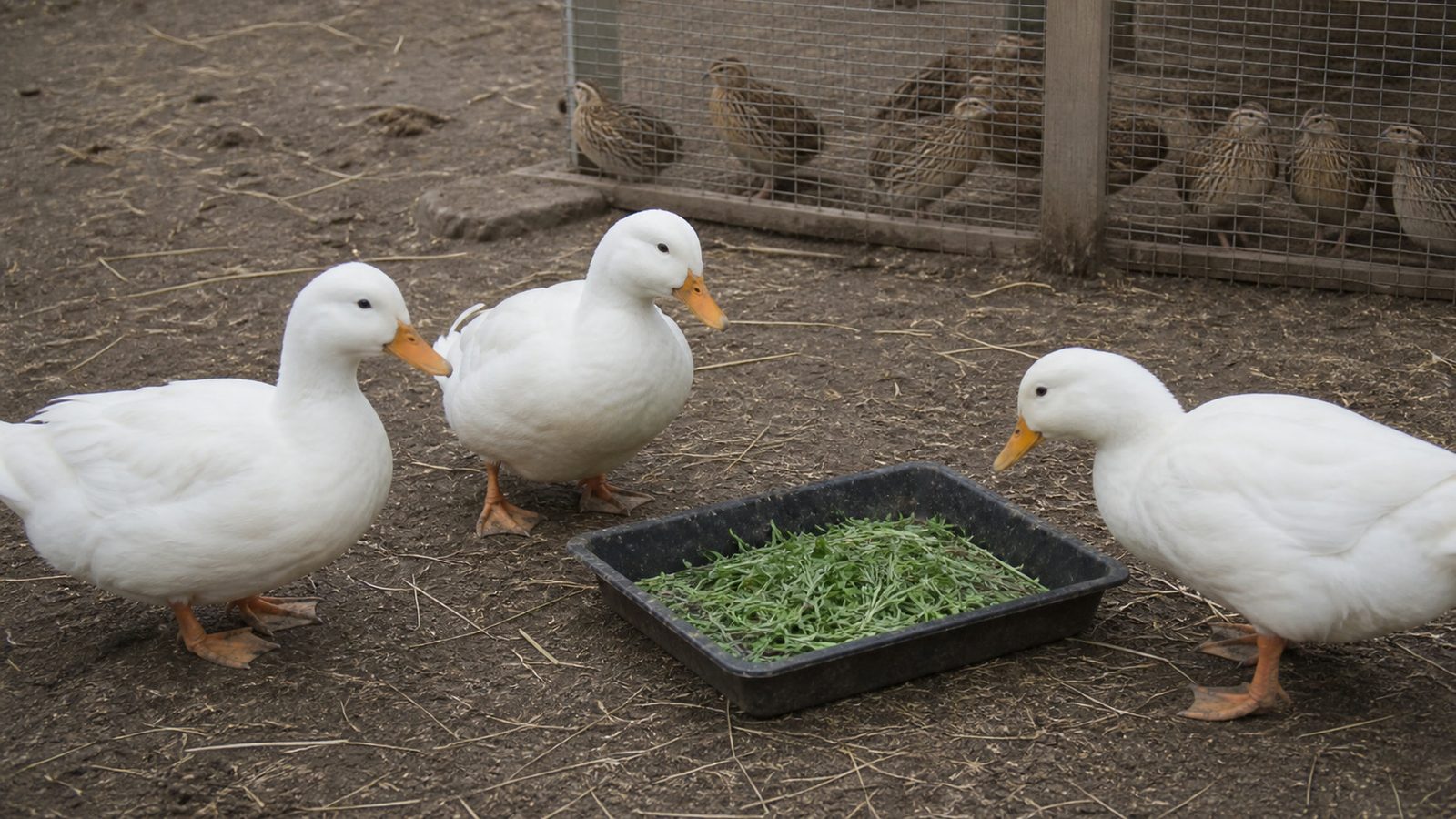
Probably, in small amounts, and nobody has established it. The thing to get right is not borrowing the answer from a chicken.
Ducks and quail get fed on chicken advice constantly, and on one point that matters it is measurably wrong: a duckling needs close to twice the niacin a chick does.
What to actually do
- Keep complete feed as the diet. Waterfowl ration for ducks, a species-appropriate game bird ration for quail.
- Treat microgreens as an occasional small treat, because no source supports any specific quantity for either bird.
- Do not apply the 10 percent chicken ceiling. It is correctly sourced for chickens and it carries no duck or quail authority.
- Do not run ducklings on chick feed. The niacin requirement is nearly double and it is the one documented divergence here.
- Go easiest on the brassicas, on the strength of a rapeseed meal trial rather than any microgreen evidence.
- Introduce anything new slowly and watch the bird, which is the general advice in the absence of specific advice.
- If you see appetite loss, weakness, bowed legs or swollen hocks in a duckling, that is a veterinary matter, and it is about the ration rather than the greens.
The chicken ceiling does not transfer
Cornell's 10 percent ceiling for all scraps combined is a chicken figure. It is a real figure with a real source.
It has no duck authority and no quail authority.
No veterinary or extension source opened for this page gives a share of daily intake that may be fresh greens or treats, for either bird. Cornell says foraging ducks can eat green plants but that output is low without supplemental feed, and sets no share. The bobwhite quail ration tables are for complete diets and give no treat allowance at all.
So, the answer to "what percentage can they have" is NOT ESTABLISHED for both species, and the chicken figure is exactly the number most keepers reach for instead.
Nor is there a portion. No source gives grams of fresh greens per bird or per kilogram of body weight for either species. A Washington State extension estimate that adult California quail eat half an ounce to an ounce of feed a day is about a wild species and a complete diet, not a microgreen dose.
Niacin: the one place the two birds genuinely split
This is the divergence that makes borrowing chicken advice risky, and it is documented.
Hover or tap a row to highlight it.
| Bird | Requirement | Source |
|---|---|---|
| Ducks | 55 mg/kg of feed, with 55 to 70 described as satisfactory for ducks, geese and turkeys | Merck, and the Pekin table at every listed stage |
| Chickens | At least 30 mg/kg | Merck |
| Quail (bobwhite) | 30 mg/kg starter | The bobwhite ration table |
A duckling needs close to twice what a chick does. A quail chick needs the same as a chick. So on this one point quail can follow poultry norms and ducks cannot, and a keeper running both on one bag of chick feed is underfeeding one of them.
Deficiency signs in ducks are appetite loss, slow growth, weakness, diarrhea, enlarged hock joints and bowed legs. Merck publishes a time-to-sign figure for deficient chicks at about two weeks and does not publish one for ducklings.
Greens are not the fix. Nothing establishes that any named microgreen prevents, treats or worsens duck niacin deficiency. Use a complete waterfowl ration and an avian vet. Niacin matters here because it is the reason not to treat a duck as a chicken, not because a tray of greens is part of the answer.
Crop by crop, there is nothing to report
No source located addresses any named crop as a cut microgreen fed to domestic ducks or to kept quail. That covers every brassica, every legume, the grains, the herbs, the alliums and the other greens. Zero.
What exists instead is three things that are not that:
- Forage descriptions. Cornell names "green plants" for ducks without naming a species.
- Complete-feed research on a different material. The one relevant duck brassica trial fed Sansui ducklings 15 or 20 percent fermented rapeseed MEAL, carrying 3.25 or 4.34 micromoles of glucosinolates per gram of complete feed, from day 15 to 35. Feed efficiency was poorer at both, and 20 percent caused intestinal damage. That is a meal at a fifth of the total diet, not a garnish of cut greens, and it converts to nothing. Treat it as a lead: the publisher blocked the full text and only the abstract was readable.
- Plant chemistry. Glucosinolates have been measured in broccoli, kale, radish, cabbage and kohlrabi microgreens. Measuring a compound in a plant is not a feeding threshold for a bird.
So, no crop is established for either bird. Nobody has looked, which is not the same as anybody having found a problem. Feed a small amount of one identified crop, keep the complete feed in front of them, and watch the bird.
What that means in practice
It does not mean do not feed them. Ducks forage green plants and quail eat plant material; neither is being warned off greens by any source. It means nobody can tell you a quantity, a frequency or a crop, so the caution has to come from the general poultry rule that treats stay small and complete feed stays the diet.
The brassicas are the group to be most conservative with, on the strength of the rapeseed trial and the plant chemistry rather than on any duck or quail microgreen result. That is a reason for a small portion, not a reason to call any crop unsafe.
The authoritative sources do make the distinction
Cornell says ducks need the same nutrients as chickens but in slightly different amounts, and extension material specifically identifies the higher duck niacin requirement. So, if a page you are reading treats a duck as a chicken outright, it is not following the sources it could have used.
What nobody has measured
- Any named microgreen fed to a duck or a quail, for any outcome. Not one crop, not once.
- A safe share of daily intake as fresh greens, for either species.
- A portion in grams, per bird or per kilogram of body weight.
- Any glucosinolate threshold for either bird from cut brassica microgreens.
- A time to deficiency sign in ducklings, which Merck publishes for chicks and not for ducks.
Terms on this page
Tap a term to see what it means.
Complete feed. A formulated ration supplying the full nutrient requirement, which is what these birds should mostly eat.
Sources
Opened 2026-08-12.
- Merck Veterinary Manual, vitamin deficiencies in poultry - that 55 to 70 mg of niacin per kg of feed is satisfactory for ducks, geese and turkeys against at least 30 mg/kg for chickens, the duck deficiency signs including enlarged tibiotarsal joints and bowed legs, and the roughly two week time to the oral lesion in deficient chicks with no equivalent figure published for ducklings.
- Merck Veterinary Manual, nutrient requirements of Pekin ducks - the NRC table giving 22 percent protein and 55 mg niacin per kg for ducklings, 16 percent and 55 mg for growers, and 15 percent protein with 2.75 percent calcium and 55 mg for breeders.
- Cornell Duck Research Laboratory, duck nutrition - that foraging ducks can consume green plants while output is low without supplemental feed, that no share of intake is set, and that ducks need the same nutrients as chickens in slightly different amounts.
- NC State Extension, feeding ducks - the stage feeding sequence, including breeder layer feed beginning a month before the first egg.
- Poultry Extension, feeding ducks intended for consumption - the extension material identifying the higher duck niacin requirement.
- Washington State University Extension, quail in the garden - the estimate that adult California quail eat half an ounce to an ounce of feed a day, reported here as a wild-species context and explicitly not as a domestic quail instruction or a microgreen dose.
- Duck fermented rapeseed meal trial, PubMed record - Sansui ducklings fed 15 or 20 percent fermented rapeseed meal at 3.25 or 4.34 micromoles of glucosinolates per gram of complete feed from day 15 to 35, with poorer feed efficiency at both levels and intestinal damage at 20 percent. The full text was blocked by an anti-bot page and only the abstract was readable, so it is reported here as a lead pending full-text review rather than as a settled figure.
- Brassica microgreen glucosinolate study, PubMed record - measurement of glucosinolates in brassica microgreens including broccoli, kale, radish, cabbage and kohlrabi. Also blocked by an anti-bot page, so no numerical result from it is used on this page.
Keep reading
Animals and microgreens
Can Chickens Eat Microgreens?
Yes, as a treat inside the 10 percent ceiling Cornell sets for all scraps combined. Not one microgreen crop has a chicken-specific safety study behind it, and the 15 percent figure in circulation is unsourced.
Read Can Chickens Eat Microgreens?Animals and microgreens
Can Alpacas and Llamas Eat Microgreens?
It would take 50 to 90 trays to supply one alpaca's dry matter for a single day, and up to 250 for a llama. That settles the feed question, and leaves identity and suddenness as the only real risks.
Read Can Alpacas and Llamas Eat Microgreens?Animals and microgreens
Can Bearded Dragons Eat Microgreens?
Probably, as part of the salad. No study has fed a microgreen to a bearded dragon, the one vet-reviewed teaspoon dose has nothing behind it, and calcium to phosphorus is unmeasured for most crops.
Read Can Bearded Dragons Eat Microgreens?Animals and microgreens
Can Cats Eat Microgreens?
Some yes, four unsafe. Parsley is ASPCA-listed toxic to cats and the alliums have a published feline dose, while greens are enrichment for a cat rather than nutrition.
Read Can Cats Eat Microgreens?