How to harvest microgreens: where to cut, with what, and how to keep it clean
Cal HewittPublished Checked
- harvest
- food safety
- method
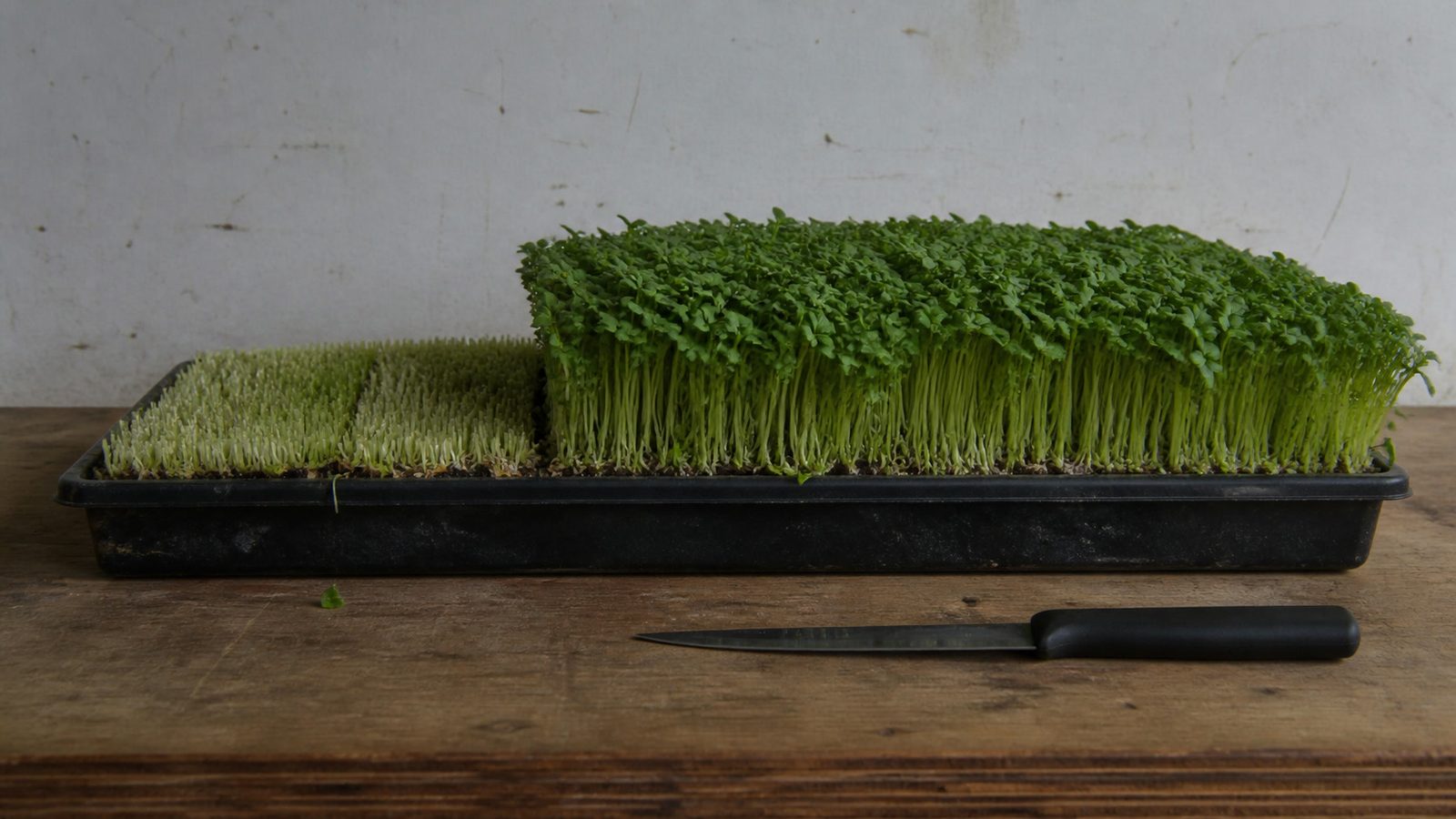
Cut higher than you probably do, and give the blade a real clearance rather than shaving the medium. The usual instruction, "cut just above the soil", is missing the number that matters. Two of four pages examined for this topic gave any clearance at all, at about a quarter inch and 0.5 to 1 cm. The other two said "just above" and left it there.
That matters more than it sounds, because cut height is a measured food-safety control. A Texas A&M study cut broccoli and clover at 2.5 cm and 6.5 cm above the soil and found significantly lower bacterial counts at the higher cut. The same study did not report the weight surrendered, and nobody since has.
So, the one decision that has been shown to change the microbiology of the crop is the one decision with no cost attached to it. Every grower makes it several times a week by eye.
Three things carry this page:
- Cut height trades weight against contamination, and only one side of that trade has ever been measured.
- The safest tested height is taller than some crops grow. A separate trial measured broccoli microgreens at 6.81 to 7.81 cm tall. Cutting those at 6.5 cm above the medium would leave 0.3 to 1.3 cm of product.
- Hard spinning damages the crop. A USDA study found centrifugal drying caused severe damage, or failed to remove the water, and shortened shelf life. Gentle forced-air drying did better.
What to actually do
- Pick a visible clearance and keep it, rather than scraping the surface. Higher cuts measurably lowered bacterial counts in the one study that looked.
- Know what the clearance costs you. Nobody has published it, so weigh a tray cut low and one cut high on your own bench once, and you will know more than the literature does.
- Leave the roots, the medium and the seed coats in the tray. The seed coat is where the measured pathogen load sits.
- Use a clean sharp blade or scissors, and keep it cleanable. Sanitize at the start and end of the day and after any soil contact.
- Wash your hands properly, and do not treat gloves as a substitute.
- Cut straight into a clean food-contact container, not onto a bench.
- Do not spin it hard. Gentle forced-air drying beat centrifugal drying in the one study that measured it.
- Refrigerate promptly, and take the storage time from the crop's own entry rather than a blanket figure.
What the sources actually specify
There are three real specifications in print, and they do not describe the same thing.
Hover or tap a row to highlight it.
| Source | Figure | What it specifies |
|---|---|---|
| CanadaGAP definition | 3 to 6 cm | The total length of the cut product, above soil, no roots or seed portion |
| Xiao and colleagues, 2015 | 1 cm above the root and substrate | Where the edible portion was defined to begin, for a food-safety experiment |
| Bryant, Texas A&M, 2017 | 2.5 cm against 6.5 cm above soil | Two cut heights compared for bacterial count. The higher one won |
Read those as three different questions. One is a product-length definition, one is a research sampling rule, and one is the only actual comparison. None of them is a recommendation you can lift straight onto your own tray.
What is unanimous is the direction. Maryland Extension says clean sharp scissors or a knife just above the media. North Carolina's produce safety fact sheet says cut high enough above the growing media to prevent substrate contamination, and leave the roots behind. CanadaGAP's definition excludes roots and seed portion outright.
The arithmetic nobody has done
Here are two published numbers that have never been put side by side.
The Texas A&M study found lower bacterial counts at 6.5 cm above the soil. A separate 2025 density trial measured broccoli microgreen height at 6.81 to 7.81 cm.
Cut a 7 cm crop at 6.5 cm and you have harvested about half a centimeter of it.
Two honest caveats. They are different studies with different crops, cultivars, densities and conditions, so this is not a contradiction and neither paper is wrong. And the taller crop in the Texas A&M work presumably grew taller than the broccoli in the density trial.
But the point survives both caveats: the cut-height decision is bounded by how tall the crop actually is, and for a short crop the safer height simply is not available. That is the trade-off in its sharpest form, and no source states it, because no source publishes the two numbers together.
Which is why the yield question is not academic. A study that reports what each centimeter of clearance costs in saleable grams, by crop, would let a grower price the safety margin instead of guessing at it. It has not been run.
Why the height changes the microbiology
The low part of the tray is the contaminated part. Cut low and you bring the lower hypocotyl, roots, attached medium and seed coats into the handled product. Seed coats specifically are where the pathogen load sits: in 2015 radish microgreens grown from inoculated seed, E. coli O157:H7 measured 3.5 log CFU per gram on the seed coats.
So "leave the roots behind" is not tidiness. It is the entire mechanism, and it is why every food-safety source states it and no source states a millimeter.
The tool, and what has never been compared
What is documented is thin and practical. Maryland says clean sharp scissors or a knife. North Carolina recommends hand cutting with scissors on soilless media and allows an electric knife or trimmer on seeding mats. NASA describes scissors and hand bagging as the Earth-standard method, with commercial automatic and robotic harvesting also in use, and tested three cutter designs in microgravity including a counter-rotating one; its 2022 report says effectiveness was still being assessed.
Nobody has compared knife against scissors against a powered cutter on cut quality, speed or crop damage on the same crop. And nobody has tested whether a clean cut outlasts a crushed one in the pack, which is the specific claim several retail pages make. The food-safety reason to keep tools sharp and undamaged is in FDA guidance for fresh herbs. The shelf-life reason is an assertion.
What growers actually use: in a 2021 survey, 56 percent hand cut with scissors or a knife.
And nobody has timed it. No published study reports how long a 1020 tray takes to harvest. One retailer guide claims 60 to 90 seconds, with no tray dimensions, crop, labor definition or data behind it.
Hygiene at the cut
This part is regulated rather than debated. Under 21 CFR 112.123, food-contact equipment and tools must be adequately cleanable and maintained, inspected and cleaned, and sanitized as frequently as reasonably necessary to prevent contamination.
The rule does not say "between every tray." It says as often as is reasonably necessary, which is a risk judgment rather than a schedule. FDA's fresh-herb guidance gives usable triggers: sanitize hand tools at the start and end of the day, when returning to work, after moving between growing areas, and after any potential contamination such as contact with soil.
Hand washing is not optional and gloves do not replace it. Wash before starting and before returning, before putting gloves on, after the toilet, after eating or smoking, and after contact with animals or waste.
Cut into something clean. A cleanable sanitized food-contact container or a single-use food-contact pack, such as a slotted clamshell or a bag. Not the bench, not the floor, and not a tray that has been sitting on medium.
One thing worth stating plainly: no outbreak investigation has ever identified the cutting step as the transfer event for microgreens. A 2021 review reported no known outbreaks linked to microgreens at that time, alongside US and Canadian recalls since 2016. A recall does not locate where contamination happened. The hygiene case here rests on mechanism and regulation, not on a traced event, and it is stronger stated that way than dressed up.
Wet or dry, and what happens next
Whether to cut a wet or dry canopy is unresolved and the guidance actively conflicts. One grower guide says let top-watered greens dry before cutting. Another says do not wash before storage. Maryland Extension tells home growers to rinse, pat dry, and use immediately or refrigerate. No study has assigned pre-harvest watering and compared wet against dry cutting, so there is no defensible number of hours to withhold.
What is measured is what happens after. A 2013 USDA study on removing water from cut microgreens found centrifugal drying caused severe damage, or failed to remove the water effectively, and shortened shelf life. Gentle forced-air drying performed better.
That is the most actionable finding on this page. It does not condemn every low-force spinner, but it rules out treating a hard spin as harmless, and "wash then spin" appears in guidance and practice constantly.
Then cool it. Minimal handling into a clean pack, then refrigeration. In the same 2021 survey, 52 percent used a refrigerator or cooler and the average time from cut to sale was 14.6 hours, with a standard deviation of 14.1, which is a description of what growers do rather than evidence that it is safe. No cut-to-cool experiment has been run on this crop.
And be careful with a single storage figure. Maryland says refrigerate for up to 10 days. Across the 38 crops with a published shelf life, the figure runs from 1 day to 21: 17 of them top out below 10 days and 21 reach 10 or more. Garden cress publishes 2 to 3 days and buckwheat publishes 21. So, a blanket ten is wrong in both directions on most crops. Take the figure from your own crop, and see how to store microgreens for what is actually known about temperature.
Staged cutting
Nobody knows, and the practice sources contradict each other. One says an uncut section may carry on for another day or two. Another says a tray can be cut in batches every few days but is generally best taken all at once at peak.
No study measures what staged cutting does to the remaining canopy's quality or safety, to the first cut's shelf life, or to total yield. If you do it, you are running the experiment.
What nobody has measured
- Yield lost per centimeter of cut height, on any crop. The safety side has been measured and the cost side has not.
- Knife against scissors against a powered cutter, on speed, cut quality or damage.
- Whether a clean cut outlasts a crushed one in the pack.
- How long a 1020 tray takes to harvest, in any published time study.
- Whether cutting a wet canopy matters, and how long before harvest to stop watering.
- How long the crop can sit at room temperature after cutting before it costs something.
- Whether staged cutting works, in any direction.
- Where contamination actually enters on this crop. No outbreak has been traced to the harvest step, or to any other step.
Terms on this page
Tap a term to see what it means.
Hypocotyl. The stem between root and seed leaves. Its lower end is the part nearest the medium and the part a low cut brings into the product.
Sources
Opened 2026-08-12. The shelf-life spread was compiled crop by crop from the published per-crop figures and recounted for this page on 2026-08-12.
- Bryant, Texas A&M dissertation, 2017 - broccoli and clover cut at 2.5 cm against 6.5 cm above soil, with significantly lower bacterial counts at the higher cut and no reported yield cost.
- Xiao and colleagues, food-safety study of radish microgreens, 2015 (PDF) - the edible portion defined as cotyledon plus hypocotyl cut 1 cm above the root and substrate, the 3.5 log CFU per gram of E. coli O157:H7 measured on seed coats, and the overhead against bottom irrigation comparison.
- CanadaGAP, scope FAQ - cut microgreens as a product about 3 to 6 cm long, cut above soil, without roots or seed portion.
- University of Maryland Extension, growing microgreens and baby greens indoors - clean sharp scissors or a knife just above the media, and the rinse, pat dry and refrigerate up to 10 days instruction.
- North Carolina produce safety fact sheet for microgreens - cutting high enough above the growing media to prevent substrate contamination, leaving roots behind, scissors on soilless media and an electric knife or trimmer on mats, the hand-washing triggers, and cleanable or single-use packaging.
- 21 CFR 112.123, equipment and tools - that food-contact tools must be adequately cleanable, maintained, inspected, cleaned, and sanitized as frequently as reasonably necessary.
- FDA, guidance for fresh herbs (PDF) - the sanitizing triggers for hand tools and the requirement for cleanable containers.
- FDA, FSMA Produce Safety Rule and 21 CFR 112.112 - hygienic handling, worker training, and the requirement not to harvest produce likely to be contaminated.
- NASA, harvesting microgreens in microgravity, 2022 - scissors and hand bagging as the Earth-standard method, and the three cutter designs tested with effectiveness still being assessed.
- Food Protection Trends, characterization of microgreen growing operations, 2021 - 56 percent hand cutting with scissors or a knife, 52 percent using a refrigerator or cooler, an average 14.6 plus or minus 14.1 hours from cut to sale across 92 respondents, and no known microgreen outbreaks at that time alongside recalls since 2016.
- Balik and Yildiz-Dasgan, six-crop density trial, 2025 (PDF) - the broccoli microgreen height of 6.81 to 7.81 cm used in the cut-height arithmetic above. A different study under different conditions from the Texas A&M work.
- USDA Agricultural Research Service, dewatering cut microgreens, 2013 - that centrifugal drying caused severe damage or failed to remove the water effectively and shortened shelf life, while gentle forced-air drying performed better. Abstract record.
- Practice guides used as practice, and the source of the four-page clearance audit: Aquager's harvest guide, which gives about a quarter inch of clearance and the unverified 60 to 90 second tray claim, BageechaBox, which gives 0.5 to 1 cm and says an uncut section may continue a day or two, and The Grow Network, which says to let top-watered greens dry before cutting and that a tray is generally best harvested completely at peak.
Keep reading
Growing guides
Do microgreens regrow after cutting?
A normal microgreen cut removes the growing point, so there is usually nothing left to regrow from. Roots do not make a new shoot; a surviving node does. The one documented path takes 3 to 4 weeks, about twice as long as sowing a fresh tray.
Read Do microgreens regrow after cutting?Growing guides
How fast do microgreens grow? Take the number from your crop, not from a general range
Of the 61 microgreen crops that publish a harvest range, only 15 fit entirely inside the usual 7 to 14 days. The real spread is 4 to 35 days, and the shelf cost between the fastest and slowest crop is 36.6-fold.
Read How fast do microgreens grow? Take the number from your crop, not from a general rangeGrowing guides
How to buy microgreen seed, and what the label cannot tell you
Pathogen testing of microgreen seed is a supplier practice, not a rule, food grade is not a certification, and organic makes no measured difference to the microbes. What matters is a traceable, explicitly untreated lot, and the six ways a seed search goes wrong.
Read How to buy microgreen seed, and what the label cannot tell youGrowing guides
Save it or compost it: three different questions with three different answers
Can I eat this, can I sell this, and will it recover are three separate decisions, and not one of the six pages checked kept them apart. The rescue everybody recommends is the one the evidence argues against.
Read Save it or compost it: three different questions with three different answers