Do You Need a Temporary Food Permit to Sell Microgreens?
Cal HewittPublished Checked
- selling microgreens
- farmers markets
- licensing
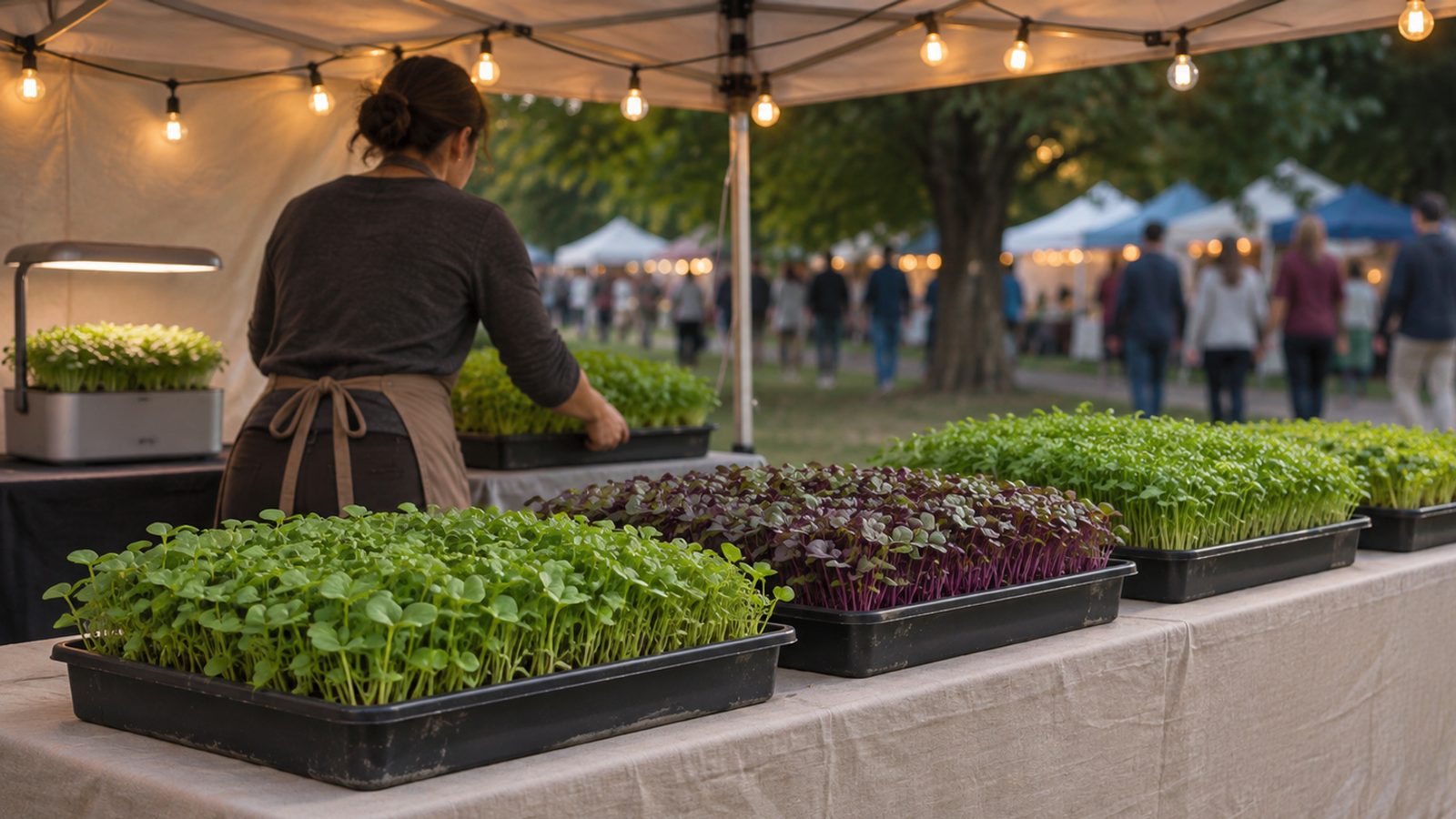
Whole, uncut microgreens are often exempt from a temporary food permit, but samples, cut microgreens and mixed trays can change that, and the answer depends on where the event is held.
The line that matters is between produce that leaves your table intact and food that you cut, portion, mix or hand out open. The first is often treated like a produce stand. The second is treated like food service.
Fees, deadlines and the exact exemption wording come from the local health authority that covers the event site, so the questions below decide the answer and that office gives you the numbers.
Sort your tray into whole or cut
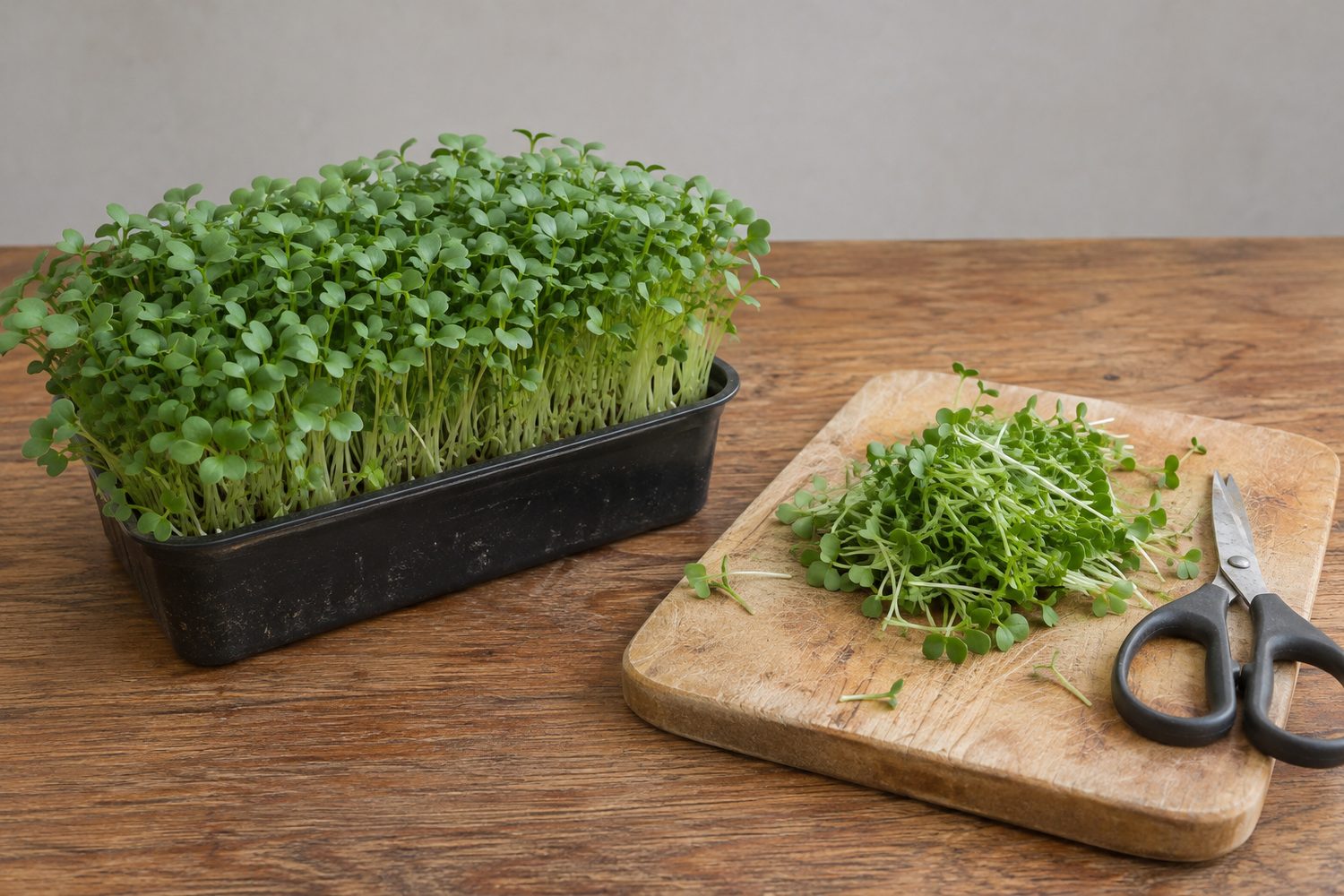
Start with what the customer actually walks away with. A living tray, or a bag of microgreens you harvested and left whole, is whole, uncut produce. A clamshell of microgreens you trimmed and packed is cut produce. A salad, a blend you mixed at the booth or a portion you scooped to order is prepared food.
The FDA Food Code is a model that states and localities adopt in their own rules. Its 2017 edition defines a food establishment broadly, including operations in a "mobile, stationary, temporary, or permanent facility or location," and then excludes "a produce stand that only offers whole, uncut fresh fruits and vegetables" (FDA Food Code 2017, §1-201.10(B)). That is a model code, not a federal rule you answer to directly. Each state or locality adopts its own version, sometimes with different limits.
The definition of "temporary" shows the spread. Texas and Iowa describe a temporary food establishment as one running no more than 14 consecutive days at a single event. Ohio's statute says no more than five consecutive days, and Washington's code allows up to 21 days for a fixed-location operation tied to an event (Texas DSHS, Iowa r. 481-30.2, Ohio Revised Code §3717.01, Washington WAC 246-215-01115).
If you are still working out whether you need any license to sell at all, start with do I need a license to sell microgreens, then come back here for the event itself.
Why samples change the answer
A sample is open, ready-to-eat food that you handle in front of the public. That is a different activity from handing over a sealed or intact product, and permit offices treat it that way.
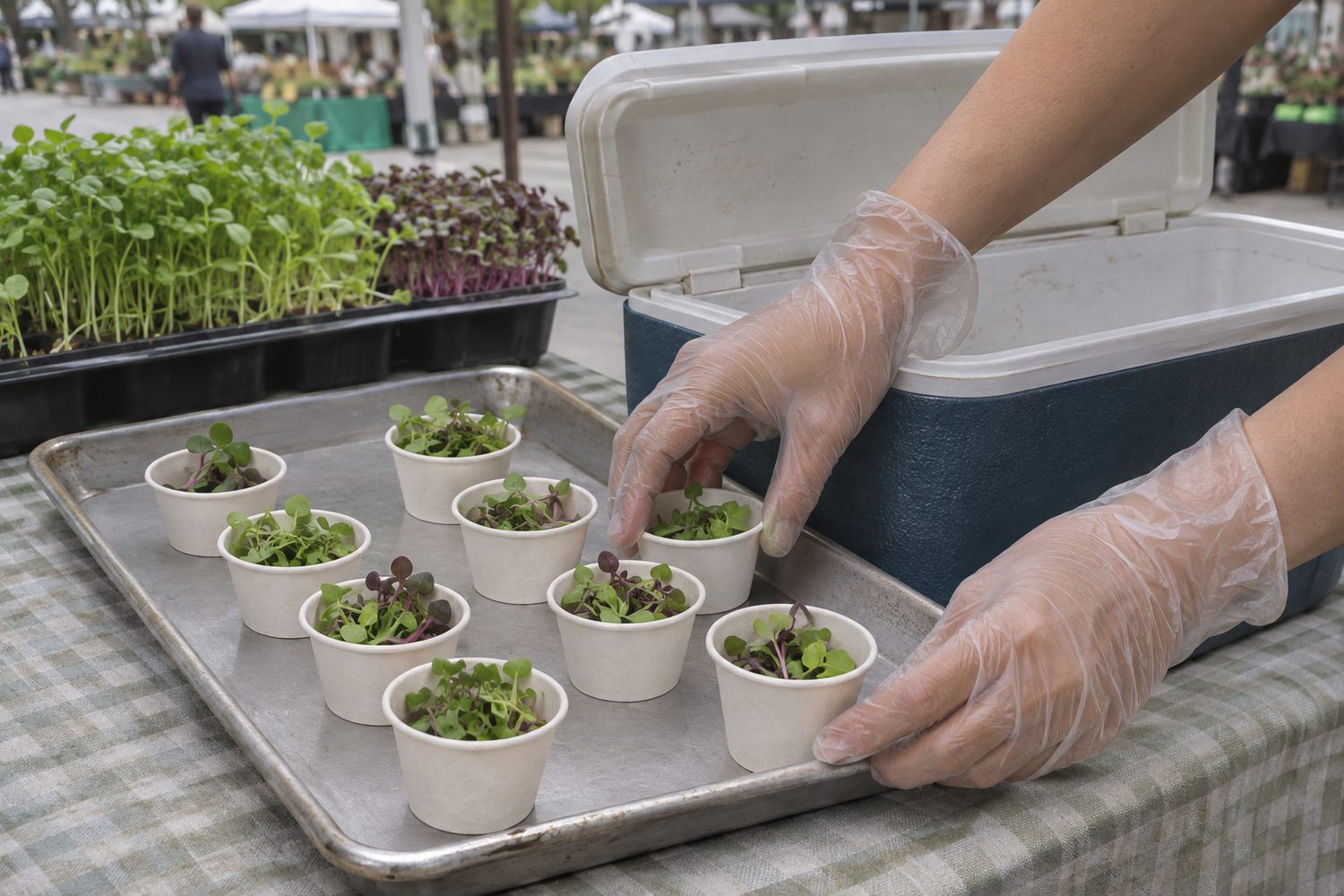
Texas shows how this can work in one state. Texas DSHS says a temporary food establishment permit is not required to provide samples at a farmers market under Texas Health and Safety Code §437.020(b-1), as long as the samples are handled sanitarily (Texas DSHS, Texas Farmers Market). The conditions are specific:
- Potable water has to be available, and any produce is washed with it before sampling.
- You use clean disposable gloves or wash your hands right before preparing samples.
- Utensils and cutting surfaces are smooth, nonabsorbent and easy to clean, or disposable.
- Cut samples stay at 41°F or below and are thrown out within two hours of cutting.
- A sample is a bite-size portion, not a full serving.
That exemption is written for farmers markets. It does not automatically carry over to a fair, a festival, a craft show or a pop-up, so do not assume a market-day habit is allowed at a general event.
One more point trips people up. The FDA Food Code line that a food employee may not use a utensil more than once to taste food that is to be sold or served (FDA Food Code 2022, §3-301.12) covers employees tasting during preparation. It is not a rule that lets you sample to customers.
Farmers market rule or general event rule
The same tray can fall under two different rules depending on the event. Many places write one set of rules for farmers markets and another for fairs, festivals and other public events where food is offered. Your product can be treated generously at the first and strictly at the second.
If your event is a farmers market, read the market-specific guidance first; the farmers market selling guide covers how markets usually work. If it is a festival, fair, school event or one-day sale, the general temporary-event rule is the one to ask about. When an organizer calls it a "market" but it runs as a festival with many food booths, ask which rule the health department applies.
Texas and Austin as worked examples
Texas is a useful example because the state rule and the city rules can be read side by side. It is an example only; your state's wording may differ.
Texas DSHS excludes produce stands that offer only whole, uncut fresh fruits and vegetables, and charges $52 for a single-event temporary permit and $200 for a multiple-event permit valid for two years, with applications due at least 30 days before the event where DSHS is the permitting authority (Texas DSHS, Permits for Retail Food Establishments). In Texas, many cities and counties run their own programs, so DSHS is not always the office you call.
Austin Public Health is the clearest local case. Its farmers-market guidance says no permit is needed for "whole, uncut raw agricultural products," and its Class B and Class C market permits allow samples (Austin Public Health, Farmers Markets).
For public or advertised events where open food or beverages are offered, Austin requires a temporary food event permit at $62 per booth for 1 to 14 days, or $52 per booth in unincorporated Travis County, with complete applications due at least 10 calendar days ahead (Austin Public Health, Temporary Food Events). The farmers-market exemption is written for markets, so if you plan a whole-produce booth at a public fair in Austin, ask Austin Public Health whether the same exemption applies at that event.
Cut microgreens do not fit the whole-produce exemption. Texas DSHS lists raw seed sprouts and cut leafy greens among foods that need time and temperature control for safety when they support bacterial growth (Texas DSHS Food Rules FAQ). A clamshell of cut microgreens, and even more so a salad, is best treated under the local rules for cut or packaged ready-to-eat food, which can mean a permit, an approved source, handwashing and cold holding.
What fees and deadlines look like elsewhere
Fees and deadlines are set place by place, and the spread is wide. These examples show the range. None of them is a national figure, and each can change by year, booth, risk category or late filing.
- San Antonio, Texas: $52 per booth for up to 14 days, bought at least three days before the event, and booths selling only whole, uncut fresh fruits and vegetables are exempt (San Antonio).
- Albuquerque, New Mexico: a $25 permit valid for 14 days for packaged uncut produce, which the city classifies as Risk 1 (Albuquerque).
- St. Louis, Missouri: $50 per day per vendor, with applications and payment due at least two business days before the event (City of St. Louis).
- Hawaii: $50 for 1 to 5 days, due at least 10 working days before the event (Hawaii Department of Health).
- New York City: $70, with the application due at least one day before the event (NYC Event Permitting Guide).
Houston charges $52 per event and, for applications from June 1, 2026, wants them at least 14 days ahead (Houston Health Department). Florida's state licensing agency lists $91 for 1 to 3 days (Florida DBPR). Cherokee County, North Carolina charges $75 per event with forms due 15 days before (Cherokee County). Oklahoma City charges $50 for the first day and $25 for each added day, capped at $250 for 14 days, and the event organizer notifies the health department 10 business days ahead (Oklahoma City-County Health Department).
Two places need a direct question before you rely on an exemption. Tulsa requires a permit to sell or give away food at an approved event and its page lists no exceptions, so ask Tulsa Health Department before relying on a whole-produce exemption (Tulsa Health Department). For Harris County, Texas, confirm the current fee in the county's permit fee schedule and ask whether a booth selling only intact microgreens is exempt (Harris County Public Health).
What the booth needs if you cut or sample
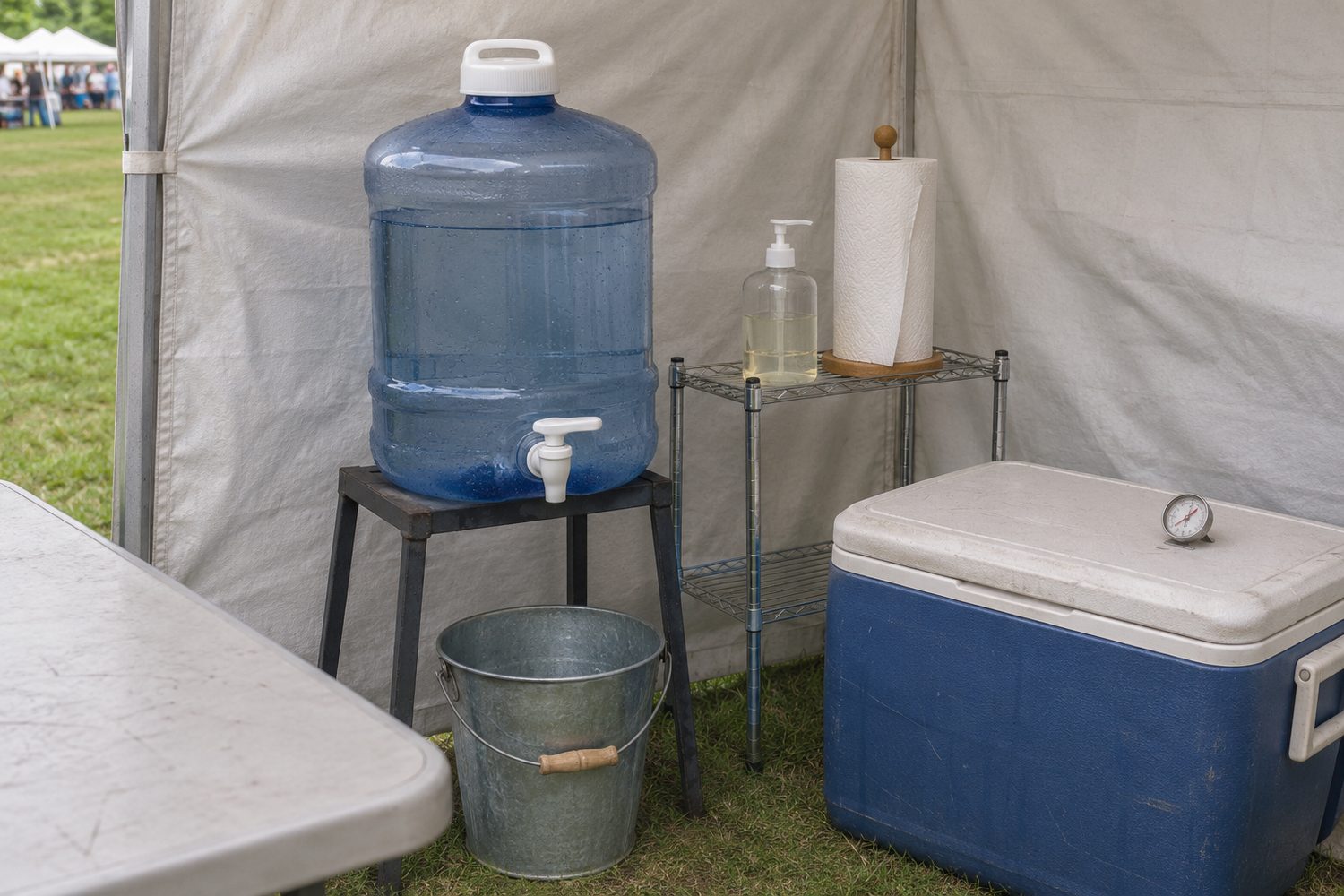
If you cut, sample or mix, expect booth requirements to follow. They differ by place, but the same themes come up. Austin requires an approved handwashing station with warm water, soap, paper towels and a wastewater catch bucket, cold food at or below 41°F, and food containers kept off the ground. Houston requires overhead protection over food preparation areas and approved coverings over dirt or gravel floors (Houston compliance requirements). Florida asks for a probe thermometer, sanitizer and test strips.
For whole, uncut produce with no cutting or sampling, some places lower these requirements or skip them. Contra Costa County, California, for example, does not require a fully enclosed booth when selling only whole uncut produce, prepackaged food or beverages, though prepackaged operations still need overhead protection (Contra Costa County). Confirm the current details with that county before your event.
The practical move for a grower is to decide your plan before you apply. A table of intact trays and bags needs a very different setup from one with a cutting board, a cooler and a handwashing station.
Who applies, you or the organizer
Do not assume the event organizer's registration covers your booth. In Austin, the organizer is responsible for obtaining a temporary food event permit for each food booth. In Houston, San Antonio, St. Louis, Hawaii and New York City, the vendor applies. Harris County and Southside Health District in Virginia split it, with the coordinator registering the event and each vendor filing its own application.
Ask the organizer who submits the event notice, who submits your booth permit, and whether the permit has to be displayed at the booth. Get the answer in writing if the event is large.
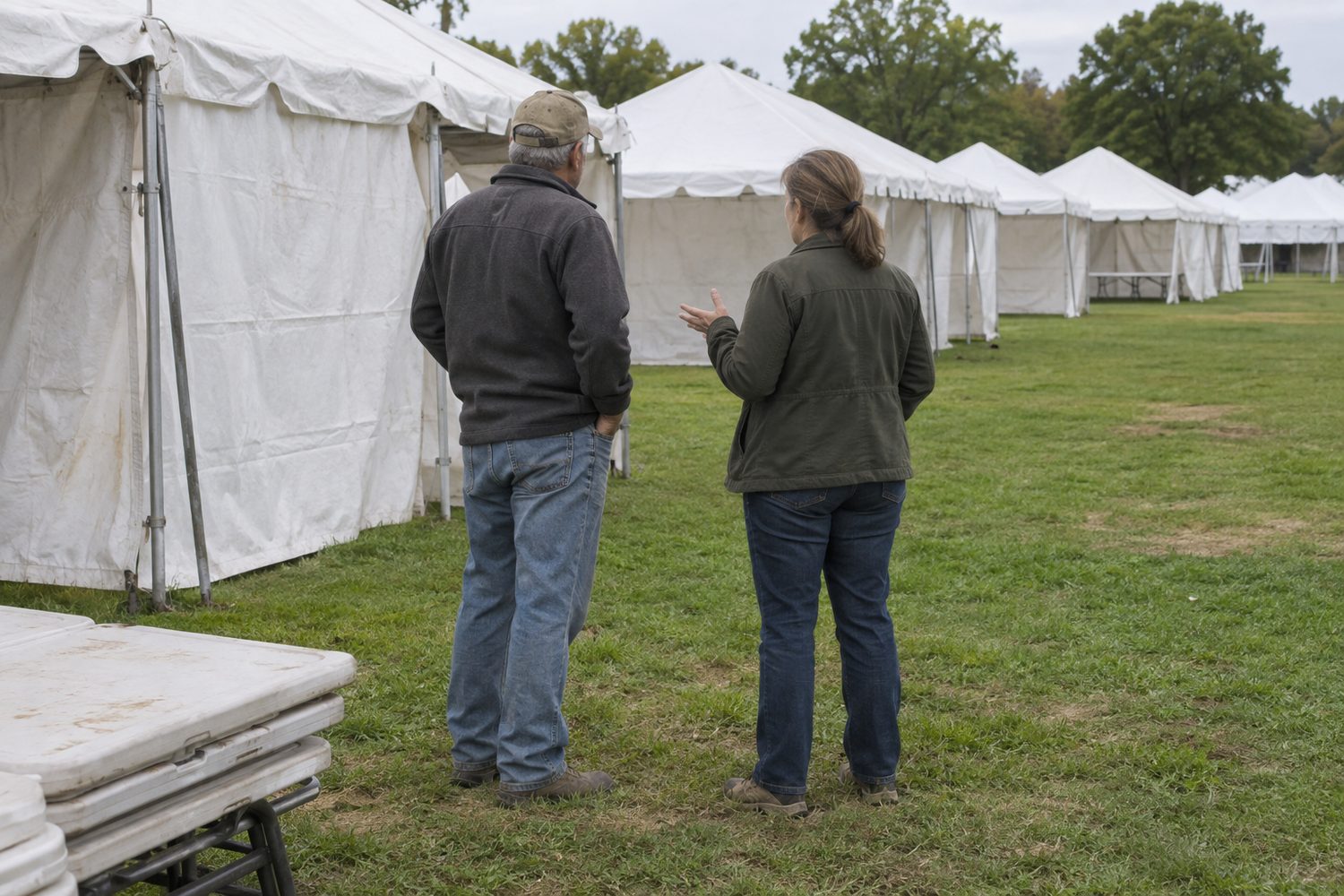
Three questions to ask before the day
Call the health authority that covers the event site, not the one where you live. Austin Public Health is the worked example for an event in Austin; for a different location it is that county or city health department. Ask these three questions, and write down the name of the person who answers:
- Is whole, uncut produce exempt at this event, and does that cover microgreens sold in a tray or bag with no cutting?
- Do samples, cut microgreens in clamshells or a salad need a temporary food permit here, and what handwashing and cold holding do they require?
- What is the fee, the application deadline, and who files, me or the organizer?
If you plan to cut or sample, describe the product plainly: cut, ready-to-eat microgreens, bite-size samples, held at 41°F. That gives the office what it needs to classify the booth.
Questions growers ask
Does cutting my microgreens on the spot change the answer? Yes. Cut produce is not whole, uncut produce, and offices can treat it as food that needs temperature control and handwashing. Describe it as cut microgreens when you ask the permit office.
Can I give out samples at a fair if I can at a farmers market? Not necessarily. Texas DSHS describes its sample exemption for farmers markets under Health and Safety Code §437.020(b-1), and that wording does not stretch to a fair or festival on its own. Ask the health authority covering the fair.
Does a farmers market permit cover a one-day festival? Not necessarily. An annual or market permit is not necessarily a substitute for a temporary-event permit. Ask whether the festival needs its own booth permit and whether any multiple-event option exists.
Is there one national fee for a temporary food permit? No. The fees above start at $25, some places charge per day, and each belongs to its own place. Check the current schedule for the event's location.
Your next step
Today, write down three things: whether your product leaves whole or cut, whether you plan to sample, and the exact name of the city or county that covers the event site. Then find that health department's temporary food page, put the three questions above in an email or call, and file well before its deadline, which in the examples here ranges from one day to 30 days. If you also sell at regular markets, the farmers market guide covers the standing rules separately.
Sources
Prices, stock and specifications are as the linked pages showed them on 2026-11-09.
- FDA Food Code 2017, §1-201.10(B)
- Texas DSHS
- Iowa r. 481-30.2
- Ohio Revised Code §3717.01
- Washington WAC 246-215-01115
- Texas DSHS, Texas Farmers Market
- FDA Food Code 2022, §3-301.12
- Austin Public Health, Farmers Markets
- Austin Public Health, Temporary Food Events
- Texas DSHS Food Rules FAQ
- San Antonio
- Albuquerque
- City of St. Louis
- Hawaii Department of Health
- NYC Event Permitting Guide
- Houston Health Department
- Florida DBPR
- Cherokee County
- Oklahoma City-County Health Department
- Tulsa Health Department
- Harris County Public Health
- Houston compliance requirements
- Contra Costa County
Keep reading
Selling guides
Selling Microgreens at Farmers Markets: What It Takes to Trade
Stall fees run $10 to $36 a day, and the growing labor behind one market day is 1.6 to 5.9 times that. A USDA report from five Vermont markets put conventional microgreens at $12 a pound in 2023, and every seller's own posted price beats that threefold.
Read Selling Microgreens at Farmers Markets: What It Takes to TradeThe journal
Can I sell microgreens from home? Zoning, permits, leases, HOAs
You can sell microgreens from home where zoning, a lease and any HOA allow it. Check the zoning office, read the lease, then ask the HOA in writing.
Read Can I sell microgreens from home? Zoning, permits, leases, HOAsThe journal
Do You Charge Sales Tax on Microgreens? State-by-State Answers
Do you charge sales tax on microgreens? A table gives the 2026 answer for all 50 states and D.C., plus local taxes, seller permits and living trays.
Read Do You Charge Sales Tax on Microgreens? State-by-State AnswersSelling and regulations
Do You Need a License to Sell Microgreens in Alabama?
Alabama has no microgreens license at all. Pick up the free Alabama Growers Permit at your county Extension office, skip the $50 permit that is not yours, and know which of two agencies owns your question.
Read Do You Need a License to Sell Microgreens in Alabama?