Are Microgreens in Demand Near You? How to Check Local Buyers
Cal HewittPublished Checked
- selling microgreens
- business planning
- market
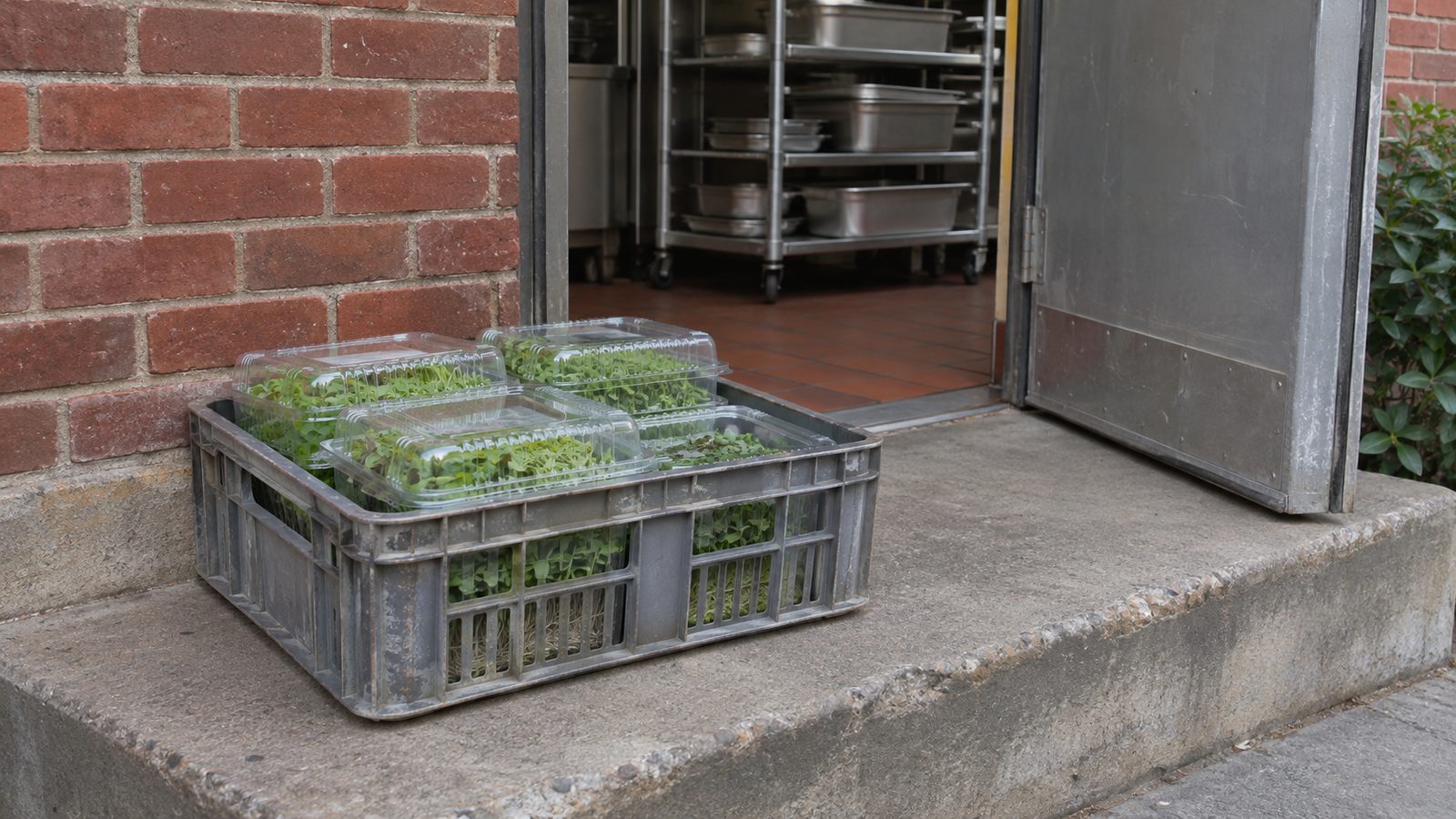
Whether microgreens are in demand near you depends on how many buyers within driving distance will order, and no national number can tell you that. Market reports can show that the product category is real. Only a short list of nearby restaurants, grocers, markets and wholesalers, plus a few repeat orders, can show that your area has room for a first crop.
You can build that list before you spend on seed, trays or lights.
What the national market numbers measure
The published estimates are paid market reports, and they disagree because each one defines the product, the sales channels and the geography differently. They are estimates of revenue for a defined category. They are not official measurements of farm-gate sales, and they say nothing about your service area.
Here is how the 2025 U.S. figures compare. Grand View Research puts U.S. revenue at $675.3 million in 2025, segmented by commercial greenhouse and indoor vertical farming. IMARC Group puts it at $469.6 million for 2025, with scope covering type, farming method, channel, end use and region. Market Research Future puts it at $175.46 million for 2025. Those three numbers sit in the same year and the same country, and they differ by almost four times.
Globally, Grand View Research's global report estimates $3.3 billion in 2025. An earlier IMARC global listing from January 2024 estimated $1.650 billion for 2023, and a Global Industry Analysts listing of a Market Glass report estimated $1.4 billion for 2023. Forecasts follow the same pattern. Grand View Research projects an 11.9% annual growth rate for the global market for 2026 through 2033. For the U.S., Market Research Future projects 14.68% for 2025 through 2035, and IMARC projects 6.90% for 2026 through 2034.
Because the reports cannot agree with each other, treat none of them as your growth rate or as proof that the market is crowded or empty. They tell you that several research firms think the category is large enough to model. Your own area will decide the rest.
Which crops the reports name
Two reports name a leading crop, and they name different ones because they measure different things. Grand View Research reports radish as the largest produce segment globally in 2025. Mordor Intelligence reports broccoli at 24.1% of the U.S. microgreens market in 2025, and puts supermarkets and hypermarkets at 33.6% of U.S. sales.
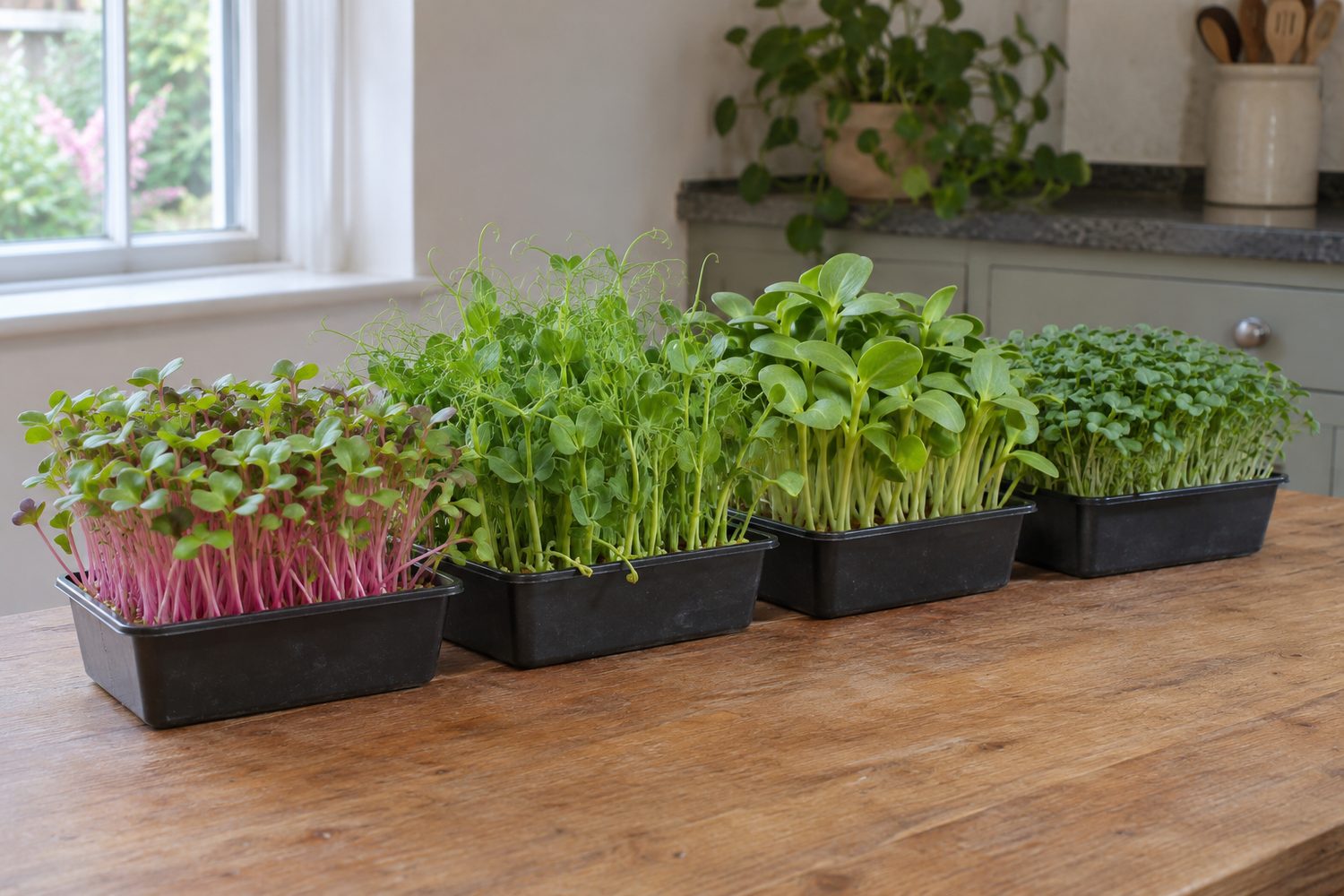
The first is a global ranking and the second is a U.S. share, so you can't average them or pick the one you like. The sales-channel figure is also worth reading carefully. It says about a third of U.S. sales in that report's model go through supermarkets and hypermarkets. If you are a small grower, the channels you can reach first are probably different: a chef down the street, a farmers market table, a neighbor's weekly box.
Seed and supplier catalogs add a third view. Sunflower, pea shoots, radish and broccoli show up again and again in supplier listings and restaurant-oriented practice sources, along with specialty items such as basil, shiso, amaranth, beet and chard mixes. A catalog shows what suppliers stock, which is not the same as what sells best. Sunflower is common, but common is not the same as best selling, so treat pea, sunflower, radish, broccoli and mixes as candidates for your first trays. Your local reorders will rank them.
What a buyer survey looks like
A national share can't tell you how many restaurants on your street will order, but a small buyer survey shows you what to ask. A 2019 paper by Yanes-Molina, Jaime-Meuly, Andrade-Bustamante, Lucero-Flores and Martinez-Ruiz, Microgreens: An Alternative of Horticultural Production and Market, surveyed restaurants in Hermosillo, Mexico. Seven of them were currently using microgreens.
Among those seven, beet was the most common crop, reported by 42.86% of them, then peas at 28.57%, with arugula and radish at 14.29% each. Average use was 214.29 grams a week, with a most common amount of 200 grams. Every current user received harvested and packed product, and 71.43% preferred that to product still growing on its substrate; the other 28.57% preferred substrate for longer kitchen life.
Do not read those numbers as a U.S. benchmark. Seven restaurants in one Mexican city is a small sample, and the crop mix reflects those kitchens. What the paper does give you is a list of questions: which crops, how many grams a week, harvested or on the tray. Ask each local buyer the same three things.
Two quantities in that list are worth turning into your own numbers right away. Two hundred grams a week is a little over seven ounces, which is less than two of the 4-ounce packs that suppliers sell. A single restaurant buying at that pace is a small account. You will want several of them, or a mix of channels, before a tray schedule makes sense.
What local chefs say they care about
The University of Nevada, Reno surveyed 31 gourmet chefs in 2009. The survey covered local-food buying in general, not microgreens, so it won't tell you what to grow. It does tell you what to ask a chef when you walk in with a sample.
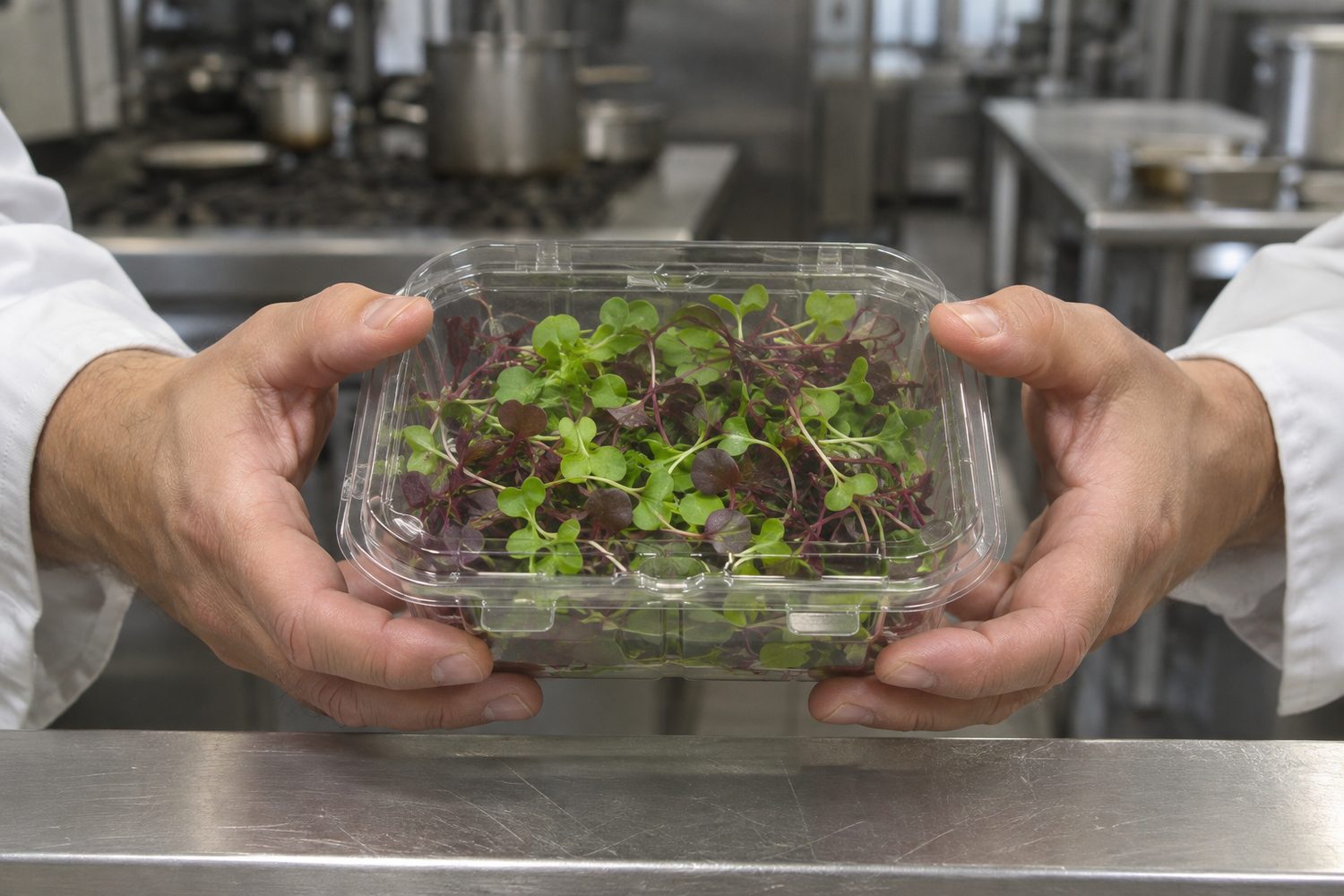
On direct-farm purchases, chefs rated origin and freshness at 4.97 out of 5, consistency at 4.87, seasonal availability at 4.32, price at 4.10 and samples at 3.55. Across all local-food attributes, product quality scored 4.97 and uniqueness 4.48. In practice that suggests leading with a fresh, even sample, and asking how much the kitchen cares about a crop that looks or tastes unlike what it already buys.
Johnny's Selected Seeds advises growers to check with chefs in the area and to talk to local wholesalers about the microgreens they handle, the types in demand and the prices paid. It also advises that restaurants value mixes with loft, texture and visual volume, and that dark-red varieties are prized for contrast. That is practice guidance from a seed company, not a sales ranking, but it is a reasonable reason to test a mix early.
For the sales side of that conversation, see how to sell microgreens to restaurants and chefs.
Asking prices are not what buyers pay
When you start comparing prices, keep two kinds of numbers apart. Supplier listings are asking prices. A 2026 supplier comparison on this site, what chefs buy, recorded $15 per 4 ounces for sunflower, pea shoots, radish and broccoli, and $25 per 4 ounces for basil, shiso, amaranth, beet and chard mixes. Another supplier listed $13 per 4 ounces and $21 per 8 ounces. Those are what sellers hoped to get, not invoices a restaurant paid.
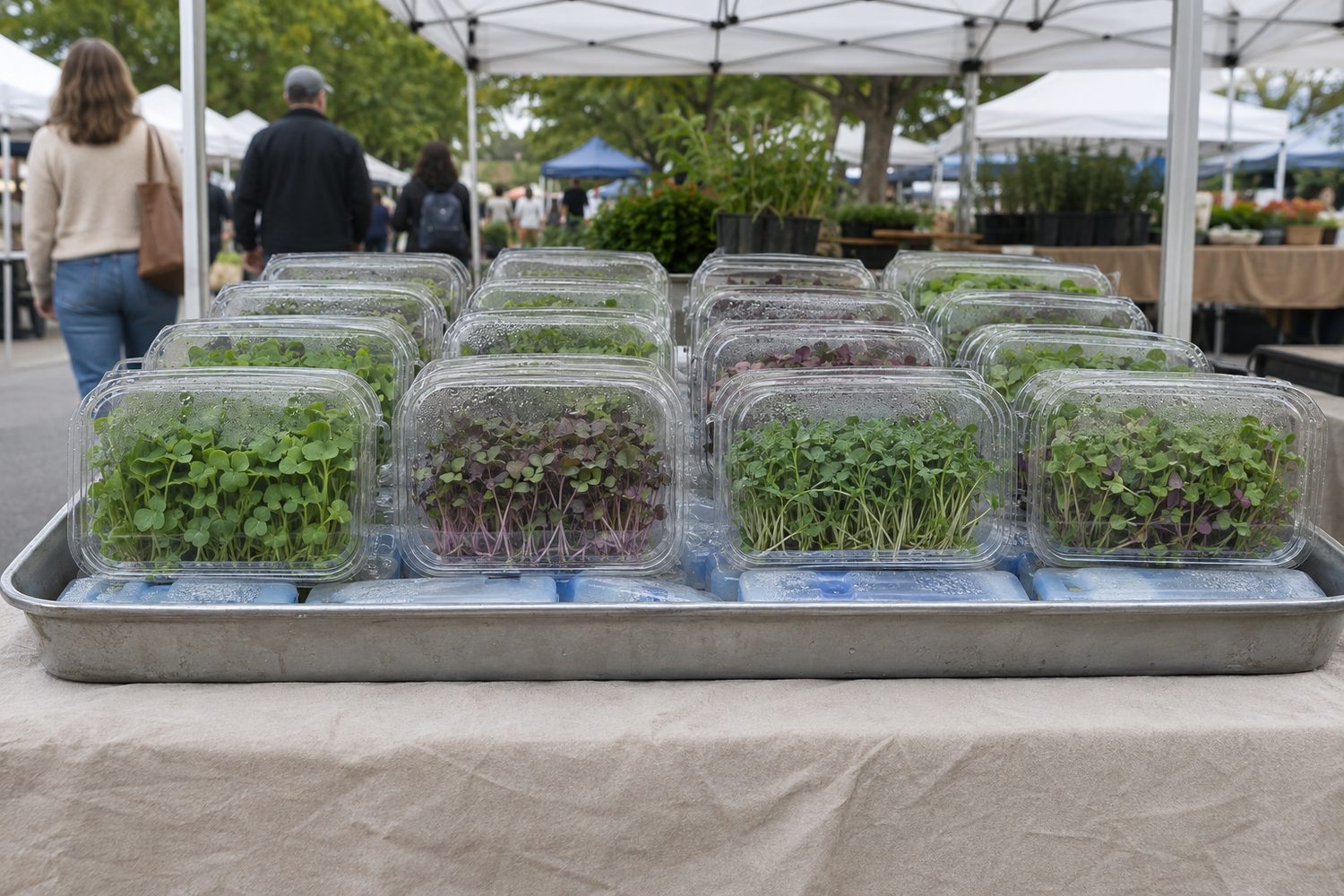
Observed prices at a real market are a little different. The University of Missouri Extension's 2025 farmers market summary recorded microgreens at $2.00 low, $2.36 average and $3.75 high per ounce. That came from nine observation days between June and October 2025 and is a convenience sample, not a statewide census. Missouri Extension notes that prices vary with season, vendor, location, quality, availability and demand.
Grower reports are looser still. In an older Reddit discussion from about 2022, growers described restaurant prices around $2.25 per ounce and some specialty products at $5 to $7 per ounce, and one commenter said pricing depended on saturation and customer service. A grower in Vilnius, Lithuania, reported around 2023 that more than 20 free samples brought little response and that the local market for cut greens was close to nonexistent. That is one grower's report about one city, and it does not tell you what sampling will do near you.
The practical use of all this is the same. Collect real prices from buyers and competitors in your own area, and set your own price from those, not from a catalog or a forum thread. For the cost side, see are microgreens profitable.
How to read your own market
You don't need a survey firm. Extension programs publish methods you can copy. Virginia Cooperative Extension says that choosing a target market comes first because it affects facility size, production quantity, species, harvest stage, post-harvest handling and price. It lists restaurants, farmers markets, direct-to-consumer sales, CSA customers and grocery stores as common markets, and it recommends adjusting crops and timing from ongoing customer feedback.
Oregon State University Extension's Rapid Market Assessment adds methods for a market table: count attendance, ask shoppers what they spend and what they would buy, record where they live, and ask what stopped them from buying more. It also says to separate results by date, because weather and events can distort a single day. University of Missouri Extension suggests thinking through end consumers, perishability, the volume a market will take, barriers to entry, the cost of serving each market and price sensitivity.
Pulling those together, here is a local test you can run before buying anything beyond a few sample trays:
- Count the restaurants, grocers, farmers markets and CSA or direct-sales outlets within a delivery distance you are willing to drive.
- Ask chefs, produce buyers and wholesalers which crops they buy, in what pack size, how much a week, on which delivery days and at what price.
- Write down every competing vendor you find, with their crops, packages and prices.
- Run a small sample or preorder test with a few trays.
- Track weekly reorder quantity, sell-through, spoilage and price by channel.
Step 5 is where the answer comes from. A buyer who says "send me some" has told you something, but a buyer who reorders the same crop three weeks in a row has told you much more. Count the repeat orders, not the enthusiastic first ones.
Seasons and slow months
Demand can move with the calendar, and one good month doesn't show a pattern. A Cornell Cooperative Extension and SARE project at Main Street Farms in Syracuse reported loyal restaurant and farmers market customers and revenue during winter and early spring, when fewer other crops were available. The same project found that winter production could stay viable with extra heat, steady sales or a winter premium, and that unheated greenhouse production became ineffective below 60°F from mid-November through February, with harvests failing or taking three to four weeks.
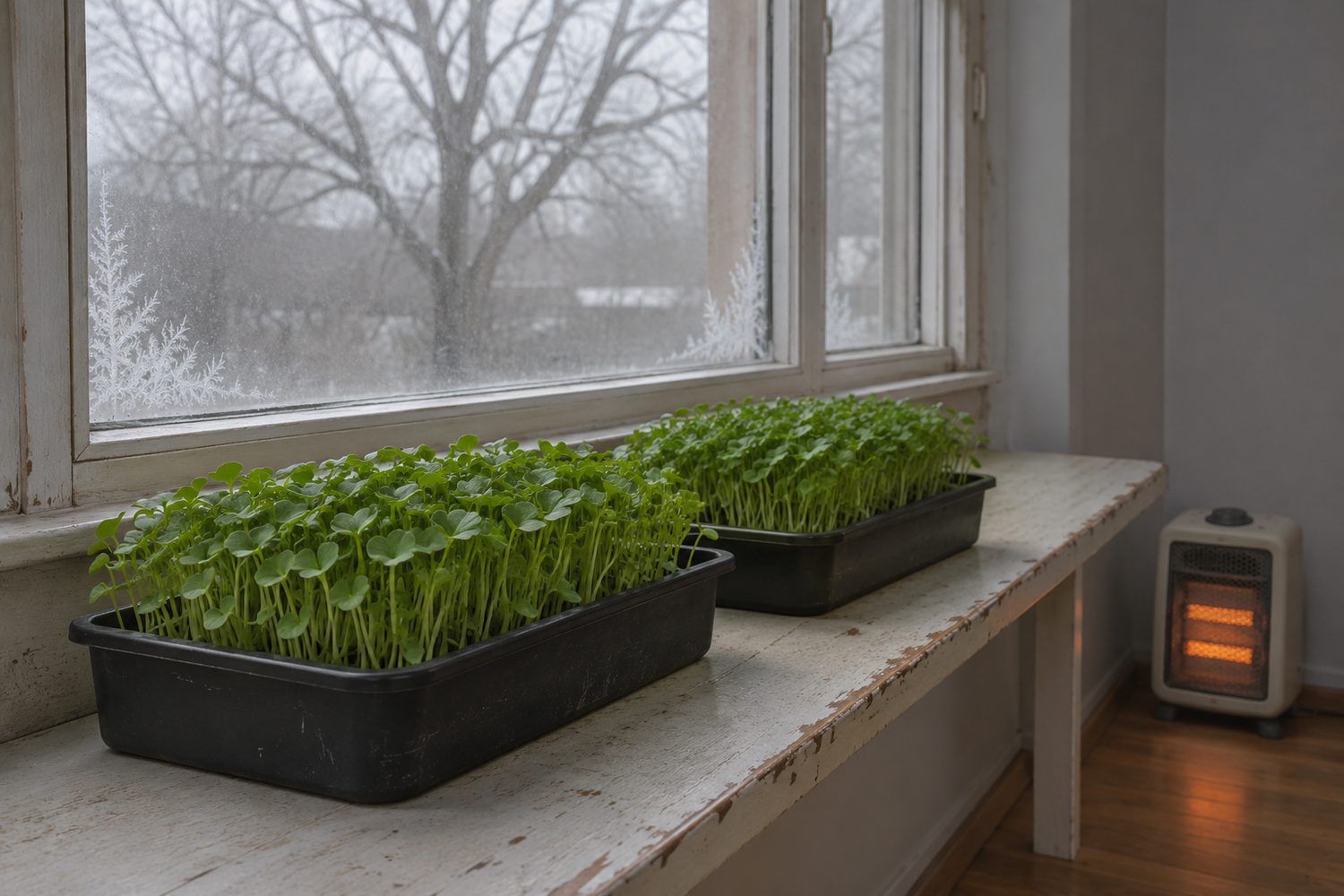
For your own numbers, keep dated sales and reorder records across at least a full year if you can, and keep restaurant, grocery, market and household sales in separate columns. Winter might be your steady season and summer your slow one, or the reverse, and you will only know by reading your own dates.
Do you have enough buyers for a first crop?
You have enough buyers for a first crop if you can name several buyers within reach and at least a few of them have agreed to a sample order. You do not need a full customer list. A realistic starting point is a handful of accounts that order weekly, because that gives you data on reorders before you scale up.
For the first crop to test, start with two or three of the candidates: pea, sunflower, radish, broccoli, or a mix. Choose by what your first buyers ask for. If a chef wants a mix with loft and color, grow a mix. If a market shopper asks for something to put on a sandwich, grow sunflower or pea. After a month of orders, rank them by repeat sales and by how much you kept after costs, not by what looked best in the catalog.
If your count shows very few buyers in reach, that is useful information too. It points you toward a smaller start, a different channel such as a farmers market, or a different crop mix, and away from buying equipment first. When you are ready to plan the next step, starting a microgreens business covers the order to do things in.
One more tool for later: USDA added microgreens as a reportable category to the 2024 Census of Horticultural Specialties form, under food crops grown under protection, with questions on retail and wholesale sales. When USDA publishes microgreens totals from that census, read them alongside your own records, and ask NASS whether a table is available.
Frequently asked questions
Is there an official count of how much microgreens are sold in the U.S.?
USDA's 2024 Census of Horticultural Specialties form lists microgreens as a category and asks for retail and wholesale sales. Check the USDA NASS release for microgreens totals, or ask NASS for the relevant table, and use your own records and local buyer conversations for your area.
Which microgreens do restaurants order most?
That depends on the restaurant and the place. In the Hermosillo, Mexico survey, beet and pea led among seven restaurants. For U.S. kitchens, ask your local chefs which crops they reorder, then rank crops by repeat sales and by margin.
Should I trust a single market report's growth number?
Treat each as one firm's estimate for a defined scope. Grand View Research, Market Research Future and IMARC give different 2025 U.S. figures and different growth rates. Use them to see that the category exists, and use your own reorders to decide how much to plant.
Can I use one sampling result, such as a slow response, to decide my town has no demand?
One slow response is one data point. The Vilnius grower's report of little response to free samples came from one city, so it does not tell you what buyers near you will do. Try different buyers, different crops and several weeks of samples before you decide.
Where to go from here
Make the buyer list first, ask each buyer the same short set of questions, and write down what comes back. If a few buyers reorder, order seed for the crop they asked for and start with a small number of trays. If few do, adjust the plan before you spend on equipment.
Sources
Prices, stock and specifications are as the linked pages showed them on 2026-11-09.
- Grand View Research
- IMARC Group
- Market Research Future
- global report
- Mordor Intelligence
- Microgreens: An Alternative of Horticultural Production and Market
- Johnny's Selected Seeds
- what chefs buy
- 2025 farmers market summary
- older Reddit discussion
- reported
- says
- Oregon State University Extension's Rapid Market Assessment
- University of Missouri Extension
- loyal restaurant and farmers market customers and revenue
Keep reading
The journal
Are Microgreens Profitable? What the Numbers Show
Are microgreens profitable? See what a national grower survey and federal sales data show, why gross revenue is not profit, and how to run your own numbers.
Read Are Microgreens Profitable? What the Numbers ShowThe journal
Are Microgreens Sustainable? The Published Range Is 3.34 to 63.34 kg CO2e a Kilo, and Your Grid Decides Where You Land
One modeled crop spans a 19-fold carbon range. Indoor growing beats field lettuce on land by roughly 37 times and can lose on carbon, because the answer is a property of your electricity rather than of the crop.
Read Are Microgreens Sustainable? The Published Range Is 3.34 to 63.34 kg CO2e a Kilo, and Your Grid Decides Where You LandThe journal
Buying a Microgreens Business for Sale: What to Check First
Thinking about a microgreens business for sale? Learn how sellers state cash flow, what SBA loans require in 2026, and what to check before you buy.
Read Buying a Microgreens Business for Sale: What to Check FirstThe journal
Can I sell microgreens from home? Zoning, permits, leases, HOAs
You can sell microgreens from home where zoning, a lease and any HOA allow it. Check the zoning office, read the lease, then ask the HOA in writing.
Read Can I sell microgreens from home? Zoning, permits, leases, HOAs