Microgreens for Chefs: Buyer Survey vs Supplier Catalogs
Cal HewittPublished Checked
- selling microgreens
- varieties
- business planning
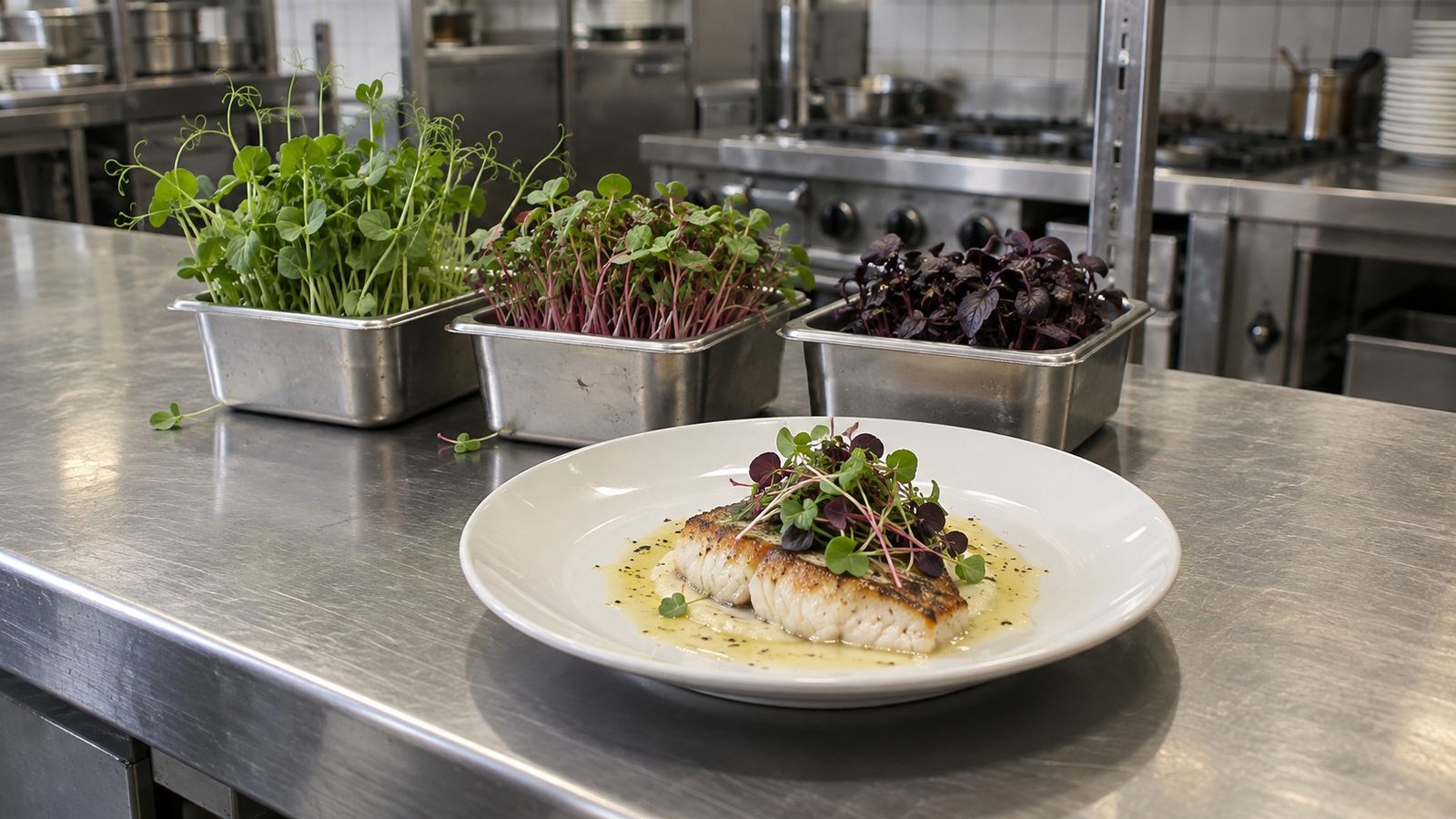
If you're choosing crops for restaurant accounts you don't have yet, start with arugula, basil, pea shoots and radish, and treat that list as a stocking pattern rather than proof of orders. Those four recur across the regular lines of six restaurant and foodservice catalogs.
The only published survey of restaurant buyers by variety is much smaller: seven kitchens in Hermosillo, Mexico, where beet, pea, arugula and radish were the preferred crops. Ask the chef you actually plan to sell to what they order; that is your best source for US demand by variety.
Two kinds of evidence sit behind that answer, and they measure different things. One is what restaurants said about their own use of microgreens. The other is what suppliers list for restaurants to order. A third kind of source, growers describing their own best sellers, sits apart from both.
Keeping the three separate tells you how much weight each list can carry when you're deciding what goes on your trays. For the selling side itself, such as finding accounts, pitching and delivery, see our guide to selling microgreens to restaurants and chefs. This page covers the buyer's side.
The one published survey of restaurant buyers
The buyer evidence comes from Yanes-Molina and colleagues, who surveyed a randomly drawn sample of 52 of the 60 gourmet restaurants in Hermosillo, Sonora, in 2018 and published the results in 2019. The interviews were fielded on April 19, 2018. At that point 13.46% of the restaurants were using microgreens, 67.31% said they would like to introduce them, and 19.23% were not interested (Yanes-Molina et al., pp. 130 to 133).
Only seven restaurants were already buying, and the variety question went to them. Beet was preferred by 42.86%, which is three restaurants. Pea came next at 28.57%, or two restaurants, then arugula and radish at 14.29% each, one restaurant apiece (study, p. 133). Read those percentages as head counts. A single kitchen changing its order would move any of them by more than 14 points.
The survey also asked what restaurants used microgreens for, or would use them for. Across the sample, 61.54% said mainly to decorate dishes and 19.23% said as an ingredient. Another 15.38% said microgreens didn't fit their dishes, and 3.85% said they didn't know how to use them. The paper doesn't break those answers down by crop (study, p. 132). For planning, the useful part is that decoration led by a wide margin in this group. Johnny's Selected Seeds makes a related point in its grower guide, which is seed-company advice rather than buyer data: dark-red leaves are prized for contrast on the plate (Johnny's guide).
The seven current users bought from outside Hermosillo, with 42.86% sourcing from Nuevo León, 28.57% from Mexico City and 28.57% from Baja California. That describes where a handful of kitchens got their product, not which crops a region wants.
Be plain with yourself about the limits before you plan around any of this. It is one Mexican city, one restaurant segment and seven buyers. It is not a US count, and it is not an industrywide one. The paper also has tables on weekly use and product form, which are worth reading in the original if you want its details on how much and in what form those kitchens bought. Still, it's the only restaurant-side result by variety that could be found, and that's why it shouldn't be blended into a supplier or grower list.
What restaurant suppliers keep on their lists
The supply-side evidence is a comparison of six catalogs aimed at restaurants or foodservice buyers, observed on September 12, 2026. A catalog shows what a supplier is prepared to sell. It doesn't show what anyone bought, how much, or how often.
Hover or tap a row to highlight it.
| Catalog | Who and where | What it can show |
|---|---|---|
| Baldor/Fresh Origins | Foodservice distributor in the Bronx, New York, listing Fresh Origins product in 8 oz packs | What was listed when the sheet was made; undated on its face, with PDF metadata from December 22, 2014 |
| Midwest Foods | Chicago and Kenosha distributor sheet dated February 26, 2025, in 4 to 8 oz products | Availability, with many items on 72-hour notice |
| Hilite Fine Foods | Supplier in Etobicoke, Ontario, Canada, with 100 g packs and named supplier lines | Catalog availability |
| Piedmont Microgreens | A grower's menu for restaurants and caterers | One grower's offer |
| The Hubb | A grower's price menu | One grower's offer |
| Koppert Cress | International specialist cress assortment | One specialist's range |
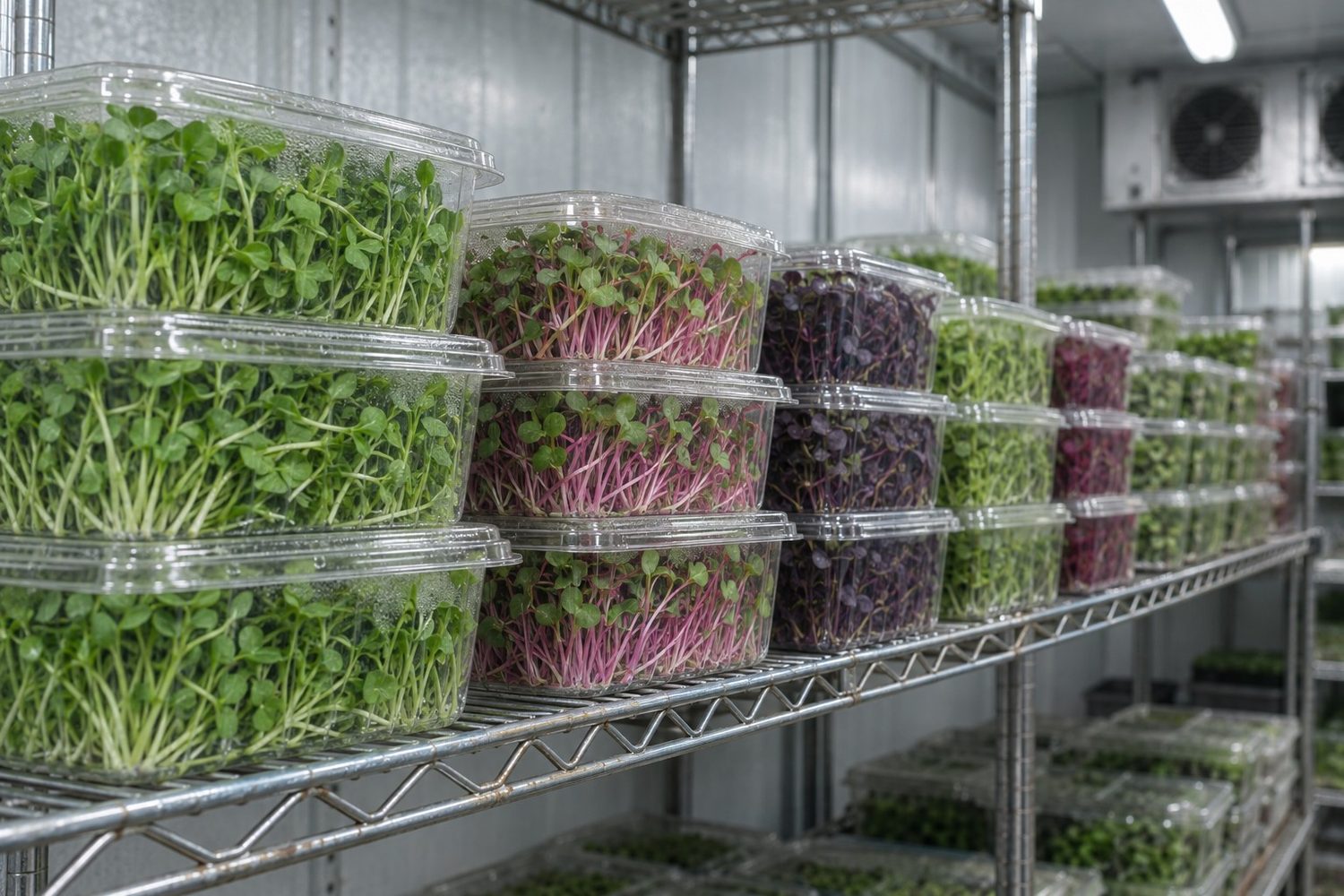
Across the five North American lists, arugula, pea shoots and radish each appear on all five, and so does amaranth or beet. Basil and cilantro show up on four. Koppert's range runs to basil, pea, daikon and shiso cresses alongside its own specialties. That shared set, with arugula, basil, pea shoots and radish the most visible, is a catalog-overlap finding. It tells you what suppliers choose to stock for restaurants. It doesn't rank what restaurants order most.
Three details change how much that overlap counts for. First, the Baldor sheet's PDF metadata dates to 2014, so it isn't a record of current availability. Second, Baldor and Midwest aren't two independent counts. The Baldor sheet is a Fresh Origins list, and the Midwest sheet invites orders for any of the other microgreens in the Fresh Origins catalog, so Fresh Origins product sits behind both. Third, Hilite is based in Ontario, which leaves four of the five North American lists as US.
The long tails are where the lists part ways. Piedmont lists cantaloupe and a Taco Mix, and Koppert carries specialty cresses such as Atsina, which it describes as sweet anise. Appearing on only one of these six lists means only that, in a small comparison that wasn't randomly chosen. It doesn't mean nobody else grows the crop.
The catalogs do settle one practical question. Wholesalers carry both single varieties and mixes in foodservice packs, so a chef who already buys from a distributor may be used to either.
Grower lists are a separate kind of source
A list of crops that hit with chefs is often traced to an April 2010 article in the American Culinary Federation's National Culinary Review. In it, Lee Jones, co-owner of The Chef's Garden, named sea spears and Chinese toon as two of the farm's more popular recent microgreens, and red ribbon sorrel and wasabi mustard as other hits with chefs ([ACF, April 2010, pp.
28 and 29](https://www.acfchefs.org/Downloads/NCR/201004.pdf)). That is a grower describing his own farm's experience with its own lines. It isn't a chef survey or a purchase record, and it belongs in neither the buyer set nor the catalog set. The same article quotes Scott Hunnel, executive chef at Victoria & Albert's at Walt Disney World, describing microgreens as flavor and presentation "supporting actors," which is one chef's view of their role, not a count.
Current grower pages work the same way. On The Grow gives sunflower, pea shoots, radish, broccoli and mixed microgreens as its core five for restaurants and says its figures are estimates from its own experience (On The Grow). Nags Head Microgreens calls sunflower, pea, radish and salad mix the most popular microgreens it sells (Nags Head chef menu). Both are useful as a record of what those growers move through their own customers. Sunflower, for example, sits high on both grower lists. Treat that as their sales experience and not as chef demand beyond their accounts.
Our posts on the most popular microgreens and the best-tasting microgreens cover the grower and eating side of crop choice.
What form and quantity chefs order
Suppliers publish the formats they offer, and your chef decides how to buy. Ask whether they want cut or living product, single varieties or mixes, and how often they take delivery.
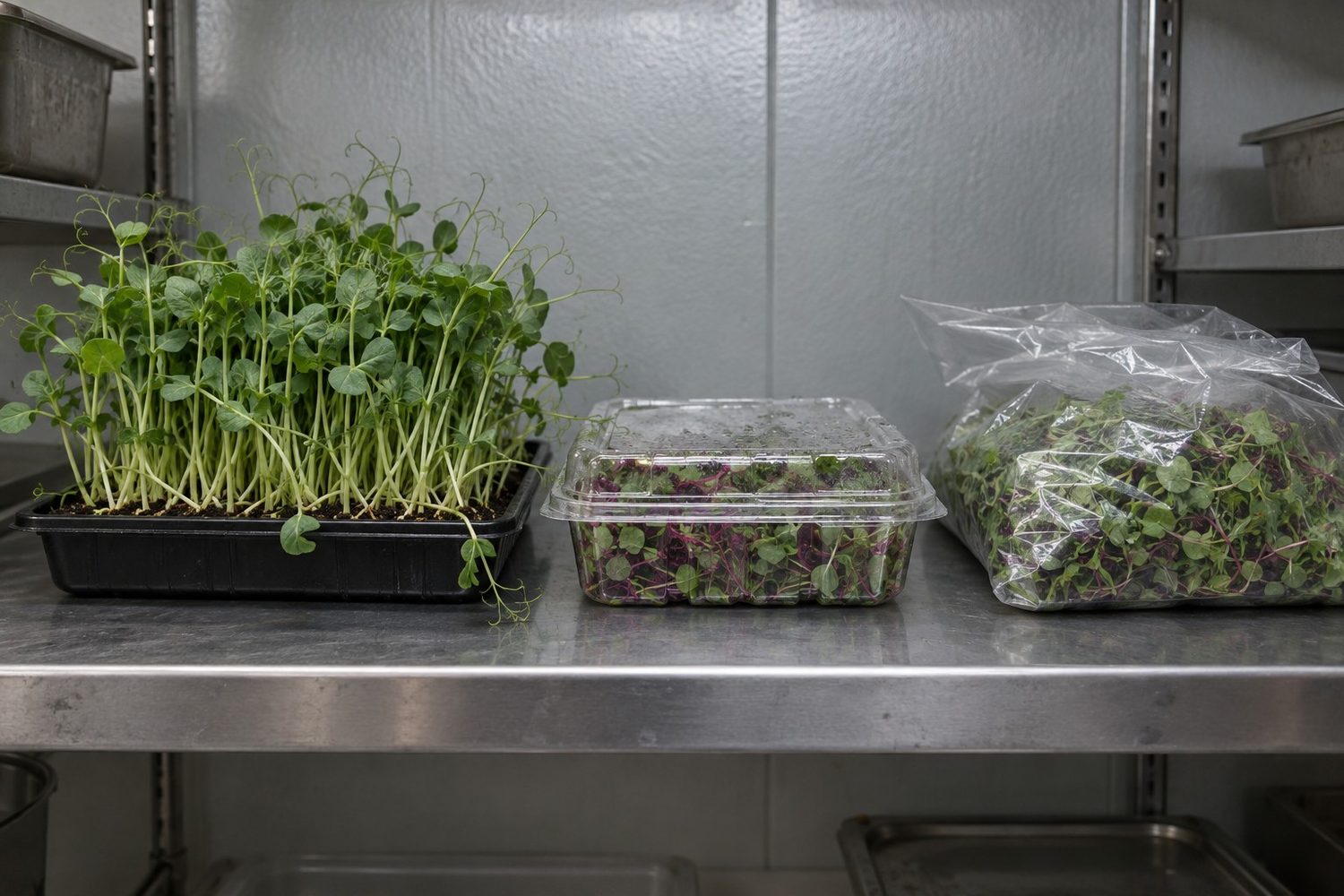
Johnny's guide says microgreens may be sold live in trays, cut in bags or clamshells, or loose by weight. One packaging option it gives is 5-by-5-inch mat inserts, eight to a 1020 tray. Cut product needs to be dry before it's packed and refrigerated, and refrigeration matters because microgreens are highly perishable (Johnny's guide). If you're pricing out clamshells, trays or inserts, that guide's packaging section is a sensible place to start your list.
Pack sizes vary by seller. Midwest uses 4, 6 and 8 oz trays. Baldor's sheet lists 8 oz and Hilite lists 100 g. The Hubb posts 4 oz, 8 oz and living trays. Nags Head posts cut packs from 1 to 4 oz and living basil in 10-by-10 and 10-by-20 trays, and says cut basil lasts only 3 to 4 days, recommending a living tray when a kitchen needs it to last a week or more.
The Institute of Culinary Education, writing as a culinary school, says some restaurants order living microgreens because the roots and growing media extend usable life, while hand cutting and bench space count against them (ICE). ICE also notes that a mix of amaranth, arugula and kohlrabi is common, and that crops growing at different rates can make some mixes impractical to grow together.
For quantity, the only figures are anecdotes. In a 2022 r/microgreens thread, one grower reported a restaurant ordering 16 oz of radish plus a basil tray each week (thread). That is one account at one farm. Until you have your own, don't plan tray counts from it. Ask each chef for a weekly amount per crop, write it down, and grow from that.
Building a chef-facing crop list from this
With the evidence sorted, a first list for restaurant pitches can be modest and honest about what it rests on.
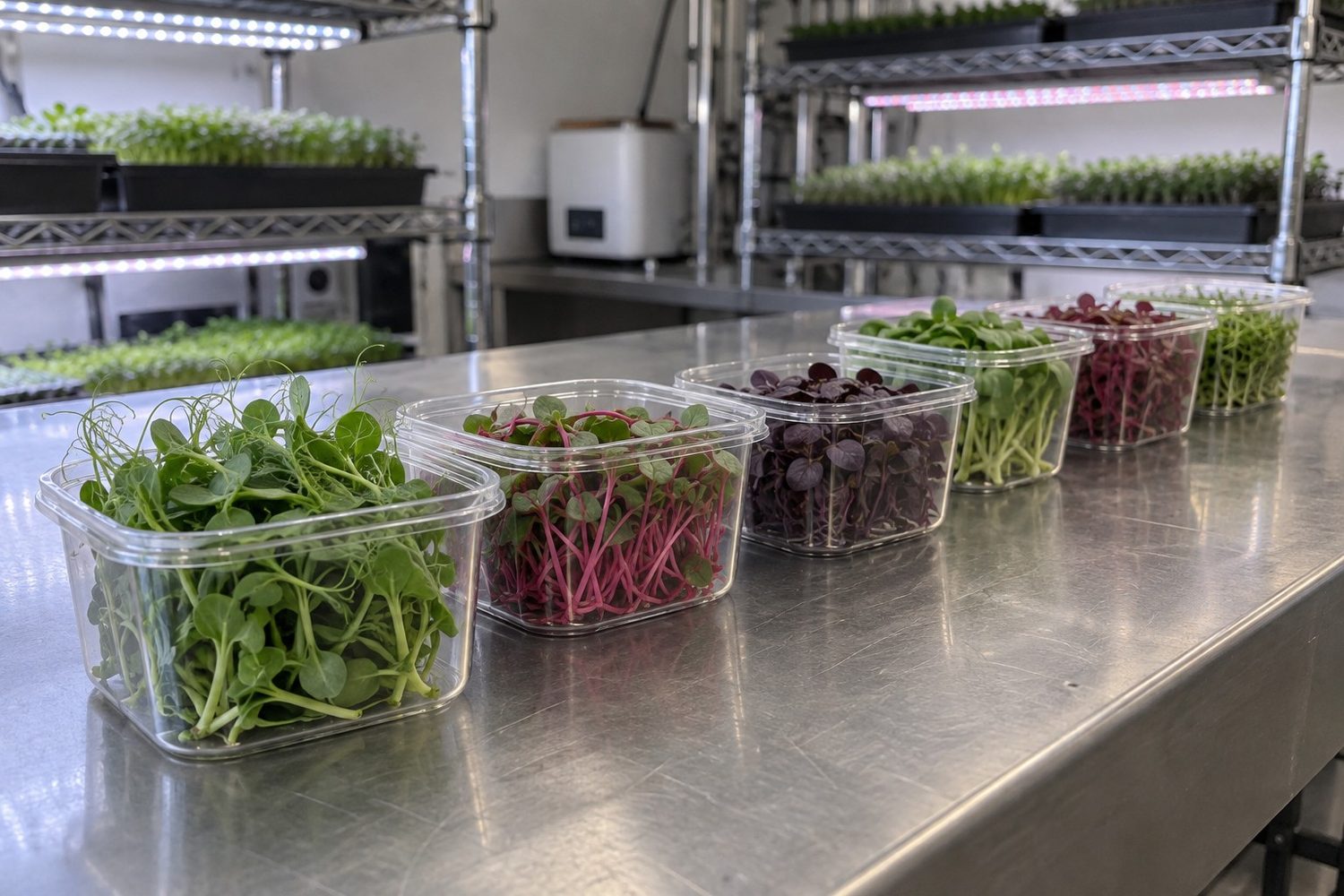
Start with the crops that recur across supplier catalogs: arugula, basil, pea shoots and radish. They're a reasonable opening set because suppliers already put them in front of restaurant buyers, which also means a chef who buys from a distributor may already have them. Add a red crop such as beet or amaranth. One of the two turns up on every North American list, beet led the small Hermosillo sample, and decoration was that survey's leading use. Hold specialty crops back until a chef asks for one by name, because the long-tail items are where supplier lists disagree most.
Then go get local evidence before committing much tray space. Johnny's guide recommends checking directly with chefs and local wholesalers to find what they have demand for, and notes that wholesalers may have price lists describing the types they buy and the prices they pay. A workable minimum is:
- A conversation with the actual chef or purchaser, tied to a specific dish and a weekly amount.
- A menu check that records the exact crop, the form, and how it's served.
- A dated distributor availability or price sheet from your area.
- A trial delivery, followed by a note of whether the kitchen reordered.
Record the refusals and the samples that didn't lead to a reorder, not only the wins. A single restaurant tells you about that restaurant. Only orders from several restaurants would tell you what your area buys.
For how to narrow a crop list on the growing side, see which crops to sell, and for setting a price, our pricing guide.
Frequently asked questions
These cover the related questions growers tend to ask once the variety list is settled.
Does the National Restaurant Association track which microgreens chefs buy?
No. Its What's Hot 2025 forecast surveyed culinary-industry thought leaders in October 2024, asking them to rate preselected trends, and it reports no microgreen variety, purchase or usage result (NRA methodology). Its 2022 show-floor report noted ready-to-plate microgreens and edible flowers as novel visual ingredients on exhibit, without ranking varieties (NRA show-floor report).
Do restaurants buy mixes more often than single varieties?
That hasn't been measured in any published study. Midwest lists several named mixes, Baldor lists rainbow mixes, and The Hubb prices its blends the same as its single varieties. Availability and matching prices show that both are offered, not which one sells more often.
What do other growers charge restaurants?
Only posted list prices are available, observed on September 12, 2026, and a posted price is an offer rather than what a kitchen paid. MicroFreshly lists a $15 base price per 4 oz for crops including sunflower, pea shoots, radish and broccoli, and $25 for basil mix, shiso, amaranth, beet and chard mixes, with approved chef accounts at 20% off base and a $150 minimum (MicroFreshly). The Hubb posts $13 for 4 oz, $21 for 8 oz and $27 for a living tray (The Hubb).
Do restaurants require food safety certification from microgreen growers?
Ask each buyer what it requires, because buyers differ. FDA says microgreens are covered produce, unless exempt or excluded, under its Produce Safety Rule, and that they are not sprouts, so sprout-specific Subpart M requirements don't apply to them (FDA guidance, pp. 9 and 10). Whether and how the rule applies to your farm is set out in FDA's Produce Safety Rule material, and FDA is the office to ask; a supplier marketing itself as food safety certified, as Fresh Origins does, is describing itself, not reporting what every buyer demands.
Are edible flowers part of the same order as microgreens?
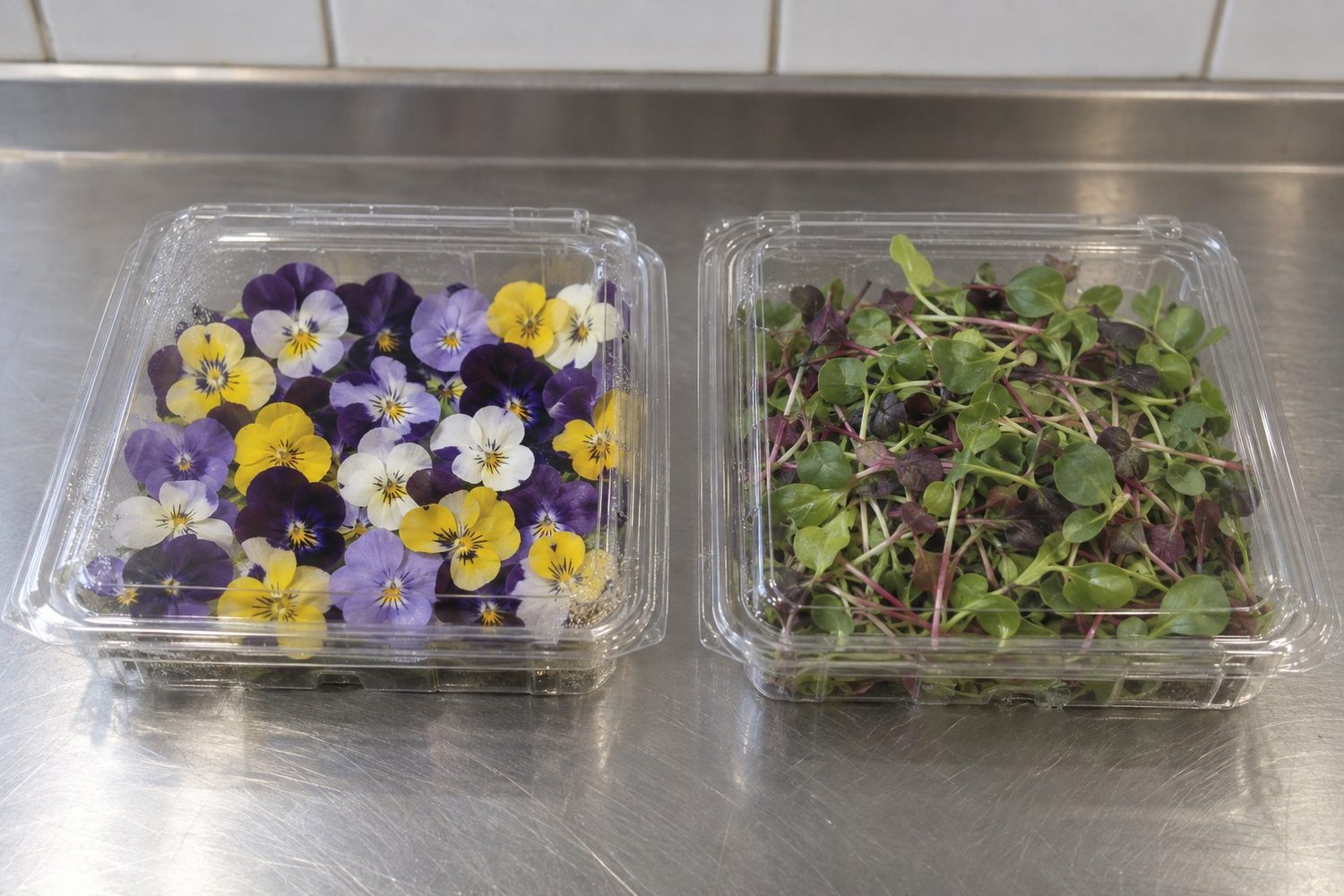
Suppliers sell them side by side but as separate items. Baldor's Fresh Origins sheet lists microgreens by weight and flowers by count, such as 50 pieces, and Midwest does the same with flowers and leaves by count. If a chef asks for both, quote and track them as separate products.
What to take into your first chef conversation
You now have three lists that look alike and mean different things. The Hermosillo survey is what seven gourmet kitchens in one Mexican city said they used. The catalog overlap is what suppliers keep on hand for restaurants. The Chef's Garden list and current grower pages are growers reporting their own sales. None of them is a count of US restaurant orders, because that count hasn't been published. So, plant a small opening set from the catalog overlap plus a red crop, ask each chef what dish it's for and how much they need a week, and let the reorders decide what earns more tray space.
Sources
Prices, stock and specifications are as the linked pages showed them on 2026-09-12.
- Yanes-Molina et al., pp. 130 to 133
- Johnny's guide
- Baldor/Fresh Origins
- Midwest Foods
- Hilite Fine Foods
- Piedmont Microgreens
- The Hubb
- Koppert Cress
- ACF, April 2010, pp. 28 and 29
- On The Grow
- Nags Head chef menu
- ICE
- thread
- NRA methodology
- NRA show-floor report
- MicroFreshly
- FDA guidance, pp. 9 and 10
- FDA's Produce Safety Rule
Keep reading
The journal
The Most Expensive Microgreens to Buy and Grow
Bronze fennel, red sorrel, and shiso can cost far more than common crops. See which are the most expensive microgreens to buy or grow, with dated prices.
Read The Most Expensive Microgreens to Buy and GrowThe journal
The Most Popular Microgreens, Ranked by Different Measures
Learn which crops top a US grower survey, a global market report and a seed retailer's best sellers to see the most popular microgreens three ways.
Read The Most Popular Microgreens, Ranked by Different MeasuresThe journal
What Each Microgreen Tastes Like, and What to Put It With
A flavor line for microgreens, crop by crop. Here is one for all 62 crops, and it shows the axis that actually matters is not how peppery a crop is but how much of it you can eat.
Read What Each Microgreen Tastes Like, and What to Put It WithThe journal
Are Microgreens Profitable? What the Numbers Show
Are microgreens profitable? See what a national grower survey and federal sales data show, why gross revenue is not profit, and how to run your own numbers.
Read Are Microgreens Profitable? What the Numbers Show