How to Clean an AeroGarden Between Plantings
Cal HewittPublished Checked
- aerogarden
- pod gardens
- growing
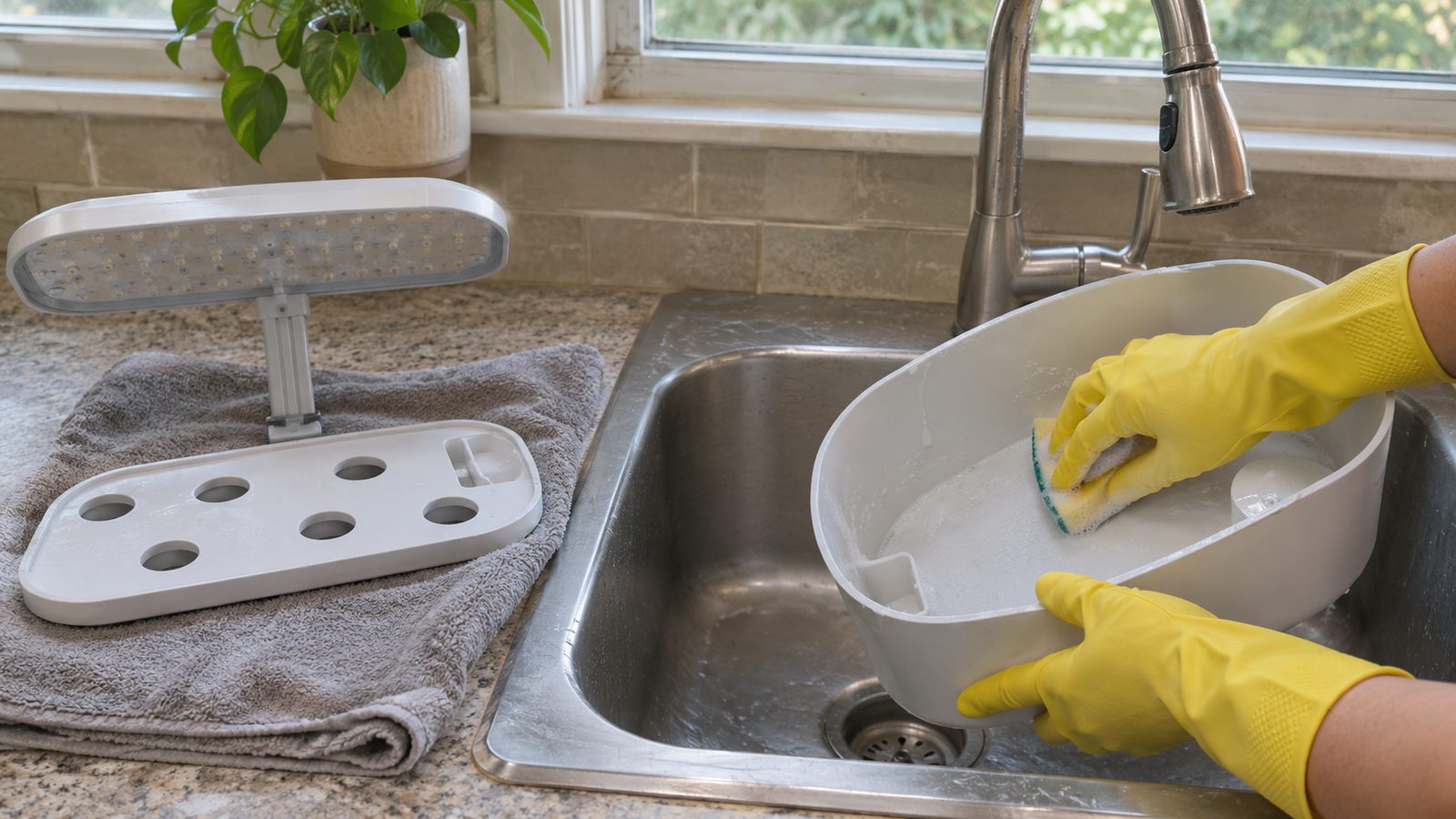
What you do depends on what you are looking at. White fuzz on top of a grow sponge is a different situation from brown, soft or slimy roots, so work out which one you have first, then follow the cleaning routine for your model.
AeroGarden's current FAQ says to clean and sanitize the garden after every planting, using either a bowl of water with 1/4 cup of chlorine bleach or 5 cups of distilled white vinegar with no water added. Never mix the two. Older models, such as the AeroGarden 3, have different instructions, so your model's manual comes first.
First, what are you looking at?
The location and look of the problem change the action, so check these before you scrub anything.
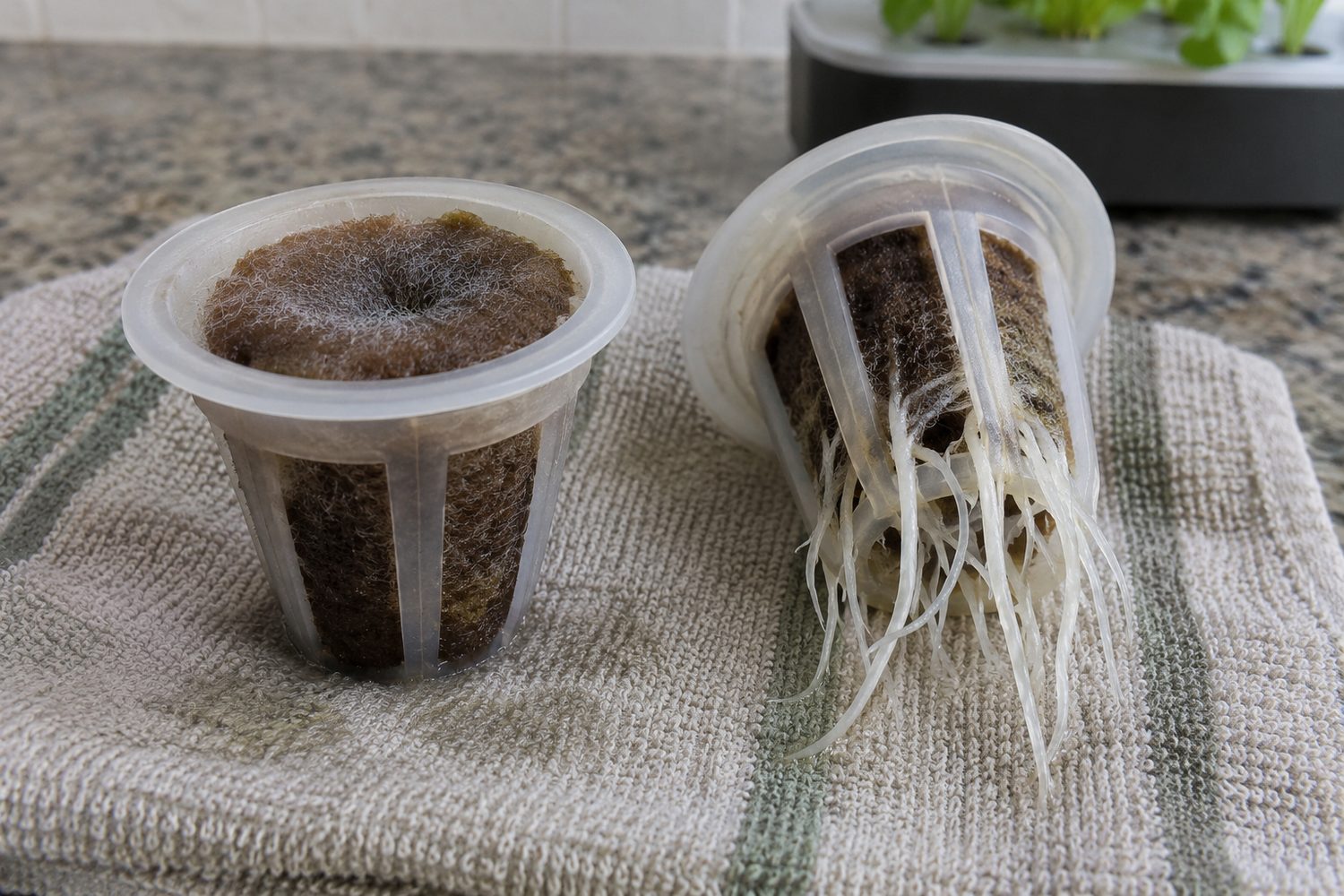
White fuzz on the top of a grow sponge. AeroGarden describes this in two ways. Its FAQ calls it likely a beneficial fungus, a sign of healthy biological activity that does not harm plants, stop seeds from sprouting or affect edibility, and that usually fades as the plants out-compete it for light, nutrients and water. Its seed-kit troubleshooting page calls the same fuzz typically mold caused by excess moisture, and says it should go away as the plant grows above the label and shades the sponge. Both descriptions are about fuzz sitting on the sponge, and in both the usual outcome is that it fades as the plant grows and shades the sponge.
Fine white fuzz on the roots. This one is harder to call. Fine, evenly spread white structures on healthy roots can be root hairs, the tiny hairs that give a root more surface to drink from. AeroGarden describes healthy roots as milky white. White fuzz on a sponge does not tell you that every white thing on the roots is mold, either.
Dark brown, soft or slimy roots. These are more consistent with root disease than with normal root hairs. Colorado State University lists brown roots, sparse root hairs, roots that may be soft or stunted, and wilting or leaf tip burn among the symptoms of root rot in hydroponic systems. Pythium is the most common cause it names. A photo cannot tell you which organism is involved, and Colorado State notes that several root diseases look alike and a trained diagnostician may be needed to name the one in your garden. If your roots are brown, soft or slimy, or the plants are wilting, ask a plant diagnostician for help, and read the root-rot section below.
Green growth in the water or around the openings. That is algae, and it is a light problem. See the prevention section.
Slime on the hard parts. University of Minnesota Extension explains that slime on the reservoir and other hard surfaces can be biofilm, a layer of microbes that can harbor bacteria. This is a reason to clean and sanitize between plantings rather than just rinse.
How to clean an AeroGarden between plantings
AeroGarden's FAQ gives two routes, depending on whether you want to use the dishwasher.
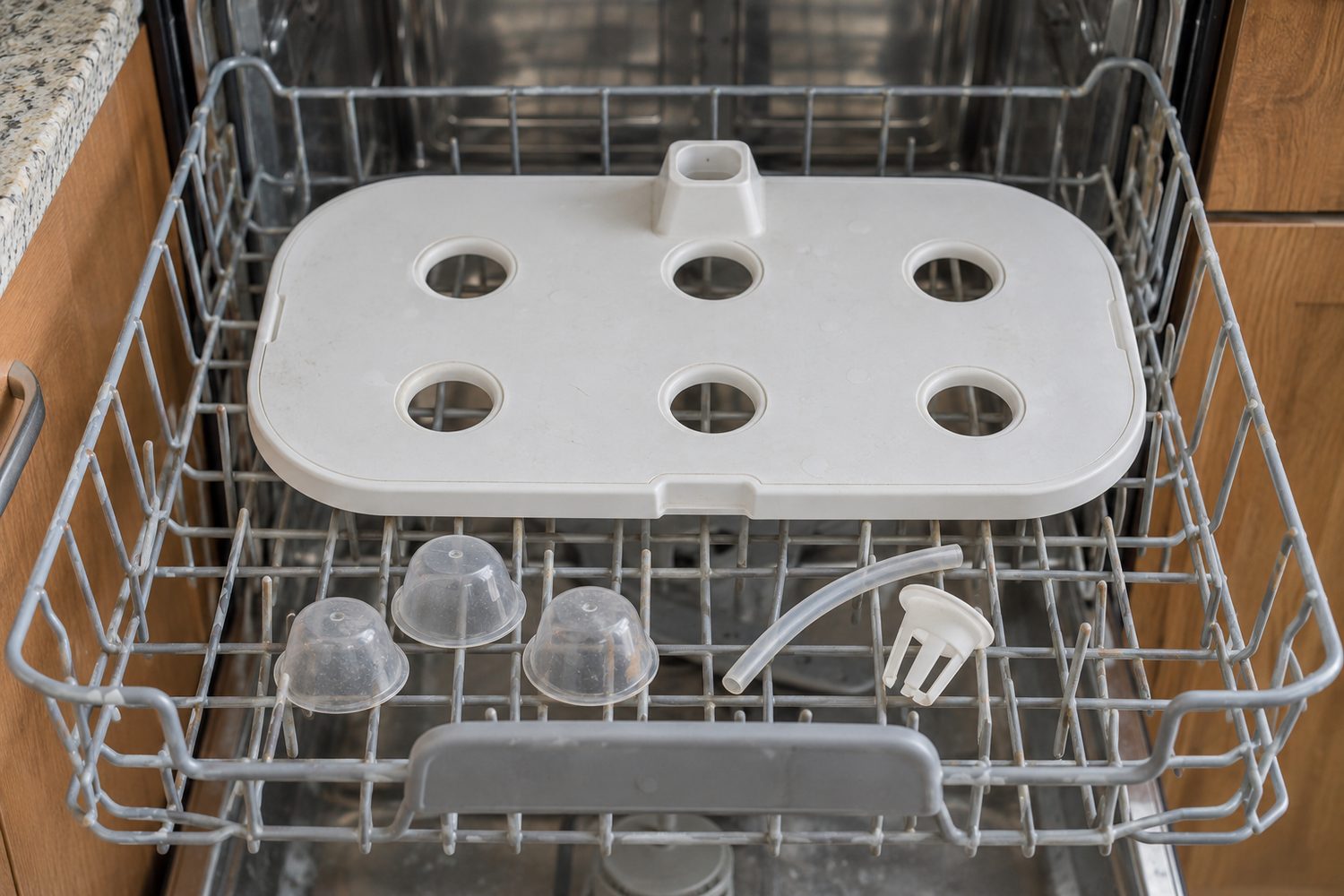
The dishwasher route
Most grow decks are top-rack dishwasher safe, according to the current FAQ. Take the pump out first, then put the grow deck and bowl on the top rack. Use a warm or cold cycle, not a hot-water or heat-dry cycle.
An older AeroGarden 3 Quick Start Guide says the opposite: use only water and mild soap for ordinary cleaning, avoid abrasive cleaners, and do not use a dishwasher. If your garden is an older model, follow its manual.
The by-hand route
Without a dishwasher, AeroGarden gives you a choice of two cleaning solutions. Use one or the other.
- Fill the bowl with water and add 1/4 cup of chlorine bleach.
- Or use 5 cups of distilled white vinegar, with no water added.
Then work through these steps:
- Circulate the solution with the pump or aerator for 5 minutes.
- Empty the bowl and rinse it well.
- Fill with clear water and circulate for 5 minutes.
- Empty and rinse again.
Never combine bleach and vinegar. Pick one and finish the full rinse.
If you have an AeroGarden 3
The older AeroGarden 3 guide sanitizes differently. It specifies 1/8 cup (24 ml) of chlorine bleach in a bowl filled three-quarters full, a 2-minute contact time, and thorough rinsing afterward. That is not the same as the current FAQ's 1/4 cup and 5-minute circulation, which is why the manual for your own model should win wherever the two differ.
What about other cleaners and sanitizers?
University of Minnesota Extension gives a general hydroponic sanitizing sequence for the reservoir and every part that touches water or plants: drain the system, wash surfaces with dish soap, water and a scrub brush, rinse with potable water, spray or dunk the parts in a sanitizer, and let them air-dry. Its example chlorine sanitizer for hydroponic systems in general is 1 tablespoon of household bleach in 1 gallon of water, about 150 to 200 ppm, with no rinse afterward and air-drying instead. That is not an AeroGarden instruction. AeroGarden's own steps use different bleach amounts and end with rinses, so for the garden itself follow the manual for your model, not these figures.
Hydrogen peroxide is not on AeroGarden's current cleaning list. University of Minnesota Extension and Colorado State University both say that peroxide-based products should be used only when their labels say they are safe for food-contact or hydroponic use, and then exactly as the label directs. If you want to go beyond the manufacturer's steps, use only a product labeled for hydroponic or food-contact use and follow its label. For a plant that is already struggling, ask a plant diagnostician instead of improvising a dose.
Your own model's manual is the final word.
Can you save plants with brown, slimy roots?
Owner experiences differ. In AeroGarden owner threads on Reddit, one owner said they usually throw out a planting that has problems and restart, and that a second attempt sometimes works. Others described changing the water and trimming roots. Treat these as individual experiences, not a success rate. One owner's fix is no guarantee for your plants.
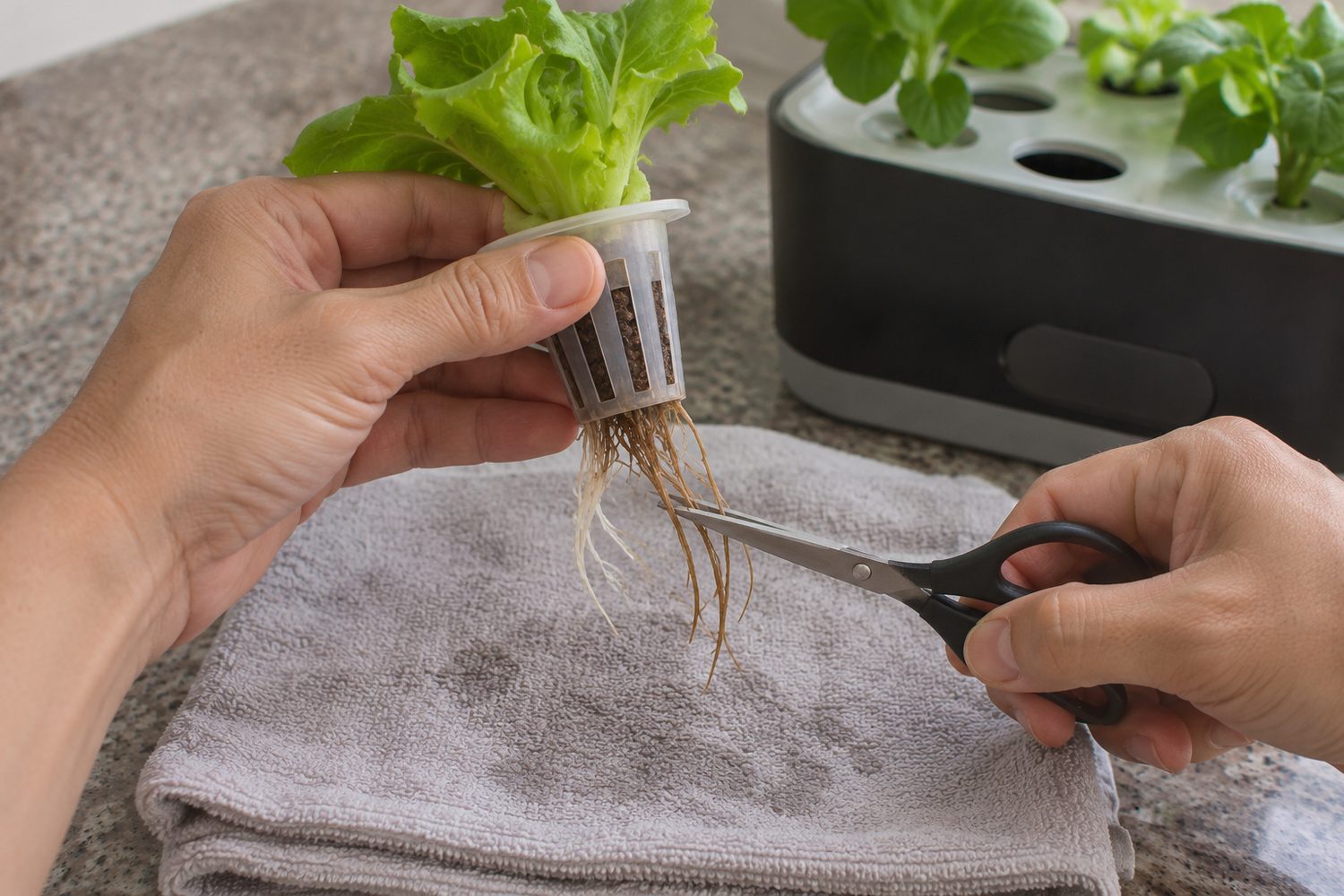
University of Minnesota Extension says excess water can keep roots from getting enough oxygen, which can lead to root rot. Colorado State University says low oxygen favors root disease and gives 68 to 72°F as the best root-zone temperature. When roots are clearly declining, these are the steps the extension sources support:
- Remove the worst plants, meaning any that are visibly diseased or badly declining.
- Check that the roots are not fully submerged and that the pump or aerator is working.
- Replace the nutrient solution.
- Clean and sanitize the reservoir, deck, pump and every other part that touches water.
- If the decline is widespread or keeps going, start again with clean materials.
If the roots look healthy and only the sponge has fuzz, these steps are not what that situation calls for; follow AeroGarden's sponge guidance above.
How to keep it from coming back
Cover what the plants are not using. AeroGarden says algae is a light-exposure problem and recommends covering unused grow-deck openings with plant spacers so light cannot reach the reservoir. The spacers are opaque, and AeroGarden describes them as fitting any model. It also describes the dark grow deck on the Harvest Lite as helping prevent algae. Whatever you use to cover an opening, make it opaque. A clear or translucent cover can let enough light through to feed algae. AeroGarden's FAQ calls algae harmless to plants, but it still means light is reaching the water, and University of Minnesota Extension notes that nutrient-rich hydroponic water is prone to algal and bacterial growth, especially without aeration.
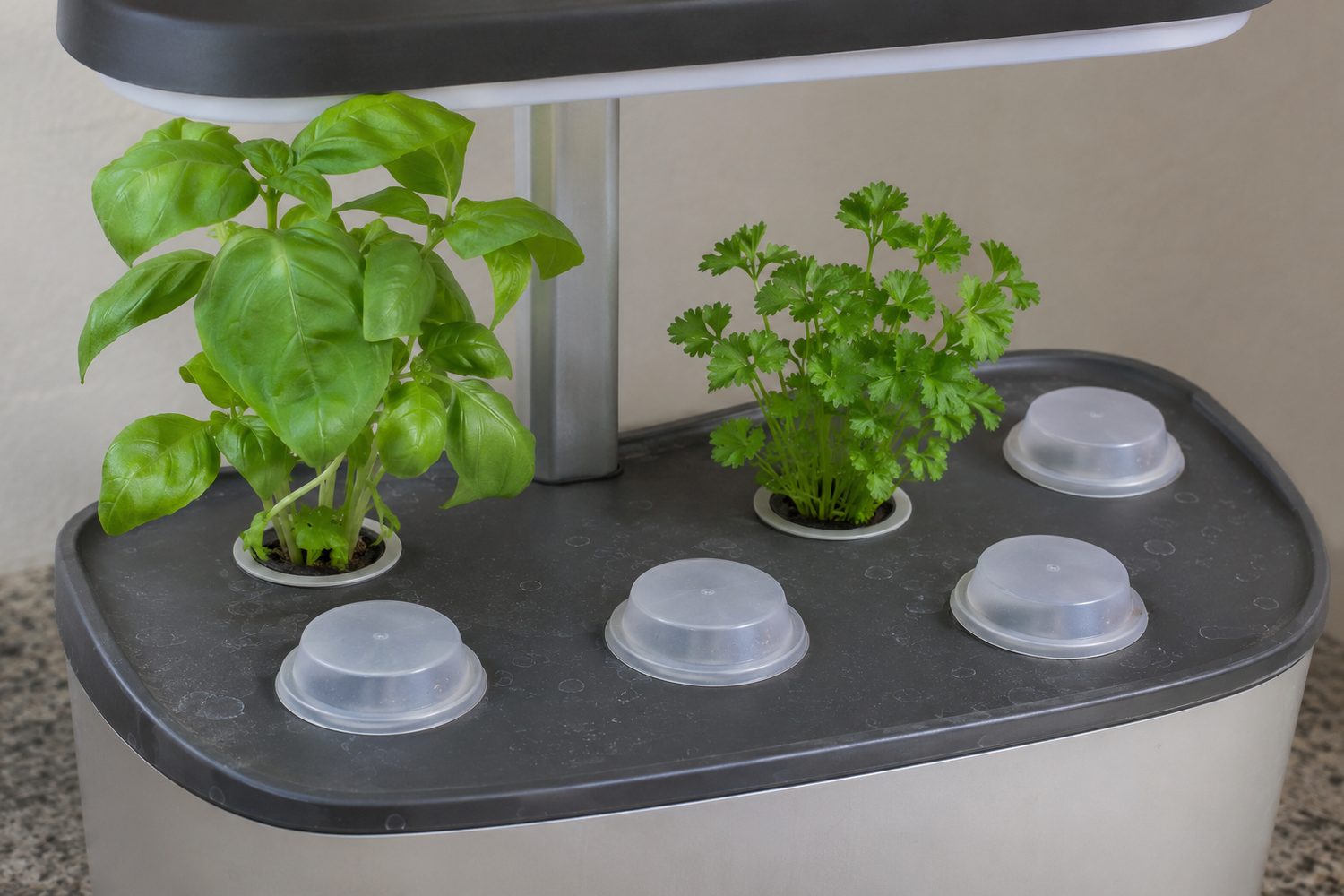
Keep roots in contact with the water, not buried in it. Roots that are fully submerged can lose their oxygen. University of Minnesota Extension recommends keeping roots in contact with water without fully immersing them, along with ventilation and clean materials.
Refresh the reservoir. AeroGarden recommends a reservoir Rinse and Refill every 4 to 6 weeks.
Keep the pump running and the garden away from heat. Colorado State University recommends aeration, balanced nutrients, and regular pH and soluble-salt checks, and warns that low oxygen favors disease. Keep the pump running and avoid putting the garden somewhere hot. Colorado State's 68 to 72°F is the best root-zone temperature for hydroponic systems in general, not a limit set for AeroGarden.
Clean after every planting. AeroGarden's FAQ recommends cleaning and sanitizing after every planting, and it helps keep slime from building up on hard surfaces.
If you are starting a new planting in a garden you have just cleaned, our posts on using your own seeds in an AeroGarden and growing microgreens in an AeroGarden cover what to put in it.
Frequently asked questions
Is white fuzz on my AeroGarden sponge mold?
AeroGarden's FAQ calls it likely a beneficial fungus that does not harm plants and usually fades as the plant grows, while its seed-kit troubleshooting page calls it typically mold from excess moisture that goes away once the plant shades the sponge. Either way, look at where it sits: fuzz on top of the sponge is treated differently from brown, slimy roots, which call for the root-rot steps above.
Can I put my AeroGarden grow deck in the dishwasher?
The current AeroGarden FAQ says most grow decks are top-rack dishwasher safe. Remove the pump, use a warm or cold cycle and skip the hot-water and heat-dry settings. The older AeroGarden 3 guide says not to use a dishwasher, so check your model's manual.
Can I use hydrogen peroxide in my AeroGarden?
It is not on AeroGarden's current list of cleaning options. If you want to use a peroxide product, choose one labeled for hydroponic or food-contact use and follow its label exactly, or ask a plant diagnostician about plants that are already declining.
How often should I clean my AeroGarden?
Clean and sanitize it after every planting. AeroGarden also recommends a reservoir Rinse and Refill every 4 to 6 weeks.
Sources
Prices, stock and specifications are as the linked pages showed them on 2026-11-13.
- AeroGarden FAQs, Scotts Miracle-Gro
- AeroGarden 3 Quick Start Guide, Home Depot PDF
- AeroGarden seed kit troubleshooting, Scotts Miracle-Gro
- AeroGarden Plant Spacer Kit, Scotts Miracle-Gro
- Small-scale hydroponics, University of Minnesota Extension
- Root Disease Problems and Management in Hydroponic Systems, Colorado State University PlantTalk
- r/aerogarden, "Mold?"
- r/aerogarden, "These plants had a strong start, but now they're struggling"
Keep reading
The journal
AeroGarden Herbs: Which Ones Struggle and How to Prune Them
Which AeroGarden herbs grow well, how to prune basil so slower herbs get light, when and how to cut, and how long each planting keeps producing.
Read AeroGarden Herbs: Which Ones Struggle and How to Prune ThemThe journal
AeroGarden Plant Food Cost: Doses and Hydroponic Alternatives
Running low on AeroGarden plant food? Hydroponic nutrients such as FloraSeries and MaxiGro have their own rates, so check the label before you switch.
Read AeroGarden Plant Food Cost: Doses and Hydroponic AlternativesThe journal
AeroGarden Seed Starting System: Which Size Fits Your Garden
AeroGarden seed starting system trays come in four versions. Match one to your garden, start seeds weeks before the last frost, then move seedlings to soil.
Read AeroGarden Seed Starting System: Which Size Fits Your GardenThe journal
AeroGarden Tomatoes, Peppers and Cucumbers: Which Model Fits
AeroGarden tomatoes call for a tall model, such as Bounty or Farm, plus some help with pollination indoors. Learn which models fit and how to shake flowers.
Read AeroGarden Tomatoes, Peppers and Cucumbers: Which Model Fits