AeroGarden Plant Food Cost: Doses and Hydroponic Alternatives
Cal HewittPublished Checked
- equipment
- aerogarden
- pod gardens
- growing
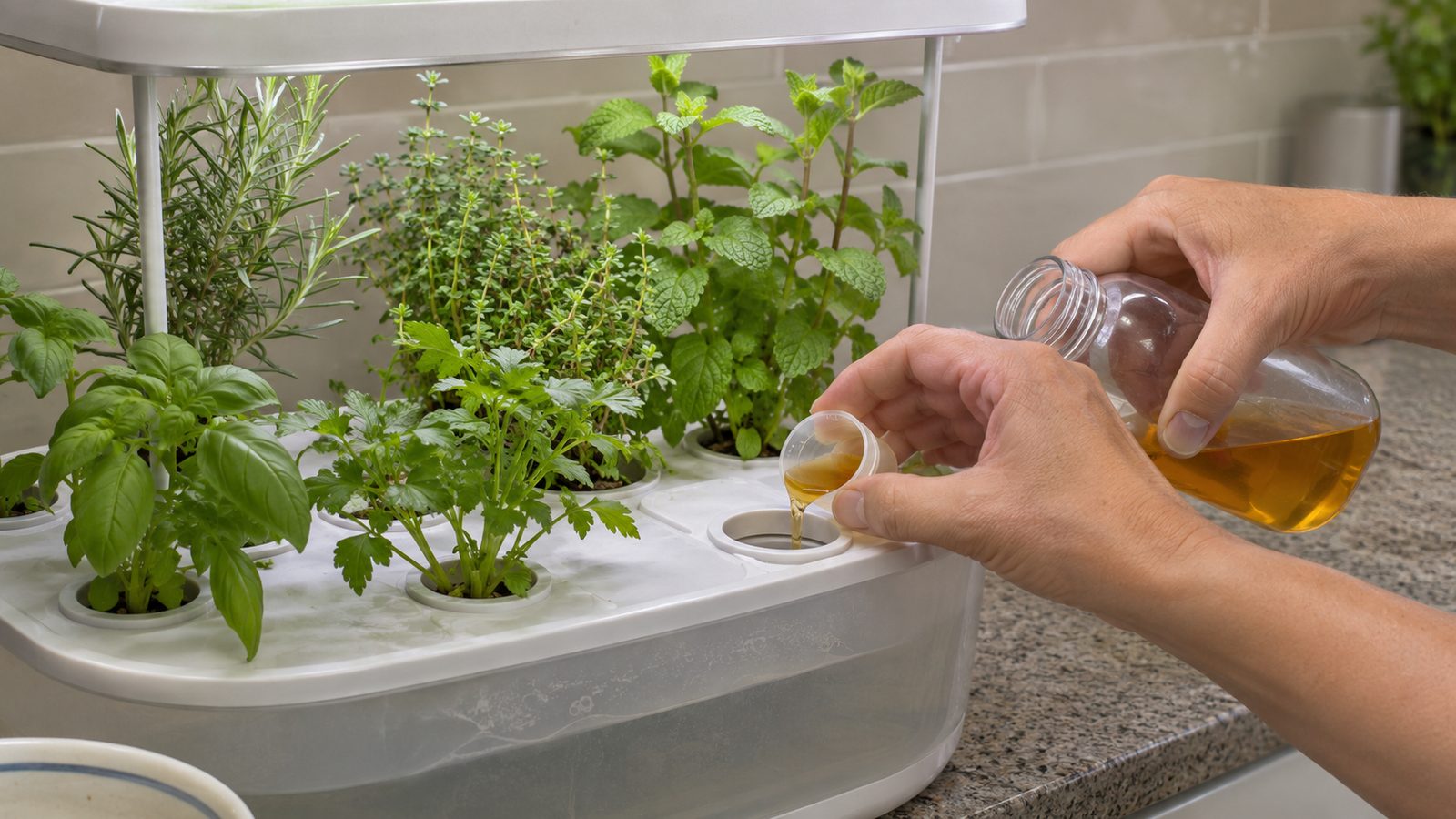
The official AeroGarden dose depends on how many pods your garden holds. A 2- or 3-pod garden gets 4 mL at planting and every 2 weeks. A 6- or 7-pod garden gets 8 mL on the same schedule. A 9-pod garden gets 8 mL at planting and 2 weeks later, then 12 mL. A 12-pod garden gets 16 mL, 16 mL, then 24 mL.
If the bottle is empty or the price stings, a substitute can work, but only one with its own hydroponic label. Ordinary soil-use Miracle-Gro is not that product.
The official dose, by pod count
AeroGarden's own plant food is a pH-buffered liquid. ScottsMiracle-Gro's product page lists it at 4-3-6, meaning 4% nitrogen, 3% phosphorus and 6% potassium, plus 1.0% calcium and 0.5% magnesium. It also contains micronutrients. For a full trace list, read the guaranteed analysis printed on the bottle you are buying.
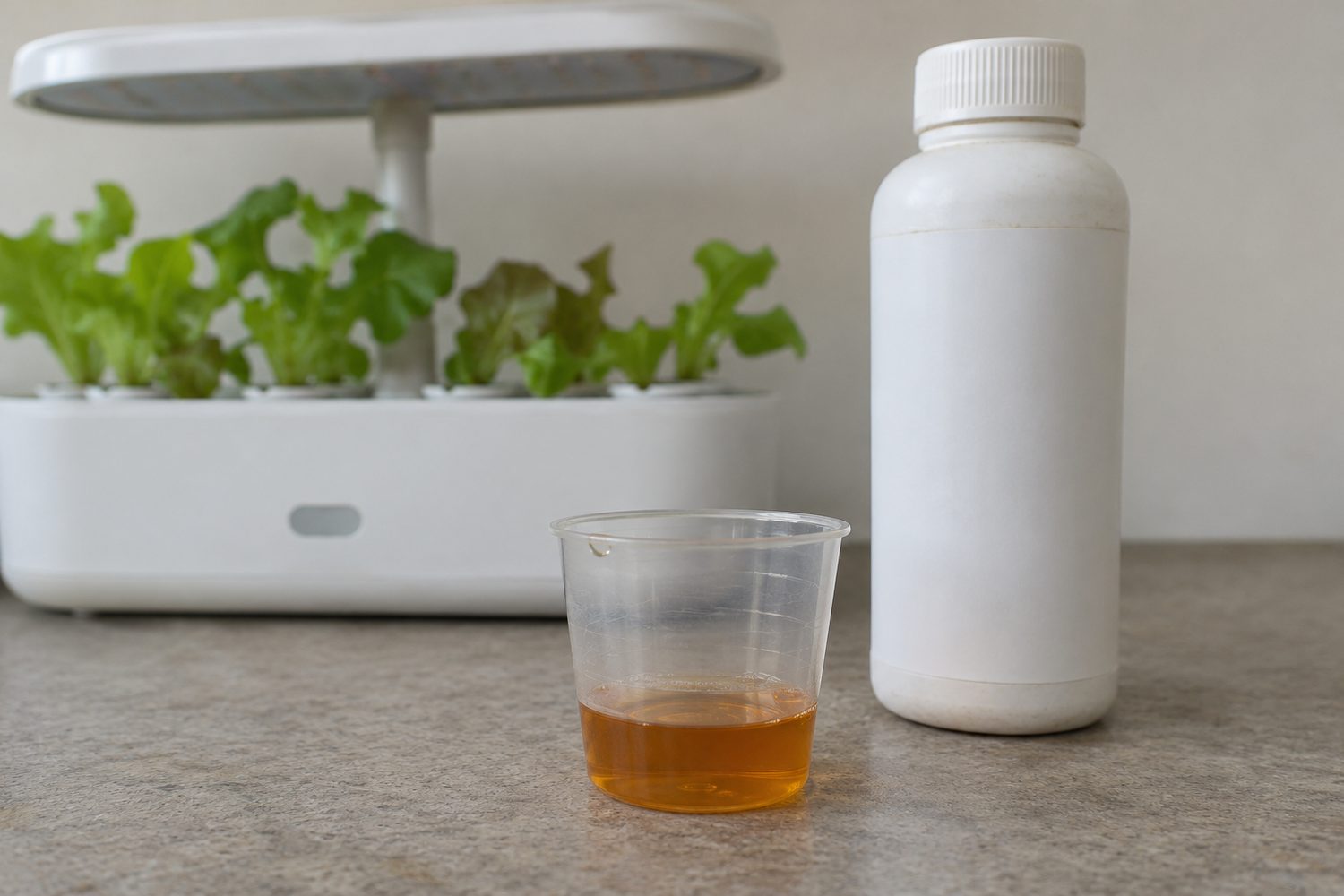
The schedule comes from that same page. The dose follows the garden's size.
Hover or tap a row to highlight it.
| Garden | At planting | Two weeks later | Every feeding after |
|---|---|---|---|
| 2 or 3 pods | 4 mL | 4 mL | 4 mL every 2 weeks |
| 6 or 7 pods | 8 mL | 8 mL | 8 mL every 2 weeks |
| 9 pods | 8 mL | 8 mL | 12 mL |
| 12 pods | 16 mL | 16 mL | 24 mL |
When you feed, top the reservoir up to the "Fill To Here" line, as the Harvest 2.0 quick setup guide says. The AeroGarden FAQ also advises emptying, rinsing and refilling the reservoir with fresh water and plant food every 4 to 6 weeks, so a long-running garden gets a full change on top of the regular doses.
The 3 fl oz bottle was listed at $11.99 on the ScottsMiracle-Gro AeroGarden page on November 13, 2026, and the label calls it one full season. For the wider cost picture, see our first-year cost breakdown. Here is the official plant food. Before you count on a particular bottle being in stock, it helps to know whether AeroGarden is still in business.
If you are still sorting out which garden you own, start with what an AeroGarden is. The Bounty review and Farm review cover two other models.
What the flashing light actually means
The plant food light is a timer. On Harvest-style controls it flashes every 14 days to tell you it is time to add Liquid Plant Food, according to the AeroGarden FAQ and the Harvest 2.0 guide. You add the food, then press the control the manual names to dismiss the alert and restart the timer. The Bounty Elite user guide describes a nutrient setting on that model.
That light does not measure anything in the water. It cannot tell you the reservoir is low on nutrients or that your plants are hungry. The useful habit is to follow the schedule above, write the feeding date on a calendar, and treat the light as a backup.
What a substitute has to match
The question to ask of any other product is what its label says, not what brand it is. Start with the label analysis and the instructions for hydroponic use. A nutrient that gives a rate per gallon for a water reservoir is a candidate. One that only gives soil directions is not.
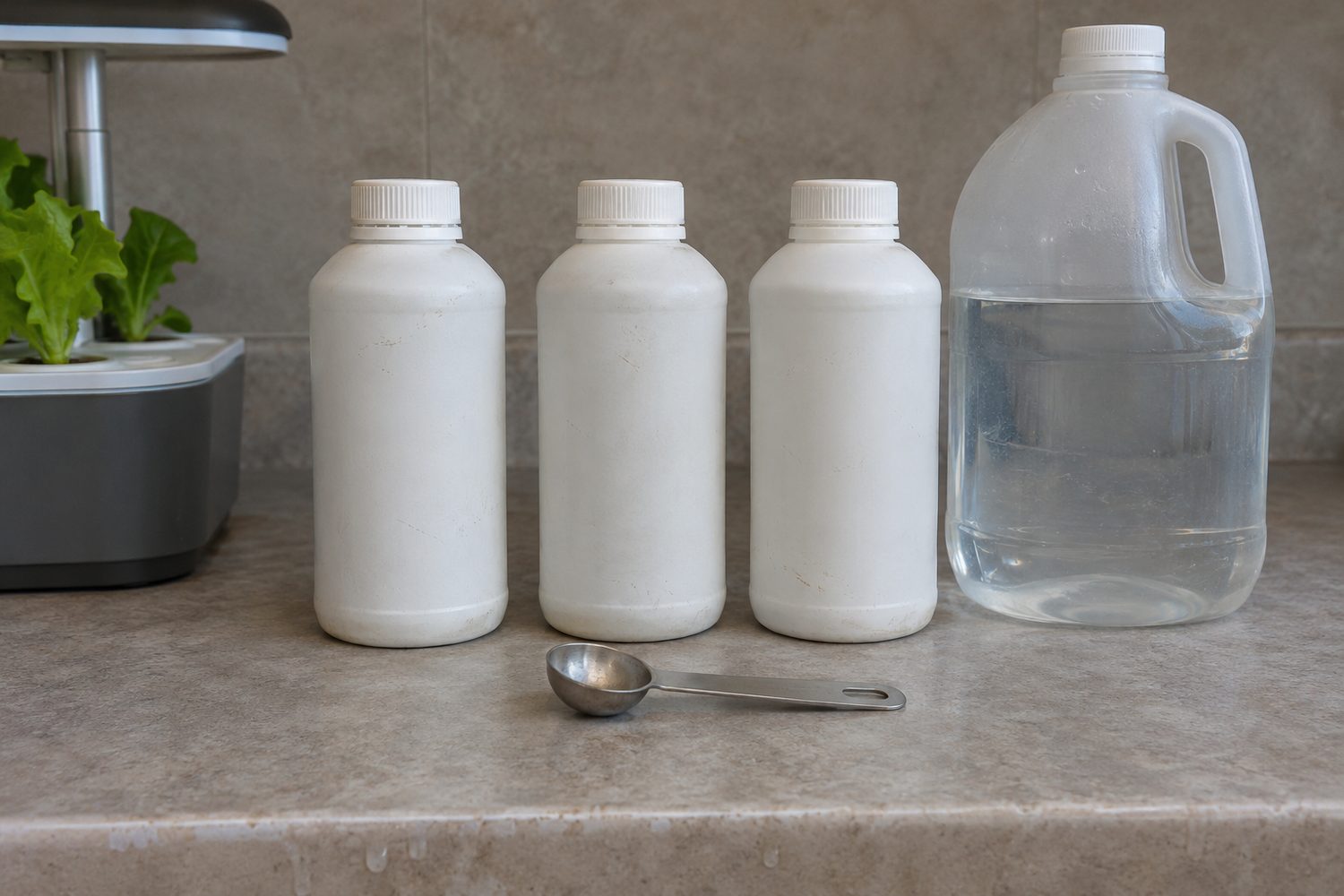
AeroGarden's food is a single liquid at 4-3-6 with calcium and magnesium already in it. Two General Hydroponics products come up in owner threads, and they are built differently.
FloraSeries is three bottles. General Hydroponics lists FloraMicro at 5-0-1 with 5% calcium, FloraGro at 2-1-6 with 0.5% magnesium, and FloraBloom at 0-5-4 with 1.5% magnesium and 1% sulfur. The maker says to add FloraMicro to fresh water first, then FloraGro and FloraBloom, mixing between additions, and to check pH and EC.
MaxiGro is one dry powder at 10-5-14, with 6% calcium and 2% magnesium on the label. The label rate is 1 to 2 teaspoons per gallon, or 5 to 10 grams per 4 liters, and for hydroponics it says to change the reservoir weekly.
Hover or tap a row to highlight it.
| Product | Analysis | Early growth | Late growth |
|---|---|---|---|
| FloraMicro | 5-0-1 | 5.2 mL | 8.5 mL |
| FloraGro | 2-1-6 | 4.8 mL | 8.0 mL |
| FloraBloom | 0-5-4 | 3.7 mL | 6.0 mL |
| MaxiGro | 10-5-14 | 1 to 2 teaspoons | 1 to 2 teaspoons |
The FloraSeries numbers come from the maker's basic feed chart. Notice the two products have a different shape. FloraSeries is three bottles to mix, and MaxiGro is one dry nutrient whose label says to change the reservoir weekly.
What the substitutes cost
The substitute prices are from Discount Hydro, read November 13, 2026. The AeroGarden bottle is from ScottsMiracle-Gro, read the same day.
Hover or tap a row to highlight it.
| Product | Size | Price | Seller |
|---|---|---|---|
| AeroGarden Liquid Plant Food | 3 fl oz | $11.99 | ScottsMiracle-Gro |
| FloraMicro | 1 quart | $15.99 | Discount Hydro |
| FloraGro | 1 quart | $9.49 | Discount Hydro |
| FloraBloom | 1 quart | $9.49 | Discount Hydro |
| MaxiGro | 2.2 lb | $14.79 | Discount Hydro |
A full FloraSeries set is the three quarts, $34.97 together at those prices. MaxiGro is the single 2.2 lb package at $14.79. The packages are far larger than the AeroGarden bottle, so the comparison that matters is price per gallon of mixed solution, and that depends on the rates in the table above and on how often you change the water. Do the math with your own reservoir size before deciding that one is cheaper.
Owners also mention Inbloom, Dyna-Gro, MasterBlend, TPS Nutrients, Ionic Grow and a Greenway Biotech tomato fertilizer. Whether any of those suits a countertop reservoir depends on its own label, analysis and hydroponic directions.
Why the AeroGarden dose cannot be converted to a strength reading
AeroGarden gives its dose in milliliters per garden size, not as a target EC or ppm. Reservoir volume, the mineral content of your starting water and the size of your plants all change the result, and none of that is fixed by model. The published dose alone cannot be converted into a reliable ppm figure to carry to a different nutrient.
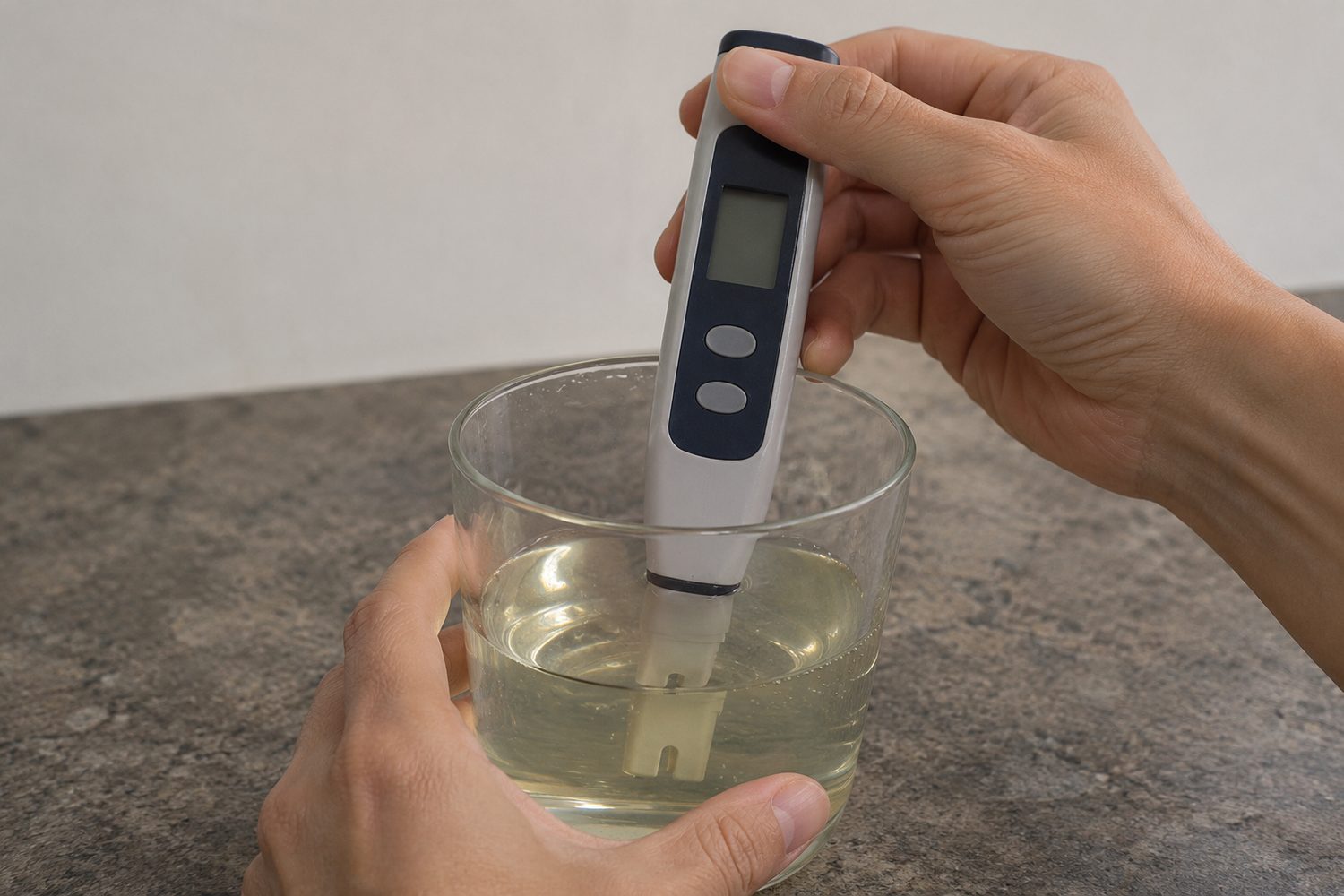
What works is to follow the substitute's own rate and then check the finished reservoir with an EC or ppm meter. EC, electrical conductivity, estimates how strong the dissolved nutrient solution is, and TDS meters commonly display a ppm value. Oklahoma State University Extension gives these targets:
Hover or tap a row to highlight it.
| Crop | EC (mS/cm) | pH |
|---|---|---|
| Basil | 1.0 to 1.6 | 5.5 to 6.0 |
| Lettuce | 1.2 to 1.8 | 6.0 to 7.0 |
| Parsley | 1.8 to 2.2 | 6.0 to 6.5 |
| Sage | 1.0 to 1.6 | 5.5 to 6.5 |
If you grow basil and lettuce in the same reservoir, those ranges overlap between 1.2 and 1.6. The General Hydroponics feed chart gives its own EC ranges too, including 1.3 to 1.5 mS/cm for early growth and 2.0 to 2.5 for late growth in one program, so the maker's ranges and the university's are not the same numbers. Use the nutrient maker's label rate and read the meter on the finished reservoir.
Can you use Miracle-Gro?
Not as labeled. Miracle-Gro Liquid All Purpose Plant Food is 12-4-8 and is labeled for soil and container plants: 1 teaspoon per gallon applied to soil every 2 weeks. Its directions do not cover a hydroponic reservoir. A Tractor Supply listing for the water-soluble all-purpose product states that it is not recommended for hydroponic gardening.
If you want something other than the AeroGarden bottle, buy a nutrient whose label gives hydroponic instructions. Owners disagree about Miracle-Gro in this Reddit discussion: some report using Miracle-Gro or related products successfully, and others say ordinary all-purpose formulas lack a complete nutrient profile or hydroponic directions. Those are individual practice reports, and a soil label is not a guide to a water reservoir.
What owners report after switching
What follows is what owners say. Treat each as one person's result with their own water, plants and meter.
On a May 2025 thread about alternatives, one owner reported "very very good" results with all three FloraSeries products plus CalMag+ for tomatoes and peppers. A second said growth was larger and faster with more fruit. A third used MaxiGro in three gardens and said all three did well at 1,000 to 1,300 ppm on a TDS meter.
In an October 2024 thread, one commenter said FloraSeries crystallized and switched to MaxiGro with "great results." Another said they had used MaxiGro for years. In a March 2025 thread, an owner reported healthy plants and clean roots with 1 teaspoon of MaxiGro per gallon, and a commenter added CalMag for soft water.
A January 2025 thread has one owner reporting good results with Inbloom A&B on lettuce, tomatoes, jalapeños and basil, and another saying Dyna-Gro seemed to work as well as AeroGarden's food. And in a 2026 thread, one owner got excellent FloraSeries results but went back to AeroGarden's food because FloraSeries took too much mixing.
Owners who named a drawback for FloraSeries cited crystallizing and the mixing effort. Marketplace reviews on retailer pages are single opinions as well, so compare the exact product, label rate and review date before you lean on one. If you grow from your own seed, our guide to using your own seeds in an AeroGarden and the post on growing microgreens in an AeroGarden cover the plants side, and the AeroGarden vs LetPot comparison covers a competing garden.
Frequently asked questions
How much plant food does a 6-pod AeroGarden need?
A 6- or 7-pod garden gets 8 mL at planting and 8 mL every 2 weeks after. Add it when the light flashes, and top the reservoir to the "Fill To Here" line. The 3 fl oz bottle covers one full season by its label.
Is there a separate food for tomatoes?
AeroGarden's tomato seed kits come with the same Liquid Plant Food. Follow the dose for your pod count. Tomatoes and peppers also need hand pollination and more pruning, so keep them inside your garden model's height and support limits.
How often should I change the water?
The AeroGarden FAQ advises emptying, rinsing and refilling with fresh water and food every 4 to 6 weeks. A general garden page describes a full water change about once a month. If you switch to MaxiGro, its own label says to change a hydroponic reservoir weekly.
Does a pH or EC meter matter?
AeroGarden's food is pH-buffered, and its dose is given by garden size. With a substitute you are setting the strength yourself. A basic EC or ppm meter lets you check the reservoir against the targets above, and the FloraSeries maker also recommends checking pH and EC.
Where this leaves you
If you are on AeroGarden's bottle, use the dose for your pod count, add it when the light flashes, and fill to the line. If you are switching, read the new label first, start at its stated rate, keep the water at the fill line, and check the finished reservoir with an EC or ppm meter. Use a product with its own hydroponic directions, and keep the bottle-directed dose for the AeroGarden's own food.
Glossary
NPK :: The three fertilizer numbers representing nitrogen, available phosphate, and soluble potash.
Guaranteed analysis :: The nutrient percentages the fertilizer label guarantees.
Macronutrient :: A nutrient plants need in relatively large amounts, including nitrogen, phosphorus, and potassium.
Micronutrient :: A nutrient plants need in smaller amounts, such as iron, manganese, zinc, boron, copper, molybdenum, and chlorine.
EC :: Electrical conductivity, a measure of dissolved salts used to estimate nutrient-solution strength.
PPM :: Parts per million, commonly used by TDS meters to estimate dissolved-solids concentration.
pH :: A measure of acidity or alkalinity in the nutrient solution.
pH-buffered :: Formulated to resist changes in pH under specified water conditions.
Reservoir :: The water bowl containing the hydroponic nutrient solution.
TDS meter :: A meter that estimates dissolved solids in water and commonly displays a ppm value.
Sources
Prices, stock and specifications are as the linked pages showed them on 2026-11-13.
- ScottsMiracle-Gro's product page
- Harvest 2.0 quick setup guide
- AeroGarden FAQ
- ScottsMiracle-Gro AeroGarden page
- Bounty Elite user guide
- General Hydroponics lists
- label
- basic feed chart
- Discount Hydro
- Oklahoma State University Extension
- Miracle-Gro Liquid All Purpose Plant Food
- Tractor Supply listing
- this Reddit discussion
- a May 2025 thread about alternatives
- October 2024 thread
- March 2025 thread
- January 2025 thread
- 2026 thread
Keep reading
The journal
AeroGarden Seed Starting System: Which Size Fits Your Garden
AeroGarden seed starting system trays come in four versions. Match one to your garden, start seeds weeks before the last frost, then move seedlings to soil.
Read AeroGarden Seed Starting System: Which Size Fits Your GardenThe journal
Can You Grow Microgreens in an AeroGarden? What Owners Do
The AeroGarden MicroGreens Kit is hard to find. Learn how owners still grow microgreens in an AeroGarden with a simple tray beside the light.
Read Can You Grow Microgreens in an AeroGarden? What Owners DoThe journal
AeroGarden Herbs: Which Ones Struggle and How to Prune Them
Which AeroGarden herbs grow well, how to prune basil so slower herbs get light, when and how to cut, and how long each planting keeps producing.
Read AeroGarden Herbs: Which Ones Struggle and How to Prune ThemThe journal
AeroGarden Tomatoes, Peppers and Cucumbers: Which Model Fits
AeroGarden tomatoes call for a tall model, such as Bounty or Farm, plus some help with pollination indoors. Learn which models fit and how to shake flowers.
Read AeroGarden Tomatoes, Peppers and Cucumbers: Which Model Fits