Sell Microgreens Online: Choosing a Carrier and Packing the Box
Cal HewittPublished Checked
- selling microgreens
- storage
- economics
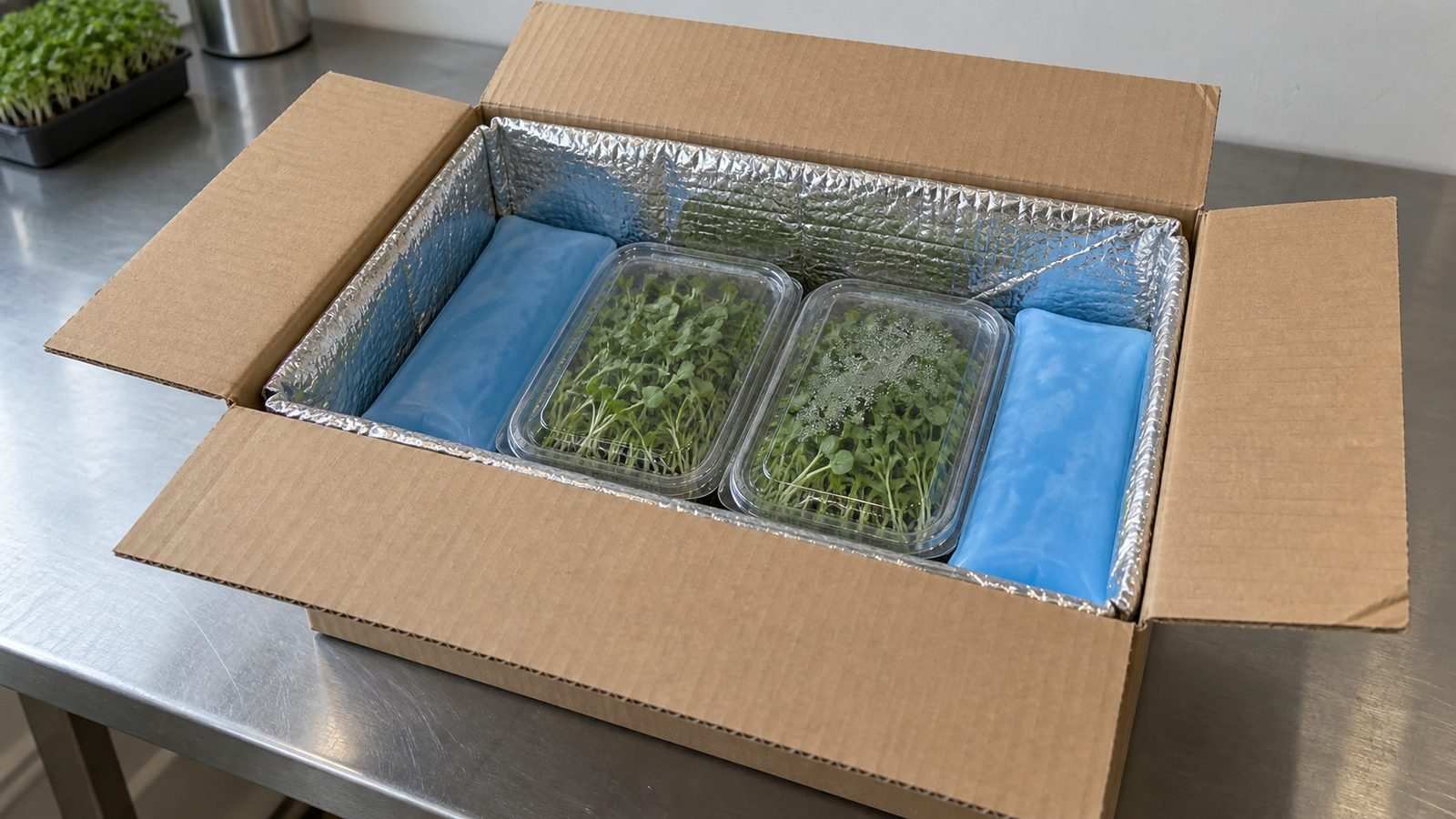
Cut microgreens can go out by parcel, but no carrier keeps them cold for you, so the box has to do that work. Book the fastest published commitment for each lane: USPS Priority Mail Express, UPS Next Day Air, or a FedEx overnight or 2Day service. Ship Monday through Wednesday.
Pack the greens in an insulated liner inside a corrugated box with gel packs, aiming to hold them at or below 4 degrees Celsius. Then price the box by the weight the carrier bills rather than the weight on your scale, because at FedEx a 2-lb pack in a 12 x 12 x 12 in box bills as 13 lb.
Everything below is about cut, packed greens. A living tray with roots and growing medium is a plant shipment with its own rules, covered on the live trays and APHIS interstate page. For the retail pack itself, see the packaging and presentation guide.
Pick a carrier and service for each lane
Start with the delivery commitment each carrier publishes, because that is the clock your box has to beat.
USPS Priority Mail Express promises 1- or 2-day service by 3 p.m. to eligible addresses, with 365-day delivery in many locations. Sunday, holiday and 10:30 a.m. service depend on the location and cost extra (USPS Priority Mail Express).
UPS tells perishable shippers to plan for a maximum 30-hour transit, use Next Day Air, keep 2nd Day Air for food that needs only minimal temperature control, and ship early enough to avoid a weekend hold (UPS food guidance). The same page says perishable food is carried on a contractual basis for regular-volume shippers who meet UPS's requirements, so talk to UPS about an account before you plan around it.
FedEx sells time-definite overnight service and FedEx 2Day, both priced on its 2026 retail rate sheet.
Weather can delay any of these, and none of them is a temperature-controlled service. That leads to a simple rule. Put each customer's ZIP code into the carrier's quote tool and sell shipped orders only where the quoted commitment is one business day. Ship Monday through Wednesday, so a one-day delay still lands on a weekday, and add a weekend lane only after you have checked that the carrier accepts and delivers on those days for that exact route.
Know, too, what happens when a box arrives warm. USPS sells insurance, but it will not pay a claim for a spoiled perishable (USPS domestic claims). UPS's tariff says perishables travel at the shipper's risk and UPS accepts no claims for heat or cold damage, even with a service guarantee (UPS tariff effective April 17, 2026, section 3.15). FedEx accepts perishables solely at the shipper's risk for heat or cold damage and bars damage claims on perishables sent by FedEx Ground or FedEx Home Delivery (FedEx Service Guide 2026). Budget replacements and refunds as your own cost, and leave Ground and Home Delivery off your list for greens.
Pack the box to hold cold past the delivery date
Alberta Agriculture's commercial microgreens guide recommends holding harvested greens at or below 4 degrees Celsius and names transport and storage conditions as the major shelf-life factors (Alberta Agriculture, 2018). Warmer storage costs days: at 10 degrees Celsius instead of 4, arugula and red cabbage microgreens lasted 7 days instead of 14, and radish 14 days instead of 21 (Berba and Uchanski, 2012). Those are storage results, not a per-hour penalty for a warm truck, but they show why the cooling is worth the trouble.
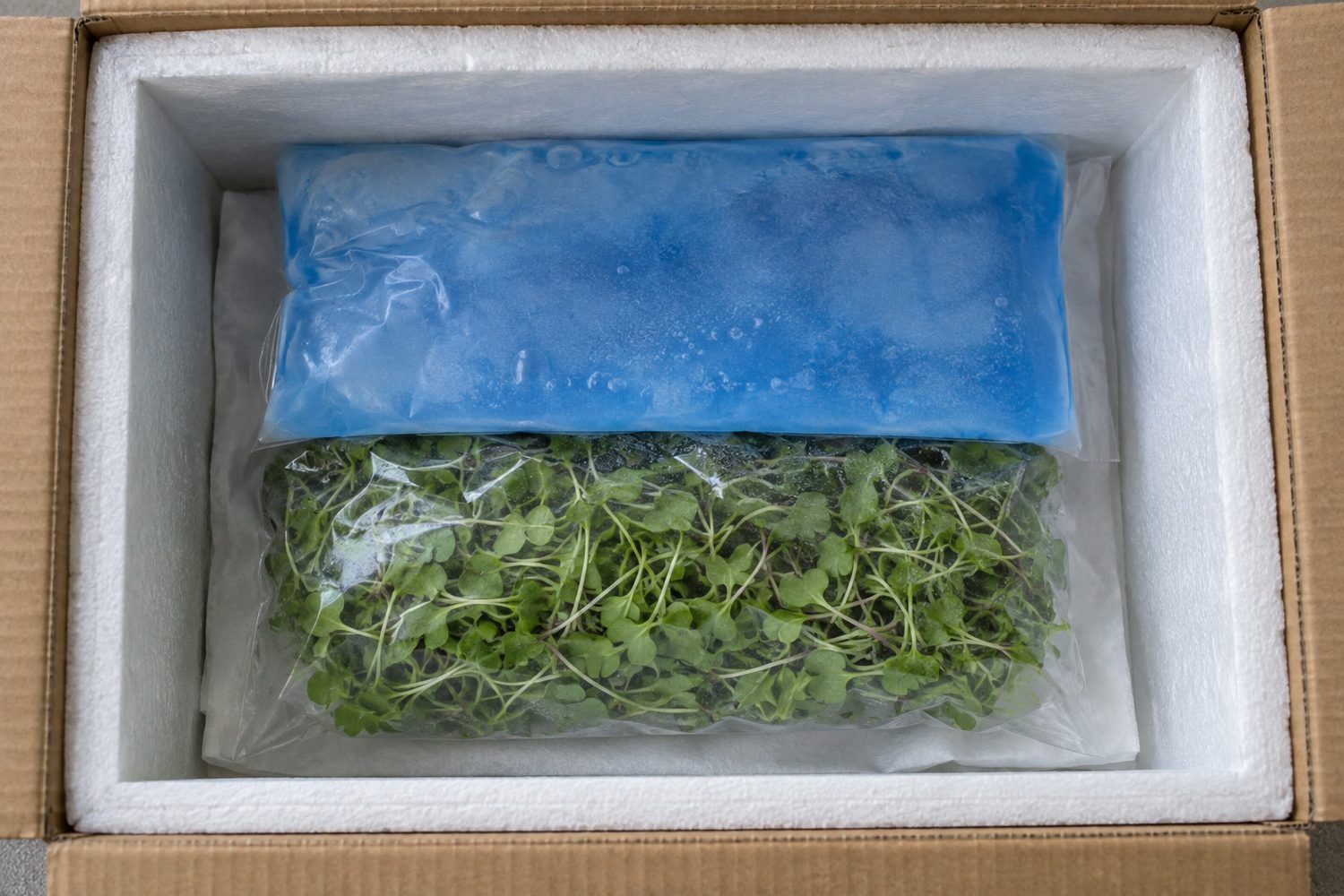
FedEx's perishable guide lays out a build that works whichever carrier you use (FedEx perishable guide):
- Cool the greens and the container before you pack. Alberta's guide says to avoid delay between harvest, washing and drying, and packing.
- Where moisture can escape, add a 2-mil watertight liner and absorbent material.
- Set the packed greens inside an insulated foam container or liner, with the coolant around and on top of them.
- Close it inside an outer corrugated box.
- Mark the box "Perishable," put the label on top, and give 24-hour phone numbers for both you and the recipient.
USDA's mail-order guidance adds "Keep Refrigerated" on the box, a heads-up to the customer, and a check that refrigerated food is below 40°F on arrival (USDA FSIS mail-order bulletin, revised January 2008).
FedEx sets one more requirement, and it changes how much coolant you need. Its Service Guide requires perishables to be packed to survive at least 24 hours beyond the delivery commitment (FedEx Service Guide 2026). For a FedEx overnight box, design for the transit day plus another full day. That is a sensible target on the other carriers too.
Gel packs or dry ice
Gel packs are the match for chilled greens. FedEx describes them for goods held at 34 to 50°F (1 to 10°C) and dry ice for frozen goods (FedEx perishable guide). Virginia Cooperative Extension advises checking reusable gel packs for leaks (Virginia Tech produce transport).
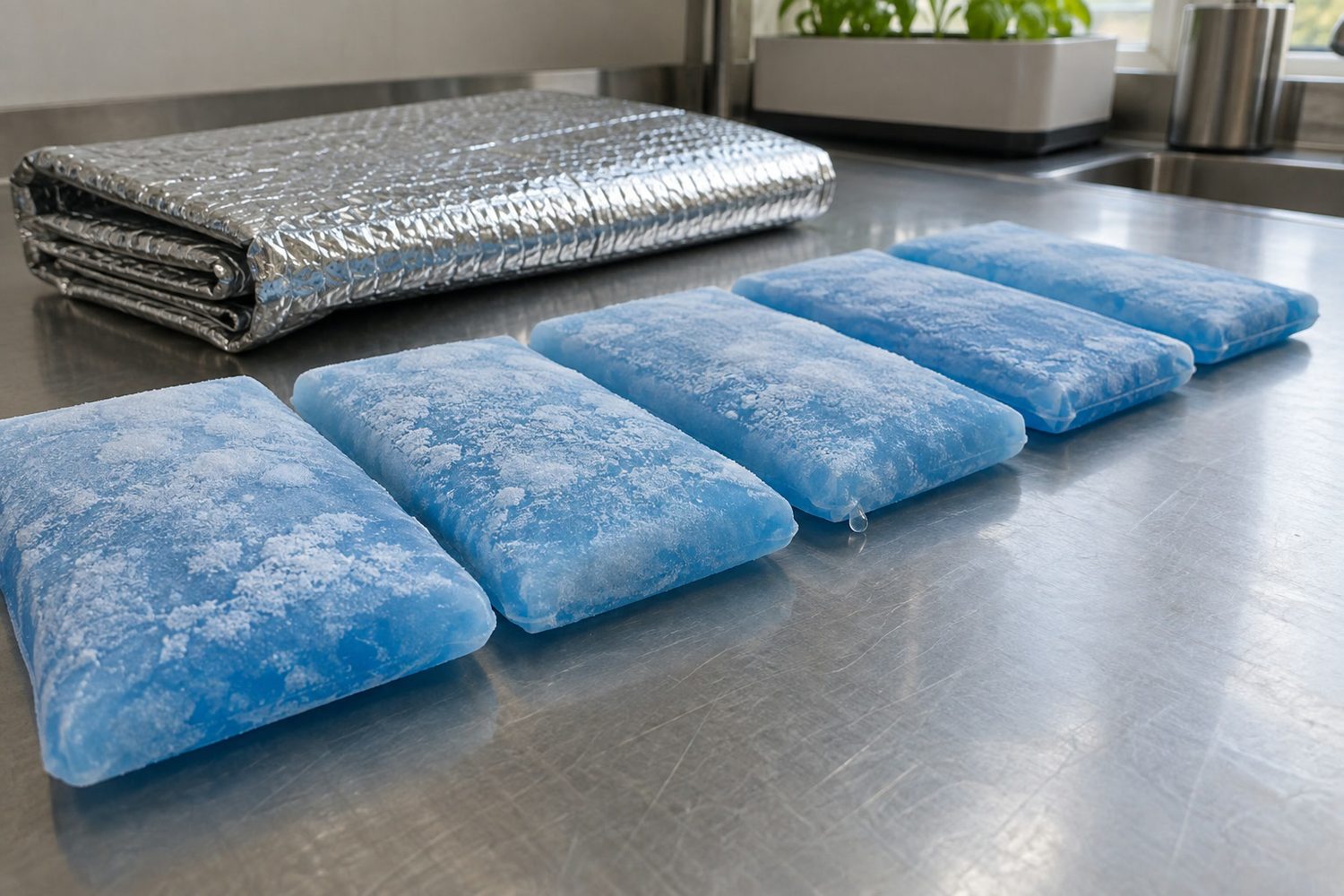
Dry ice is meant for frozen goods, which makes it a poor match for fresh greens, and each carrier sets terms if you use it. UPS's 2026 tariff accepts packages that use dry ice only as a coolant, with no other hazardous materials, on UPS Ground and Air services without a Hazardous Materials Agreement, provided they are prepared under applicable government regulations (UPS tariff 2026, section 3.10). USPS allows it as a refrigerant in a venting container, capped at 5 lb per air mailpiece (USPS Packaging Instruction 9A). FedEx treats it as dangerous goods with its own venting and marking rules (FedEx dry-ice guide).
How many gel packs
The gel a box needs depends on your pack weight, your liner and the lane's weather, so find your own number. Put your pack and your gel packs on a scale, write both weights down, and test a box in your hottest expected week before you sell into that lane. A caution from outside microgreens explains why: a North Carolina State University review of delivered meal kits found 55 of 72 boxes had at least one item above 40°F on opening, and 93% of gel-pack deliveries had at least one item above 40°F (NC State meal-kit summary, archived capture).
Those were meal kits, not greens, but they show that an insulated box with gel inside is not proof the food stayed cold.
What one box costs once dimensional weight is counted
FedEx bills the greater of the actual weight and the dimensional weight, which is length times width times height in inches divided by 139 (FedEx 2026 retail rates). A 12 x 12 x 12 in box holds 1,728 cubic inches, which divides out to about 12.4, and the box bills as 13 lb even with only 2 lb of greens inside.
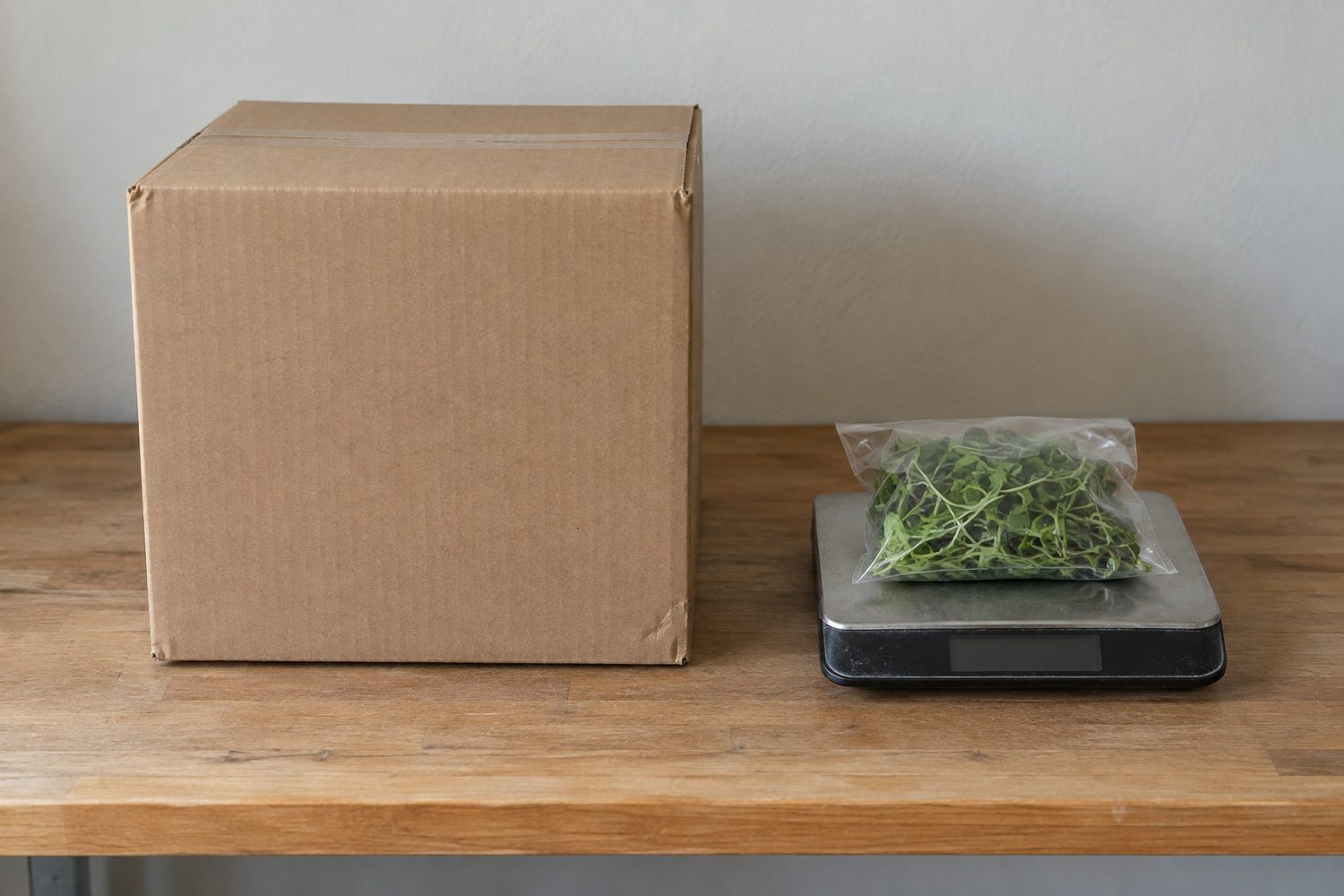
On the 2026 FedEx retail sheet, a 13-lb billed package in Zone 2 costs $69.36 by Standard Overnight or $43.65 by FedEx 2Day, before applicable surcharges. The same sheet lists $43.54 Standard Overnight and $27.54 FedEx 2Day in Zone 2, but those apply only to a package that bills at 2 lb. A 12-inch insulated cube is not that package, so do not use the 2-lb price as your shipping cost.
Here is the FedEx 2Day box line by line, with packaging at WebstaurantStore prices listed on 2026-09-12 (tax and freight excluded):
Hover or tap a row to highlight it.
| Line | Cost | Source |
|---|---|---|
| FedEx 2Day, Zone 2, 13 lb billed | $43.65 | FedEx 2026 retail rates |
| 12-in insulated liner ($59.99 per 25) | $2.40 | WebstaurantStore, 2026-09-12 |
| 12-in corrugated box ($32.99 per 25) | $1.32 | WebstaurantStore, 2026-09-12 |
| Two 48-oz gel packs ($18.49 per 12) | $3.08 | WebstaurantStore, 2026-09-12 |
| Total before surcharges | about $50.45 |
That is $6.80 of packaging per box, and the same $6.80 goes on top of the $69.36 Standard Overnight rate if your lane needs overnight. The two gel packs are for costing only; your summer test decides the count.
No UPS rate appears here. UPS publishes daily rates for account and pickup customers in its 2026 Daily Rate and Service Guide and points everyone else to its time-and-cost calculator (UPS rates), and USPS Priority Mail Express pricing depends on zone and format, so quote both carriers for your own lanes. Save a dated screenshot of each quote with the box dimensions and billed weight. The pricing guide covers turning that box cost into an order price, and the subscriptions and delivery guide covers local drop-off routes as an alternative to parcels.
Food-by-mail rules that apply to a shipped order
USPS mailability. USPS Publication 52, in its current August 2026 edition, does not bar cut microgreens. Section 53 says fresh fruits and vegetables are nonmailable unless presented in a "dry (not dried) condition," and it does not define that condition or mention leafy greens (USPS Publication 52, section 53). The publication provides for requests for rulings in section 215, so ask USPS for a written answer about your packed greens before you mail them.
Destination law. UPS will not carry what origin or destination law prohibits (UPS restricted items). Before adding a state, write to its agriculture or food agency and ask whether packed cut microgreens need an entry permit, inspection or particular labeling, and keep the reply on file.
Your own state's rules. A state home-food registration is not permission to ship across state lines, and the licensing detail lives on its own pages. Start with the federal overview of cottage food and microgreens, which leads on to the state guides.
The federal Produce Safety Rule. FDA treats microgreens as covered produce, separate from sprouts, unless an exemption or exclusion applies (FDA Produce Safety guidance). Farms averaging $25,000 or less in annual produce sales over the previous three years, adjusted for inflation, are not covered, and FDA's inflation-adjusted value for 2023 to 2025 is $34,324 (FDA inflation-adjusted cut-offs).
Above that line, shipping matters for the qualified exemption: consumers count as qualified end-users wherever they live, but a restaurant or retail food establishment counts only if it is in your state or within 275 miles of your farm (21 CFR 112.3). Track sales by buyer type and distance, and take the question to FDA as you approach the threshold.
The Food Traceability Rule. FDA's Food Traceability List includes fresh leafy greens and fresh-cut leafy greens, but FDA exempts food the producing farm sells direct to the consumer, and farm-packed product whose package stays intact and carries the farm name, complete address and phone number (FDA exemptions chart). Confirm how FDA classifies your crop rather than assuming every microgreen is on the list.
Test a lane before you sell into it
Run test boxes before you take orders, one crop and pack format at a time. Ship to your nearest and farthest planned ZIP codes in the hottest and coldest weeks you expect, and hold one box an extra day to act out a delay. For each box, write down the harvest time, the crop temperature at packing, the pack and gel weights, where the gel sat, the carrier scans, the weather, and the arrival time and condition.
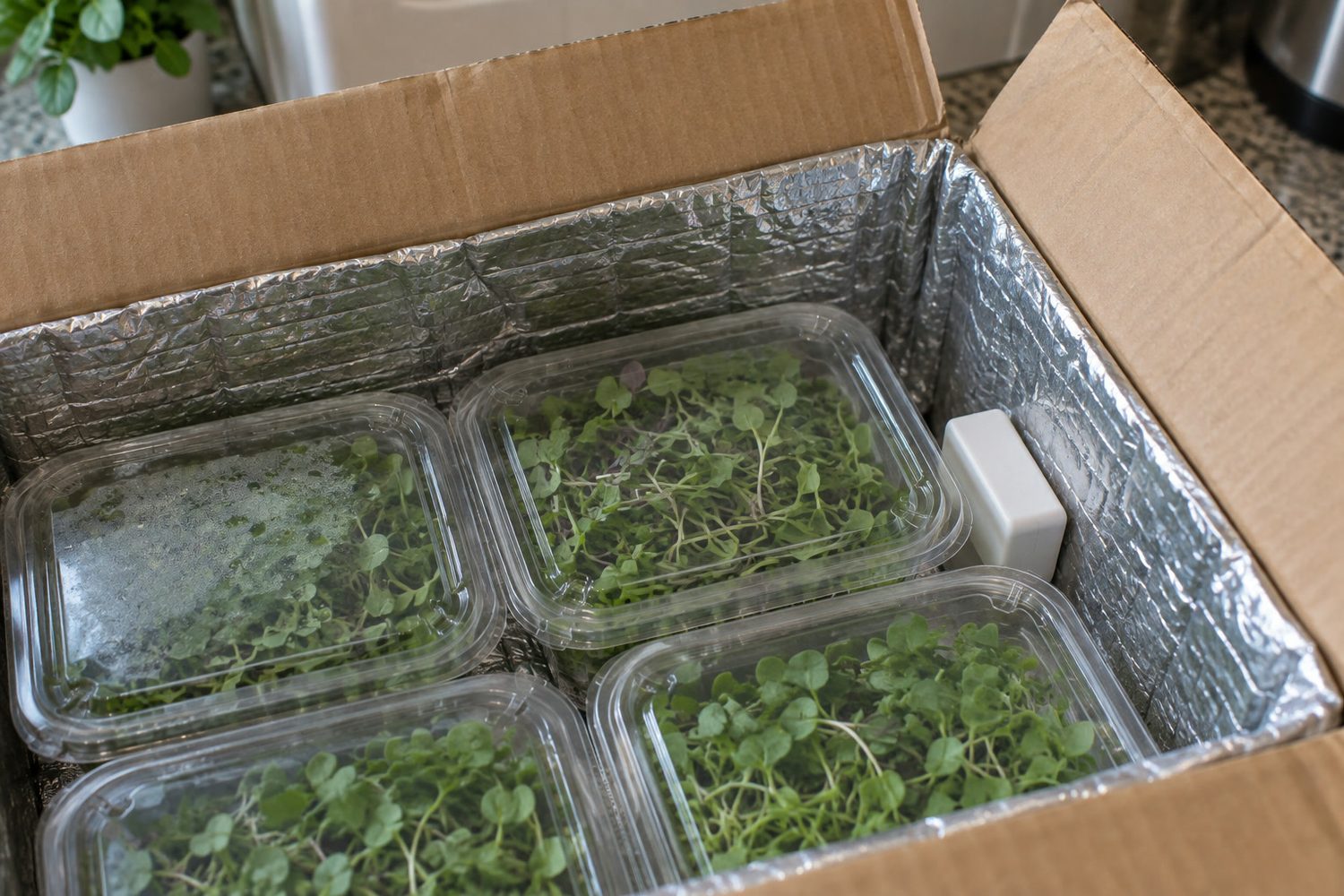
A data logger turns that into a record. LogTag's January 2025 North America price list shows the single-use SRIC-4 at $20 (LogTag price list), and SpotSee listed its single-use MaxiLog2 at $18 with a minimum of 5 units on 2026-09-12 (SpotSee listing). Place the logger beside the greens, not against the gel pack, and keep a fridge thermometer in your own cooler for the home control pack. Keep a refrigerated pack from the same harvest at home and compare the two over the following days, using the habits in the microgreens storage post.
Then write a refund policy that matches what you can check. Ask for a same-day photo of the pack, label and greens, plus a thermometer or logger reading where the customer has one. Promise a defined replacement or refund, and do not tell customers the carrier will reimburse it.
Frequently asked questions
These come up once the carrier and the box are settled.
Does a vacuum or modified-atmosphere bag replace the gel packs?
No. A 2026 sunflower microgreen study found active modified-atmosphere packaging in polypropylene film kept moisture and quality best at 4°C, in a comparison that included 12°C storage (sunflower MAP study). Arugula packs held at 5°C in open, vacuum and modified-atmosphere packaging were reported safe to eat within 10 days (arugula study). Both depend on cold storage and neither was a parcel shipment, so the bag works alongside the cooling, not instead of it.
Does the shipping label count as the food label?
It does not. FDA's packaged-food rules commonly call for a statement of identity and net quantity, with net quantity normally given by weight for solids and placed in the bottom 30% of the principal display panel (FDA Food Labeling Guide.pdf)). "Perishable" and "Keep Refrigerated" belong on the outer box, and the pack inside still needs its own label.
Do I have to collect sales tax in other states?
That depends on each destination state, because economic nexus is based on sales delivered into it. California sets a $500,000 threshold for remote sellers (California CDTFA), and South Dakota requires remote sellers with more than $100,000 in gross sales into the state to register and remit (South Dakota DOR). Whether greens or shipping charges are taxable is a separate rule in each state, so check each destination's food and delivery-charge rules.
How long should shipped greens keep once they arrive?
Alberta's commercial guide gives a typical range of 5 to 10 days with proper handling, varying by species (Alberta Agriculture, 2018). How much a day or two in a parcel takes off that range depends on the crop, the pack and the lane. Keep a refrigerated control pack from each test harvest, check both daily, and set the use-by note on shipped packs from what you record.
Before your first shipment
Quote every customer ZIP and keep the one-business-day lanes. Pick USPS Priority Mail Express, UPS Next Day Air under a UPS account, or FedEx overnight or 2Day, and ship Monday through Wednesday. Pack a liner inside corrugate with gel packs, built to hold cold a full day past the promised delivery. Cost the box at its billed weight, about $50.45 for the 13-lb FedEx 2Day Zone 2 example, and add your own dated UPS and USPS quotes. Put a logger in your first boxes, and ask USPS and each new destination state in writing wherever the rules leave a question open.
Sources
Prices, stock and specifications are as the linked pages showed them on 2026-09-12.
- USPS Priority Mail Express
- UPS food guidance
- 2026 retail rate sheet
- USPS domestic claims
- UPS tariff effective April 17, 2026, section 3.15
- FedEx Service Guide 2026
- Alberta Agriculture, 2018
- Berba and Uchanski, 2012
- FedEx perishable guide
- USDA FSIS mail-order bulletin, revised January 2008
- Virginia Tech produce transport
- USPS Packaging Instruction 9A
- FedEx dry-ice guide
- NC State meal-kit summary, archived capture
- WebstaurantStore, 2026-09-12
- UPS rates
- USPS Publication 52, section 53
- UPS restricted items
- FDA Produce Safety guidance
- FDA inflation-adjusted cut-offs
- 21 CFR 112.3
- FDA exemptions chart
- LogTag price list
- SpotSee listing
- sunflower MAP study
- arugula study
- FDA Food Labeling Guide
- California CDTFA
- South Dakota DOR
Keep reading
The journal
Are Microgreens Profitable? What the Numbers Show
Are microgreens profitable? See what a national grower survey and federal sales data show, why gross revenue is not profit, and how to run your own numbers.
Read Are Microgreens Profitable? What the Numbers ShowThe journal
Are Microgreens Sustainable? The Published Range Is 3.34 to 63.34 kg CO2e a Kilo, and Your Grid Decides Where You Land
One modeled crop spans a 19-fold carbon range. Indoor growing beats field lettuce on land by roughly 37 times and can lose on carbon, because the answer is a property of your electricity rather than of the crop.
Read Are Microgreens Sustainable? The Published Range Is 3.34 to 63.34 kg CO2e a Kilo, and Your Grid Decides Where You LandThe journal
Buying a Microgreens Business for Sale: What to Check First
Thinking about a microgreens business for sale? Learn how sellers state cash flow, what SBA loans require in 2026, and what to check before you buy.
Read Buying a Microgreens Business for Sale: What to Check FirstThe journal
Growing Microgreens for Profit: A Weekly Production Plan
Plan growing microgreens for profit with tray counts per crop, a buffer from your own records, and a weekly sowing and harvest schedule you can repeat.
Read Growing Microgreens for Profit: A Weekly Production Plan