How to Sell Microgreens: Your First Sale, Step by Step
Cal HewittPublished Checked
- selling microgreens
- business planning
- food safety
Disclosure: some links on this site are affiliate links, and we may earn a commission if you buy through them, at no extra cost to you.
To make your first microgreens sale, work through seven steps in order: check your state and local rules and where you sit against the federal produce rule, set up simple records, get the insurance your market or buyer asks for, find one first buyer, pack and price the order and decide how you'll take payment, deliver it cold, and then review how it went before you sell again. The order matters because the early steps decide what the later ones look like. A market that wants a certificate of insurance, or a state that treats a restaurant sale differently from a sale to a shopper, changes who your first buyer can be.
Step 1: Check the rules where you sell
Start with the offices that actually decide: your state agriculture department, your county or city health department, your state sales-tax authority, and the rules of the market or buyer you have in mind. The site's page on whether you need a license to sell microgreens goes through this state by state. What follows is how different the answers can be, which is the reason to ask your own state rather than borrow another's.
In Oregon, the Oregon Department of Agriculture's Farm Direct Marketing handout (updated 07/2025) says the Farm Direct Marketing rules exempt farm direct marketers from ODA licensing for agricultural products they grow, including fresh vegetables and herbs, and it states: "All sales must be directly to the end retail consumer." The handout does not mention restaurants. An Oregon extension answer from May 2020 listed restaurants as a direct-to-consumer example, but the current handout does not back that up, so if your first buyer is a Portland chef or a grocer, ask ODA before you sell.
In Michigan, an extension answer from February 2021 relayed what one Michigan Department of Agriculture inspector said when asked: microgreens trimmed from the root are treated as produce, reselling another grower's greens or making salads would need licensing, and sprouts need to be licensed. That is one inspector's informal answer passed along by extension, not a published MDARD rule, so treat it as a reason to call MDARD yourself.
Then the federal side. FDA's Produce Safety Rule scales with your sales, and both of its dollar cutoffs are adjusted for inflation every year from a 2011 baseline. On FDA's inflation-adjusted cut-offs page (content current as of 05/13/2026), the current three-year averages for 2023 to 2025 are:
Hover or tap a row to highlight it.
| Federal cutoff | Three-year average, 2023 to 2025 | What it means |
|---|---|---|
| Not covered by the rule | $34,324 in average annual produce sales | Below this, the Produce Safety Rule does not apply to the farm |
| Qualified exemption | $686,476 in average annual sales of all food | Below this, and selling more to qualified end users than to everyone else, the farm gets modified requirements |
Use these figures, and check the page again each year, because both numbers move. A qualified end user, under 21 CFR part 112, is the consumer, or a restaurant or retail food establishment in the same state or Indian reservation as your farm or not more than 275 miles away. None of this replaces a state or local requirement; a farm the federal rule doesn't cover can still need a state license, a county permit or a market's approval.
One more date to know. FDA's Food Traceability Rule adds recordkeeping for foods on its Food Traceability List. FDA's cut-offs page says an act of Congress in 2026 directed FDA not to enforce that rule before July 20, 2028, and that FDA intends to comply. Not every microgreens operation is covered by it, and exemptions apply, but it is worth knowing the date before you build your records.
Step 2: Set up your records before the first harvest you sell
Records are easier to start than to reconstruct. If the Produce Safety Rule applies to you, FDA says its records must include:
- the farm name and location
- the actual values and observations from monitoring
- an adequate description of the produce (commodity name or variety and, when you have one, a lot number or other identifier)
- the location of the growing or packing area
- the date and time of the activity
That list comes from 21 CFR 112.161(a)(1), as FDA sets it out in its FSMA FAQ. If you are a qualified-exempt farm, you also keep records showing you still qualify, including a written annual review, and your dated sales receipts kept in the normal course of business don't need a signature or initials. A qualified-exempt farm also has to show its farm name and complete business address on the label or at the point of purchase.
Whatever your status, a practical first-sale record covers the sale date, the customer and how to reach them, the product and variety, the quantity and unit, the harvest or packing date, a lot or batch number, the receipt number, the price, tax and payment method, the delivery date, and any complaint or return. Add seed, growing-medium, sanitation and harvest notes good enough to trace a batch back to where it came from. A notebook or a spreadsheet does the job. The page on writing a microgreens food safety plan covers the growing-side records in more detail.
Step 3: Get the insurance your market or buyer asks for
There is no single national insurance rule for a microgreens seller. What you carry depends on who you sell through, and published market agreements show the range. Each of these four asks for a certificate of liability insurance with at least $1 million per occurrence:
Hover or tap a row to highlight it.
| Market | What it asks for |
|---|---|
| Nashville Farmers Market, Nashville, Tennessee | A certificate of liability insurance with a $1 million minimum, naming the Metropolitan Government of Nashville and Davidson County and the State of Tennessee as additional insureds, plus a Local Farmer Certificate from your nearest extension office |
| La Grange Farmers Market, La Grange (the page prints no state; its 708 contact number is an Illinois area code) | $1 million per occurrence and $2 million aggregate general liability, naming the Village of La Grange and La Grange Business Association as additional insureds, plus a waiver of subrogation |
| Venice Farmers Market, Venice, Florida | A general liability certificate "covering operations and products" of at least $1 million per occurrence and $1 million aggregate, naming Independent Jones and the City of Venice (2023 agreement) |
| Vancouver Farmers Market, Vancouver, Washington | At least $1 million per occurrence and $2 million aggregate, naming VFMA as a primary additional insured (2024 agreement, archived copy; the 2025 agreement carries the same limits) |
Read your own market's vendor agreement before you apply, and note who has to be named as an additional insured, since that wording goes on the certificate your insurer issues. A restaurant or grocery buyer may ask for its own certificate, product liability coverage or higher limits. The page on microgreens business insurance covers the policy types.
Step 4: Find your first buyer
Extension sources name restaurants, farmers markets, direct-to-consumer sales, CSA subscriptions and grocery stores as the common markets. Penn State Extension calls restaurants the primary market for microgreens, and Virginia Cooperative Extension says to factor transportation distance and cost into which market you choose. For a first sale, pick the channel that fits the volume you can grow, when you can harvest, how far you can drive and what the buyer requires. Neighbors and friends are a practical small test, farmers markets need approval and often insurance, and restaurants usually want a conversation, steady supply and delivery. The page on where to sell microgreens compares them, and separate pages cover selling at farmers markets and selling to restaurants and chefs.
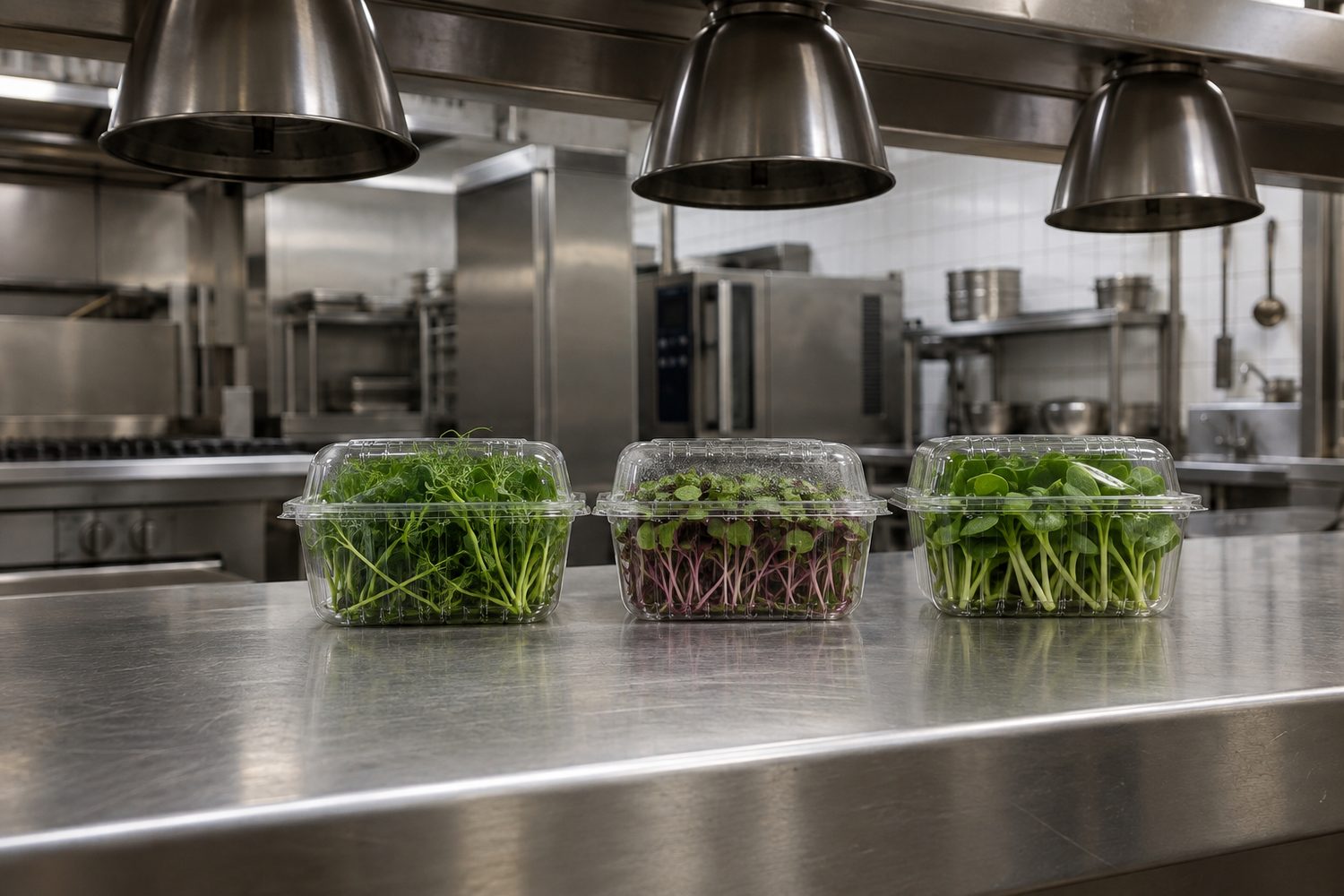
When you approach a chef, Penn State Extension's Marketing Microgreens (updated June 4, 2025) recommends "small sample sizes, detailed storage and handling instructions, and recipe ideas." It also says samples in retail outlets can show freshness and versatility, and that independent restaurants are often more flexible than chains because the chef can change recipes and presentation. So, bring a small sample, a card telling them how to store it, and a couple of ways to use it.
You can also bring a one-page price or product sheet, though that is your own choice rather than something the extension guidance calls for. If you make one, keep it to what a buyer needs to order: the variety or mix, unit size and weight, delivery day, any minimum order, price and payment terms, packaging, storage instructions, whether it is sold rooted or cut, and your contact details.
Expect this step to take some tries. No published figure says how many visits or samples a first sale takes, so keep count of your own: who you approached, how, and what came of it. That tally is what tells you whether a channel is worth a second round.
Step 5: Pack it, price it and decide how you'll get paid
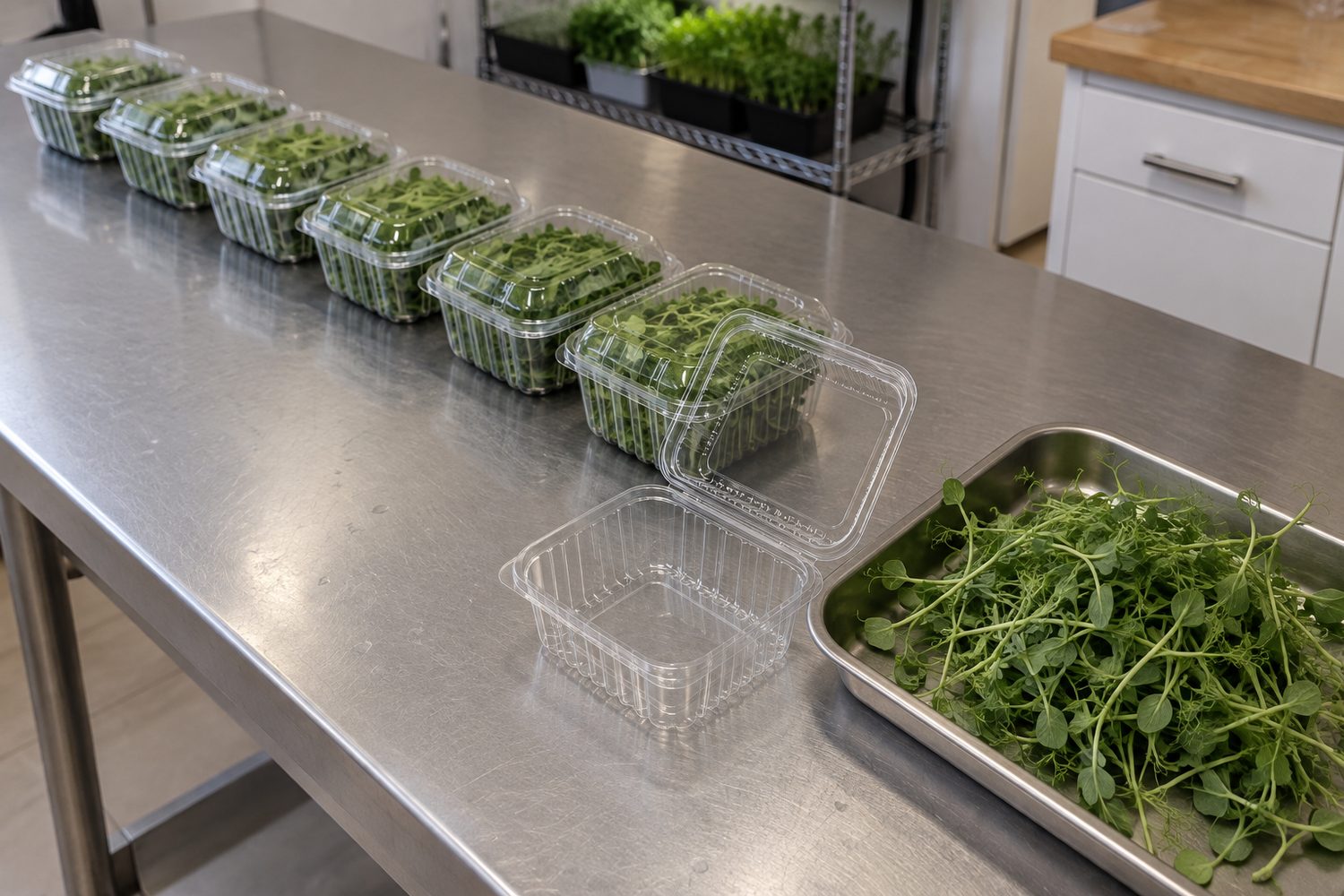
Penn State names clamshells and plastic bags as the usual packaging, and says the market determines price, quantity and packaging. A restaurant may take bulk containers or trays, depending on what the chef wants, while a grocery buyer will usually want a consistent retail package and may set its own date-code or case-pack rules. Whatever you pack in, it should carry the product name and your business name, and meet your state's and market's labeling rules. The pages on microgreen labels and pricing and what to charge cover both.
Then decide how you'll take money, and build the fee into your price. Cash and checks carry no processor fee but mean handling and reconciling cash. Card fees, as each provider published them:
Hover or tap a row to highlight it.
| Provider | In person | Online | Bank transfer (ACH) |
|---|---|---|---|
| Stripe, read September 26, 2026 | 2.7% + $0.05 (domestic cards) | 2.9% + $0.30 (domestic cards) | 0.8%, capped at $5 |
| PayPal Point of Sale, fee page last updated September 1, 2026 | 2.29% + $0.09 (card present); 3.49% + $0.09 keyed in | ||
| Square Free ($0 a month), read September 26, 2026 | 2.6% + $0.15 | 3.3% + $0.30 | 1%, $1 minimum, by invoice |
| Square Plus ($49 a month per location) | 2.5% + $0.15 | 2.9% + $0.30 | 1%, $1 minimum, $10 cap, by invoice |
| Square Premium ($149 a month per location) | 2.4% + $0.15 | 2.9% + $0.30 | 1%, $1 minimum, $10 cap, by invoice |
Stripe adds 1.5% for international cards in person and 0.5% for manually entered cards online. Square's fee explainer puts manually entered transactions at 3.5% + $0.15, and PayPal Point of Sale is subject to eligibility and approval. Rates can vary by account, so check the rate on your own dashboard before you set a price, and run your actual price through the fee to see what you keep.
Step 6: Deliver it cold
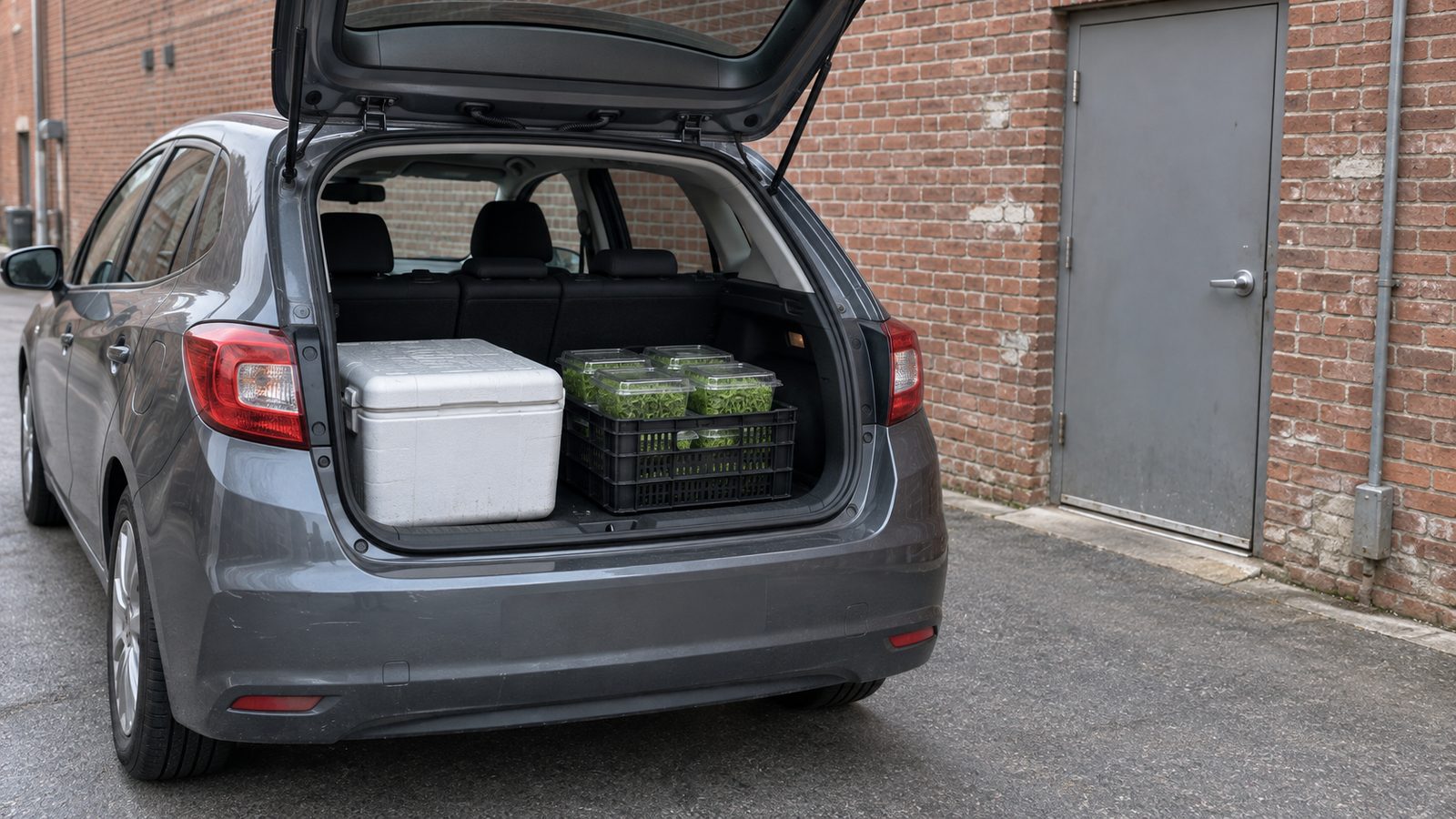
For cut, packaged greens, the practical sequence is to harvest with clean, sanitized equipment, pull out anything damaged, pack into clean containers, cool and hold the packed product in the fridge, move it in a clean insulated bag or temperature-controlled container, keep the drive short and out of direct sun, and tell the buyer to refrigerate it promptly. Write down the delivery time, customer, product and quantity, and any temperature you took.
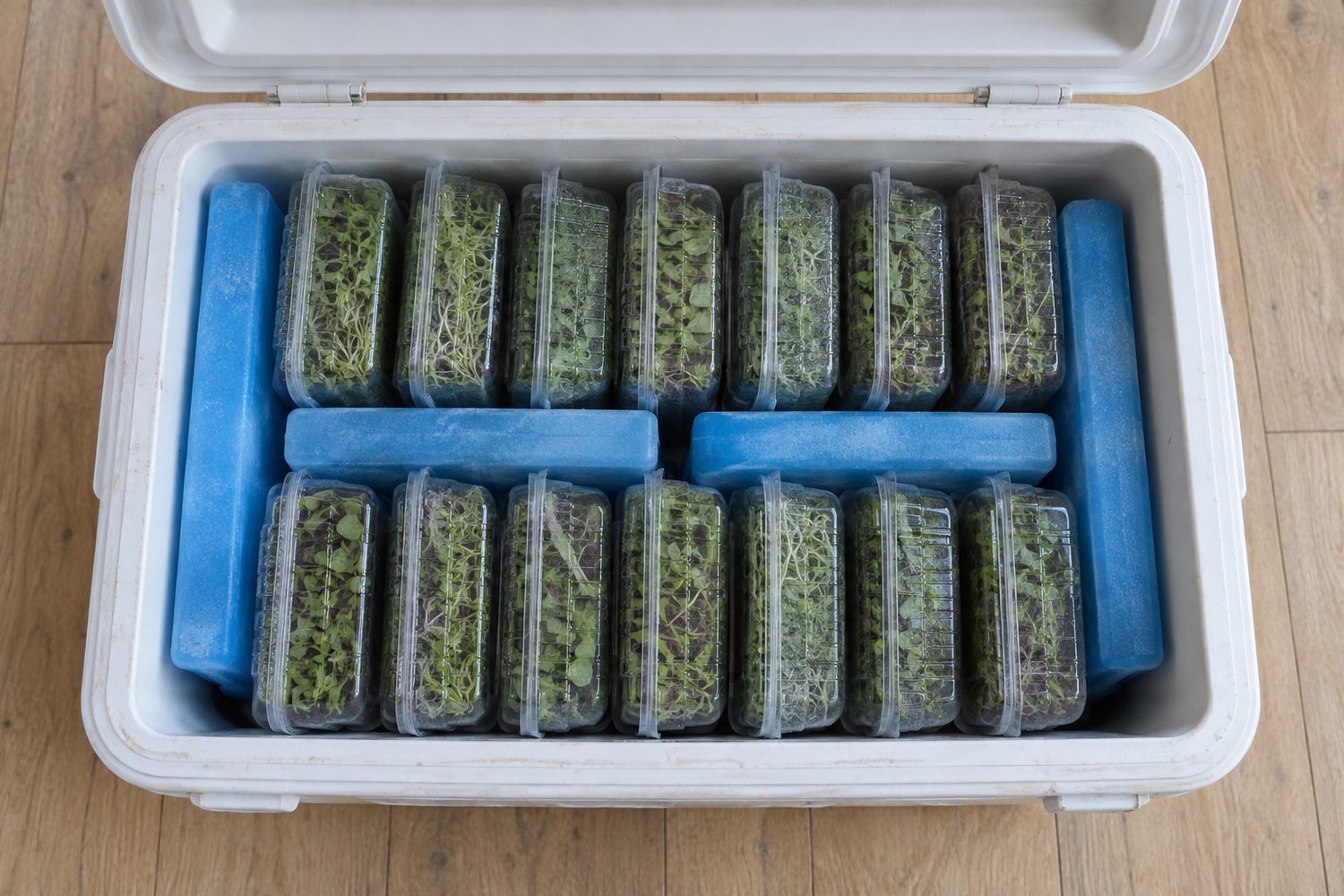
The 41 F figure you'll see is a holding figure, not a transport one. USDA's checklist for buyers visiting a fresh-cut processor says finished, packaged fresh-cut produce is held under refrigeration at or below 41 F, and that vehicles should be at the right temperature for the products; it gives no transport temperature. FDA's August 2026 final guidance on ready-to-eat fresh-cut produce is written for manufacturers and processors, and notes that the Food Code recommends holding most temperature-controlled foods at 41 F or lower. FDA's retail recommendation for cut leafy greens is to keep them at 41 F or less during storage and display; it is a recommendation, and microgreens are not named in the Food Code's cut leafy greens definition.
For shelf life, Penn State Extension says research shows storing microgreens at 41 F in the dark can stretch shelf life to 10 to 14 days, against 2 to 4 days at room conditions. Virginia Cooperative Extension says the best storage temperature for microgreens is still being evaluated. Keep your packed greens cold and dark from harvest to hand-off, and note how they hold up on your own route.
Step 7: Review the first sale before the second
Once the money is in, sit down with the numbers while you still remember the details. Penn State's business-planning guidance (updated September 27, 2025) recommends a plan that covers products, pricing, packaging, target market, sales strategy and projected cash flow, and its marketing guidance suggests asking customers for feedback informally. No published list says exactly what to record after a first sale, so record what you'll need to decide on the second:
- the customer, the channel and how many contacts it took
- product, weight, units and price
- revenue collected and processor fees
- packaging, transport, market and labor costs, including your hours
- anything unsold or turned back
- what the buyer said about quality, size, packaging and price
- what you'll do next: repeat, change the price or pack size, or try another channel
What any one grower did to land a first sale is that grower's experience. A Pennsylvania farmer in Penn State's material sells to restaurants and through a vegetable subscription, and another farmer it describes sells clamshells to shoppers as a quick handful for sandwiches and tacos. Both are one farm each. Your own record from this first sale is the better guide to your second.
Frequently asked questions
Do I have to register my farm with FDA as a food facility? FDA says farms that carry out only activities inside the federal farm definition generally don't have to register as food facilities under its preventive-controls rules. That says nothing about your state or county, which can still require a license or permit, so check those separately.
Can I sell microgreens to a restaurant in Oregon without an ODA license? The current ODA Farm Direct Marketing handout, updated 07/2025, says all sales under that exemption must be directly to the end retail consumer, and it does not mention restaurants. Ask ODA directly before a restaurant or grocery sale.
Does the Food Traceability Rule apply to my first sale? FDA says it will not enforce the rule before July 20, 2028, and not every microgreens operation is on the Food Traceability List or covered. Keeping a lot number and harvest date with each sale now makes it easier to meet if it does apply to you later.
Do I need product liability coverage, or just general liability? That depends on the agreement you sign. Venice Farmers Market in Florida asks for coverage of "operations and products," while the Nashville, La Grange and Vancouver agreements ask for liability coverage with set limits. Read the exact wording your market or buyer uses and give it to your insurer.
Start with the call to your state agriculture department, since its answer tells you which buyers are open to you, and work down the steps from there.
Sources
Prices, stock and specifications are as the linked pages showed them on 2026-09-26.
- Farm Direct Marketing handout
- Oregon extension answer from May 2020
- extension answer from February 2021
- inflation-adjusted cut-offs page
- 21 CFR part 112
- 21 CFR 112.161(a)(1), as FDA sets it out in its FSMA FAQ
- Nashville Farmers Market
- La Grange Farmers Market
- Venice Farmers Market
- Vancouver Farmers Market
- 2025 agreement
- Penn State Extension
- Virginia Cooperative Extension
- Marketing Microgreens
- Stripe
- PayPal Point of Sale
- Square
- fee explainer
- checklist for buyers visiting a fresh-cut processor
- August 2026 final guidance on ready-to-eat fresh-cut produce
- retail recommendation for cut leafy greens
- business-planning guidance
Keep reading
The journal
Do I Need a License to Sell Microgreens?
Do I need a license to sell microgreens at a market, to a restaurant, or to neighbors? Find your state's answer, its condition, and what would change it.
Read Do I Need a License to Sell Microgreens?The journal
How to Write a Microgreens Food Safety Plan
Build a microgreens food safety plan section by section, pick a free template to start from, and know which records buyers, markets and audits expect.
Read How to Write a Microgreens Food Safety PlanThe journal
Selling Living Microgreens Trays: Classification and Care
Thinking about selling living microgreens trays? Learn how states classify them, what care instructions to give buyers, and how sellers price trays.
Read Selling Living Microgreens Trays: Classification and CareThe journal
Microgreen Powder Business Math: Yield, Price, and the Rules
Before you start a microgreen powder business, run the numbers. See the dry weight yield, a tray revenue comparison, and the rules for a processed food.
Read Microgreen Powder Business Math: Yield, Price, and the Rules