Where to Sell Microgreens: Every Channel Beyond the Market
Cal HewittPublished Checked
- selling microgreens
- business planning
- economics
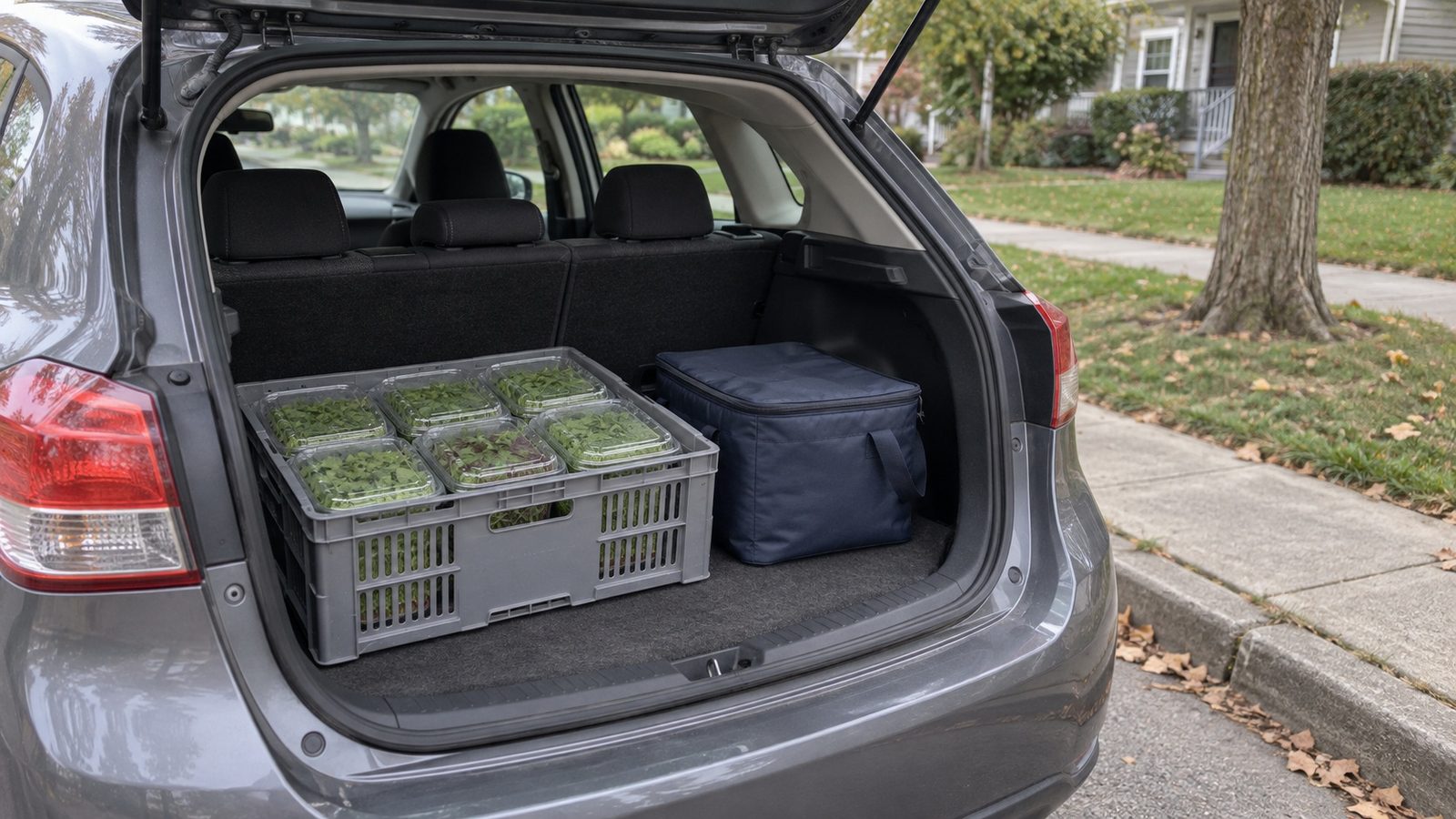
Beyond the farmers market, microgreens can go to restaurants and caterers, cafes and juice bars, grocery stores and food co-ops, CSA shares and subscription boxes, food hubs, distributors, your own farm stand, online farm stores, and schools, hospitals and other institutions.
Each channel has a different buyer, and each buyer asks for something different before the first order: a certificate of insurance, a steady weekly supply, invoices, food safety certification, a barcode, or agreed payment terms. None of those requirements belong to microgreens as a whole. A named market, chain, co-op, county or school district sets them, and each section below says which one.
Who buys in each channel and what they ask for first
The table below shows who is on the other side of each channel, what the buyers named further down ask for first, and where the fuller breakdown sits.
Hover or tap a row to highlight it.
| Channel | Who buys | What named buyers ask for first | Fuller breakdown |
|---|---|---|---|
| Farmers markets | Shoppers, through a market that writes its own rules | Application, insurance certificate, producer rules | Farmers markets |
| Restaurants and caterers | Chefs, sous chefs, kitchen managers | Samples, a kitchen trial, steady weekly supply | Restaurants and chefs |
| Cafes and juice bars | Owners and managers | Small, frequent orders | Section below |
| Grocery stores and co-ops | Produce and category buyers | Vendor forms, W-9, insurance, barcode or PLU, sometimes food safety certification | Grocery and wholesale |
| CSA and subscriptions | Households | A delivery schedule you can keep | Subscriptions and delivery |
| Food hubs | A hub that gathers and resells from several farms | Volume, quality, delivery frequency, sometimes certification | Section below |
| Distributors | Produce distributors | GAP certification, cold chain, weekly availability, insurance, invoices | Section below |
| Farm stands | Neighbors and passersby | County zoning and health permits | Section below |
| Online farm stores | Your own customers, through software you pay for | A subscription and transaction fees | Section below |
| Schools and institutions | District or institution purchasing offices | Registration, insurance minimums, labels, invoices, quotes | Section below |
No survey says which channel most growers use
Misra and Gibson's U.S. microgreen grower survey collected 176 responses between 2018 and 2019 and did not report a sales-channel table (Misra and Gibson, 2021), so it cannot tell you which channel growers favor. Choose from your own numbers instead: ounces harvested in a normal week, how many weeks in a row you can promise that, and the paperwork you already hold.
For all local food, not microgreens alone, USDA's 2020 Local Food Marketing Practices survey sorts outlets into four groups. Direct to consumer covers farmers markets, on-site and off-site farm stores or stands, CSA and online marketplaces. Direct to retail covers supermarkets, restaurants and caterers, and independent grocers and food co-ops. Direct to institutions covers K to 12 schools, colleges, hospitals and others. Intermediaries are distributors, food hubs, brokers, auction houses, wholesale markets and processors (USDA NASS questionnaire, 2020). That year more than 147,000 farms sold $9.0 billion of food locally: $4.1 billion to institutions and intermediaries, $2.9 billion direct to consumers and $1.9 billion direct to retailers (USDA NASS, 2022). Those are not microgreen figures.
Channels also move at different speeds when conditions change. From 2019 to 2020, USDA's Economic Research Service reports that sales through farm stores, CSAs and other direct-to-consumer outlets rose 79%, sales to regional distributors rose 73%, and sales to local institutions fell 86%, which ERS ties to COVID closures and restrictions (USDA ERS, 2022). That is all local food, and a fair reason not to rest a whole harvest on one kind of buyer.
Farmers markets: each market sets its own insurance and producer rules
Booth fees, displays and pricing are in the farmers market guide. Entry paperwork changes from one market to the next. Pittsburgh's city markets require, for 2026, general liability coverage of at least $1 million personal and $2 million aggregate with the City named as additional insured, and anyone sampling faces extra requirements (City of Pittsburgh, 2026).
Portland Farmers Market's 2025 handbook asks accepted vendors for a $1 million per occurrence liability certificate naming the market as additional insured, along with an agricultural practices form (Portland Farmers Market handbook, 2025). FRESHFARM's 2025 agreement is producer-only, limits vendors to within 200 miles and requires a site visit (FRESHFARM, 2025). Read the application for the market you want before you buy a policy, and compare coverage types in microgreens business insurance.
Restaurants and caterers: a sample, a trial, then a standing order
Chefs want the same varieties arriving on the same day every week. Simply Clean Microgreens describes its sequence as a sample, then a kitchen trial, then a standing weekly order (Simply Clean Microgreens). Varieties kitchens ask for are in microgreens chefs buy, and pitching, pricing and delivery are in the restaurants and chefs guide.
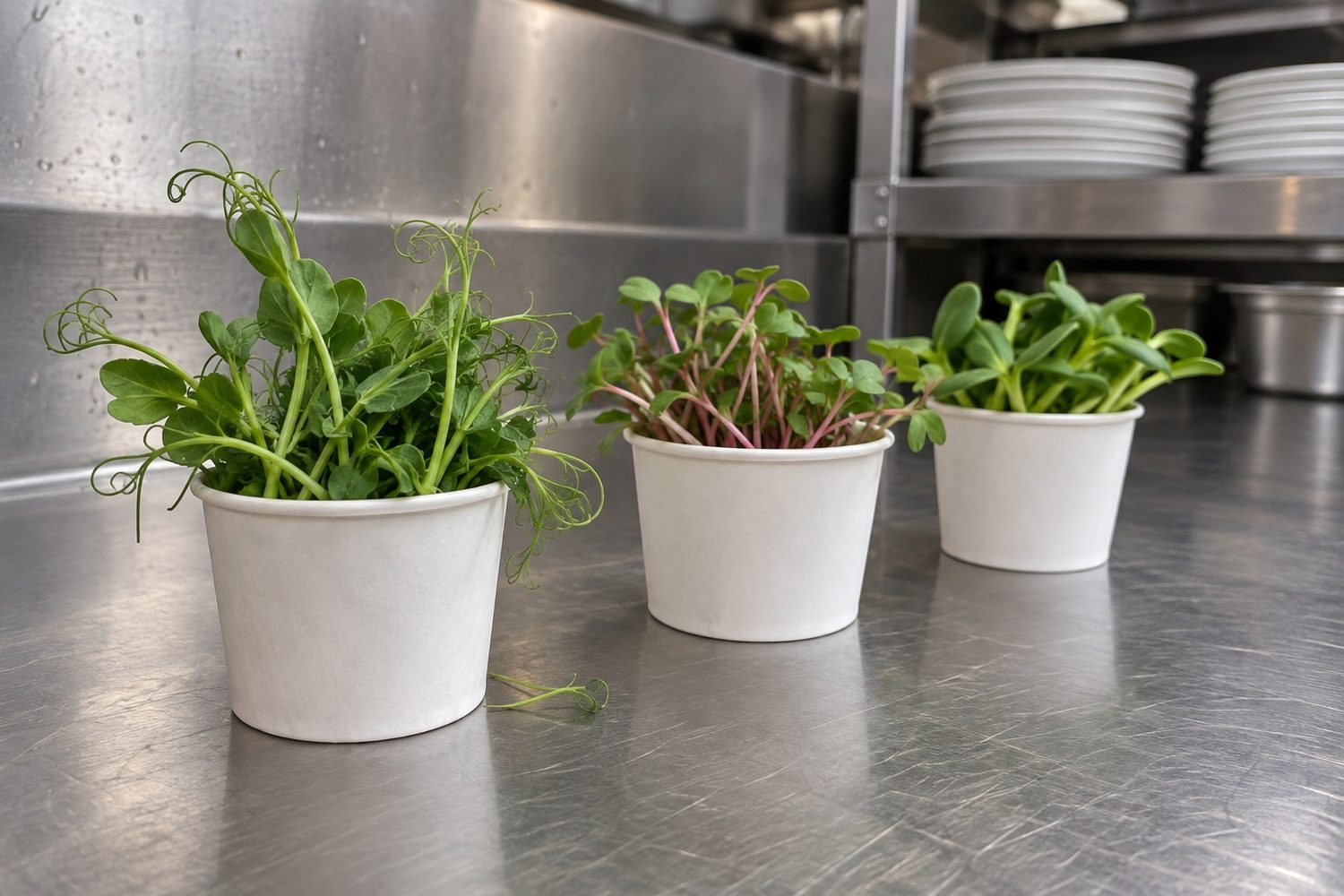
Plan around small orders. One grower's 2020 forum account found that most restaurants ordered 6 oz or less a week and that it took about four weeks to win each client (grower forum account, 2020). That is one operation, and one that did not last, but it is worth remembering before you seed extra trays for a single account. Caterers sit in the same USDA direct-to-retail group as restaurants; nothing published says what they ask of a microgreen grower, so ask the caterer for order size, lead time and paperwork.
Cafes and juice bars: small orders, unknown demand
Cafes and juice bars can be customers. microGREEN FX names King Juice Bar as a wholesale partner and markets same-day harvested greens in small-format orders rather than large minimums (microGREEN FX juice bars). Bring a sample that fits something already on the menu, ask how much they would use in a week, and write the answer down before you plant for it.
Grocery stores and food co-ops: a vendor package before shelf space
Grocers and co-ops that publish vendor rules each write their own list. Price Chopper asks for a trade-partner form, a W-9, an insurance certificate, SQF or BRC certification (with exceptions it notes), and produce meeting GFSI (Global Food Safety Initiative) standards (Price Chopper). PCC Community Markets requires a $1 million general liability certificate naming the co-op as additional insured (PCC Community Markets). Oryana requires at least $1 million per occurrence, including product and completed operations coverage, plus a sell sheet and a barcode or PLU. It pays fresh produce Net 14, meaning within 14 days, and does not pay cash on delivery (Oryana).
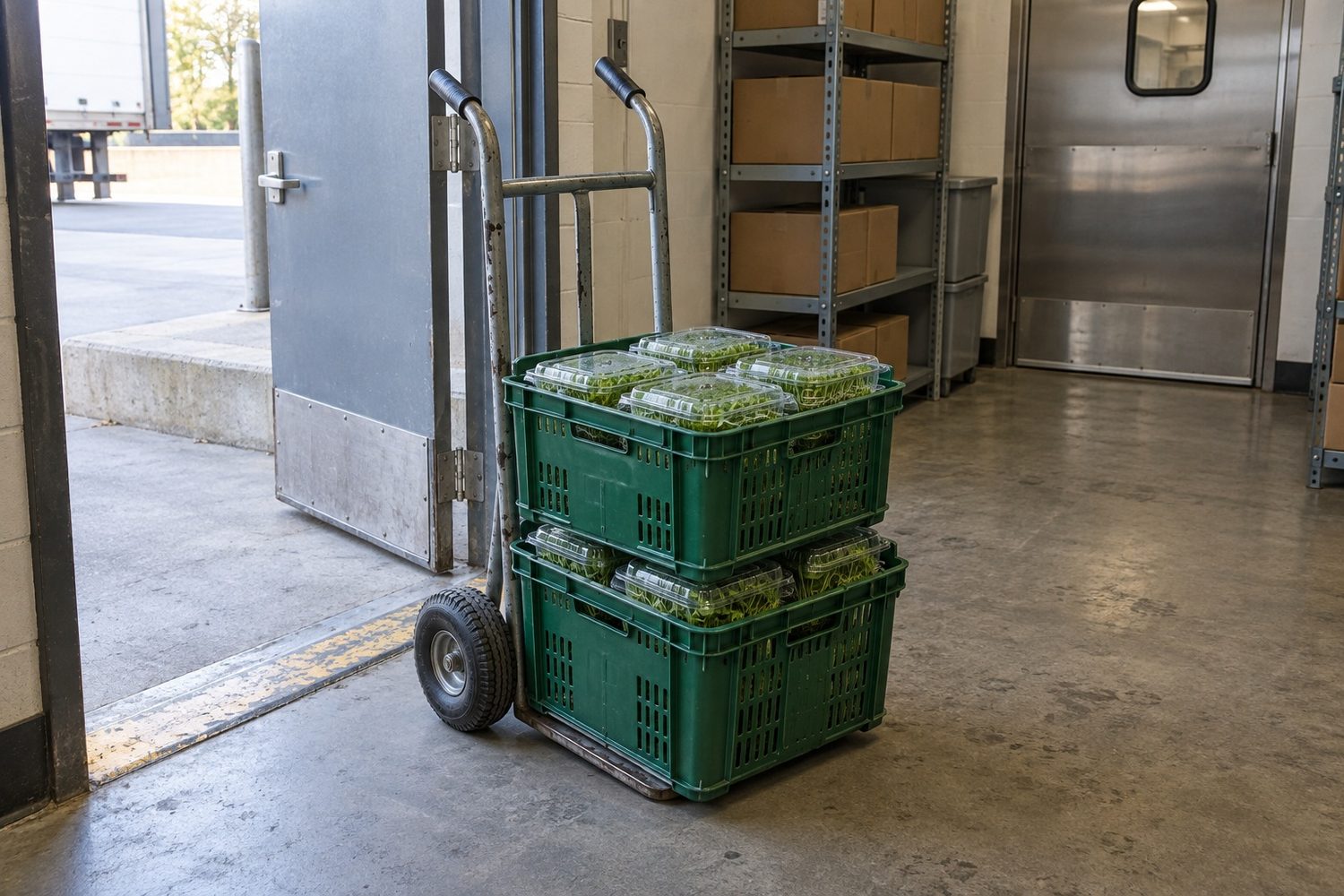
The Neighboring Food Co-op Association tells prospective vendors to be ready to talk about samples, packaging, licenses, a UPC, liability insurance and a way to keep ordering and delivery consistent (Neighboring Food Co-op Association). Clamshells and labels are in packaging and presentation, and case pricing and margins are in grocery and wholesale.
CSA shares and subscription boxes: a weekly promise to households
Subscribers are households who expect the box on the day you promised. microGREEN FX charges $20 per 8 oz delivery (microGREEN FX), and Unlikely Farms lists $39.99 a month for 4 oz delivered weekly (Unlikely Farms). Record your own sign-ups, pauses and cancellations from the first week to see how long subscribers stay. Routes, billing and pricing are in subscriptions and delivery. If you would rather hand over growing trays than cut greens, see selling living microgreen trays.
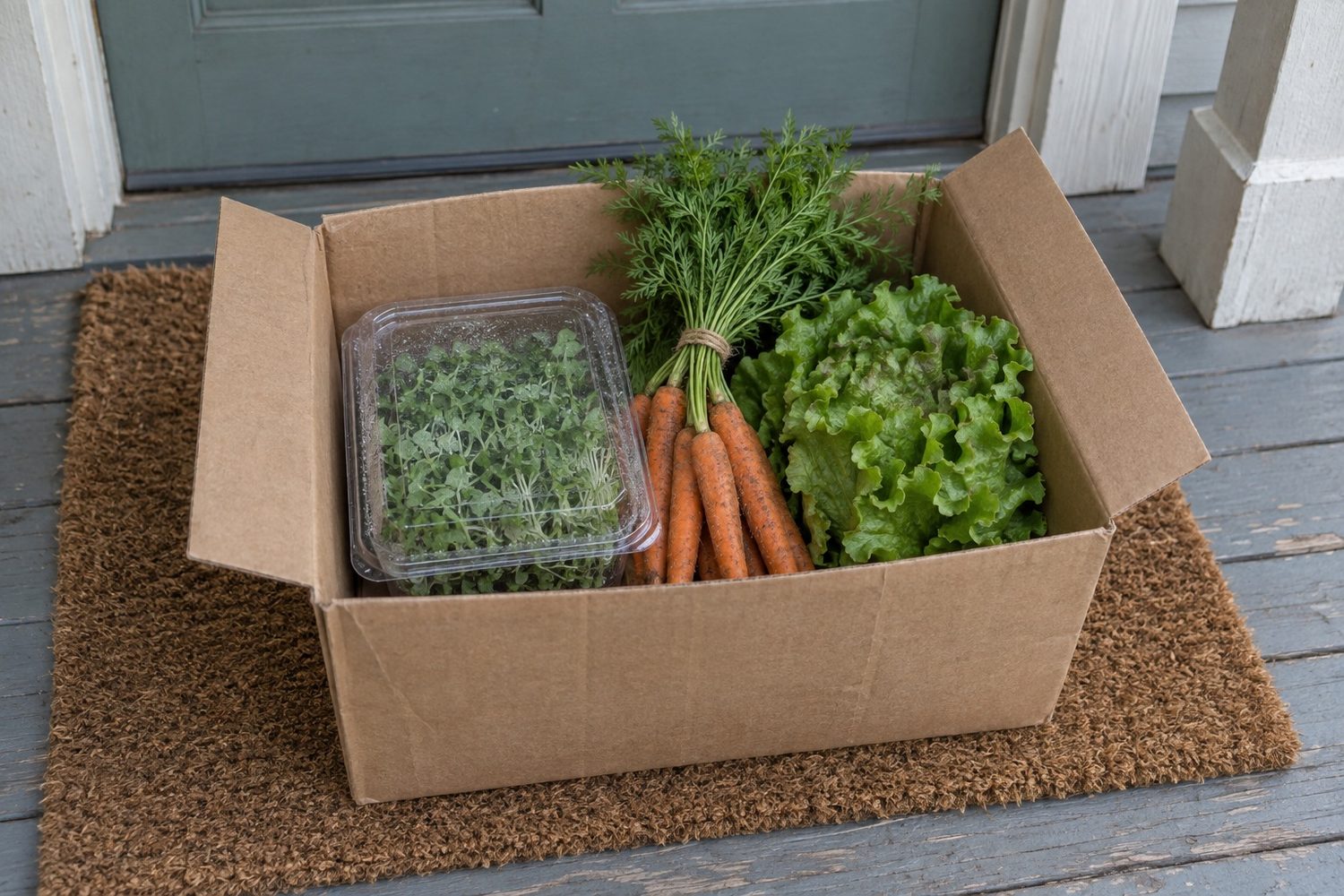
Some CSAs resell food from other farms; USDA's local food survey asks CSA operators whether they did and how many operations contributed (USDA NASS questionnaire, 2020). If you supply another CSA, or add another grower's greens to yours, sign a written agreement naming the producer, lot, label, whose insurance covers the product and how a recall notice reaches everyone.
Food hubs: someone else sells, and keeps a share
A food hub gathers product from several farms, then markets and distributes it. USDA describes three ways hubs pay producers: the grower sets a price and the hub adds its margin, the hub buys the product outright and carries the risk of selling it, or the hub pays the grower a set share of revenue (USDA, Running a Food Hub, Vol. 2).
USDA's historic examples are hub-specific, not microgreen rates. Tuscarora Organic Growers sent 75% of revenue to growers, Local Food Hub returned 80% of the buyer's price to farmers, and Intervale producers netted 60 to 70% of CSA income and 85% of wholesale income (USDA Regional Food Hub Resource Guide). Before you commit, the University of Kentucky's food hub guidance says to ask about food safety certification, the volume the hub expects, quality standards, delivery frequency, how payment works and how prices are set (University of Kentucky). Get those answers in writing.
Distributors: certification and cold chain come first
Distributors buy produce and sell it onward to their own customers. NC State Extension says almost all distributors require GAP (Good Agricultural Practices) certification, and that they ask about your cold chain, your weekly availability, a certificate of insurance, invoicing and product samples (NC State Extension). Warehouse storage may run up to a week, so your greens need to hold up well past harvest day. If you cannot yet fill the same order weekly with that paperwork in hand, this is a channel to grow into.
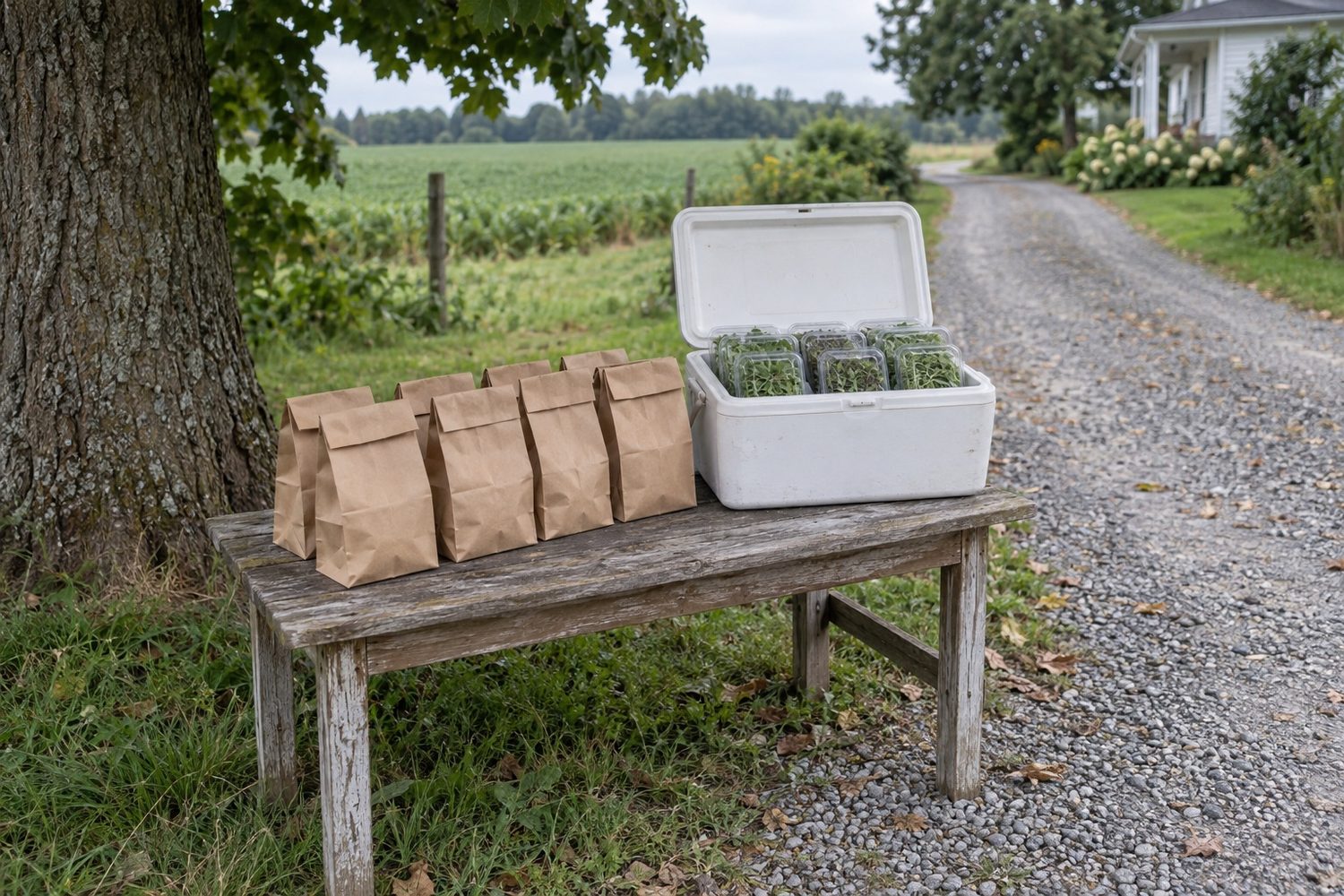
Farm stands: county zoning and health permits set the cost
At a farm stand, the requirements come from your county rather than a buyer. In Sonoma County, California, Permit Sonoma says a seasonal farmstand, generally open no more than 180 calendar days and selling what is grown on the site, needs no zoning permit but does need a health permit. A year-round small farm retail facility of up to 500 square feet needs a zoning permit plus the health permit, and building, well, septic or health code permits could still apply (Permit Sonoma).
In Multnomah County, Oregon, OSU Extension says zoning determines both the process and the cost, and its example treats a simple honor-system card table differently from a building (OSU Extension). Call your county planning office before you build anything, and check your state's rules in do I need a license to sell microgreens.
Online farm stores and marketplaces: you pay for tools, not buyers
Farm store software gives you a storefront, order handling and payment processing, not customers; you still have to send people to it. The table below shows each platform's published pricing as of September 2026.
Hover or tap a row to highlight it.
| Platform | Subscription | Fees on sales |
|---|---|---|
| Local Line | $99, $199 or $399 a month | Card processing from 2.9% plus $0.30; no commission |
| Barn2Door | $99 to $299 a month paid annually, or $119 to $379 paid monthly; $399 to $599 setup | 3.0% on sales up to $99,999, plus card processing |
| GrownBy Wholesale | $45 a month paid annually, or $50 month to month | 2% on card and ACH transactions |
Local Line's card rate drops to 2.7% and then 2.5%, plus $0.30, on its higher plans (Local Line). On Barn2Door, a $100 card sale by a farm under $100,000 in yearly sales carries $6.20 in fees before the subscription: $3.00 from the 3.0% fee and $3.20 in card processing at 2.9% plus $0.30 (Barn2Door seller FAQ). Its legal terms also add a 3% service fee applied to its own subscription pricing (Barn2Door legal terms). GrownBy's wholesale plan lets you set your own payment terms with buyers (GrownBy). Before you sign up, divide the monthly subscription by the orders you already take in a month to see its cost per order.
On general marketplaces, permission to list is not permission under food law. Etsy generally allows food, but says sellers must follow the government rules for making, packaging and selling it, as well as carrier restrictions (Etsy food policy). Craigslist's prohibited list bans "unpackaged or adulterated food" and does not name fresh produce specifically (Craigslist prohibited list). Facebook Marketplace directs sellers to its Commerce Policies (Meta help page); read the current version before you list greens there. If you plan to ship, insulated liners and ice packs and carrier choices are in shipping microgreens.
Schools, hospitals and other institutions: procurement paperwork and delivery windows
Institutions buy through purchasing offices, and their requirements come from the district, state or distributor involved. USDA sets no federal liability insurance amount for sales to schools, but districts, states and distributors may set their own (USDA Farm to School). Washington State Department of Agriculture lists what a district may ask for: registration with its business office, insurance minimums, labels, invoices, GAP or other documentation, quotes, specified pack sizes and quality, and set delivery windows. Hospitals and universities may prefer to buy through a distributor (Washington State Department of Agriculture). Ask a district's food service office what it buys, in what pack, and through whom.
Payment terms: agree on them before the first delivery
Payment timing is set buyer by buyer. Oryana's published policy pays fresh produce Net 14 with no cash on delivery (Oryana). NC State's guide for retail and wholesale buyers tells them that local growers may appreciate cash on delivery or payment in under net 14 days (NC State buyer guide), and NC State's distributor guidance says each delivered order needs an invoice (NC State Extension). Send an invoice with every delivery, date it, and print the agreed terms on it. What to charge in each channel is in pricing and what to charge.
Choosing your next channel from volume, schedule and paperwork
Start with volume. If your extra trays vary from week to week, channels where you decide how much to put out fit for now: a market table, a farm stand, a few subscribers, or a cafe that takes what you have.
Then check your schedule. The restaurant, co-op, food hub, distributor and institutional buyers named above each ask about steady weekly supply or set delivery windows. Before approaching one, grow on that schedule for a month and write down each week's harvest.
Last, sort your paperwork. A certificate of insurance comes up across the buyers named here, from Pittsburgh's and Portland's markets to PCC, Oryana, Price Chopper, NC State's distributors and Washington's school districts. GAP certification is next, and SQF or BRC certification is what a chain such as Price Chopper asks for. When your current channel is full, move to the one whose paperwork you are closest to holding.
Questions about selling microgreens beyond the market
Can I sell another grower's microgreens alongside mine?
It depends on where you sell. FRESHFARM's 2025 agreement prohibits resale without written consent (FRESHFARM, 2025), while USDA's local food survey treats CSAs that include other farms' food as a normal category (USDA NASS questionnaire, 2020). Where it is allowed, write down the producer, lot, label, insurance and recall notice before the first sale.
Does every buyer require GAP certification?
No single rule covers every buyer. USDA says GAP is required when selling fresh produce directly to USDA but is not mandated for all school sales, and schools, distributors and retailers can each require it on their own (USDA Farm to School). Ask each buyer directly before you pay for an audit.
Which channel makes the most money for microgreens?
Profit and labor differ by channel, so log revenue, fees, packaging, delivery miles, hours and days waiting for payment for each channel you use, and compare your own figures after two or three months.
Does a food hub take less of my time than selling direct?
The University of Kentucky rates food hub marketing time as "medium" and says it may be lower than direct marketing, but gives no hours (University of Kentucky). Time your own market days, deliveries and sales calls for a month before comparing.
Your next step: one named buyer at a time
Pick the channel whose buyer you can satisfy with the trays and paperwork you already have. Get that buyer's requirements in writing, deliver on them for a few weeks, and add the next channel once the current one is full.
Sources
Prices, stock and specifications are as the linked pages showed them on 2026-09-13.
- Misra and Gibson, 2021
- USDA NASS questionnaire, 2020
- USDA NASS, 2022
- USDA ERS, 2022
- City of Pittsburgh, 2026
- Portland Farmers Market handbook, 2025
- FRESHFARM, 2025
- Simply Clean Microgreens
- grower forum account, 2020
- microGREEN FX juice bars
- Price Chopper
- PCC Community Markets
- Oryana
- Neighboring Food Co-op Association
- microGREEN FX
- Unlikely Farms
- USDA, Running a Food Hub, Vol. 2
- USDA Regional Food Hub Resource Guide
- University of Kentucky
- NC State Extension
- Permit Sonoma
- OSU Extension
- Local Line
- Barn2Door seller FAQ
- Barn2Door legal terms
- GrownBy
- Etsy food policy
- Craigslist prohibited list
- Meta help page
- USDA Farm to School
- Washington State Department of Agriculture
- NC State buyer guide
Keep reading
The journal
Buying a Microgreens Business for Sale: What to Check First
Thinking about a microgreens business for sale? Learn how sellers state cash flow, what SBA loans require in 2026, and what to check before you buy.
Read Buying a Microgreens Business for Sale: What to Check FirstThe journal
Growing Microgreens for Profit: A Weekly Production Plan
Plan growing microgreens for profit with tray counts per crop, a buffer from your own records, and a weekly sowing and harvest schedule you can repeat.
Read Growing Microgreens for Profit: A Weekly Production PlanThe journal
How to Write a Microgreens Business Plan Step by Step
Build your microgreens business plan section by section, from executive summary to financial plan, with startup costs itemized by scale and source.
Read How to Write a Microgreens Business Plan Step by StepThe journal
Microgreen Growers Insurance: Costs, Limits and Markets
Selling microgreens at a market or restaurant? See what microgreen growers insurance covers, who requires it, and what policies cost by limit, state and year.
Read Microgreen Growers Insurance: Costs, Limits and Markets