How to Write a Microgreens Food Safety Plan
Cal HewittPublished Checked
- food safety
- selling microgreens
- business planning
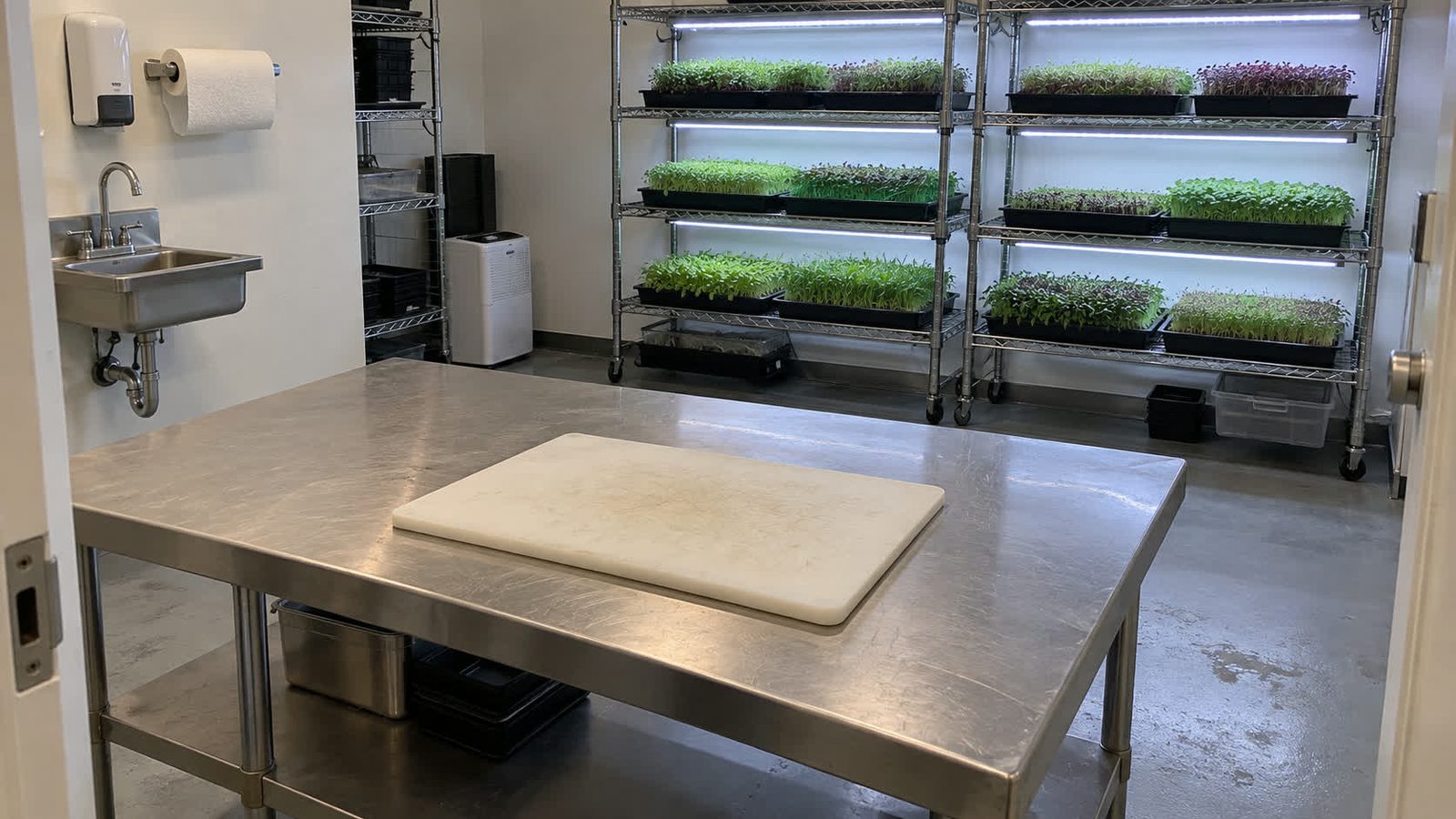
A microgreens food safety plan is one binder, paper or digital, that names your farm and the person in charge of food safety, lists the contamination risks in your grow room, writes down the steps you take to reduce them, and holds the logs that show those steps happened. That is how Penn State Extension describes it.
The federal Produce Safety Rule does not require one compiled written plan; for covered farms it requires certain practices, training and records (NMSU All About Microgreens). The request in front of you most likely comes from a buyer, an audit program or a local health department, and a free Extension template gets you most of the way to a finished plan.
Start by naming who is asking
Write down who asked for the plan and what they asked for, because each source carries different weight.
Hover or tap a row to highlight it.
| Who is asking | What sits behind the request |
|---|---|
| A buyer, market or distributor | A condition of doing business with them, set in their supplier agreement |
| A GAP or Harmonized GAP auditor | A voluntary USDA audit standard |
| FDA, under the Produce Safety Rule | Practices, training and records for covered farms, not one compiled plan |
| Your county or city health department | Local food-establishment rules, which vary by place |
A USDA study that interviewed nine retailers found they were likely to keep demanding third-party audits even though the Produce Safety Rule does not require them, and CAFF notes that a buyer's audit request is related to but different from FSMA. Ask the buyer for their questionnaire or supplier terms in writing, since each buyer decides its own requirement.
A GAP audit is where a written program becomes a firm condition. USDA calls its GAP/GHP program voluntary, and the audit standard, as quoted in the University of Minnesota workbook, requires that "a documented food safety program that incorporates GAP and/or GHP has been implemented."
Local rules apply only where they are written. Yellowstone City-County Health Department in Billings, Montana, requires a HACCP plan and a variance to grow sprouts or microgreens in a retail food establishment. That packet's seed chlorination, spent irrigation water lab testing and wash log items sit under a heading for sprouts intended to be consumed raw, not microgreens. Its request for documentation from the seed supplier, such as a certificate of analysis showing the seed is intended for sprouting, carries no such heading, so in that packet it covers microgreens too. If you grow inside a restaurant or store, ask your own health department whether microgreens count as a special process there.
The Preventive Controls for Human Food rule does require a written plan by a trained PCQI, but for a covered processing facility, not ordinarily a raw-produce farm. If you do more than harvest, pack and hold, get a facility-status determination.
Check where your farm sits under the Produce Safety Rule
Your sales decide how much of the federal rule reaches you. The 2026 thresholds are $34,324 in average annual produce sales, at or below which a farm is not covered, and $686,476 for the qualified exemption; our Produce Safety Rule page walks through how each test is calculated. A qualified-exempt farm still needs the regulation's eligibility records and an annual review, according to the FDA FSMA FAQ.
The sprout rules you may have heard about are Subpart M. Subpart M excludes soil- or substrate-grown greens harvested without roots (21 CFR 112.141), which describes a cut microgreen; the details are on our microgreens vs sprouts page. The North Carolina Department of Agriculture fact sheet draws the same line: microgreens are usually grown in soil or substrate and cut above it, while sprouts are eaten with the seed attached. If a buyer also asks about lot tracking under the newer federal traceability rule, see our Food Traceability Rule page.
Write your coverage status and the sales figures behind it on the first page, so anyone who picks up the plan can tell legal duties from buyer or audit requirements.
Pick a free template and adapt it for indoor trays
The free templates below are written for general produce rather than an indoor, substrate-grown microgreens room, so you start from one and adjust it. These are the credible free options:
- **University of Minnesota, A Food Safety Plan for You** (Version 3, updated June 2020): a 45-page customizable workbook linked from NMSU's microgreens project. Its appendix names 22 log sheets, but the sheets are not included in the PDF, so pull your logs from Penn State or CAFF instead.
- Penn State Extension: a Harmonized GAP-patterned template, sample plan and named logs for self-audit, pre-harvest risk, training, cleaning, mock recall, wash water and equipment.
- CAFF: templates in English, Spanish and Hmong, plus an SOP template, checklists, risk assessments and logs.
- Cornell National GAP Program: a general farm plan template.
- FamilyFarmed On-Farm Food Safety Project: a yes/no decision tree that generates a customizable plan and record tools based on harmonized GAP standards.
- NMSU All About Microgreens: a microgreens page that links decision trees, templates and SOP examples, and works as the bridge between a general template and your grow room.
These templates are written around fields and packinghouses, so rewrite the risk analysis for your room. Keep traceability, worker health, water, storage and policies. Turn "animal and wildlife" into indoor pest monitoring, and turn "field sanitation" into racks, trays and the harvest table. A sensible set of SOPs to add for an indoor grower covers receiving and separating seed and growing medium by lot, soaking (only if you soak), filling and seeding trays, your irrigation water source and equipment cleaning, harvest and pack, the cooler, and pest monitoring. Treat that list as a starting point, not a legal checklist.
Section 1: Farm identity and a food safety manager
The opening pages identify the operation: address and contacts, emergency contacts, what you grow and sell, a buyer list, and a map of the grow room showing racks, sink, harvest table and cooler.
Then name one food safety manager, even if that is you. In Penn State's sample plan, that person identifies at-risk lots, contacts every buyer of them, asks for removal from market, and records the problem, the action taken and the fix.
Section 2: Risk assessment for water, hygiene and harvest
Walk your room from seed delivery to the buyer's door and write down what could contaminate the crop at each step.
Water. Split your water by use, because the federal rule treats each use differently. Water applied to growing crops falls under the written annual pre-harvest agricultural water assessment in 21 CFR 112.43; very small farms, those with no more than $250,000 in average annual produce sales, are due by April 5, 2027. The zero detectable generic E. coli per 100 mL standard in 21 CFR 112.44(a) covers harvest and post-harvest uses: water that touches produce during or after harvest, water on food-contact surfaces, water for ice, and handwashing water during and after harvest. If a harvest or post-harvest water source fails that standard, the rule says to stop using it for that purpose (112.45(a)).
Public water is exempt from testing for those uses when you keep the utility's results or certificates of compliance showing the water meets the standard (112.44(c)(1)). Ask your utility for its annual water-quality report and file it. For a private well, UMN Extension reports an average of $30 to $50 per sample, and NC State reports $20 to $70 depending on lab and location. Our water quality page covers the growing side.
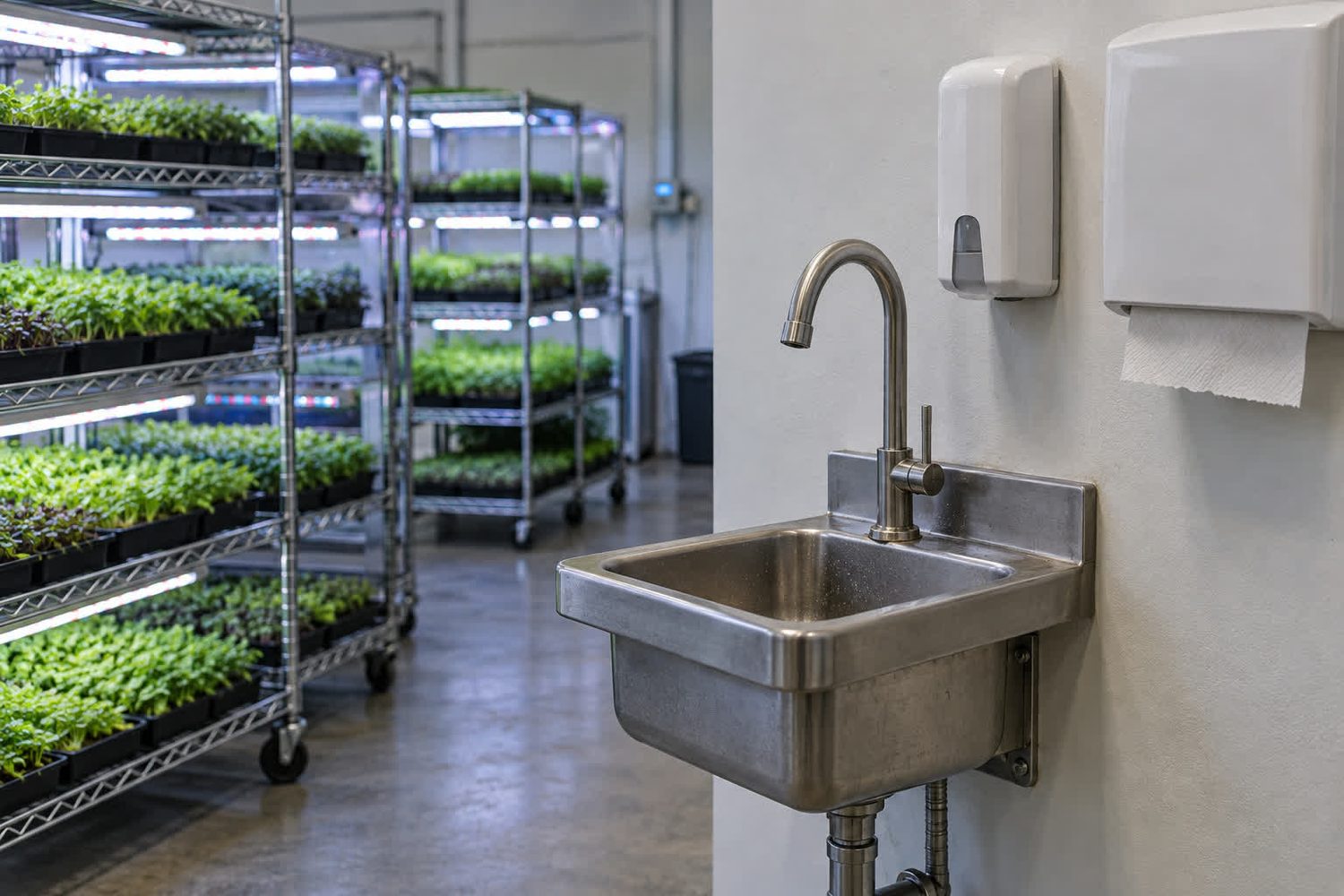
Hygiene. The UMN template tells a sick worker to notify the manager and stay away from fresh produce, and lists diarrhea, fever, vomiting, jaundice, sore throat with fever, and pus-containing lesions as reasons to exclude someone. Note where the hand sink is and who checks that soap, water and single-use towels are stocked.
Seed, substrate and harvest. Michigan's microgreens guidance recommends buying seed and substrate from sources that test, treat and certify them, and controlling humidity in the room. Record supplier, variety, seed lot, receipt date and any certificate the supplier actually sent. No federal rule sets a seed-testing schedule for microgreens, so if a buyer or permit names one, write it into the plan with that buyer or permit as its source.
Section 3: Written procedures for cleaning, harvesting and cold storage
An SOP is step-by-step instructions for a task you repeat. NMSU suggests each one carry a title, purpose, scope, responsibility, materials and procedure.
Cleaning and sanitizing. Michigan's guidance uses a rinse, wash, rinse, sanitize sequence on food-contact surfaces. Pick a sanitizer from the Produce Safety Alliance labeled-products tool and follow its EPA label for concentration and contact time, since rates are product-specific; one chlorine label, for example, directs 200 ppm for one minute on pre-cleaned hard food-contact surfaces.
Check the mix with test strips made for that chemistry, chlorine strips for chlorine and quat strips for quats (UMN Extension). There is no single required cleaning interval, so set your own: Alabama Extension recommends cleaning growing equipment between production cycles, and NCDA&CS says to clean food-contact surfaces as often as reasonably necessary to protect against contamination. Our cleaning and sanitation page has the day-to-day steps.
Harvest. UConn Extension says a harvest policy should cover inspecting and cleaning tools and bins before use and keeping contamination from soil and people off the crop. A suggested starting SOP for cut microgreens:
- Keep sick workers out of harvest and wash hands.
- Inspect and sanitize scissors or knives, the table, scale, totes and anything that touches packaging.
- Confirm the harvest lot and the tray or rack it came from.
- Cut above the substrate, keeping roots and medium out of the package.
- Label and record lot, date, crop and destination.
- Move the product promptly into cold storage.
- Clean and sanitize contact equipment and note anything that went wrong.
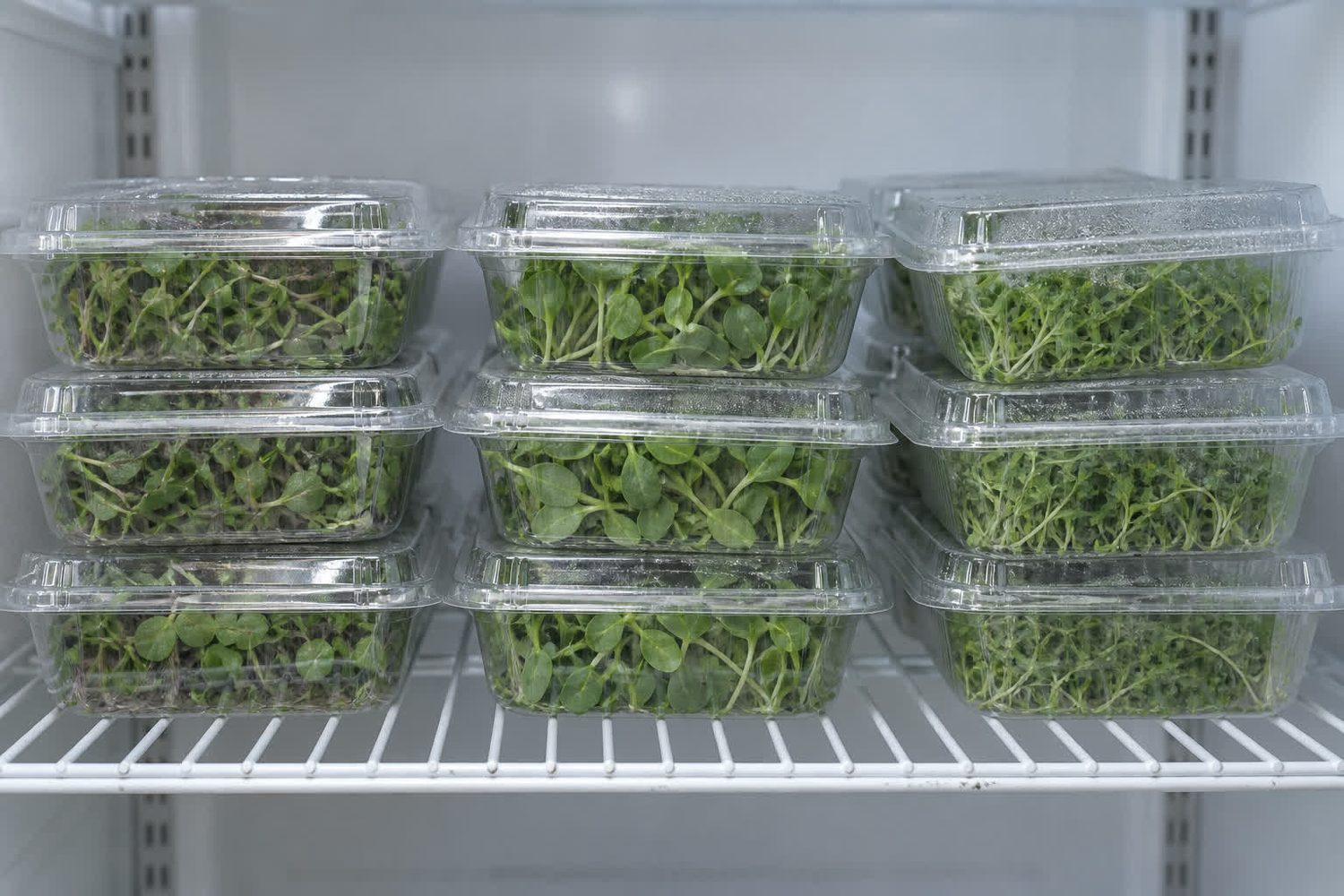
Cold storage. If you wash microgreens, Michigan's guidance says to spin-dry and refrigerate them. Write down the cooler temperature you hold at (read from a fridge thermometer kept in the cooler), who checks it and how often, and what you do with product if the cooler fails.
Section 4: Training and monitoring
For covered farms, FDA says workers need hygiene training when hired and at least once a year, and the training record must show the date, the topics and who attended (FDA FAQ). Produce Safety Alliance Grower Training is the FDA-approved standardized course, and one of its modules is how to develop a farm food safety plan (Illinois Extension).
Monitoring is the part that proves the plan runs. Penn State's sample plan uses an annual internal self-audit before the season: walk the room with your own plan, note gaps, and assign a fix. That is an audit and template practice rather than a federal duty for every farm. If you want an outside set of eyes without an audit, Michigan's Produce Safety Risk Assessment offers a free, confidential walk-through, action plan and state certificate, and North Carolina offers a free educational On-Farm Readiness Review after PSA training.
Pest monitoring belongs here too: Alabama Extension says to inspect for openings, keep pets out, remove plant debris, and discard crop affected by droppings.
Section 5: The logs to keep, and for how long
Each record should carry the date, the responsible person, what was done, any chemical name and amount, and any supporting test result (Alabama Extension). Keep these logs:
Hover or tap a row to highlight it.
| Log | What goes in it | Why you keep it |
|---|---|---|
| Water | Lab results for wells, or the utility's report for public water | Federal rule for covered farms; buyers and auditors ask |
| Cleaning and sanitizer | Mixing, application and strip readings (UConn) | Shows your SOP happened; audit item |
| Training | Date, topics, attendees | Federal rule for covered farms |
| Illness and injury | Who was excluded and when | Plan and audit item |
| Pest monitoring | Checks, findings, pest-control visits | Plan and audit item |
| Harvest and lot | Lot code, crop, seed lot, medium lot, tray or rack, sow and harvest dates, worker, pack count, customer | Traceability; buyers ask |
| Corrective action | The problem, the action, the person, the fix | Plan and audit item |
| Mock recall | Lot tested, time taken, gaps found | Audit and template expectation |
For the lot code, Alabama Extension's example RL-101422-Z3 stands for crop, October 14, 2022, and zone 3. A mock recall picks one finished lot, pulls its seed, medium and sanitation records, lists every customer who received it, and times how long that took; Penn State's sample runs one each year.
For a covered farm, keep records at least 2 years past the date each was created, under 21 CFR 112.164. Records supporting a qualified exemption are kept as long as needed to support that status; FDA's 2018 draft guidance, which is nonbinding, says that could be as long as four years. A buyer contract or audit can ask for longer, so note any longer period next to the buyer who set it.
Answering a buyer's questions
Buyers do not share one questionnaire; the UC Davis food hub model plan uses an annual grower assessment. Keep a one-page answer sheet ready: contacts, what you grow and pack, your food safety manager, water documents, seed and substrate lot records, SOP summaries, any permit or insurance, audit status, and a recall contact.
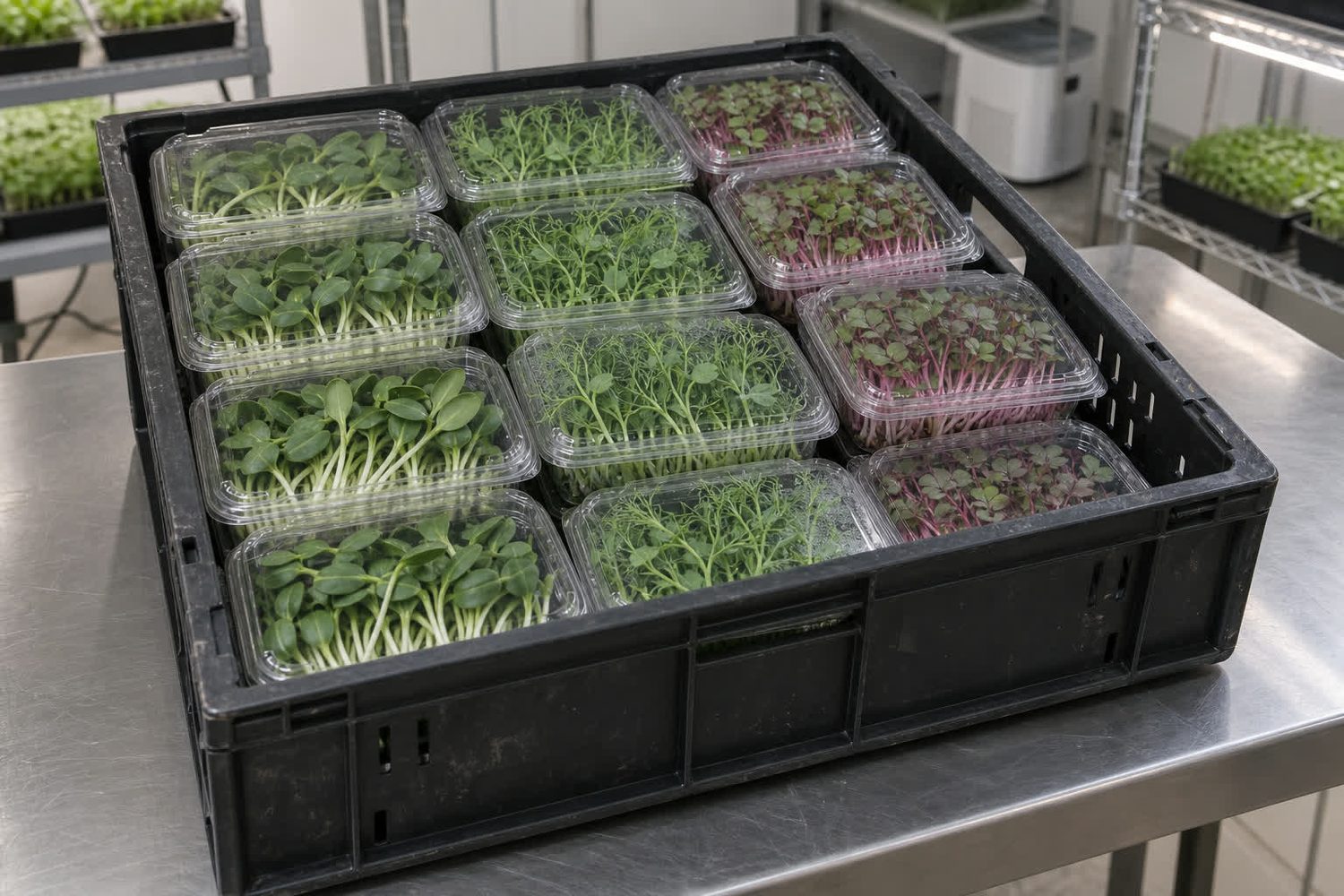
Review the plan at least once a year before your busy season, as Penn State's sample does, and update it whenever you change seed supplier, water system, rack layout, sanitizer or a buyer's specification.
Frequently asked questions
Do I need a HACCP plan to grow microgreens? Only where a local authority requires one. Yellowstone City-County's packet for retail establishments asks for a process flow diagram, hazard analysis, refrigeration and batch logs, and training records. Ask your own health department in writing before you build one.
How much does Produce Safety Alliance Grower Training cost? Prices are set locally. Illinois listed a $60 manual and a $35 certificate, Iowa State listed an April 7, 2026 remote course for $30 including both, and UC ANR listed July 2026 virtual courses at $10 for California residents and $150 otherwise.
Is a sanitizer labeled "food grade" enough for my trays? Go by the EPA registration and label for the use you intend, not the phrase on the jug. EPA says the label sets the permitted ppm rate and that there are no standard levels for quaternary ammonium. UConn advises keeping an updated list separating food-grade and non-food-grade chemicals, with safety data sheets.
Will a buyer accept my plan without a third-party audit? Some models do. The Davis Food Hub model accepts an annual grower questionnaire reviewed by a qualified auditor, and Michigan's program ends in a state certificate with a three-year check-in and no outside audit. Whether a specific grocery or distributor accepts it depends on their current supplier terms, so get their answer in writing.
Start filling it in today
Open the Penn State or CAFF template, fill in your farm identity, name your food safety manager and write your Produce Safety Rule status on the first page. Request your utility's water report or book a well test, and start the harvest and lot log before your next cut. Add the other logs one at a time; the ones you start this week are the ones a buyer will ask to see.
Sources
Prices, stock and specifications are as the linked pages showed them on 2026-09-12.
- Penn State Extension
- NMSU All About Microgreens
- nine retailers
- CAFF
- voluntary
- University of Minnesota workbook
- to grow sprouts or microgreens in a retail food establishment
- processing facility
- FDA FSMA FAQ
- North Carolina Department of Agriculture fact sheet
- farm plan template
- yes/no decision tree
- sample plan
- 21 CFR 112.43
- 21 CFR 112.44(a)
- $30 to $50 per sample
- $20 to $70
- Michigan's microgreens guidance
- Produce Safety Alliance labeled-products tool
- 200 ppm for one minute
- UMN Extension
- Alabama Extension
- UConn Extension
- Illinois Extension
- Produce Safety Risk Assessment
- 21 CFR 112.164
- 2018 draft guidance
- model plan
- $30
- $10 for California residents and $150 otherwise
- no standard levels
Keep reading
The journal
Do I Need a License to Sell Microgreens?
Do I need a license to sell microgreens at a market, to a restaurant, or to neighbors? Find your state's answer, its condition, and what would change it.
Read Do I Need a License to Sell Microgreens?The journal
How to Sell Microgreens: Your First Sale, Step by Step
How to sell microgreens for your first sale: check the rules, keep records, get insurance, find a buyer, pack, price, and deliver cold, then review.
Read How to Sell Microgreens: Your First Sale, Step by StepThe journal
Selling Living Microgreens Trays: Classification and Care
Thinking about selling living microgreens trays? Learn how states classify them, what care instructions to give buyers, and how sellers price trays.
Read Selling Living Microgreens Trays: Classification and CareThe journal
Microgreen Powder Business Math: Yield, Price, and the Rules
Before you start a microgreen powder business, run the numbers. See the dry weight yield, a tray revenue comparison, and the rules for a processed food.
Read Microgreen Powder Business Math: Yield, Price, and the Rules