Microgreens Seeder: Which Type Fits Your Tray Count and Budget
Cal HewittPublished Checked
- growing
- equipment
- growing at home
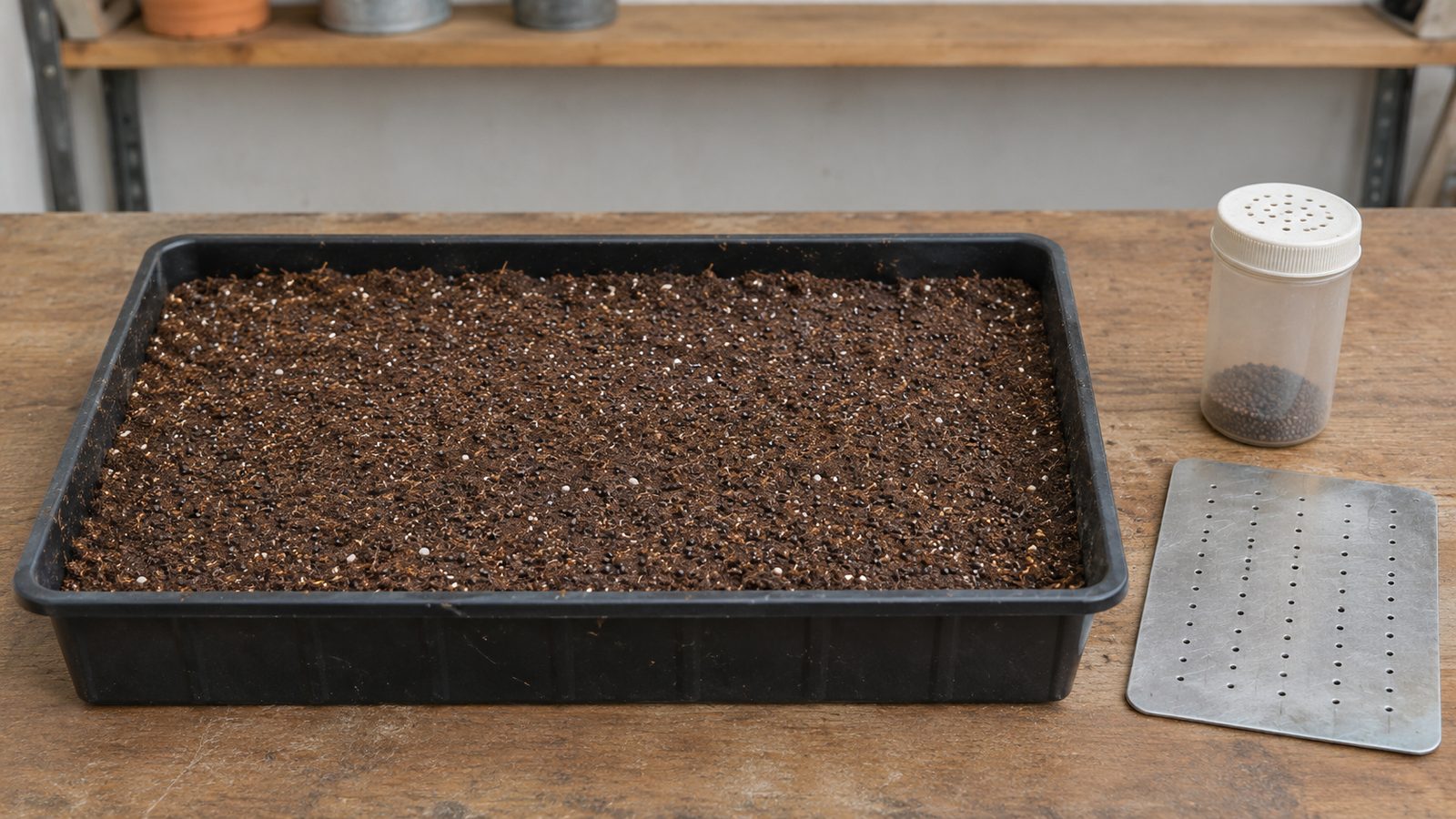
If you sow a few trays a week at home, keep sowing by hand. A seeder is a tool for saving tray-prep time.
The cheapest step up from your fingers is a cup or a shaker bottle, and Home Microgreens listed its shaker at $1.99 on November 19, 2026. Plate, drop and vacuum seeders listed from $99.99 to $760 before extra plates, and one commercial machine listed from $2,499.
Which type fits depends on two things you already know: how many trays you sow in a week and how big your seeds are. Count your trays for a few weeks, then read the types below against that number.
A seeder does one job. It spreads seed across a tray or into its cells. The types differ in how they meter the seed and in how many seed sizes they handle.
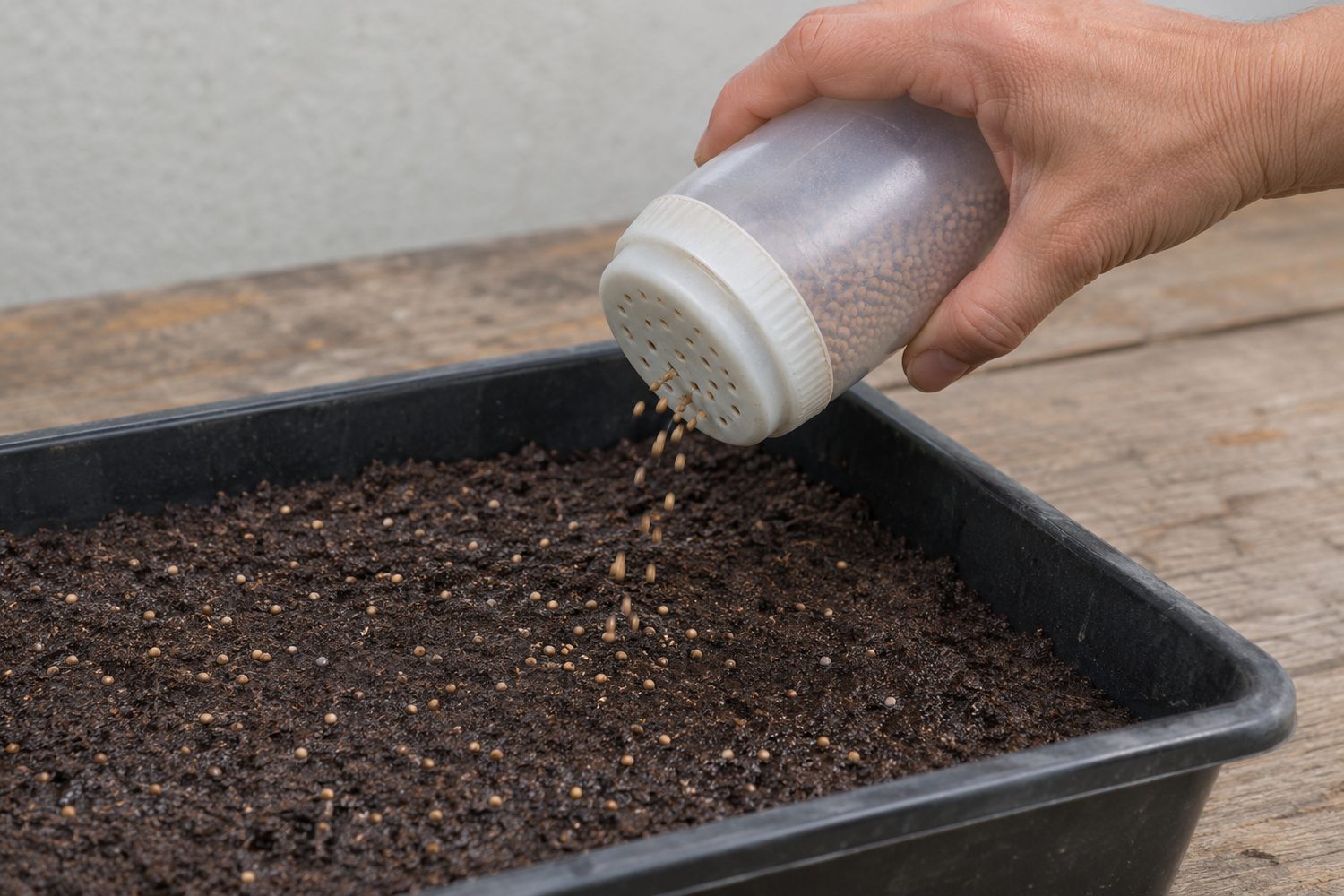
A shaker is a bottle with holes in the cap. You tip it over the tray and seed falls out through the holes as you move across the surface. It suits small seed. For larger seed, such as peas, sunflower and borage, the seller of one shaker bottle recommends a measuring cup instead (Home Microgreens shaker bottle).
A manual plate or cell-tray seeder holds seed in a reservoir and meters it along each row as you slide it across the tray. The plate you choose controls which seed sizes pass through. Johnny's makes one that fits 50, 72, 128 and 200 cell trays, and it is built for round and pelleted seed in cells, not for broadcasting across an open 1020 flat (Johnny's Manual Cell-Tray Seeder).
A vacuum seeder holds seed against a perforated plate with suction. You pour seed over the plate, remove the extras, set the plate over a filled tray and shut the suction valve. The held seed drops into the cells (Johnny's vacuum seeder manual).
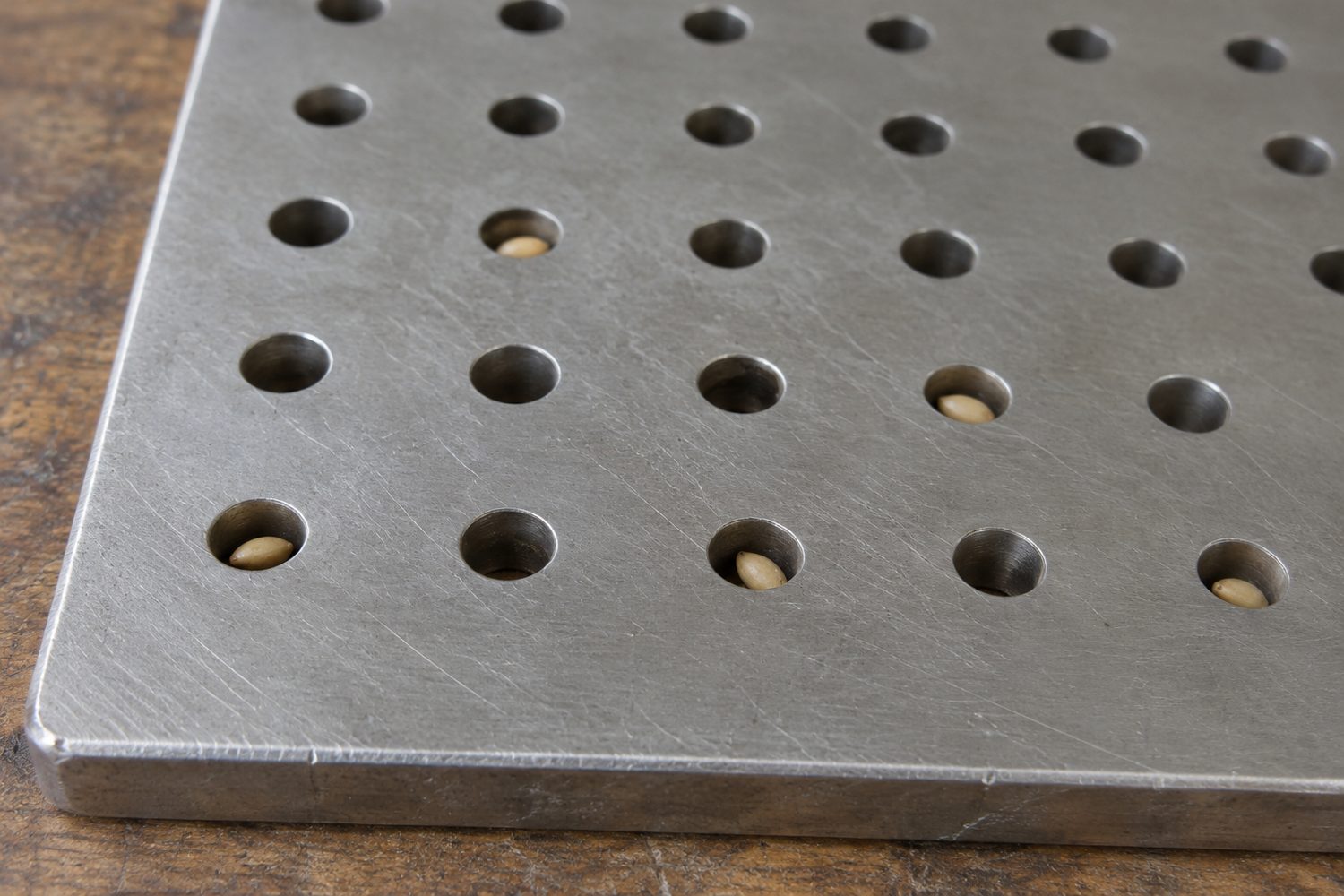
A drop seeder sandwiches seed between a top plate and a matching bottom plate. When you lift, click or slide the top plate, the seed falls through the matching holes.
The maker of the Kwik Klik frame says tray pattern, plate thickness and hole diameter set how many seeds land in each opening: a thinner plate with a smaller hole gives fewer seeds, and a thicker plate with a larger hole gives more (Paperpot Kwik Klik instructions). For an open 1020 microgreen tray, the plate pattern spreads seed across the tray instead of putting one seed in each cell.
What each type costs
Prices below are what each seller listed on November 19, 2026, and they change. Plates are often sold separately, so the price of the frame or body is not the price of a working setup.
Hover or tap a row to highlight it.
| Type | Example | Listed price | Notes |
|---|---|---|---|
| Shaker bottle | Home Microgreens | $1.99 | Listed out of stock; small seed |
| Half-tray drop seeder | Garden Gadgets half-1020, 72 cell | $99.99 | Seeds 36 cells at a time |
| Drop seeder | Bootstrap Farmer | $159.99 | Plates listed at $49.99 |
| Manual cell-tray seeder | Johnny's | $176.70 | 50, 72, 128 and 200 cell trays |
| Paperpot Kwik Klik frame | Paperpot | $450 | Before the required top and bottom plates |
| Vacuum seeder | Johnny's Precision Vacuum Seeder | $760 | Aluminum plates sold separately |
| Commercial machine | Bootstrap Farmer | From $2,499 | Made for production growers |
The Johnny's vacuum plates add to the total. Two 128-cell plates were listed at $210 for size D and $214 for size E. A vacuum setup with a plate or two lands above the $760 body price.
Neversink Tools sells a Vertigo drop seeder kit for 1020 trays with four top plates. Confirm the live cart price and the included plates with the seller before you buy (Neversink Tools Vertigo kit). A tabletop 1020 seeder from Rooted Robotics started at $15,500, which puts it in commercial territory (Rooted Robotics tabletop seeder).
For the shaker, confirm the current capacity and cap-hole size with the seller before you buy.
Tray formats decide which plate fits
A plate is cut for one tray pattern. Match the plate pattern to your tray format before you compare brands.
The formats you will see are the 1020 tray, which is roughly 10 by 20 inches though the outside size varies by maker, and the cell trays with 50, 72, 128 or 200 cells. A half-1020 format covers a 10-by-10-inch area, and the Garden Gadgets half-tray seeder fills 36 cells of a 72-cell insert in one pass. If you grow in open 1020 flats, look for a drop seeder with microgreen plates. Cell-tray seeders and vacuum plates are built around individual cells.
If you are still choosing trays, see the tray reviews and the growing medium reviews. Both matter here, because a seeder drops seed onto whatever surface you give it.
Seed size decides which plate you need
Seed size is the other half of the fit. Makers sort seed into small and large categories: brassicas such as broccoli, kale, cabbage and mustard count as small, and peas, sunflower and spinach count as large. Plates are sorted by seed category. Johnny's vacuum plates run from size A through G, covering large, medium and small seed and countersunk and plain-hole styles (Johnny's Precision Vacuum Seeder).
Raw seed and pelleted seed behave differently. Pelleted seed is coated to make it larger and more uniform, which is why cell-tray seeders like it. The Kwik Klik maker lists both raw and pelleted seed as compatible, so check your own seed type against the plate.
Before you sow a full tray, match your crop and your seed lot to the maker's plate chart, or run a small amount of seed through the plate and watch what happens. If you grow a mix of crops, the seeding rate chart gives you a starting weight to compare against.
How many trays a week before a seeder makes sense
One equipment guide for microgreen farms says to hold off on drum or plate seeders under about 100 trays a week and to revisit the question at 150 or more (Microgreen Manager equipment guide). That is one guide's threshold, based on setup and cleaning time, not a measured trial and not a rule.
The other numbers in circulation are looser still. A grower account in Homes & Gardens describes sowing more than 50 trays a week for restaurants, which shows 50 trays is a real production scale (Homes & Gardens grower account). A grower who ran a microgreens business for two years describes sowing by hand (Reddit business account). These are practice reports from individual growers.
Makers make their own claims. Johnny's says its vacuum seeder handles up to 120 trays per hour and suits small to midsize operations. Paperpot says a flat can be seeded in seconds. Those are manufacturer specifications and seller claims, not independent timings.
Time yourself instead. Sow your usual trays by hand for several weeks and write down the minutes per tray, then add your own estimate of cleanup time for any seeder you are considering. Set that against the purchase price plus the plates you would need.
Where hand sowing still wins
Hand sowing is the documented default for a household growing a few trays. Illinois Extension says to sow seed thickly and evenly across the surface, press it into the medium so it makes contact, and mist after sowing (Illinois Extension microgreens tipsheet).
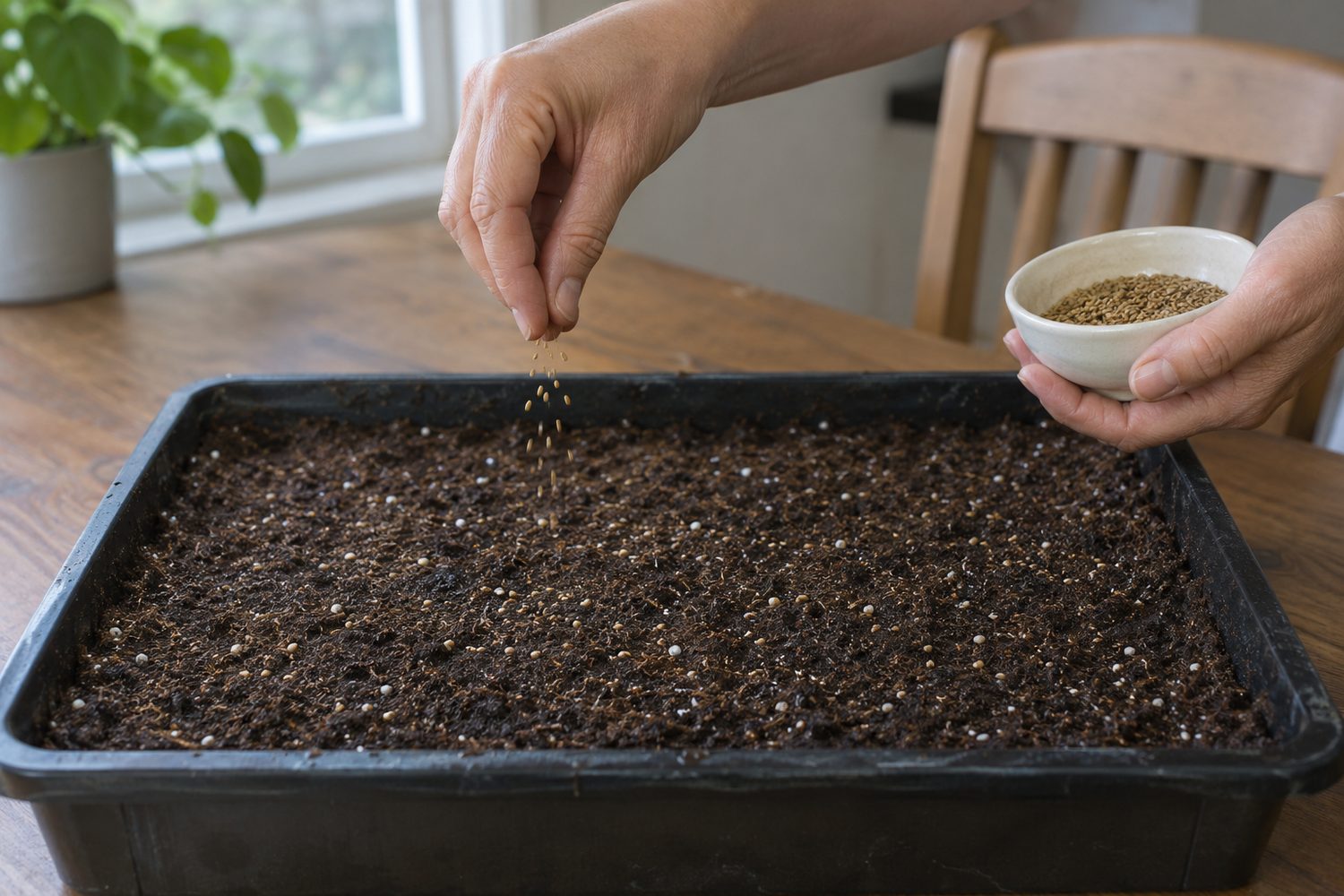
Growers describe a few habits. One Reddit grower starts at one corner of the tray and sprinkles across and down in a diamond pattern, then fills the gaps (Reddit hand-sowing discussion). Another uses a cup or an old herb shaker and moves back and forth until the density looks right. Johnny's suggests a sifter or colander to sort seed by size before sowing (Johnny's microgreens production guide).
A seeder also does not tell you how much seed a tray should get. That depends on the crop, the seed size, the tray area and when you plan to harvest. LSU AgCenter notes that crops cut at the seed-leaf stage can be sown more densely than crops held for true leaves (LSU AgCenter home microgreens guide). Virginia Cooperative Extension points growers to a seed-density calculator or supplier recommendations for the crop and tray (Virginia Cooperative Extension microgreen production guide).
Density still has to be tested
When you broadcast by hand, Johnny's suggests about 10 to 12 seeds per square inch for small seed and 6 to 8 for large seed, with seeds roughly 1/8 to 1/4 inch apart. It warns that sowing too densely can reduce air circulation and increase the risk of disease (Johnny's microgreens production guide, linked above).
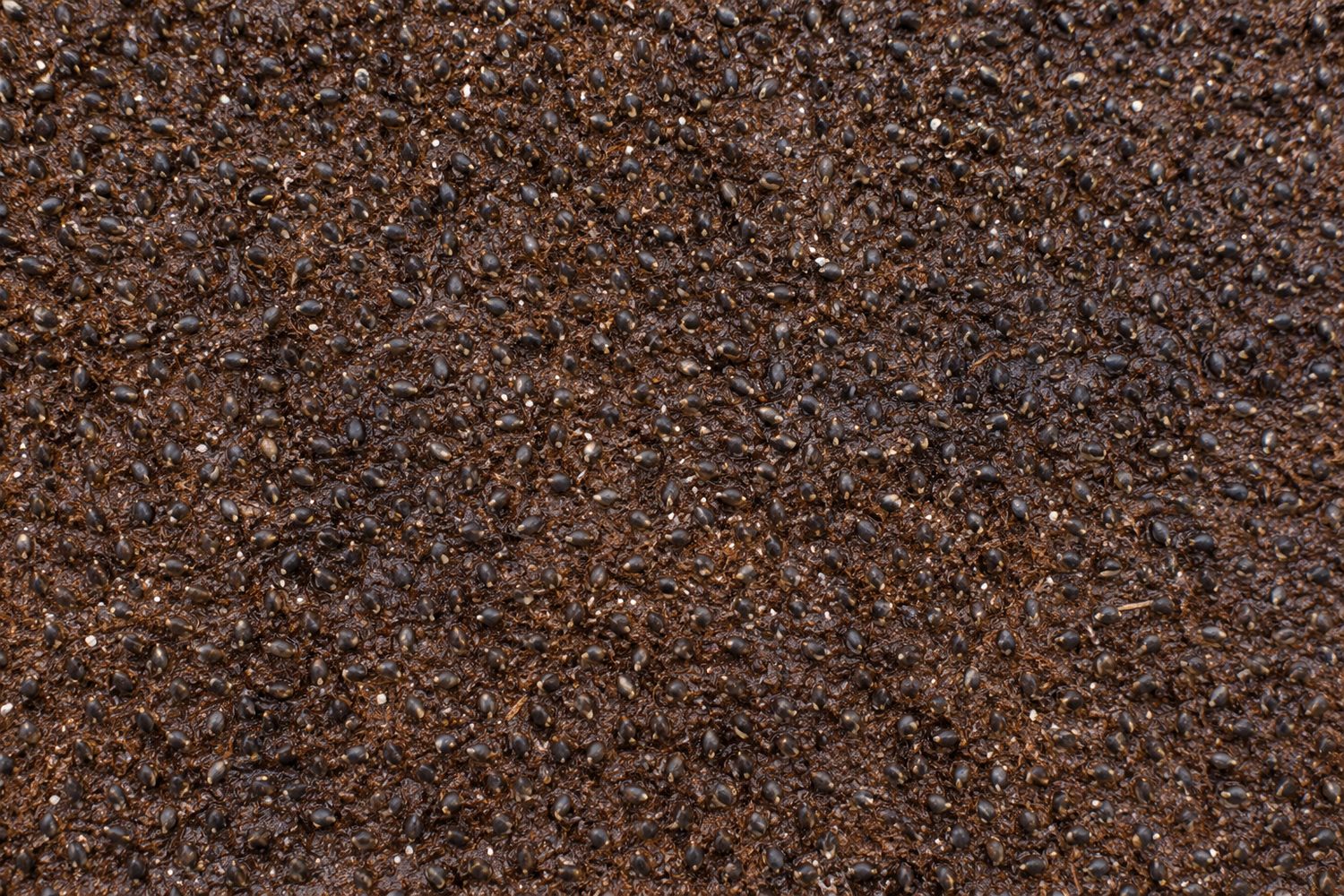
A seeder spreads seed. It does not choose the amount for you. Pick one crop and weigh the seed for one tray. Sow it by hand, then sow the same weight with the seeder you are considering. Keep the tray count, the seed lot and the person sowing the same, and compare how even the stand looks at harvest. A few weeks of notes on one crop show how your own seed lot behaves.
Matching a seeder to your week
If you sow a few trays a week, hand sowing is the documented default, and a cup or a shaker is the lowest-cost way to improve how seed is spread.
If tray prep takes a real share of your week, a drop seeder with microgreen plates is the type designed for open 1020 trays. The half-tray unit is the lowest-priced drop seeder listed above. Check which plates are included, since extra plates are priced separately (Bootstrap Farmer lists its at $49.99).
A vacuum seeder or a commercial machine is built for growers sowing in volume. Johnny's describes its vacuum seeder as suited to small to midsize operations, and the equipment guide above says to revisit seeders at 150 or more trays a week.
If you are building a setup from the beginning, read the best microgreen growing kits and the grow light reviews before you spend on a seeder. The growing guides cover the rest of the tray workflow, from medium to blackout to watering.
Questions growers ask
Can I use a drop seeder on every microgreen seed?
Not always. Plate hole size affects which seeds pass and plate thickness affects how many land in each opening, and large seed such as peas or sunflower may need a different plate or a measuring cup. Match your crop and seed lot to the maker's plate chart, or test a small amount of seed through the plate first.
Does a seeder improve germination or yield?
Paperpot says its seeder reduces labor and seed waste, but that is a seller claim, not a controlled test. A seeder distributes seed, and the crop result still depends on your density, your seed lot and your harvest timing. Keep your own records to judge it.
Is a shaker worth buying if I already use a cup?
Home Microgreens listed its shaker at $1.99 on November 19, 2026, out of stock at the time. It is intended for small seed, and its cap holes distribute seed instead of dumping it in one spot. Larger seed still goes through a cup.
Should I read marketplace reviews to decide?
Treat each review as one grower's report. Before you rely on a claim of time saved, look for the reviewer's tray count, crop mix and what they did before the seeder.
Pick by your own numbers
Count the trays you sow in a typical week and note which seeds you grow. If prep is a few minutes, keep your hands, or add a cup or shaker for a few dollars. If prep takes real hours and you sow open 1020 trays, a drop seeder is the type to price next, with plates included. Confirm live prices, plates and shaker capacity with each seller, and test density against your own crop before you commit a whole week of trays.
If you want a second opinion on your setup or a question about a crop, contact Microgreens Guru and ask.
Sources
Prices, stock and specifications are as the linked pages showed them on 2026-11-19.
- Home Microgreens shaker bottle
- Johnny's Manual Cell-Tray Seeder
- Johnny's vacuum seeder manual
- Paperpot Kwik Klik instructions
- Garden Gadgets half-1020, 72 cell
- Bootstrap Farmer
- Paperpot
- Johnny's Precision Vacuum Seeder
- $210 for size D
- $214 for size E
- Neversink Tools Vertigo kit
- Rooted Robotics tabletop seeder
- Microgreen Manager equipment guide
- Homes & Gardens grower account
- Reddit business account
- Illinois Extension microgreens tipsheet
- Reddit hand-sowing discussion
- Johnny's microgreens production guide
- LSU AgCenter home microgreens guide
- Virginia Cooperative Extension microgreen production guide
Keep reading
The journal
Growing Microgreens Indoors in Winter: Light, Heat and Mold
Winter window light, a cold growing medium and dry heated air can slow microgreen trays. Learn what to change, from timers and heat mats to airflow and mold.
Read Growing Microgreens Indoors in Winter: Light, Heat and MoldThe journal
Seed Starting Mix for Microgreens: Depth, Cost and Handling
Compare seed starting mix with potting mix and coco coir for microgreens. See the ingredients, cost per tray, fertilizer and reuse after harvest.
Read Seed Starting Mix for Microgreens: Depth, Cost and HandlingThe journal
AeroGarden Plant Food Cost: Doses and Hydroponic Alternatives
Running low on AeroGarden plant food? Hydroponic nutrients such as FloraSeries and MaxiGro have their own rates, so check the label before you switch.
Read AeroGarden Plant Food Cost: Doses and Hydroponic AlternativesThe journal
AeroGarden Seed Starting System: Which Size Fits Your Garden
AeroGarden seed starting system trays come in four versions. Match one to your garden, start seeds weeks before the last frost, then move seedlings to soil.
Read AeroGarden Seed Starting System: Which Size Fits Your Garden