Strawberries in an AeroGarden: Crowns, Seed and Pollination
Cal HewittPublished Checked
- aerogarden
- pod gardens
- growing
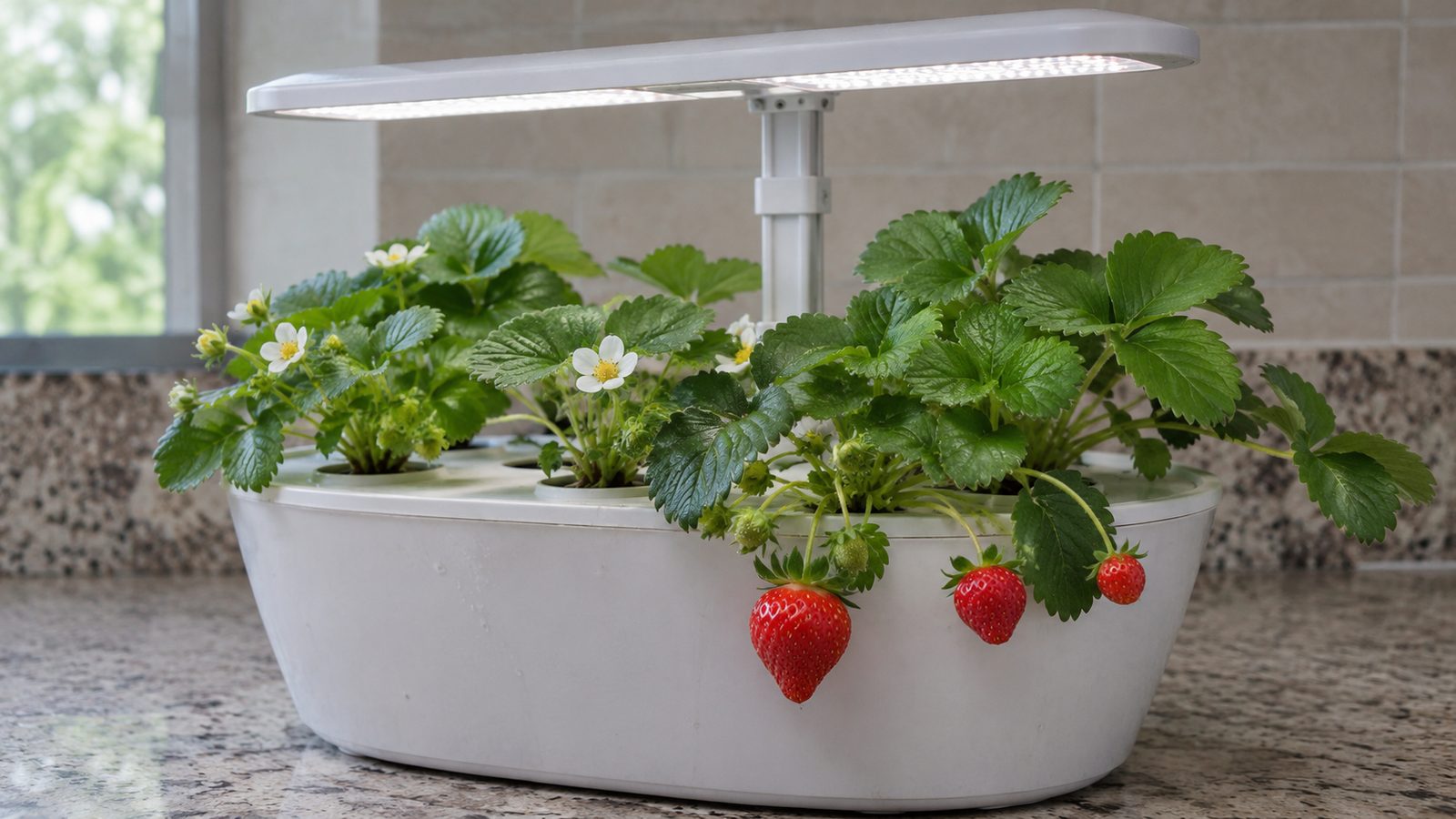
Yes, strawberries can fruit in an AeroGarden, but owners report modest harvests, not a bowlful. AeroGarden's own FAQ says strawberries can be grown with a Seed Pod or with the Grow Bowl made for the Bounty Classic, Ultra and Extra models, which holds live strawberry crowns.
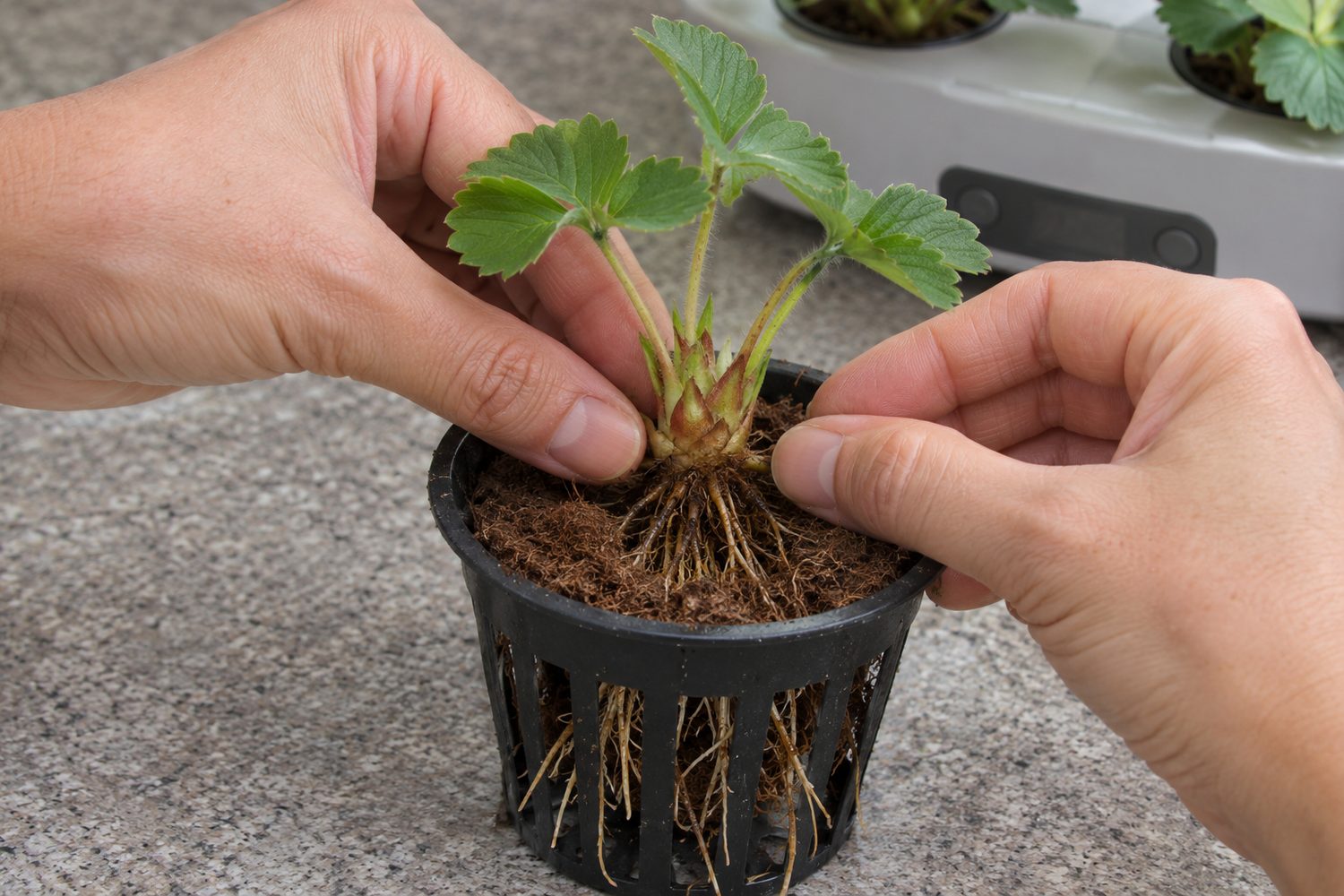
The Grow Bowl uses soilless media, with coconut fiber recommended. If you want the most predictable first harvest, start from a healthy day-neutral or alpine crown, not from seed. Seed adds germination and baby-plant time that crowns skip.
Pick a garden with height to spare, and plan to pollinate by hand, because there are no bees on your counter. Read the product page for anything labeled for strawberries before you pay, since owners mention a strawberry bowl or kit that has been discontinued.
What AeroGarden says about strawberries
The maker's answer is short. Strawberries can go in a seed pod, or in the Grow Bowl for the Bounty Classic, Ultra and Extra, which takes live crowns instead of seed (AeroGarden FAQ, read November 19, 2026). A crown is the short central stem between a strawberry plant's roots and leaves, and a bare-root crown is sold mostly as roots and that stem.
If you would rather use your own seed, the Grow Anything route lets you supply it, but AeroGarden does not guarantee germination for seed you bring. The Grow Anything Seed Pod Kit is the product built for that.
The standard Bounty box holds seed pods, grow domes, liquid plant food and a quick-start guide (Bounty manual, read November 19, 2026). Follow the manual's general fruiting guidance for light and feeding.
Owners in 2020 and 2022 discussions refer to a strawberry bowl or kit that is no longer made (2020 thread, 2022 thread). That is owner practice, not word from the manufacturer. Check the current product page for the exact item, and confirm availability with AeroGarden if the page is unclear. If you are still deciding on a garden, what an AeroGarden is and how much an AeroGarden costs cover the basics, and whether AeroGarden is still in business covers supply.
Choose the garden by height and room
Strawberries need room to spread, so match the garden to the plant before you buy anything else.
The Bounty has nine pods, a 40-watt LED and a light that rises to 24 inches (Bounty product page, read November 19, 2026). AeroGarden's garden guidance points buyers to the Bounty or the Farm 12XL for plants that need 24 inches or more. The Farm models give the most vertical and side-to-side space, and the Farm manual says to keep the light 4 to 6 inches above the plants.
Hover or tap a row to highlight it.
| Garden | Light height | Fit for strawberries |
|---|---|---|
| Sprout | Short light arm, three pods, small reservoir | Weakest pick; little room for crowns, roots and runners |
| Harvest family | About 12 inches | Compact alpine types; spreading plants can run short of room |
| Harvest XL | 18 inches (specifications video) | Compact alpine types; watch for crowding |
| Bounty | Up to 24 inches | Clearest countertop choice; the Grow Bowl is made for the Bounty Classic, Ultra and Extra |
| Farm models | Most vertical and lateral space | Roomiest option; light kept 4 to 6 inches above the plants |
Choose the roomiest model you can afford and confirm its current light height on the product page before buying. Our AeroGarden Bounty review and AeroGarden Farm review cover those two models, and Harvest models compared lays out the smaller family.
The Sprout is the poorest fit. Its small reservoir, three-pod layout and short light arm leave little space for the crown, its roots, the leaves and any runners. If a Sprout is what you own, a compact alpine type is the better fit, and space may run short as the plant spreads.
Seed or crown: how long to first fruit
Start with what the numbers mean. AeroGarden's manual says fruiting plants, strawberries included, generally begin flowering about 4 to 6 weeks after planting (Bounty manual). That is a flowering estimate. It is not a date for ripe fruit, and a flower still has to be pollinated and the berry still has to swell and color.
University of Minnesota planning tables count 65 days from transplant to first harvest for day-neutral strawberries (UMN crop planning table, read November 19, 2026). That is a field and high-tunnel figure, and it starts at transplant, not seed. Treat it as the shape of the timeline for a crown, not a promise for your counter.
Owner reports run much wider. Some owners describe months, or a second year, before fruit. These are practice reports, and they cannot set a typical timetable.
If you start from seed, allow several months. If you start from a crown, your wait is shorter and easier to predict, and a 2025 owner who got a first ripe alpine berry from seed recommended crowns for a faster start (r/aerogarden, 2025).
Which types to look for
Alpine strawberries, also called woodland, wild or European strawberries, or Fragaria vesca, are small, sweet and day-neutral, and they are commonly grown from seed (UMN home strawberry guide, read November 19, 2026). The same guide says they may make runners or stay as clumps, and reports roughly two to three berries per plant per week in home-garden conditions. That is a garden figure, not an AeroGarden one.
Day-neutral means the plant can flower and fruit without waiting for short days, as long as temperatures stay suitable. University of Minnesota lists Albion, Evie-II, Monterey, Portola, San Andreas and Seascape as day-neutral varieties used in production trials (UMN day-neutral strawberry guide, read November 19, 2026). Those are production varieties, so check what a crown seller actually offers. Everbearing types give two main crops, commonly one in early summer and another in early fall.
Pollination: you are the bee
Indoors there are no bees or other insects to move pollen. The University of California Agriculture and Natural Resources hydroponics lesson shows a small soft paintbrush touching the stamens at the center of each open flower (UC ANR hydroponics lesson, read November 19, 2026).
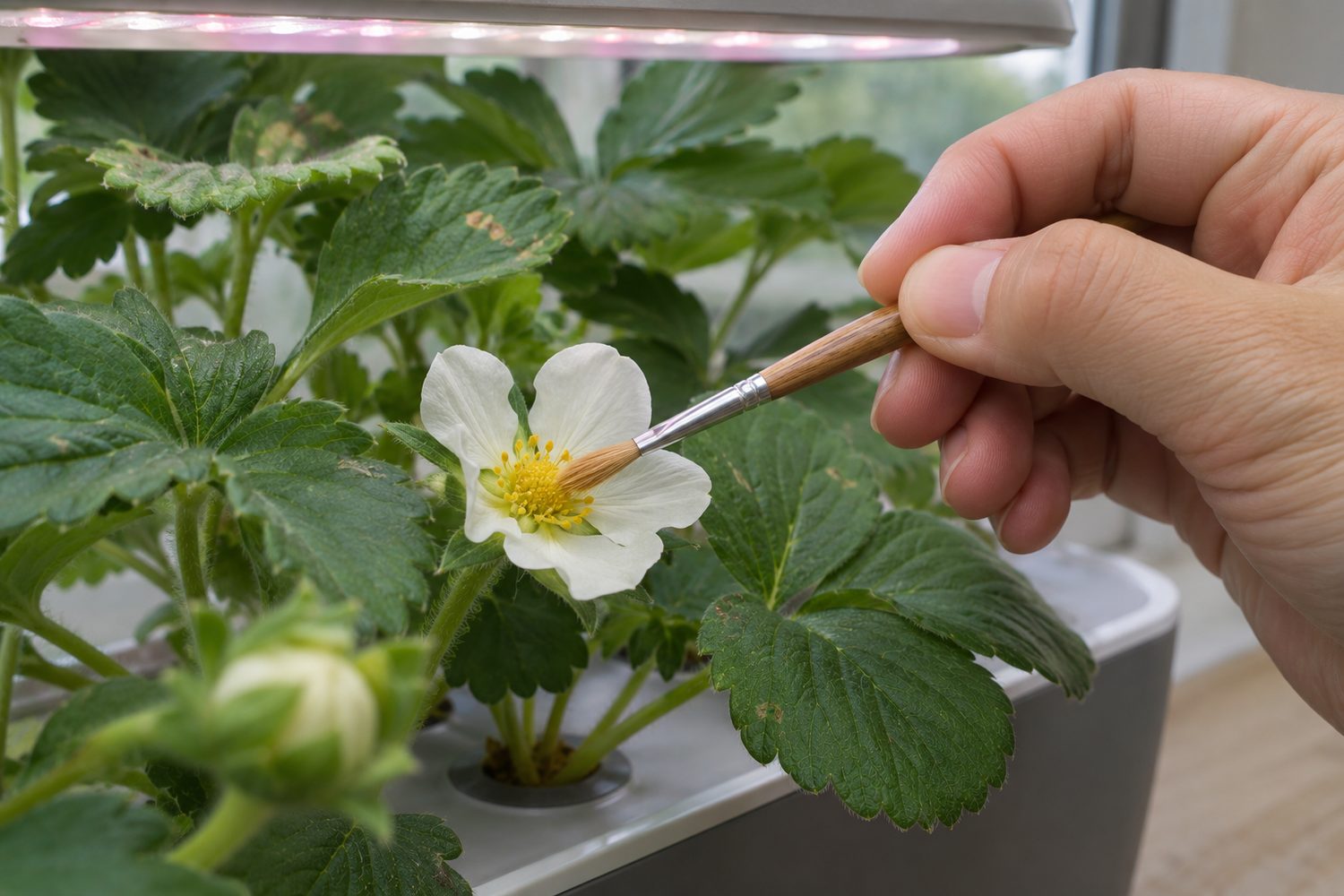
Go from flower to flower and brush every open one. Incomplete pollination can give misshapen or poorly filled berries. Hand pollination still helps even though a strawberry flower has both male and female parts, because pollen has to move within the flower.
The Farm manual lists three methods: gently shake the plant, set a fan near it, or use AeroGarden's Be the Bee pollinator. It also says strawberries may benefit from more forceful pollination, and it recommends touching each flower with the brush when you use the pollinator (Farm instruction guide, read November 19, 2026).
Light, temperature and feeding
Follow your model's manual for light and feeding. AeroGarden's FAQ describes a 15-to-17-hour light cycle for year-round growing, and the Harvest 2.0 setup guide gives 15 hours on and 9 off.
University of Florida Extension gives 50°F to 80°F and 14 hours of daylight or less for most strawberry varieties (UF/IFAS strawberry guide, read November 19, 2026). University of Minnesota gives a wider day-neutral range of 45°F to 85°F, with growth stopping outside it. Those are field and garden figures, and the AeroGarden timer can run longer than the 14-hour day length the Florida guide describes, so follow your model's manual for the light cycle.
Add liquid plant food at planting and whenever the feeding prompt appears, normally every 14 days. Use the amount printed on the nutrient packaging, top off the reservoir and do not add extra fertilizer. University of Minnesota notes that day-neutral strawberries have high nutrient demands because they fruit while they keep growing leaves. That is a reason to stay on schedule, not a reason to add more than the label says. See AeroGarden setup and instructions for the routine, and replacement parts and grow lights if a light or pump fails mid-season.
Keep the light close to the leaves without touching them. Raise it as the plant grows, up to the 24-inch limit on a Bounty, or hold it at 4 to 6 inches above the plants on a Farm.
Runners, crowding and problems to watch
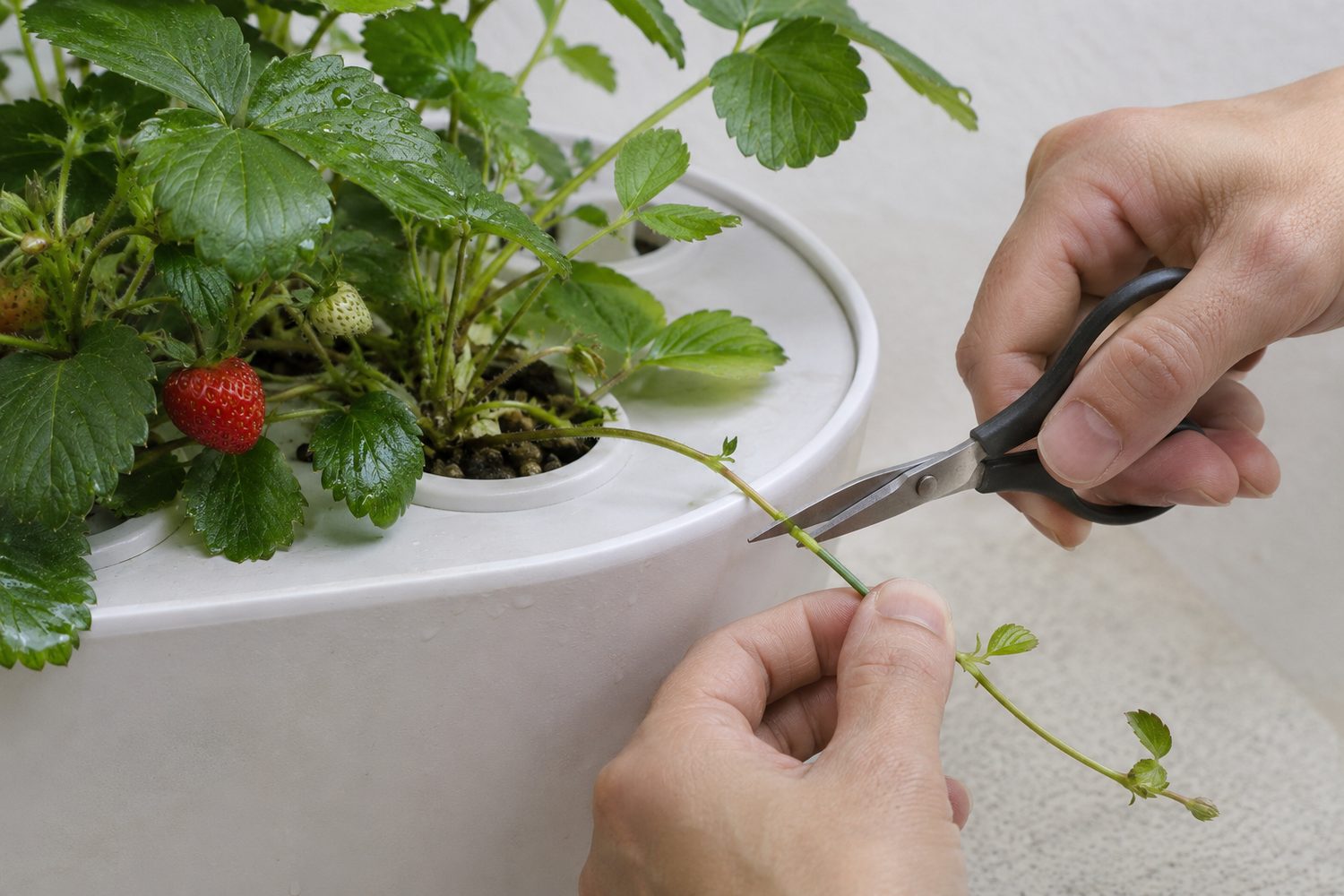
Runners are the long horizontal stems that form daughter plants. Owners often mention them on ordinary strawberries, and alpine types are usually described as clumping with few or none, though that varies. Remove runners unless you want new plants.
Inspect the crowns, roots, leaves and reservoir often. Owner threads describe several problems:
- A 2023 thread reports limited fruiting, tasteless fruit, fungal problems and runners, with one grower getting only one or two good berries a week from a larger system (r/aerogarden, 2023).
- A 2026 thread reports root rot, spider mites, aphids and mealybugs (r/aerogarden, 2026).
- Another 2026 grower called alpine plants fairly prolific once established, with small berries and no runners, but sensitive to too much or too little nutrient and to pH changes, and needing heavy pruning (r/aerogarden, 2026).
These are owner reports, not measurements of how common each problem is. A regular clean helps with the reservoir side; how to clean an AeroGarden has the steps.
What a realistic harvest looks like
Owner reports describe modest, intermittent harvests, not a steady supply of grocery-sized berries. The 2023 thread above reports one or two good berries a week from a larger system, and the 2026 alpine grower reports small berries.
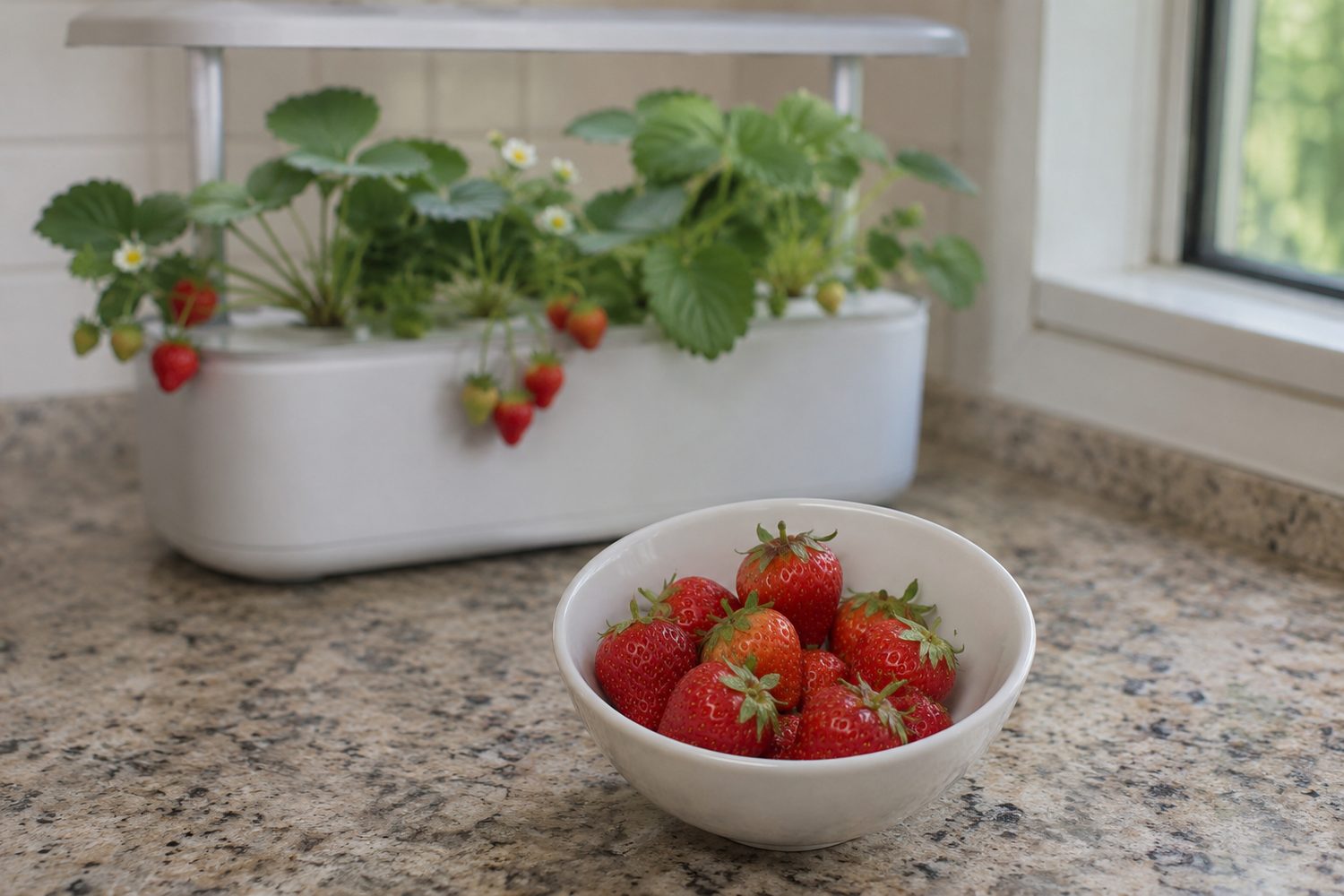
Keep a log. Count what you pick for a few weeks, write it down, and work from your own numbers. Treat the glossy berries on a kit box as how the plant looks, not what it will yield.
If you want to see what else the garden grows, AeroGarden pods and seed pod kits shows what the standard kits hold. Comparing brands before you buy is covered in AeroGarden vs LetPot.
Questions owners ask
Can I grow strawberries from seed in an AeroGarden?
Yes, through a Seed Pod or the Grow Anything route, but AeroGarden does not guarantee germination for seed you supply. Allow several months before fruit, and expect the wait to be longer than with a crown.
Do I have to hand pollinate indoors?
Yes, plan on it. Without bees, use a soft brush on every open flower, or follow the Farm manual's options of shaking the plant, using a fan, or using the Be the Bee pollinator.
Will a Sprout work?
It is the weakest choice because of its small reservoir, three pods and short light arm. A Bounty or a Farm gives you the height and room that strawberries use.
How often do I feed strawberries?
Add liquid plant food at planting and whenever the feeding prompt appears, normally every 14 days. Use the amount on the label and add nothing else.
Should I remove runners?
Yes, unless you want new plants. Owners report runners on ordinary strawberries, and each one can form a daughter plant that takes up room in a small garden.
Your next step
Start with the garden's light height, then the crown. If you have a Bounty or a Farm, choose a healthy day-neutral or alpine crown, confirm the current Grow Bowl or kit on AeroGarden's product page, and keep a brush near the flowers. If you have a question about a specific garden or pod kit, send it to Microgreens Guru through the contact page.
Sources
Prices, stock and specifications are as the linked pages showed them on 2026-11-19.
- FAQ
- Bounty manual
- 2020 thread
- 2022 thread
- Bounty product page
- garden guidance
- Farm manual
- specifications video
- UMN crop planning table
- r/aerogarden, 2025
- UMN home strawberry guide
- UMN day-neutral strawberry guide
- UC ANR hydroponics lesson
- Farm instruction guide
- Harvest 2.0 setup guide
- UF/IFAS strawberry guide
- r/aerogarden, 2023
- r/aerogarden, 2026
- r/aerogarden, 2026
Keep reading
The journal
Can You Grow Microgreens in an AeroGarden? What Owners Do
The AeroGarden MicroGreens Kit is hard to find. Learn how owners still grow microgreens in an AeroGarden with a simple tray beside the light.
Read Can You Grow Microgreens in an AeroGarden? What Owners DoThe journal
AeroGarden Herbs: Which Ones Struggle and How to Prune Them
Which AeroGarden herbs grow well, how to prune basil so slower herbs get light, when and how to cut, and how long each planting keeps producing.
Read AeroGarden Herbs: Which Ones Struggle and How to Prune ThemThe journal
AeroGarden Lettuce: Which Greens to Grow and How to Harvest
Which AeroGarden lettuce and leafy greens grow well, how to cut them so they regrow, how long a pod keeps producing and how much salad it makes.
Read AeroGarden Lettuce: Which Greens to Grow and How to HarvestThe journal
AeroGarden Plant Food Cost: Doses and Hydroponic Alternatives
Running low on AeroGarden plant food? Hydroponic nutrients such as FloraSeries and MaxiGro have their own rates, so check the label before you switch.
Read AeroGarden Plant Food Cost: Doses and Hydroponic Alternatives