Can Ferrets Eat Microgreens?
Cal HewittPublished Checked
- ferrets
- obligate carnivore
- animal feeding
- safety
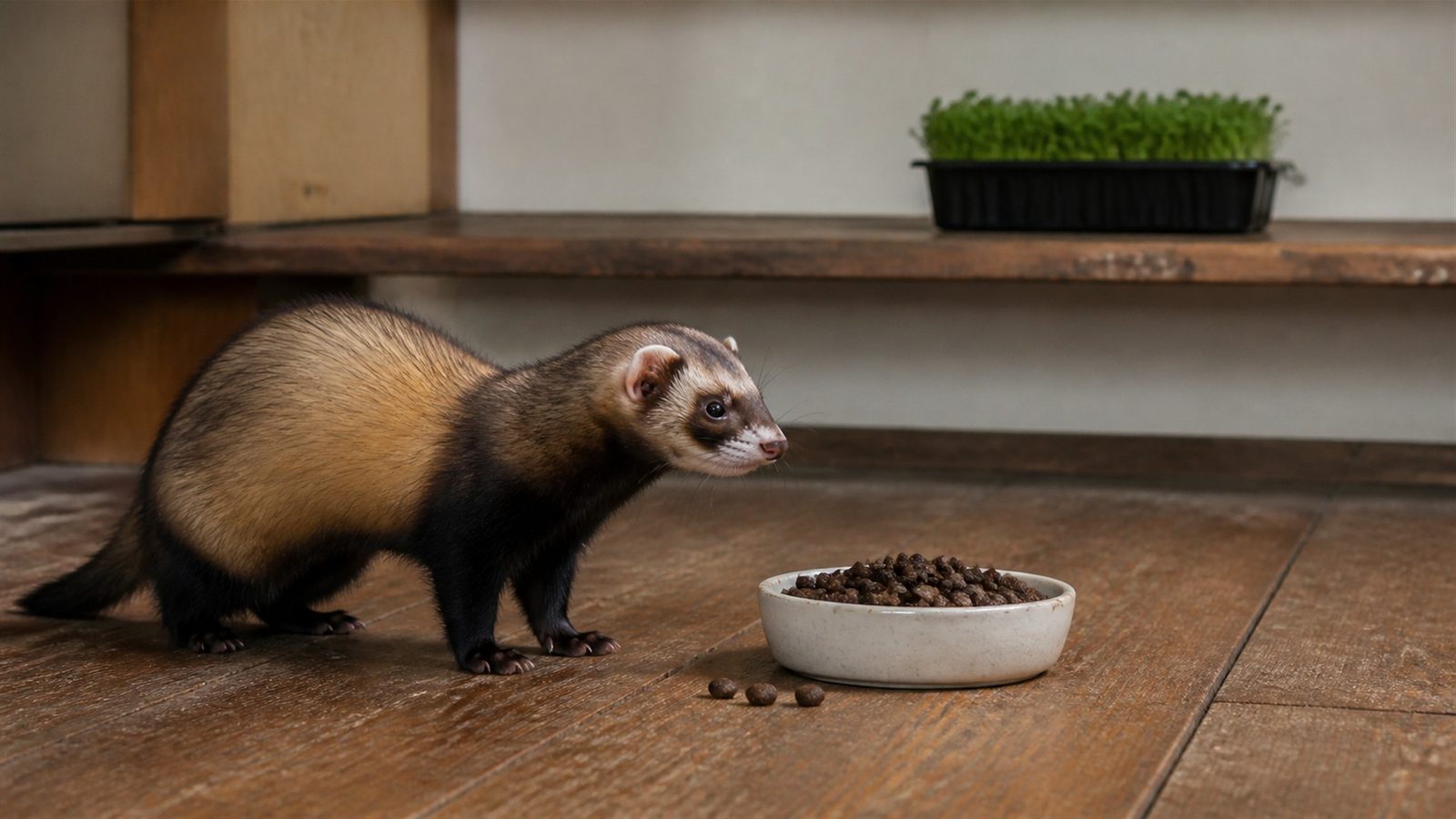
No. Not as a food, not as a treat, and not as enrichment.
For ferrets the sources actually looked and said no, which is unusual in this subject. For most species the honest finding is that nobody has checked either way.
A veterinary school's ferret care guidance says to avoid high-fiber foods such as fruits and vegetables. A large veterinary hospital group says to avoid feeding your ferret sweets, dairy products, raisins, fruits and vegetables. Those are explicit, and a microgreen is a vegetable.
What to actually do
- Feed a species-appropriate formulated diet and keep it as the whole diet. That is the entire feeding answer for this animal.
- Do not offer microgreens at all, including as enrichment or variety. Two independent veterinary sources say avoid vegetables.
- Keep Allium microgreens away from ferrets entirely. This is the one outright toxic call.
- Do not panic over a stolen leaf. A gram of microgreen is a fraction of a gram of carbohydrate. Watch the animal and move the tray.
- If you want to give a treat, make it animal-derived and low in fiber. That is what the welfare guidance actually recommends.
- Grow your trays out of reach. A ferret that can get onto the shelf will investigate, and the seed tray and growing medium are worse than the leaves.
- Do not use the insulinoma story as the reason. The diet link is unproven, and the real reason is better.
Why the answer is different for this animal
A ferret is an obligate carnivore, which is a description of anatomy rather than a preference. It has a simple stomach, a short intestine, no cecum at all, and a colon of roughly 7 centimeters. Gastrointestinal transit runs 1 to 8 hours with an average of 3 to 4.
There is no fermentation chamber and no microbial population to break plant cell walls down. Combine that with a three to four hour transit and plant material has almost no opportunity to be fermented or to give up nutrients. It passes through as bulk, and may contribute to loose stool.
The formulated diet targets show the same thing from the other direction. Veterinary and welfare guidance puts a maintenance ferret at 30 to 40% animal protein, 15 to 20% fat, and fiber under 3%. A second veterinary source gives 32 to 40% protein and 10 to 15% fat.
Fiber under 3% is the number that matters here.
The composition, compared on the right basis
A published review puts Brassicaceae microgreens at 2.70 to 3.70 grams of carbohydrate and 0.36 to 2.08 grams of fiber per 100 grams fresh weight. A 2021 study that measured six Brassicaceae microgreens directly found 2.32 to 3.70 grams of carbohydrate per 100 grams fresh weight, with any fiber counted in that total (Kowitcharoen et al., 2021). On fresh weight those look small, and that comparison is misleading, because the ferret's diet specification describes a dry formulated food and a microgreen is mostly water.
Put both on a dry basis, taking fresh leafy material at around 90% moisture:
Hover or tap a row to highlight it.
| Component | Microgreen, per 100 g fresh | The same on a dry basis | Ferret diet specification |
|---|---|---|---|
| Fiber | 0.36 to 2.08 g | 3.6% to 20.8% | under 3% |
| Carbohydrate | 2.70 to 3.70 g | 27% to 37% | Not the basis of the diet at all |
| Protein and fat | Not the point | Not the point | 30 to 40% protein, 15 to 20% fat |
Compared like for like, the fiber runs from 1.2 to 6.9 times the ceiling the diet is supposed to stay under. The carbohydrate lands where the protein is supposed to be.
That is the case against it, and it does not need a toxin. Nothing here says a microgreen poisons a ferret. It says a microgreen is the wrong shape of food for an animal built to eat animals.
What one accidental nibble actually means
Very little, and it is worth saying plainly so nobody panics.
A one gram nibble of a Brassica microgreen carries about 0.027 to 0.037 grams of carbohydrate and 0.004 to 0.021 grams of fiber. In absolute terms that is nothing.
So, a ferret that stole a leaf is not an emergency. Watch it, keep its normal food available, and move the tray somewhere it cannot reach.
The reason to say no is not the single leaf. It is that a treat becomes a habit and a habit displaces a diet, in an animal with a narrow margin for that. Welfare guidance is direct: treats are not nutritionally necessary, and if you use them they should be animal-derived and low in fiber.
The one genuine toxin, and the one myth
Allium crops are the hard no. Ferret-specific poison guidance names allium toxicity for this species, and the general mechanism is oxidative red-cell damage. Onion, leek and chives microgreens are unsafe for a ferret.
Now the myth, and it runs the other way. Ferret keepers widely believe dietary carbohydrate causes insulinoma, a pancreatic tumor that secretes insulin and causes low blood sugar. It is one of the common ferret cancers.
That link is plausible, widely suspected, and not proven. A retrospective study comparing 46 insulinoma cases against 77 controls over 2006 to 2015 found no statistically significant difference between its lower-carbohydrate and higher-carbohydrate commercial diet groups, and notably none of its animals were on a genuinely low-carbohydrate household diet. A 2025 veterinarian-authored handout from a ferret association says plainly that there are no good studies proving diet's impact on blood glucose or insulinoma development, then offers anecdotal clinical improvement after lowering carbohydrates.
So, do not treat insulinoma as the reason. The reason to keep vegetables out of a ferret is the digestive anatomy and the diet specification above, both of which are solid. An unproven tumor claim makes a sound case weaker rather than stronger.
What to watch for, and when to call a veterinarian
A narrow small intestine raises the risk of foreign body entrapment, and foreign bodies are a documented ferret emergency. The literature does not identify fibrous vegetable material as the culprit, so this is a general caution rather than a measured microgreen risk.
Contact a veterinarian for anorexia or refusing food, weight loss, lethargy, dehydration, nausea, vomiting, diarrhea, or black tarry stool. Those are the signs the clinical literature lists for gastrointestinal obstruction and disease in this species.
And separately, for a suspected allium ingestion, treat it as urgent rather than waiting for signs.
What nobody has measured
- Any microgreen fed to a ferret. No trial, no case series, no crop, at any amount.
- What actually happens to a leaf in a ferret gut. The anatomy predicts poor utilization and rapid passage, and no controlled digestibility or tolerance study has been done.
- Whether dietary carbohydrate causes insulinoma. The one retrospective study found no significant difference and the ferret association says there are no good studies.
- Any published harm in a ferret from eating a non-allium vegetable leaf. No case report was located, which cuts both ways: it is not evidence of safety either.
- Whether plant material has ever caused a ferret obstruction. The narrow lumen raises the risk in principle and the literature does not name vegetables as the cause.
- The dry matter of a microgreen, which is why the 90% moisture used above is a stated assumption rather than a measured crop value.
Terms on this page
Tap a term to see what it means.
Obligate carnivore. An animal physiologically adapted to meet its nutritional needs from animal tissue. Not a preference, and not something a formulated plant diet can satisfy.
Sources
Opened 2026-08-12. The composition arithmetic is computed for this page from the published fresh-weight figures below and a stated 90% moisture assumption, so that the microgreen and the diet specification are compared on the same basis.
- Halck and colleagues, Ferret Gastroenterology, 2025 (PDF) - the simple stomach, short intestine, absent cecum and roughly 7 cm colon, the 1 to 8 hour transit range averaging 3 to 4 hours, the narrow lumen and its bearing on foreign body entrapment, and the gastrointestinal signs listed above.
- UC Davis veterinary medicine ferret care - the instruction to avoid high fiber foods such as fruits and vegetables, the 3 to 4 hour transit, and the absence of the intestinal flora needed to break high-fiber foods down.
- VCA Hospitals on feeding ferrets - the 32 to 40% protein and 10 to 15% fat targets, and the instruction to avoid feeding sweets, dairy products, raisins, fruits and vegetables.
- RSPCA Knowledgebase on feeding ferrets - the 30 to 40% animal protein, 15 to 20% fat and under 3% fiber targets used in the comparison table, and that treats are not nutritionally necessary and should be animal-derived and low in fiber if used.
- A 2023 review of Brassicaceae microgreens - the 2.70 to 3.70 grams of carbohydrate and 0.36 to 2.08 grams of fiber per 100 grams fresh weight. The publisher's viewer returned an error when opened, so the figures are used as reported and no further claim is drawn from the full text.
- Kowitcharoen et al., 2021 - six Brassicaceae microgreens at 2.32 to 3.70 grams of carbohydrate per 100 grams fresh weight, calculated by difference, so fiber is included.
- A retrospective veterinary thesis on ferret insulinoma - 46 insulinoma cases against 77 controls from 2006 to 2015, finding no statistically significant difference between carbohydrate-low and carbohydrate-rich commercial diet groups, and noting that none of the animals received a genuinely low-carbohydrate household diet. The viewer returned an error on opening.
- American Ferret Association insulinoma handout, May 2025 (PDF) and its insulinoma care sheet (PDF) - the statement that there are no good studies proving diet's impact on blood glucose or insulinoma development, alongside anecdotal clinical improvement after lowering carbohydrates. Clinical opinion rather than evidence, and labeled as such here.
- American Ferret Association poison guide (PDF) - the ferret-specific identification of allium toxicity, and RSPCA on ferret poisons for the toxic plant warning. The mechanism is described in Merck on garlic and onion toxicosis, which is not ferret-specific and is used for mechanism only.
- Commercial diet labels read for their ingredient lists and guaranteed analysis: Oxbow Essentials ferret food and Wysong Epigen 90.
- Ranking and care pages audited rather than relied on: ExoticDirect, Ferret-World on vegetables, a clinic feeding page, a toxic food list and a general ferret health page.
- Keeper discussion, recorded as practice and not as evidence: r/ferrets threads on fruit, greens and accidental exposure, whether an ingredient is safe and carbohydrates, the last of which carries directly conflicting community positions.
Keep reading
Animals and microgreens
Can Alpacas and Llamas Eat Microgreens?
It would take 50 to 90 trays to supply one alpaca's dry matter for a single day, and up to 250 for a llama. That settles the feed question, and leaves identity and suddenness as the only real risks.
Read Can Alpacas and Llamas Eat Microgreens?Animals and microgreens
Can Bearded Dragons Eat Microgreens?
Probably, as part of the salad. No study has fed a microgreen to a bearded dragon, the one vet-reviewed teaspoon dose has nothing behind it, and calcium to phosphorus is unmeasured for most crops.
Read Can Bearded Dragons Eat Microgreens?Animals and microgreens
Can Cats Eat Microgreens?
Some yes, four unsafe. Parsley is ASPCA-listed toxic to cats and the alliums have a published feline dose, while greens are enrichment for a cat rather than nutrition.
Read Can Cats Eat Microgreens?Animals and microgreens
Can Chickens Eat Microgreens?
Yes, as a treat inside the 10 percent ceiling Cornell sets for all scraps combined. Not one microgreen crop has a chicken-specific safety study behind it, and the 15 percent figure in circulation is unsourced.
Read Can Chickens Eat Microgreens?